
About a quarter of American homes have hummus in the fridge, according to a 2020 review by Reister and colleagues. It's the snack that feels like a safe choice: chickpeas, plant-based, almost no sugar, and it makes raw carrots worth eating.
It's also the snack that can vanish faster than you planned. If you've scraped the bottom of a tub and wondered whether it still counts as healthy, you're not alone, and a dip shouldn't be one more thing to feel guilty about. So is hummus good for you, and is hummus healthy in the amounts people really eat? The answer is yes, with a few numbers worth knowing.
This page covers hummus nutrition per 2 tablespoons, how little protein it has, what the snack trials found, what tahini and olive oil add, the sodium in store-bought tubs, and how much to eat.
Hummus Nutrition: What 2 Tablespoons Give You
A 2-tablespoon serving of commercial hummus weighs 30 grams and has about 71 calories, with more fat than protein or carbohydrate. Here's the full picture from USDA FoodData Central.
| Commercial hummus, 2 tbsp (30 g) | Amount | % Daily Value |
|---|---|---|
| Calories | 71 | n/a |
| Fat | 5.3 g | 7% |
| Saturated fat | 0.8 g | 4% |
| Monounsaturated fat | 1.6 g | n/a |
| Polyunsaturated fat | 2.6 g | n/a |
| Carbohydrate | 4.5 g | 2% |
| Fiber | 1.7 g | 6% |
| Sugars | 0.2 g | n/a |
| Protein | 2.3 g | 5% |
| Sodium | 128 mg | 6% |
| Potassium | 94 mg | 2% |
| Magnesium | 23 mg | 5% |
| Iron | 0.8 mg | 4% |
| Folate | 14 mcg | 4% |
| Copper | 0.11 mg | 13% |
| Manganese | 0.35 mg | 15% |
Values from USDA entry 174289, scaled to USDA's 15-gram tablespoon and rounded. Percentages use the FDA's adult Daily Values. USDA's newer analysis of commercial hummus (entry 321358) comes in close, at 229 calories per 100 grams against 237.
The FDA's guide treats 5 percent of the Daily Value or less as low and 20 percent or more as high. By that measure, a 2-tablespoon serving isn't high in anything, and manganese and copper come closest. Hummus earns its reputation through small amounts of many nutrients, with no single standout.
Fat supplies about two-thirds of the calories, but only 0.8 grams of it is saturated. Carbs are modest: 4.5 grams, or about 3 grams after fiber.
Is hummus high in fiber?
Not per serving. Two tablespoons give 1.7 grams, 6 percent of the Daily Value, and FDA rules need 10 percent for a "good source" claim. Four tablespoons get you to 3.3 grams.
Does Hummus Have Protein? Less Than You'd Think
Yes, but not much. Two tablespoons have 2.3 grams of protein, 5 percent of the Daily Value. Hummus borrows its protein reputation from chickpeas, but blending in tahini and oil adds calories faster than it adds protein. Boiled chickpeas give 5.4 grams of protein per 100 calories, and hummus gives 3.3.
| Food | Protein per 100 calories | Calories for 20 g of protein |
|---|---|---|
| Plain nonfat Greek yogurt | 17.3 g | about 116 |
| Whole egg | 8.8 g | about 228 |
| Chickpeas, boiled | 5.4 g | about 370 |
| Peanut butter | 3.7 g | about 540 |
| Hummus, commercial | 3.3 g | about 609 |
| Tahini | 2.9 g | about 700 |
Our calculation from USDA entries 170894, 171287, 173757, 174266, 174289 and 170189.
A whole cup of hummus has about 19 grams of protein and 583 calories. You'd get the same protein from about 190 grams of plain nonfat Greek yogurt for roughly 110 calories. If you train, treat hummus as a side and build the meal around eggs, chicken, tuna or yogurt. Our guide to how much protein you need per day shows the targets.
Health Benefits of Hummus: What the Snack Trials Found
A 2020 review found only two trials of hummus itself, and both looked at short-term effects. The larger, by Reister and Leidy (2020), enrolled adults who already snacked in the afternoon. Thirty-nine of them each tried three patterns for six days: 240 calories of hummus and pretzel crisps (4 tablespoons of hummus with 10 crisps), 240 calories of chewy granola bars, or water alone. Compared with the alternatives, here's what the hummus snack did:
- Time until the next food. People waited 124 minutes before asking for food, against 136 after the bars and 50 with no snack.
- Evening desserts. Sweet snacking fell by about 20 percent compared with either alternative.
- Vegetables. Daily vegetable intake went up.
- Blood sugar. Over the three hours after the snack, glucose averaged 93 mg/dL, against 99 after the bars.
- Total calories. No real change: about 2,490 a day, against 2,610 with bars and 2,540 with no snack.
That last line is the useful one. People ate less in the evening, which made up for the snack, so it added nothing to the day. It didn't cut the day's total either, so it isn't a weight-loss trick. Each snack ran for under a week in healthy adults, the pretzels were part of the snack, and a hummus maker funded the study. Our page on chickpeas covers how the same food performs before it's blended.
Hummus and blood sugar
In the other trial, Augustin and colleagues (2016) gave 10 adults hummus or white bread at breakfast. Hummus had a glycemic index of 15, and a portion matching the bread's 25 grams of carbohydrate raised blood sugar about four times less. That portion was over a cup, though. And adding hummus to white bread didn't significantly change the meal's overall glucose or insulin response. Hummus is gentle on blood sugar by itself, but spreading it on bread doesn't cancel out the bread.
What hasn't been tested
The heart claims you'll see for hummus rest on its ingredients. The 2020 review says no studies had looked at hummus and blood lipids or blood pressure, and none had tested hummus, chickpeas or tahini directly for weight change. I couldn't find a newer trial that fills the gap. The same hummus maker funded both trials and both major reviews, so keep that in mind when you read the glowing summaries. Our page on why legumes are so healthy is the better place to read about long-term benefits.
Knowing what to do is the easy part.
FitCraft, our mobile fitness app, pairs you with an AI coach who builds you a personalized plan around your goals, schedule, and fitness level. Every FitCraft program is designed by Domenic Angelino, MPH (Brown University) and NSCA-CSCS, with research published in the Journal of Strength and Conditioning Research and Medicine & Science in Sports & Exercise.
Take the Free Assessment Free • 2 minutes • No credit cardIs Hummus Fattening or Healthy?
Hummus is healthy and not fattening in normal portions, but it's dense enough to overdo. It has about 2.4 calories per gram, against 1.6 for boiled chickpeas, so a generous scoop adds up quickly. Here's what realistic portions come to.
| Portion | Calories | Protein | Fiber | Sodium |
|---|---|---|---|---|
| 1 tablespoon (15 g) | 36 | 1.2 g | 0.8 g | 64 mg |
| 2 tablespoons (30 g) | 71 | 2.3 g | 1.7 g | 128 mg |
| 4 tablespoons (60 g) | 142 | 4.7 g | 3.3 g | 256 mg |
| Half a cup (123 g) | 292 | 9.6 g | 6.8 g | 524 mg |
| 10-ounce tub (283 g) | 671 | 22 g | 15.6 g | 1,206 mg |
Scaled from USDA entry 174289 using its tablespoon and cup weights. The 10-ounce tub is our own example.
A snack of 2 to 4 tablespoons stays under about 150 calories. Half a cup is closer to a small meal, and a whole tub carries more than half a day's sodium.
People who eat hummus and chickpeas do tend to be leaner. In US survey data summarized by Wallace and colleagues (2016), they had an average BMI of 26.4 against 28.6, along with better overall diets. That's a correlation, and people who buy hummus may simply eat better in other ways. If you're trying to lose weight, measure a serving for a week, scoop with vegetables, and see our list of the best snacks for weight loss.
Tahini and Olive Oil: What They Add
Tahini, the sesame paste in traditional hummus, brings much of the fat and flavor. One tablespoon has about 89 calories, 8 grams of fat, 2.6 grams of protein and 64 milligrams of calcium.
The direct evidence is thin. In Mirmiran and colleagues (2013), 41 adults with type 2 diabetes either replaced part of breakfast with 2 tablespoons of sesame paste a day for six weeks or didn't. Triglycerides fell by 15.3 mg/dL, and LDL cholesterol barely moved. A 2016 meta-analysis of 10 trials by Khalesi and colleagues found a similar pattern: lower triglycerides and no significant change in LDL. Two tablespoons of hummus hold 5.3 grams of fat in total, against about 16 in that much tahini, so a normal serving gives you a fraction of the studied amount.
Olive oil may be the ingredient you're picturing, but it may not be the main fat in your tub. Olive oil's fat is 73 percent monounsaturated. USDA's newer analysis of commercial hummus is 37 percent monounsaturated and 44 percent polyunsaturated, nearly identical to tahini at 38 and 44. USDA's home-prepared recipe is 57 percent monounsaturated. If olive oil matters to you, check which oil the ingredient list names and how high it sits. The fat in hummus is mostly unsaturated either way.
Is Store-Bought Hummus Healthy? The Sodium in Tubs
Yes, store-bought hummus is a reasonable choice, but it's saltier than homemade. USDA's 11 lab samples of commercial hummus ran from 387 to 489 milligrams of sodium per 100 grams, or about 116 to 147 milligrams per 2 tablespoons. The real range is wider. A 2016 UK survey by Action on Salt found 108 hummus products with 0.43 to 1.6 grams of salt per 100 grams, which is about 170 to 630 milligrams of sodium.
A 2-tablespoon serving looks light on its own, at 6 percent of the 2,300-milligram Daily Value. But the FDA's "low sodium" rule also caps small-serving foods at 140 milligrams per 50 grams, and commercial hummus has about 213. Four tablespoons a day is fine for most people, but it counts.
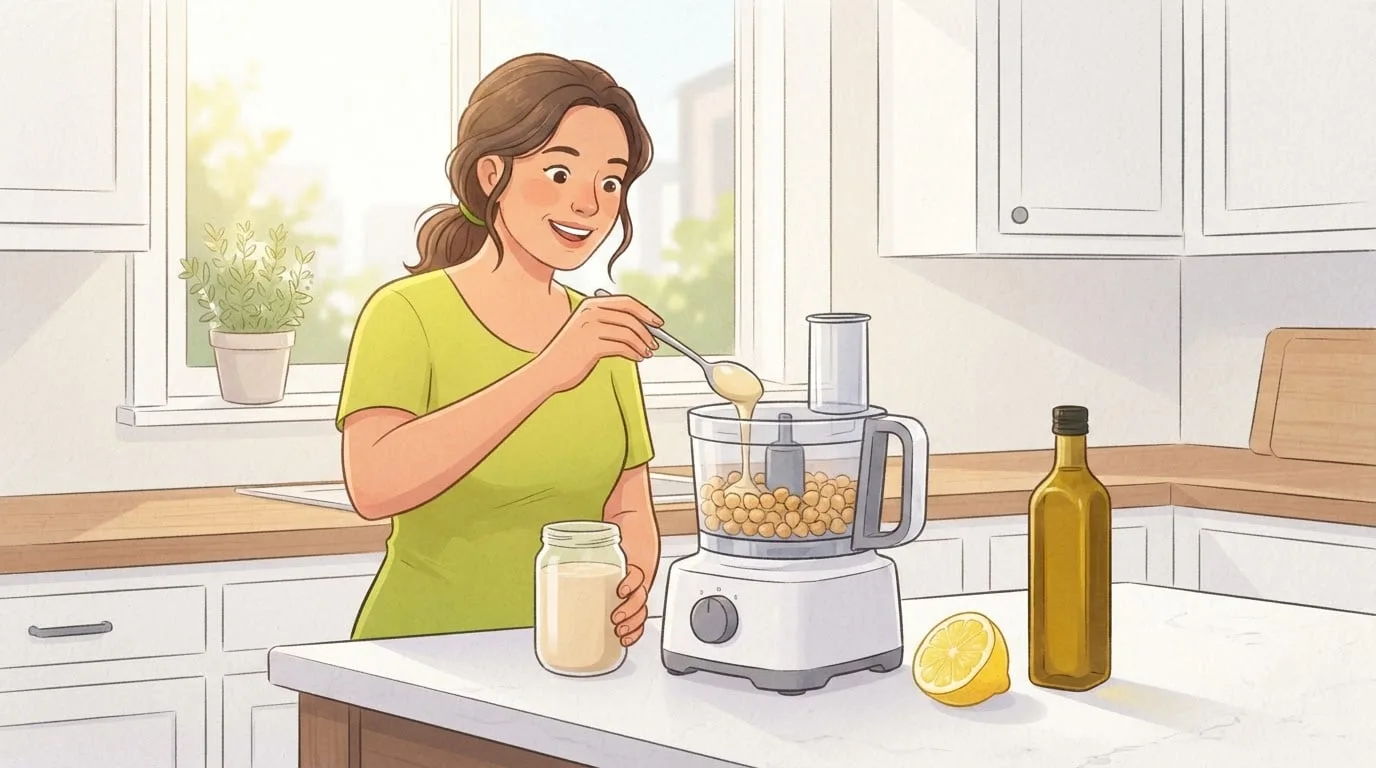
USDA's home-prepared recipe has 73 milligrams of sodium per 2 tablespoons, with 53 calories and 2.6 grams of fat. It also has less protein, at 1.5 grams. Making your own lets you set the salt and the oil. If you buy it, compare labels and pick the lowest sodium you enjoy.
Is Hummus Good for Your Stomach?
For most people, yes, though chickpeas and garlic can cause gas, especially in big portions or if you rarely eat legumes. Legumes do this to many people at first. In three bean feeding trials reported by Winham and Hutchins (2011), 45 to 50 percent of people eating pinto or baked beans noticed more gas in the first week, and that share fell over the following weeks. Those trials used beans rather than chickpeas, so treat them as a guide.
If you have IBS, portion matters more. Monash University's low-FODMAP hummus recipe uses rinsed canned chickpeas and garlic-infused olive oil in place of garlic.
When Should You Not Eat Hummus?
Most people can eat it. Skip it, or ask your doctor first, in these cases:
- Sesame allergy. Tahini is sesame, and the FDA has required sesame to be labeled as a major allergen since January 1, 2023.
- Chickpea or legume allergy. Hummus is mostly chickpeas.
- A sodium-restricted diet. Check the label, because tubs vary a lot.
- Kidney disease. Ask your doctor or dietitian how hummus fits your limits.
- An IBS flare. Garlic and chickpeas are common triggers.
- A recalled or out-of-date tub. In 2018 and 2019, CDC linked Salmonella in imported tahini to 8 illnesses in 4 states and warned against hummus made with it. Keep hummus cold and within its date.
Hummus vs Avocado and Peanut Butter
Hummus sits in the middle of the common spreads. Here's how 2 tablespoons of each compare.
| Per 2 tablespoons | Calories | Protein | Fat | Fiber | Sodium |
|---|---|---|---|---|---|
| Hummus (30 g) | 71 | 2.3 g | 5.3 g | 1.7 g | 128 mg |
| Mashed avocado (30 g) | 50 | 0.6 g | 4.6 g | 2.0 g | 2 mg |
| Peanut butter (32 g) | 191 | 7.1 g | 16.4 g | 1.6 g | 136 mg |
| Tahini (30 g) | 179 | 5.1 g | 16.1 g | 2.8 g | 35 mg |
| Plain nonfat Greek yogurt (30 g) | 18 | 3.1 g | 0.1 g | 0 g | 11 mg |
USDA entries 174289, 171706 (California avocado), 174266, 170189 and 170894, scaled and rounded.
Avocado wins on sodium, and peanut butter on protein per spoonful. Greek yogurt beats them all on protein per calorie, and stirring a spoonful into hummus is an easy way to stretch it.
What This Means for You
Hummus is a good snack. Keep it to about 2 to 4 tablespoons, scoop with vegetables when you can, and read the sodium line on the tub. Count it as a source of fiber and unsaturated fat, and get your protein somewhere else.
The snack is the easy part to fix. Sticking with the training that goes with it is harder, and that's where most plans fall apart. Matt put it this way: "The real win is I actually want to work out now. That's never happened before." If motivation is what keeps slipping, see how a workout app that keeps you motivated is built. With FitCraft, your 3D AI coach demonstrates each bodyweight and dumbbell exercise and says your name as you train, while streaks, leaderboards and a new quest every month give you a reason to come back.
Frequently Asked Questions
Can I eat hummus while trying to lose weight?
Yes. Two to four tablespoons add about 71 to 142 calories, and in one trial a hummus snack didn't raise daily calories. Measure your portion for a while, and scoop with vegetables instead of chips.
What is healthier, avocado or hummus?
Neither wins outright. Per 2 tablespoons, avocado has about 50 calories, 2 grams of fiber and almost no sodium, while hummus has about 71 calories, 2.3 grams of protein and 128 milligrams of sodium. Avocado is the better pick if you're watching sodium, and hummus if you want a little more protein.
What's healthier, peanut butter or hummus?
They're closer than they look. Peanut butter has about 191 calories and 7 grams of protein per 2 tablespoons, and hummus has about 71 calories and 2.3 grams. Per calorie their protein is nearly the same, so hummus is simply the lighter spoonful.
Is hummus healthy to eat every day?
For most people, yes, in a normal portion. Four tablespoons a day add about 142 calories, 3.3 grams of fiber and 256 milligrams of sodium, which is 11 percent of the Daily Value. People with a sesame allergy should skip it.
Is hummus healthy for diabetics?
It can fit well. Hummus had a glycemic index of 15 in one small study, and 2 tablespoons carry only about 3 grams of carbohydrate after fiber. Spreading it on white bread didn't lower the meal's overall glucose response in that study, so count the bread separately.
Is hummus healthy for pregnancy?
For most people, yes. It adds a little folate and iron, about 4 percent of the Daily Value of each in 2 tablespoons. Keep it cold and within its date, and ask your doctor or midwife about anything specific to your pregnancy.
Can hummus cause gas?
Yes, especially in big portions or if you rarely eat legumes. Chickpeas and garlic both contain carbohydrates that gut bacteria ferment. In bean feeding trials, gas complaints were highest in the first week and fell over the following weeks.