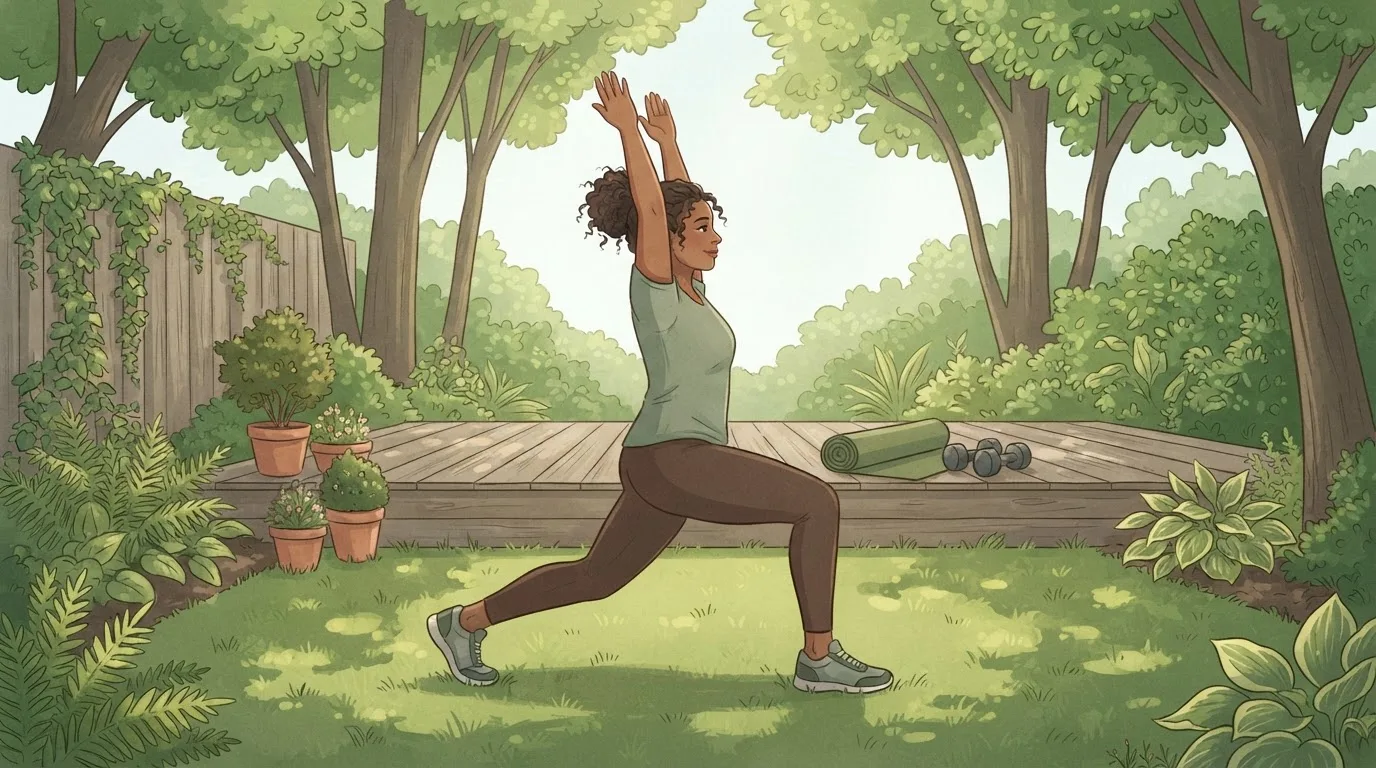
You've probably been told to touch your toes and hold it before you exercise. Maybe a gym teacher counted to 30 while your class sat on the floor reaching for their feet. So when you're short on time before a workout, skipping that part can feel like you're asking for an injury.
So should you stretch before exercise at all? Yes, but use moving stretches. Long, held stretches before a workout can make you a little weaker for a short time, and they don't seem to prevent injuries. A few minutes of moving exercises does the job better and takes less time, which matters when you're squeezing a workout into a busy day.
Below you'll find what the studies show about static stretching before strength and power work, why a dynamic warm-up works, when a short held stretch is fine, whether stretching counts as exercise and a 5-minute warm-up to copy.
Is Stretching Before a Workout Bad?
Long static stretching before a workout is mildly bad for your strength and power, and short holds are close to harmless. Static stretching means moving a muscle to the end of its range, as in a seated toe reach, and holding it still.
Behm and colleagues (2016) reviewed the research for Applied Physiology, Nutrition, and Metabolism. When people were tested a few minutes after stretching, static stretching lowered performance by 3.7% on average. PNF stretching, which adds a contract-and-relax step, lowered it by 4.4%, and dynamic stretching raised it by 1.3%. The dose mattered. Holds of 60 seconds or more per muscle group cost 4.6%, while shorter holds cost 1.1%.
Two earlier reviews point the same way. Simic, Sarabon and Markovic (2013) combined 104 studies and found that strength fell 5.4% on average after static stretching. Stretches of 45 seconds or less per muscle did the least harm. Kay and Blazevich (2012) found no meaningful effect from holds under 30 seconds, and a drop became likely once holds reached 60 seconds.
Why does a long hold make you weaker? The reviews point to two things. The muscle and tendon get less stiff for a while, and your nervous system switches the muscle on a little less. The changes are short-lived. In Behm's review, even the extra range of motion from stretching usually faded within 30 minutes, and most strength studies tested people within a few minutes of stretching. Our static vs dynamic stretching review covers those studies in more depth.
Should You Stretch Before Lifting Weights?
You don't need to stretch before lifting weights, and long holds can cost you reps. In a 10-week study by Junior and colleagues (2017), each person trained one leg with leg extensions alone and the other leg with two 25-second static stretches first. Every set went to failure. The stretched leg managed fewer reps and less total work in both halves of the study, and the outer thigh muscle the researchers measured grew 7.4%, against 12.7% in the leg that wasn't stretched. Strength gains were the same, at 12.9% and 12.7%, and the stretched leg gained more flexibility.
That's one study of a single exercise, so treat it as a caution rather than a rule. It does fit the short-term data. In Simic's review, strength losses were larger in tests where people pushed against something that didn't move than in moving lifts, so the cost during a normal dumbbell workout may be smaller.
The best warm-up for lifting is lifting. The US Physical Activity Guidelines note that a warm-up for muscle-strengthening activity commonly means doing the exercises with lighter weight. So before goblet squats, do 8 to 10 easy squats with no weight or a light dumbbell, then start your working sets. If a tight spot keeps you out of position, such as stiff ankles in a squat, hold a stretch for that one area for 20 to 30 seconds and then do your warm-up set.
What Is the Difference Between Warm-Up Exercises and Stretching Exercises?
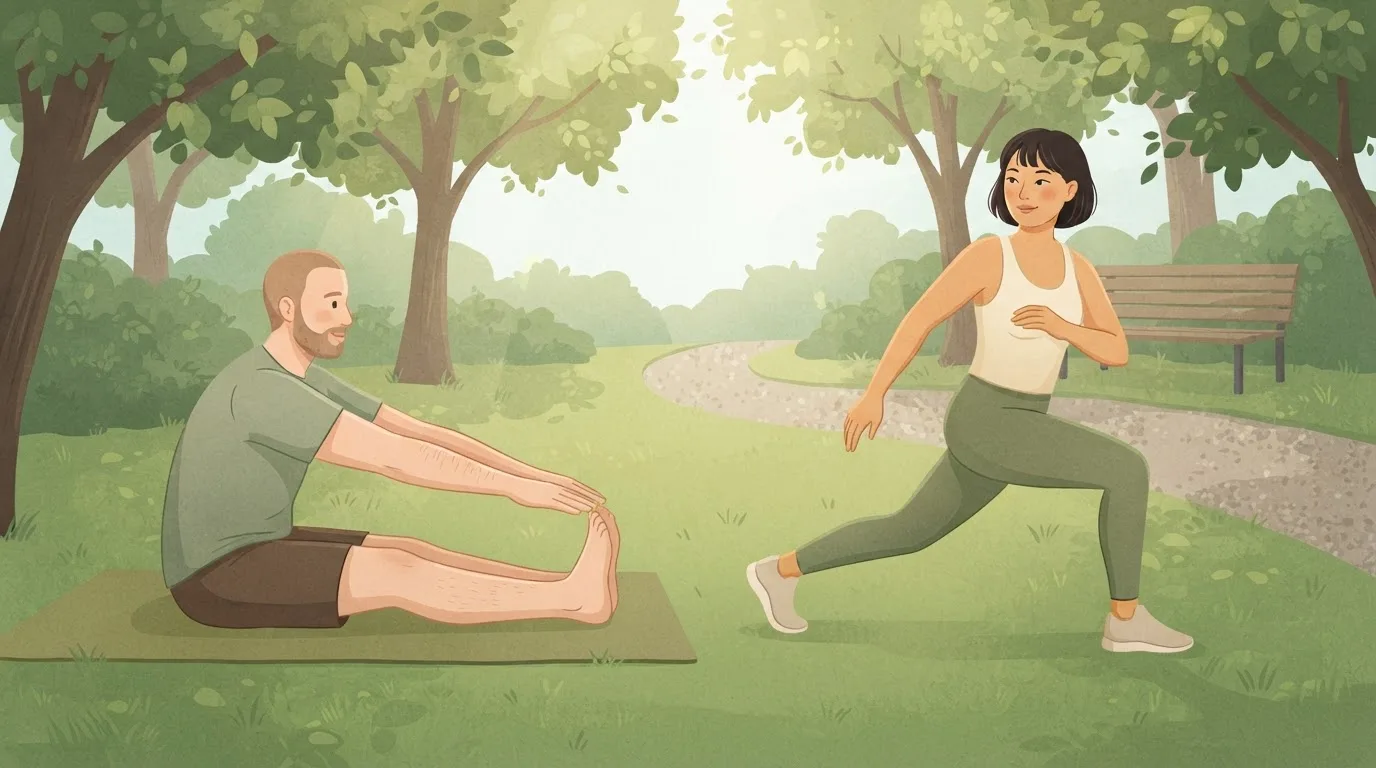
A warm-up gets your whole body ready to work, and stretching aims to increase how far your joints can move. A warm-up raises your heart rate, breathing and muscle temperature and walks you through the movements you're about to do. Stretching works on range of motion, the distance a joint can travel, usually one muscle at a time.
Warmer muscles work better. Chaabene and colleagues (2019) explain that a higher muscle temperature speeds up the signals that travel along muscle fibers and helps the proteins that produce force bind together. That's a big part of why warming up helps. Fradkin, Zazryn and Smoliga (2010) reviewed 32 high-quality studies of warm-ups that included more than stretching, and warming up improved performance in 79% of the measures tested.
You'll hear about four kinds of stretching:
- Static stretching. You move into a stretch and hold it still, usually for 10 to 60 seconds.
- Dynamic stretching. You move a joint through its range again and again in a controlled way, as in leg swings or walking lunges.
- PNF stretching. You stretch, tighten the muscle against resistance, then stretch a little further. A partner often helps.
- Ballistic stretching. You bounce at the end of your range to push past it.
Dynamic stretching belongs to both groups. It stretches your muscles and warms them up at the same time, which is why it fits so well before a workout.
Should you stretch before warming up?
No. Warm up first, then stretch if you need to. In the studies where stretching did no harm, it came after a light warm-up and before practice of the movements being tested. In a randomized crossover study by Blazevich and colleagues (2018), 20 male team-sport athletes did a light warm-up and then one of four routines: 5-second static stretches, 30-second static stretches, dynamic stretches or no stretching. Each session ended with practice that built to full speed. Sprint, jump and change-of-direction results were the same whichever routine they did. Most of the athletes expected stretching to help, but their results didn't differ.
A 5-Minute Warm-Up You Can Copy
This warm-up takes five minutes, needs no equipment and suits a home strength workout with body weight or dumbbells. Move at an easy pace. By the end you should feel a little warmer and slightly out of breath, never tired.
| Minute | Move | How to do it |
|---|---|---|
| 1 | March with arm swings | March on the spot or around the room, swinging your arms. Lift your knees a little higher as the minute goes on. |
| 2 | Hip hinges and side lunges | Do 10 hip hinges with your hands on your hips, pushing your hips back with a flat back. Then do 5 slow side lunges on each side. |
| 3 | Wall push-ups and arm circles | Do 10 push-ups with your hands on a wall or kitchen counter, then 10 arm circles forward and 10 back. |
| 4 | Cat-cow and thread the needle | On your hands and knees, round and arch your back slowly 6 times. Then reach one arm under your body and open it toward the ceiling, 3 times per side. |
| 5 | Ramp set | Do one easy set of your first exercise at about half your usual effort, such as 8 squats with no weight or a light dumbbell. |
If you're new to exercise or coming back after a long break, make the moves smaller and slower and rest whenever you need to. Before a run, swap minutes 2 and 4 for leg swings and ankle rocks from our guide to the best stretches for runners. For a longer routine with versions for running and HIIT, try our 9-minute dynamic warm-up.
Knowing what to do is the easy part.
FitCraft, our mobile fitness app, pairs you with an AI coach who builds you a personalized plan around your goals, schedule, and fitness level. Every FitCraft program is designed by Domenic Angelino, MPH (Brown University) and NSCA-CSCS, with research published in the Journal of Strength and Conditioning Research and Medicine & Science in Sports & Exercise.
Take the Free Assessment Free • 2 minutes • No credit cardWhen Does a Short Static Stretch Before a Workout Make Sense?
A short held stretch before a workout makes sense when your session needs a big range of motion, or when one tight spot keeps you out of position. Yoga, dance, martial arts kicks and deep squats all ask more of your joints than a brisk walk or a set of rows.
The evidence supports short holds in these cases. Behm's review found that static stretching improved performance by 2.2% when it was tested at long muscle lengths, close to the stretched position. Chaabene's team concluded that holds of 60 seconds or less per muscle group inside a full warm-up cut strength and power by only 1 to 2%, while longer holds cut them by 4 to 7.5%. They also suggested that short holds within a full warm-up may lower the risk of muscle strains in sports with sprinting and quick changes of direction.
How to fit a held stretch into your warm-up
- Warm up first with a few minutes of easy movement.
- Hold each stretch for 30 seconds or less, and keep the total under 60 seconds per muscle.
- Finish with dynamic moves or a ramp set, so the last few minutes before your workout are spent moving.
If you compete and every bit of sprint speed or strength counts, that small cost still matters, so keep longer holds for after your session.
Does Stretching Prevent Injury?
Stretching before exercise doesn't seem to prevent injuries for most people. In a large trial, Pope and colleagues (2000) randomly assigned 1,538 male army recruits to warm up with or without a 20-second stretch for each of six leg muscle groups before every training session. Over 12 weeks there were 158 lower-limb injuries in the stretching group and 175 in the group that didn't stretch, a gap small enough to be chance. Fitness, age and enlistment date predicted who got hurt. Stretching didn't.
Lauersen, Bertelsen and Andersen (2014) pooled 25 trials with 26,610 participants. Stretching made no measurable difference to injury risk. Strength training cut sports injuries to less than a third, and balance training and programs that combined several kinds of exercise also helped. Behm's review also found no clear effect of static or PNF stretching on injuries.
Stretching doesn't prevent DOMS, the soreness that peaks a day or two after a hard workout, either. A Cochrane review by Herbert, de Noronha and Kamper (2011) found that stretching before exercise lowered soreness the next day by about half a point on a 100-point scale, which nobody would notice.
If staying injury-free is your main reason for stretching, a couple of strength sessions a week is the better use of that time.
Is Stretching an Exercise?
Yes, stretching is a type of exercise called flexibility exercise, but it doesn't count toward the weekly activity targets. The US Physical Activity Guidelines call flexibility activities an appropriate part of a physical activity program, though their health benefits are unknown and it's unclear whether they reduce the risk of injury. Time spent only stretching doesn't count toward the 150 minutes of aerobic activity or the 2 days of muscle-strengthening work the guidelines ask for.
The American College of Sports Medicine still recommends flexibility exercise for each major muscle group on at least 2 days a week, with about 60 seconds per stretch in total. The goal is to keep your joints moving through their full range. So stretching earns a place in your week. It just doesn't replace your walks or your strength sessions. Our answer to how often you should stretch sets out a weekly schedule.
Should You Stretch After Working Out Instead?
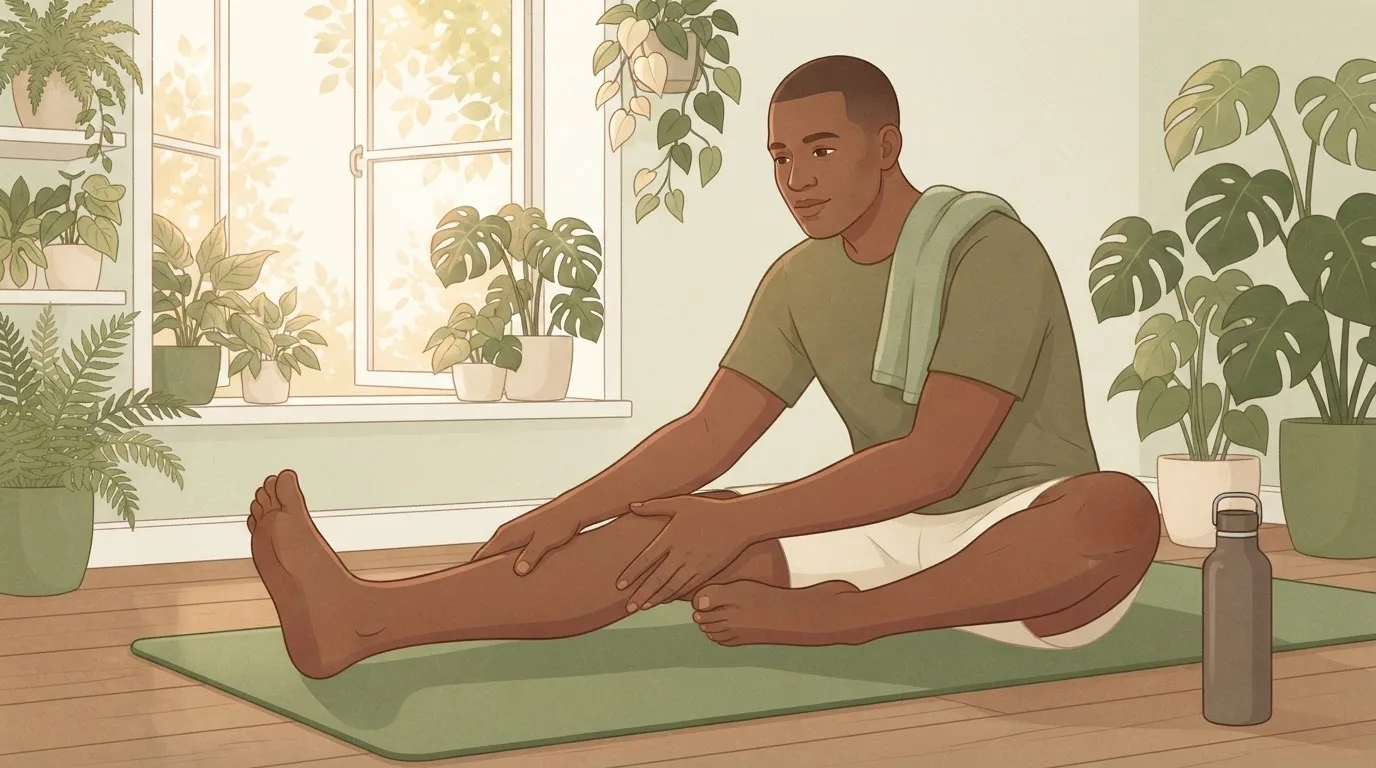
After your workout is the easiest time to fit in held stretches if you want more flexibility. Your muscles are warm and there's nothing left to perform, so a short-term drop in strength doesn't matter. Hold each stretch for 10 to 30 seconds, or up to 60 seconds if you're older, and repeat it until you reach about a minute per muscle.
Don't expect it to speed up recovery. Afonso and colleagues (2021) pooled 10 randomized trials and found that stretching after exercise didn't restore strength or ease soreness at 24, 48 or 72 hours any better than resting did. Stretch after a workout for your flexibility and because it feels good. It won't fix soreness.
What This Means for You
Skip the long toe-touch before your next workout and spend five minutes moving instead. March, hinge, push against the wall, roll your spine and do one easy set of your first exercise. Then keep your held stretches for the end of the session, or for a calm 10 minutes on a rest day.
Picture a month from now. Your warm-up is so familiar that you start it without thinking, your first set feels smoother and you've stopped worrying that skipping the toe-touch will hurt you. Small, repeatable steps are what make a habit stick. If you're restarting after a long break, sticking with it is usually the hard part. That's a design problem, and it can be solved.
A personalized training program can take the planning off your plate. In FitCraft, an AI coach demonstrates each exercise on an interactive 3D model and says your name during the workout, your workouts adjust as you progress, and streaks give you a reason to come back. Sessions include strength work with dumbbells and body weight as well as yoga, mobility and cardio. As one FitCraft user, Stacy, put it: "After my second kid, I needed something stupidly simple."
Frequently Asked Questions
How long should I hold a stretch?
Hold a stretch for 10 to 30 seconds and repeat it until you've spent about 60 seconds on that muscle, which is the American College of Sports Medicine's guidance for flexibility. Older adults may do better with holds of 30 to 60 seconds. Before a workout, keep each hold to 30 seconds or less so it doesn't sap your strength.
How long should you stretch before working out?
Spend about 5 to 10 minutes warming up before working out, mostly with moving exercises. If you add held stretches, keep each one to 30 seconds or less and the total under 60 seconds per muscle group. In one review, holds of 60 seconds or more cut performance by 4.6% on average.
Is there a downside to stretching?
The main downside of stretching is bad timing. Long static holds right before a workout can leave you weaker and less powerful for a short time, and stretching doesn't prevent injuries the way strength training does. Stretch to mild tension, never pain, and save longer holds for after your workout.
What type of stretching has the highest risk of injury?
Ballistic stretching, which means bouncing at the end of your range of motion, is the type usually seen as riskiest. A 2012 review in the International Journal of Sports Physical Therapy said it's no longer recommended because of the increased risk of injury. Controlled dynamic stretches that move through your range without bouncing are the safer choice before a workout.
Should I stretch before or after working out?
Do moving stretches before working out and save held stretches for afterward. A dynamic warm-up gets your muscles ready without the short-term loss of strength that long static holds cause. After the workout your muscles are warm and there's nothing left to perform, so longer holds can't hurt your session.