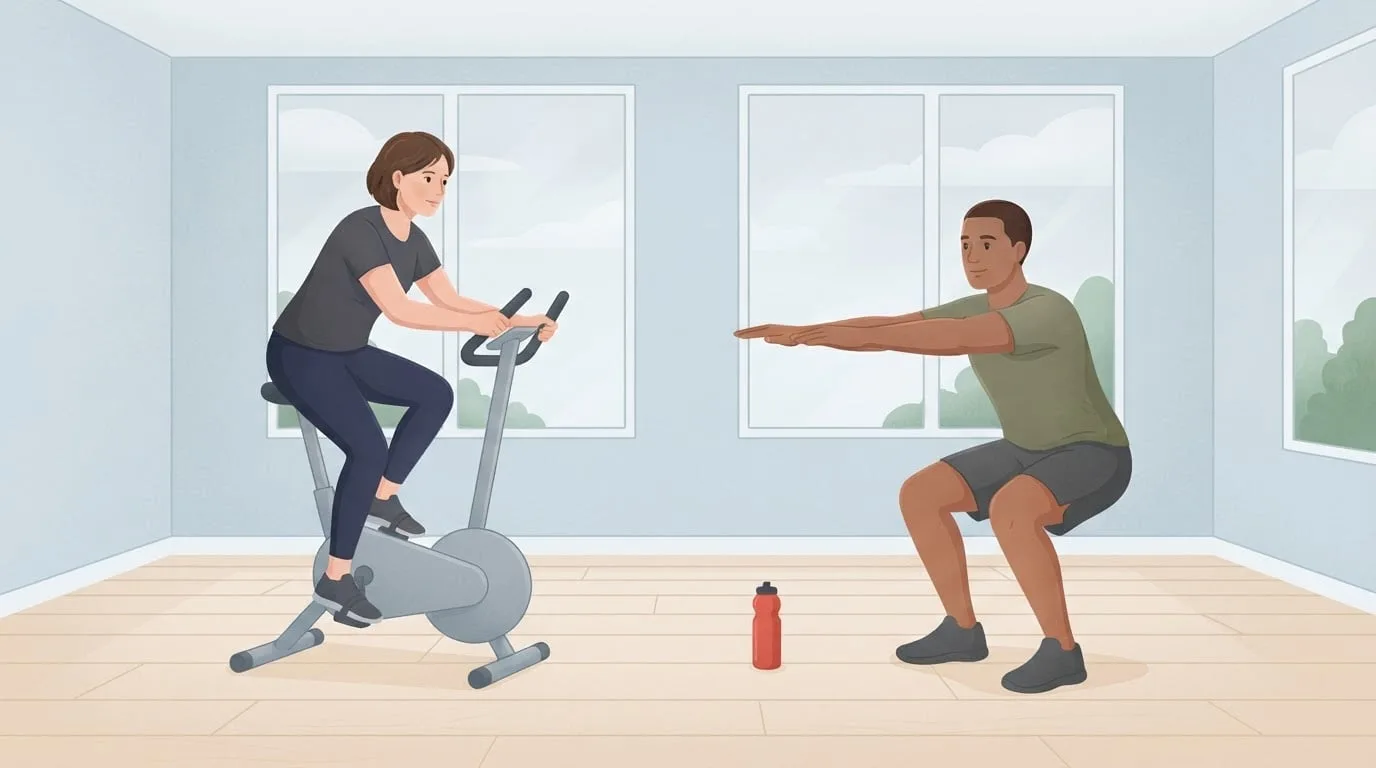
You run four days a week, or lift, or go to the same class every Tuesday and Thursday, and someone tells you that you should be cross training. It sounds like one more thing to fit in. Or maybe a niggle has flared up, you've been told no running for a few weeks, and you're worried about losing everything you've built.
Cross training is simpler than it sounds and more forgiving than most fitness advice. It's the habit of mixing different kinds of exercise so that one activity doesn't carry the whole load, and it's what keeps a lot of people training through injuries, travel and plain boredom.
Below you'll find the cross training meaning and what counts, what the studies show it does, how it compares with HIIT, good exercises to use, how runners should cross train, three sample weeks and what the word means at work.
Cross Training Meaning: What Counts as Cross Training
Cross training is any exercise that differs from your main sport or workout and that you do to support it or to round out your fitness. For a runner, it's anything that isn't running. For someone who mostly lifts, it might be cycling, swimming or yoga. For someone who mostly does yoga, it might be strength training or brisk walking.
Most cross training falls into four groups:
- Cardio in a different mode: cycling, swimming, rowing, the elliptical, hiking or brisk walking.
- Strength training: bodyweight and dumbbell exercises such as squats, lunges, push-ups and rows.
- Flexibility and mobility: yoga, mobility routines and stretching.
- Other sports and play: tennis, dancing, climbing or a pickup game with friends.
One word causes confusion. In British English, a cross trainer is the elliptical machine, which is why searches for cross trainers often lead to gym equipment. Our guide to what muscles the elliptical works covers that machine on its own.
As for spelling, dictionaries hyphenate the word: cross-train is the verb and cross-training the noun, although cross training without the hyphen is just as common online. It's also different from cross-education, the strength an untrained limb picks up when you train only the opposite one.
Benefits of Cross Training: What the Research Shows
The benefits are real, but they're more specific than the usual list of claims suggests. Here's what the studies support.
Some fitness carries over between activities
Your heart and lungs get fitter from any hard aerobic work, so some of the fitness you build on a bike shows up when you run. Some isn't all, though. In a review of how fitness transfers between cycling, running and swimming, Tanaka (1994) concluded that training in another activity never produced bigger gains than training in the sport itself. Running carried over most to other activities and swimming the least, and the gap mattered most for highly trained athletes. For the general population, the review judged cross training highly useful for overall fitness.
A randomized trial by Foster and colleagues (1995) put numbers on it. Thirty well-trained people who ran regularly were split three ways for eight weeks: more running, added swimming or no change. Their 3.2 km time trial improved by 26.4 seconds with more running, 13.2 seconds with swimming and 5.4 seconds with no change. Swimming helped, at about half the effect of simply running more.
You can stay fit when you can't do your main activity
This is where cross training earns its keep. Wilber and colleagues (1996) trained 16 male runners for six weeks, five days a week, either on a treadmill or by deep-water running in a pool. VO2 max, ventilatory threshold and running economy held steady in both groups. The water runners went from 58.7 to 59.6 mL/kg/min without a single step on land. Deep-water running is the best-tested option, and cycling or the elliptical work on the same idea, so an injury that stops you running doesn't have to stop your training. Get the go-ahead from your doctor or physical therapist first.
Variety lowers overuse injuries in young athletes
Doing one sport year-round puts the same loads on the same tissues. In a study of 1,190 athletes aged 7 to 18, Jayanthi and colleagues (2015) found that specializing in a single sport was an independent risk factor for injury, with an odds ratio of 1.27, and for serious overuse injury, at 1.36. Training more hours per week than their age in years roughly doubled the odds of a serious overuse injury. Adults have far less direct evidence, so treat this as a principle rather than a measured effect for you: spreading your week across different movements means no single tissue takes every hit.
Strength work makes your main activity more durable
Strength training is the cross training with the strongest injury evidence. A meta-analysis by Lauersen and colleagues (2014) found that strength training programs cut sports injuries to less than a third, while stretching programs showed no clear effect. Our review of the research on strength training and injury prevention covers the details. For runners, cyclists and anyone who does one thing a lot, two short strength sessions a week are an easy place to start.
Variety helps you stick with it
Mixing things up also makes exercise easier to keep doing. Sylvester and colleagues (2016) randomly assigned 121 inactive university students to a six-week exercise program with either high or low variety. The high-variety group stuck to the program better, and the effect ran through how varied the program felt to them. Boredom is one of the quiet reasons people drift away from exercise, and a week with two or three kinds of training gives you more to look forward to.
What Is Cross-Training vs HIIT?
Cross training describes what you do, and HIIT describes how hard you do it. HIIT, or high-intensity interval training, alternates short hard efforts with recovery, and you can do it in any mode: running, cycling, rowing or a circuit of bodyweight moves. So the two overlap. A runner who does intervals on a bike is doing both at once.
When you want to raise your aerobic fitness quickly, intensity matters more than the machine. In a trial by Helgerud and colleagues (2007), 40 moderately trained men followed one of four running programs three times a week for eight weeks, all matched for total oxygen use. Four 4-minute intervals at 90 to 95 percent of maximum heart rate raised VO2 max by 7.2 percent, and both interval programs beat steady running at 70 or 85 percent of maximum heart rate. Those intervals were run on foot, but you can use the same pattern on a bike or a rower when your legs need a break from impact.
CrossFit is something else again: a branded program of varied, high-intensity workouts that mixes weightlifting, gymnastics and conditioning. It mixes modes, so it's cross training in the broad sense, but most people who cross train never set foot in a CrossFit gym. Our article on what functional fitness is explains how functional training, HIIT and CrossFit differ.
Knowing what to do is the easy part.
FitCraft, our mobile fitness app, pairs you with an AI coach who builds you a personalized plan around your goals, schedule, and fitness level. Every FitCraft program is designed by Domenic Angelino, MPH (Brown University) and NSCA-CSCS, with research published in the Journal of Strength and Conditioning Research and Medicine & Science in Sports & Exercise.
Take the Free Assessment Free • 2 minutes • No credit cardGood Exercises for Cross Training
The best cross training for you depends on what your main activity already does and what it leaves out. These are the common choices and what each one adds:
| Exercise | Impact | What it adds | Best for |
|---|---|---|---|
| Cycling, indoors or out | Very low | Aerobic fitness and leg endurance | Runners, walkers, people with sore joints |
| Swimming | None | Aerobic fitness and upper-body endurance | Injured runners, people with joint pain |
| Deep-water running | None | Running-specific aerobic fitness | Injured runners |
| Elliptical | Low | A running-like motion without the landing | Runners, beginners |
| Rowing | Very low | Aerobic fitness plus back and leg work | Lifters, runners |
| Brisk walking or hiking | Low | Easy aerobic time | Everyone, especially on recovery days |
| Bodyweight and dumbbell strength | Low | Strength, muscle and sturdier joints and tendons | Everyone, especially runners and cyclists |
| Yoga and mobility | None | Flexibility, balance and range of motion | Lifters, runners, desk workers |
| Jump rope or HIIT circuits | High | A lot of fitness in a short time | People short on time and free of injuries |
For the strength sessions, a short circuit of goblet squats, reverse lunges, push-ups, dumbbell rows, glute bridges and planks covers the main movement patterns with one pair of dumbbells. Do two or three rounds, twice a week, and add weight or reps when the last few feel easy.

Cross Training for Runners
Ask what cross training is in running and the answer is anything that keeps your aerobic fitness and strength growing without adding more pounding. Running loads your legs with every landing, so the usual swaps are cycling, swimming, deep-water running and the elliptical, plus strength work twice a week. These rules keep it useful:
- Swap, don't stack. Replace one easy run with 30 to 45 minutes of cycling or swimming instead of adding a session on top.
- Match by time and effort. An easy 40-minute run becomes roughly 40 to 50 minutes of easy cycling, not a set number of miles.
- Go by feel in the pool. Heart rate often reads lower in the water than on land at the same effort, so use your breathing and perceived effort instead of the numbers.
- Use it on hard-to-run days. The day after a hard run, an easy ride or swim does the job of a recovery run with less impact. Our explainer on what a recovery run is covers that day in detail.
- Keep running the main event. Cross training supports your running fitness, and the transfer studies above show it can't fully replace it.
If you're new to running, our first-time running tips show where cross training fits around your first weeks of runs.

How to Cross Train: Three Sample Weeks
A good cross-training week keeps your main activity at the center, adds two or three sessions of something different, and keeps the total load about the same. Here are three versions built on bodyweight, dumbbells and simple cardio:
| Day | Runner | Strength-focused | Beginner |
|---|---|---|---|
| Monday | Rest | Upper-body dumbbell session | Full-body bodyweight strength, 20 min |
| Tuesday | Easy run | Easy ride or row, 30 to 40 min | Brisk walk, 30 min |
| Wednesday | Bodyweight and dumbbell strength | Lower-body dumbbell session | Rest |
| Thursday | Intervals or tempo run | Yoga or mobility, 20 min | Easy cycling or swimming, 20 to 30 min |
| Friday | Easy swim or ride, 30 to 45 min | Full-body dumbbell session | Full-body bodyweight strength, 20 min |
| Saturday | Long run | Brisk walk, hike or swim, 45 to 60 min | Yoga or mobility, 20 min |
| Sunday | Strength and mobility, or rest | Rest | Rest or an easy walk |
Keep one or two hard sessions in the week, no more, and let everything else stay easy. When you want strength and endurance to be equal goals rather than one supporting the other, that's the hybrid athlete approach, and our guide to what a hybrid athlete is covers how to sequence the two.
If you'd rather not plan the mix yourself, a personalized training program can do it for you. FitCraft's workouts cover strength, cardio, yoga and mobility with bodyweight and dumbbells, a 3D AI coach demonstrates every exercise, the workouts adjust as you progress, and streaks keep count of the days you show up.
Cross Training at Work, in Healthcare and in Shoes
The term has a life outside the gym, which is why searches for it head in so many directions:
- At work and in HR: cross-training means teaching employees to do more than one job, so a team can cover absences and people can move between roles. A cross-trained employee can step into several roles.
- In project management: it means sharing skills across a team so that no task depends on a single person.
- In healthcare: nurses and other staff are cross-trained to work in more than one unit or role, which helps hospitals cover busy periods.
- Cross-training shoes: shoes made for mixed gym work, with a flatter, wider and more stable sole than running shoes for side-to-side moves and lifting. For runs longer than a few miles, running shoes are the better choice.
What This Means for You
Cross training is mostly a different way of filling the days you already train. Swap one session for something new, add two short strength workouts and keep a low-impact option ready for the weeks your body says no.
The all-or-nothing trap is the week a niggle or a packed schedule knocks out your main activity and everything else goes with it. Cross training gives you a plan B that still counts, so a sore shin becomes a month of riding and strength work instead of a month on the couch. Picture the next time it happens: you swap the runs for rides, keep your strength days, and come back with most of your fitness intact. As one FitCraft user, Mike, put it: "The streak system got me hooked. I didn't want to break my chain."
Frequently Asked Questions
What does cross trained mean?
Cross-trained means trained in more than one area. In fitness, a cross-trained athlete uses other types of exercise, such as cycling, swimming or strength work, alongside their main sport. At work, a cross-trained employee can do more than one job.
Is walking good for cross-training?
Yes. Brisk walking is low-impact aerobic exercise, so it suits runners on easy days, people coming back from an injury and anyone who wants more cardio without more pounding. Hiking adds hills and uneven ground for extra leg work.
How do I raise my VO2 max quickly?
Add interval training. In a trial of 40 moderately trained men, four 4-minute intervals at 90 to 95 percent of maximum heart rate, three times a week, raised VO2 max by 7.2 percent in eight weeks, more than steady training did. You can do the same intervals on a bike, a rower or an elliptical when you need a break from running.
Can I lose belly fat with CrossFit?
CrossFit-style workouts can help you lose belly fat as part of losing fat overall, but no workout burns fat from your belly specifically. Fat loss comes from eating a little less than you burn over weeks, and pairing strength work with cardio, as CrossFit and most cross-training plans do, helps you keep muscle while you lose fat.
What is the 3-3-3 rule for workout?
The 3-3-3 rule is an informal social media guideline rather than a research-based standard, and its versions differ. Common ones include three strength and three cardio sessions a week, or running 3 miles three times a week for three months. The useful idea inside most versions is a weekly mix of strength and cardio, which is cross training by another name.
Is cross-training the same as cross-education?
No. Cross-training means mixing different types of exercise. Cross-education is the strength gain that shows up in an untrained arm or leg when you train only the opposite one, a nervous system effect that's useful when one limb is injured.