Arm walking keeps your feet still and moves only your hands. You fold forward, walk your hands out in small steps, walk them back and come up again, rep after rep at a steady pace. It needs no equipment, only enough floor space to walk your hands out in front of you.
The FitCraft app has three similar hand-walking exercises, and it helps to know which one you're doing. Walk outs go all the way out to a straight high plank, pause, and stand tall, at a slower pace. Plank walks stay in the plank and move between your forearms and your hands. Arm walking is the quicker, shorter hand walk: your hands walk out and back while your feet stay planted, and the reach can stop with your hips still high. It is related to the inchworm, but in arm walking your feet never walk up to your hands and you don't travel across the floor.
Like the walk out and the plank walk, it goes wrong when your back rounds, your lower back sags or your hips sway side to side. The cues below keep that from happening.
Quick Facts: Arm Walking
- Equipment needed: None (enough floor space to walk your hands out in front of you)
- Difficulty: Expert in the FitCraft app (a shorter reach and more knee bend make it easier)
- Modality: Cardio in the FitCraft app (a continuous hand walk at a steady rhythm)
- Body region: Core, with the shoulders, chest and arms helping
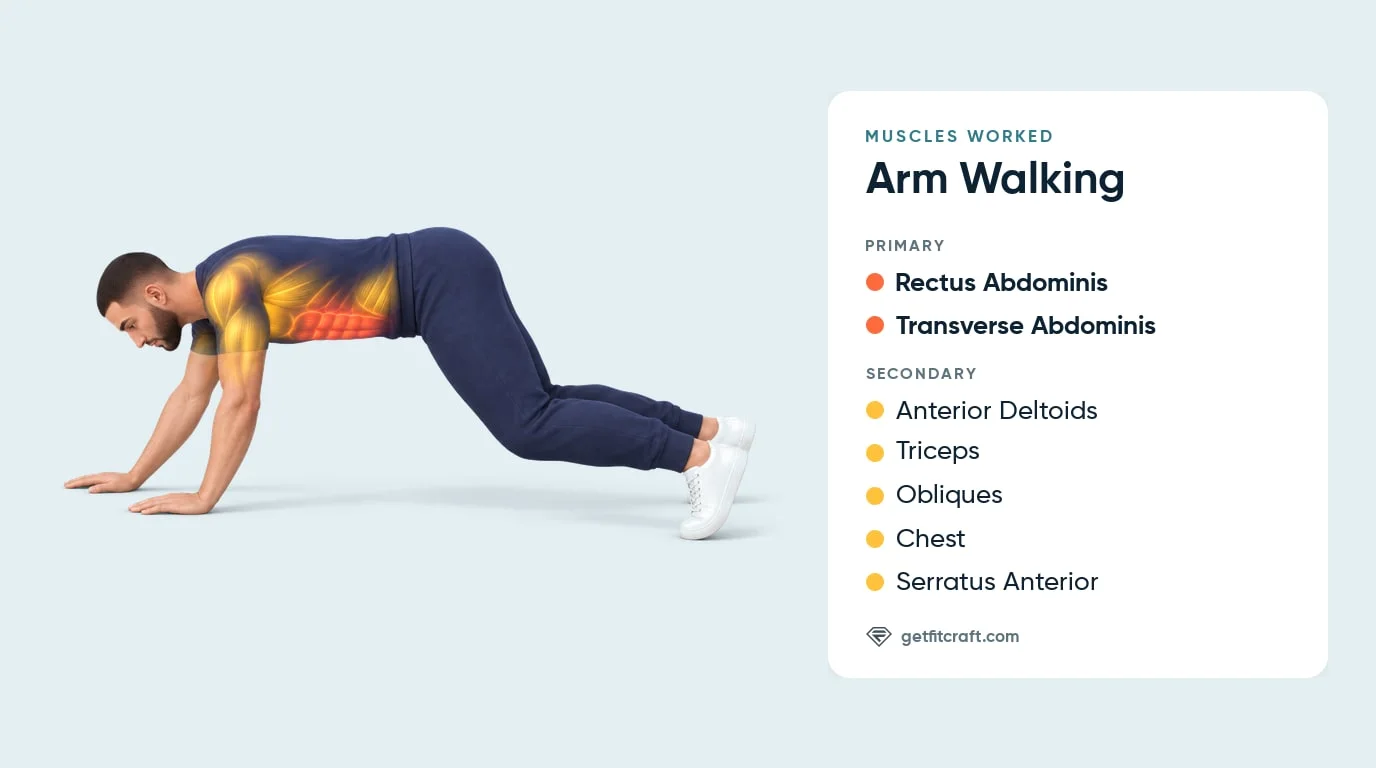
Muscles Worked
Primary muscles: the rectus abdominis and the transverse abdominis. The rectus abdominis, down the front of your trunk, holds your body firm so your lower back doesn't sag as your hands walk away from your feet. The transverse abdominis, the deep layer that wraps around your waist like a corset, tightens when you brace and keeps your trunk steady as each hand steps.
Secondary muscles: the anterior deltoids, triceps, obliques, chest and serratus anterior. The anterior deltoids (the fronts of your shoulders), the triceps and the chest hold you up on your hands and carry your weight on one arm every time a hand leaves the floor. The obliques, along the sides of your waist, stop your hips from swaying side to side as your hands move. The serratus anterior, the muscle on the side of your ribs under your armpit, holds your shoulder blades against your ribcage while your weight is on your hands.
Why the reach matters: the farther your hands walk from your feet, the longer the lever becomes and the harder your abs have to brace to keep your back flat. That is why the reach is a range: stop where your back stays flat and your hips stay steady.
Step-by-Step: How to Perform Arm Walking
You only need enough floor space to walk your hands out in front of you. Your feet stay where they start for the whole set.
Step 1: Stand Tall and Brace
Stand tall with your feet about hip-width apart or a little wider, and brace your abs.
Step 2: Hinge and Place Your Hands
Breathe out and hinge forward at your hips with a flat back, and place your hands flat on the floor in front of your feet. Bend your knees as much as you need so your back stays flat as your hands reach the floor.
Tip: keep your back flat as you fold at your hips, and don't let it round.
Step 3: Walk Your Hands Out
Keeping your feet planted, walk your hands forward in small steps, one hand at a time. Go only as far as your back stays flat and your hips stay steady. Stopping with your hips high and your knees bent is fine, and a full high plank is the far end of the range. Keep breathing steadily.
Tip: keep your supporting arm straight and strong each time a hand steps, and keep your eyes on the floor just ahead of your hands so your neck stays in line with your back.
Step 4: Walk Your Hands Back
Walk your hands back to your feet in small steps, keeping your hips steady so they don't sway side to side. Either hand can lead: switch the hand you lead with from rep to rep or halfway through your set, so both sides do the same work.
Step 5: Come Up and Repeat
Come back up to standing or close to it, then go again. Keep a steady, controlled rhythm of about five seconds a rep, with small hand steps you can control. Slower is fine when you need it for control.
Get this exercise in a personalized workout
FitCraft, our mobile fitness app, uses an AI coach to program pressing exercises like this into your plan at the right volume and intensity, based on your level, goals, and equipment. Every FitCraft program is designed by Domenic Angelino, MPH (Brown University) and NSCA-CSCS, with research published in the Journal of Strength and Conditioning Research and Medicine & Science in Sports & Exercise.
Take the Free Assessment Free • 2 minutes • No credit card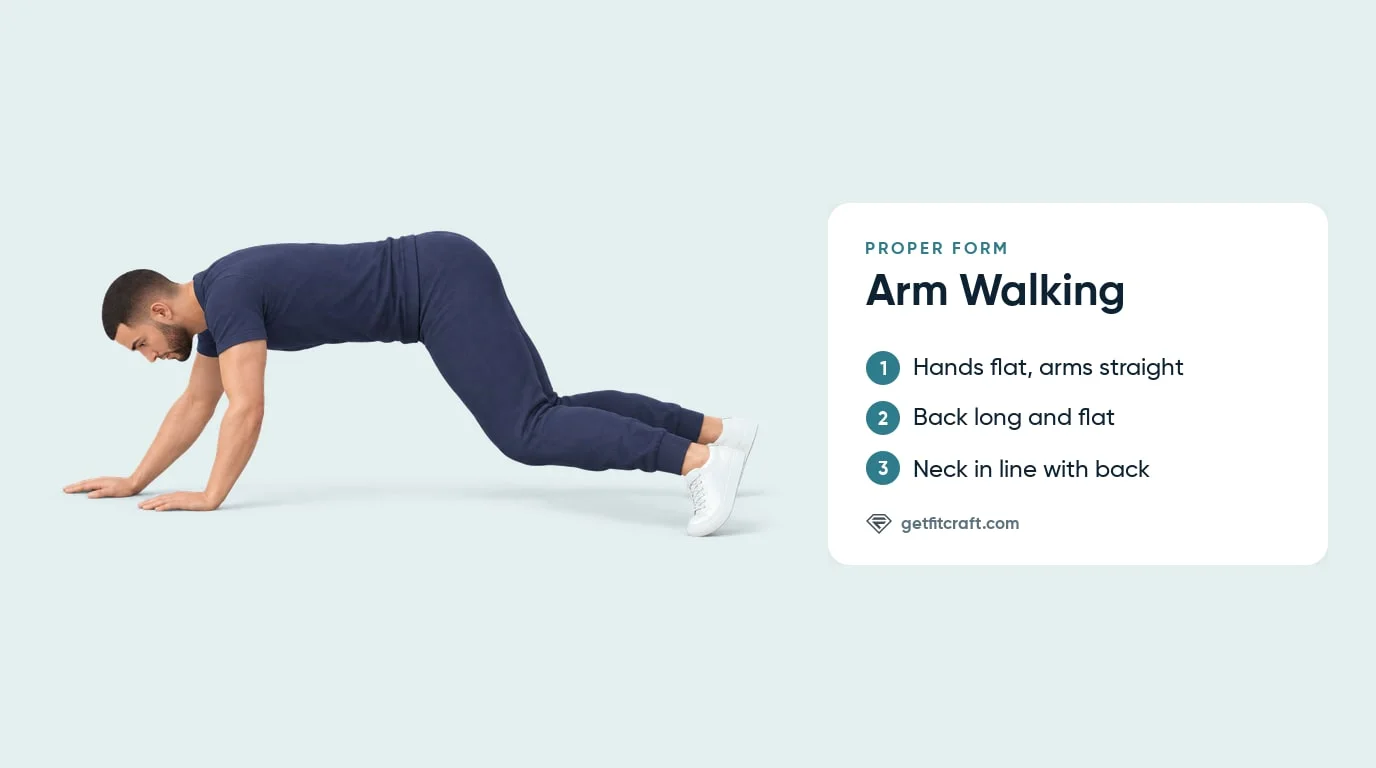
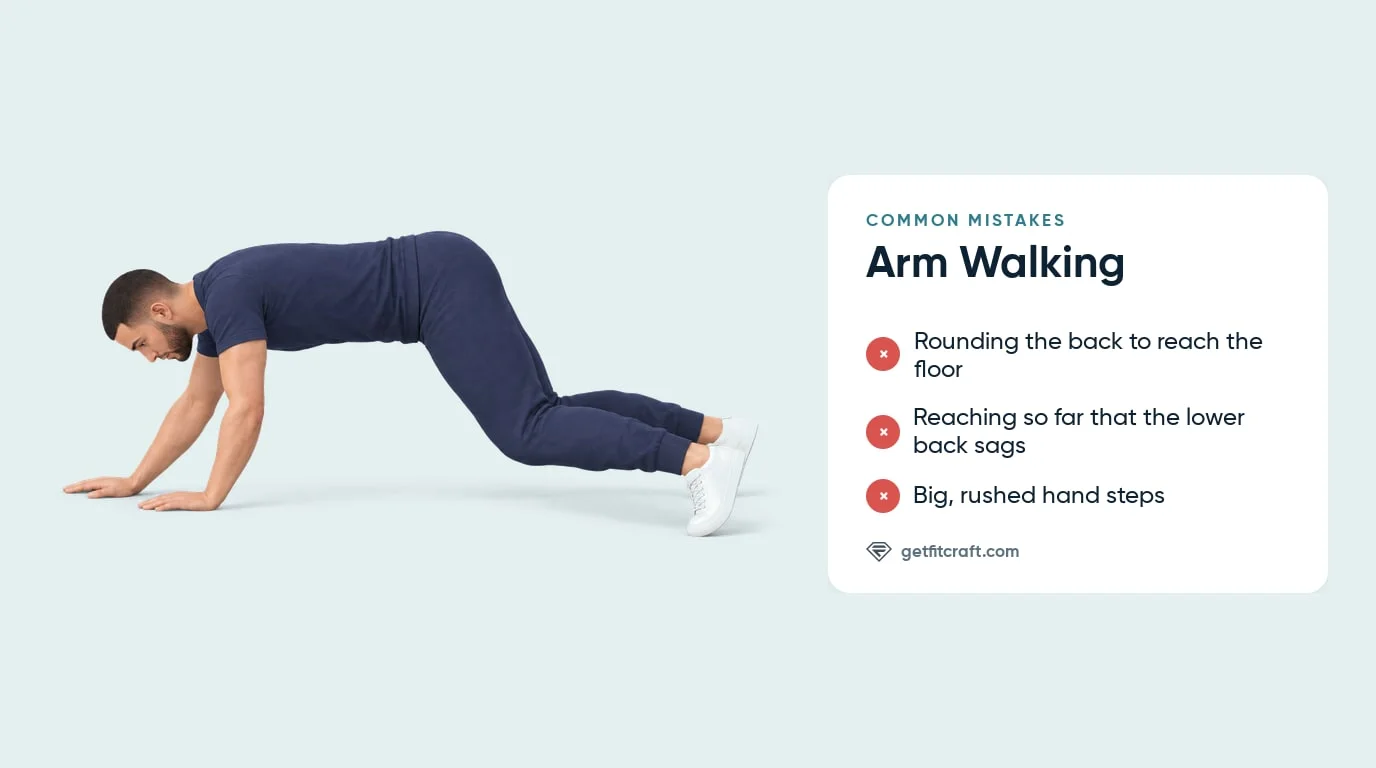
Common Mistakes (and How to Fix Them)
These are the most common arm walking errors, and the fix for each.
- Rounding the back to reach the floor. The legs stay locked straight and the back rounds to get the hands down. Fix: bend your knees as much as you need, so your hands reach the floor while your back stays flat.
- Reaching so far that the lower back sags. The hands keep walking after the core can no longer hold the back flat, and the lower back dips toward the floor. Fix: stop the reach while your back is still flat. A shorter reach with your hips high is a valid rep.
- Big, rushed hand steps. Long reaches and a hurried pace make the hips sway and make it easy to overshoot. Fix: take small hand steps you can control, at a steady rhythm.
- Hips swaying side to side. The pelvis rocks left and right as each hand moves. Fix: slow down, plant one hand fully before the other leaves the floor, and keep your abs braced.
- Craning the head up to look forward. Looking ahead bends your neck back out of line with your spine. Fix: keep your eyes on the floor just ahead of your hands, so your neck stays in line with your back.
Arm Walking Variations: Regressions and Progressions
Scale the exercise by changing how far your hands walk out, how much your knees bend, and your pace.
Short-Reach Arm Walking (Easier)
Walk your hands out only a short way, keeping your hips high, then walk back. Slowing the pace and bending your knees more on the way down and up also makes it easier.
Standard Arm Walking (Expert in the FitCraft App)
Your hands walk out and back with your feet planted, as far as your back stays flat, at a steady rhythm of about five seconds a rep.
Longer Reach (Harder)
Walk your hands a little farther out each rep, up to a high plank with your hands under your shoulders and never past it, as long as your back stays flat and your hips stay steady.
Walk Out (Harder)
Walk your hands all the way out to a straight high plank with your hands under your shoulders, pause, then walk back and stand tall, at a slower pace.
Plank Walks (Related)
Stay in a plank and move between your forearms and your hands one arm at a time, keeping your hips level.
Inchworm (Related, Travels)
In the classic inchworm, your hands walk out to a plank, then your feet walk up to your hands and you travel across the floor. The FitCraft app does not use that version: in arm walking, your feet stay planted.
When to Avoid or Modify Arm Walking
A burn in your abs from the effort is the normal feeling in arm walking. Any pain in your wrists, shoulders, elbows or another joint, your lower back or your neck means stop the exercise. Stop too if you feel dizzy or light-headed. If any of the following applies to you, see a doctor or physical therapist before you do arm walking.
- Wrist pain or carpal tunnel. Every hand step puts your bodyweight on your hands with your wrists bent back. See a doctor or physical therapist before you do arm walking, and stop right away if your wrists hurt.
- Shoulder pain, impingement or a rotator cuff injury. See a doctor or physical therapist before you do arm walking, and stop right away if your shoulder hurts.
- Recent shoulder, wrist, elbow or abdominal surgery. Get clearance from your surgeon or physical therapist before you put weight on your hands like this.
- The first weeks after giving birth, or diastasis recti. Ask a doctor or pelvic-floor physical therapist before you return to plank-style exercises, and stop if you see doming or coning along the middle of your belly.
- Lower-back pain. See a doctor or physical therapist first. You should not feel arm walking in your lower back; if it hurts, stop.
Related Exercises
If arm walking is in your routine, these movements train the same plank, brace and upper-body support:
- Same movement family: Walk Outs (the full walk out to a straight plank) and Plank Walks (moving between your forearms and hands in a plank) are the two closest neighbors.
- Upper-body strength: Push-Ups and Incline Push-Ups train the chest, shoulders and triceps that help hold you up in arm walking.
- Core foundation: Hand Planks, Forearm Planks, Deadbugs, and Bird-Dogs build the brace that keeps your back flat and your hips steady during the hand walk.
- Related conditioning: Burpees drop into a plank at a faster pace. Try them once you can reach a straight plank with good control.
How to Program Arm Walking
Arm walking programming follows the same progressive principles as other bodyweight core work. The American College of Sports Medicine position stand defines progressive overload as a gradual increase in training stress, such as more repetitions, more load, or more total volume (Ratamess et al., 2009). Count one trip out and back as one rep. The ranges below are practical starting points, not figures from a study.
| Version | Sets × Reps | Rest between sets | Frequency |
|---|---|---|---|
| Starting out (short reach, more knee bend, slower pace) | 2-3 × 4-6 | 60-90 seconds | 2-3 sessions/week |
| Expert (the feet-planted hand walk at a steady rhythm, the app's version) | 3-4 × 5-8 | 60-90 seconds | 2-4 sessions/week |
| Harder (a longer reach, up to a full high plank) | 3-4 × 4-6 | 90-120 seconds | 3-4 sessions/week |
Where in your workout: arm walking fits at the front of a session as part of a warm-up for upper-body or full-body training, or in the main workout as a core exercise. Keep it early, while your shoulders and wrists are fresh.
Form before rep targets: the set ends when your back starts to round or sag, or your hips start to sway side to side. Those all mean the useful reps are behind you.
How FitCraft Programs This Exercise
Knowing how to do arm walking is step one. The next step is knowing whether it belongs in your warm-up, your core work, or both.
FitCraft handles that. During your personalized diagnostic assessment, the app maps your fitness level, goals, and available equipment, then builds a balanced training plan for your level. The app has one arm walking exercise, rated Expert and filed under cardio: your hands walk out and back with your feet planted, at a steady rhythm of about five seconds a rep.
Its walk out goes all the way out to a straight high plank at a slower pace, and its plank walk moves between your forearms and your hands.
Frequently Asked Questions
What muscles does arm walking work?
Arm walking works the rectus abdominis and transverse abdominis most, keeping your back steady while your hands walk out and back. The anterior deltoids, triceps, obliques, chest and serratus anterior help: your front shoulders, triceps and chest hold you up on your hands, the obliques stop your hips swaying, and the serratus anterior holds your shoulder blades against your ribcage.
What is the difference between arm walking, walk outs, and plank walks?
All three are in the FitCraft app and all three put your weight on your hands. In a walk out, your feet stay planted while your hands walk all the way out to a straight high plank, you pause, then walk back and stand tall, at a slower pace. In arm walking, your feet also stay planted, but the hand walk is quicker and shorter: you reach only as far as your back stays flat, often with your hips still high, and repeat at a steady rhythm. In plank walks, you stay in a plank and move between your forearms and your hands one arm at a time.
Is arm walking a good warm-up?
It can be part of one. Arm walking needs no equipment, takes you through a hip hinge and puts your weight on your hands at a steady, controlled pace, so a couple of easy sets with a short reach fit at the start of an upper-body or full-body session. Keep each rep controlled, not rushed.
How many arm walking reps should I do?
Count one trip out and back as one rep. As a warm-up, 2-3 sets of 4-6 reps works for most people. As a core exercise in the main workout, 3-4 sets of 5-8 controlled reps is plenty. At a steady rhythm, one rep takes about five seconds.
Can I do arm walking with wrist pain?
No, not while your wrists hurt. A burn in your abs from the effort is normal, but any pain in your wrists or another joint, your lower back or your neck means stop the exercise. If you have wrist pain or carpal tunnel symptoms, see a doctor or physical therapist before you do arm walking.