Plank-N-Twist takes a regular high plank and adds a controlled open rotation. You shift weight onto one hand, turn your ribcage toward the ceiling, reach the other hand up, then return to the plank and switch sides.
That makes it more demanding than a static plank. Your trunk has to brace, rotate, and resist collapsing at the same time. Your shoulder also has to stay stable while one hand briefly supports almost all of your upper-body weight.
Use this as a core stability exercise. Speed reps miss the point. Slow reps make the movement work.
Quick Facts: Plank-N-Twist
- Equipment needed: None
- Difficulty: Intermediate to Advanced
- Modality: Core strength and stability
- Body region: Core, shoulders, and hips
- FitCraft quest category: Core
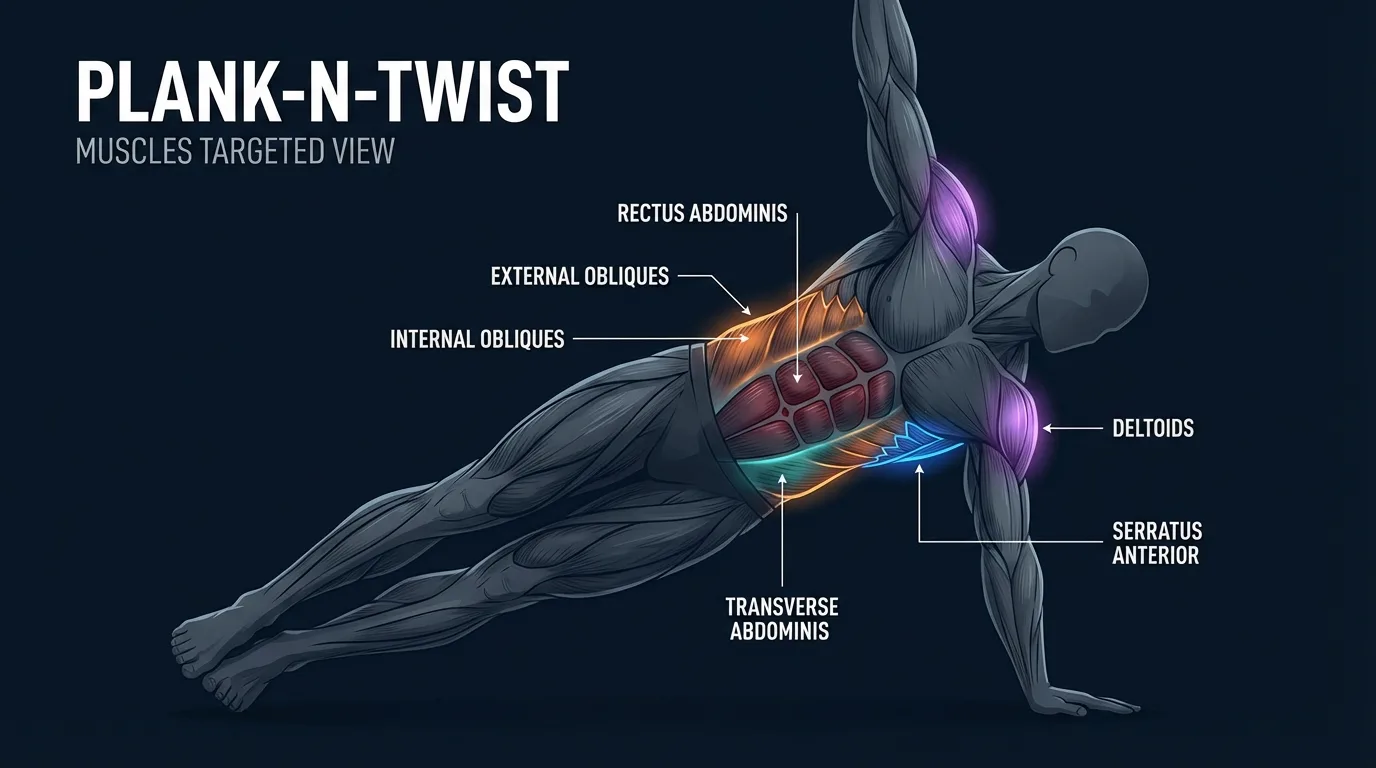
Muscles Worked
Primary movers: the internal and external obliques drive the rotation as you open the chest and bring the arm toward the ceiling. The rectus abdominis and transverse abdominis help keep the ribs and pelvis connected so the motion stays controlled instead of becoming a loose shoulder swing.
Secondary movers: the deltoids, serratus anterior, and rotator cuff support the arm that stays on the floor. The serratus anterior helps keep the shoulder blade active against the ribcage, while the deltoid and rotator cuff keep the upper arm stable as bodyweight shifts side to side.
Stabilizers: the glutes, quadriceps, spinal erectors, diaphragm, pelvic floor, and deep abdominal wall hold the plank line. The supporting-side hip has to resist dropping, and the opposite hip has to rotate without pulling the lower back into extension.
Why the movement feels hard: Plank-N-Twist combines anti-extension, anti-rotation, and active rotation in one rep. The trunk rotates through the ribcage, but the pelvis has to stay organized. That is why slow tempo matters more than rep count.
Step-by-Step Instructions
- Set up in a high plank. Place your hands under your shoulders, extend your legs, and set your feet about hip-width apart. Make a straight line from the back of your head to your heels.
- Brace before you move. Tighten your abs, squeeze your glutes, and press the floor away with both hands. Coach Ty's cue: "Lock the plank before you twist."
- Shift onto one hand. Move your weight into your left hand and stack the left shoulder over the wrist. Spread your fingers and press through the knuckles and heel of the palm.
- Rotate from the ribs. Turn your chest to the right and let the right hand peel off the floor. Coach Ty's cue: "Open the ribs, then reach."
- Reach to the ceiling. Extend the right arm straight up until your arms form a vertical line. Keep your hips controlled and your neck long.
- Return under control. Bring the right hand back to the floor, reset the plank, then repeat to the left. Exhale as you rotate and inhale as you return.
Get this exercise in a personalized workout
FitCraft, our mobile fitness app, uses its AI coach Ty to program core stability work like this into your plan at the right volume and intensity, based on your level, goals, and equipment. Ty was designed and trained by Domenic Angelino, MPH (Brown University) and NSCA-CSCS, with research published in the Journal of Strength and Conditioning Research and Medicine & Science in Sports & Exercise.
Take the Free Assessment Free · 2 minutes · No credit card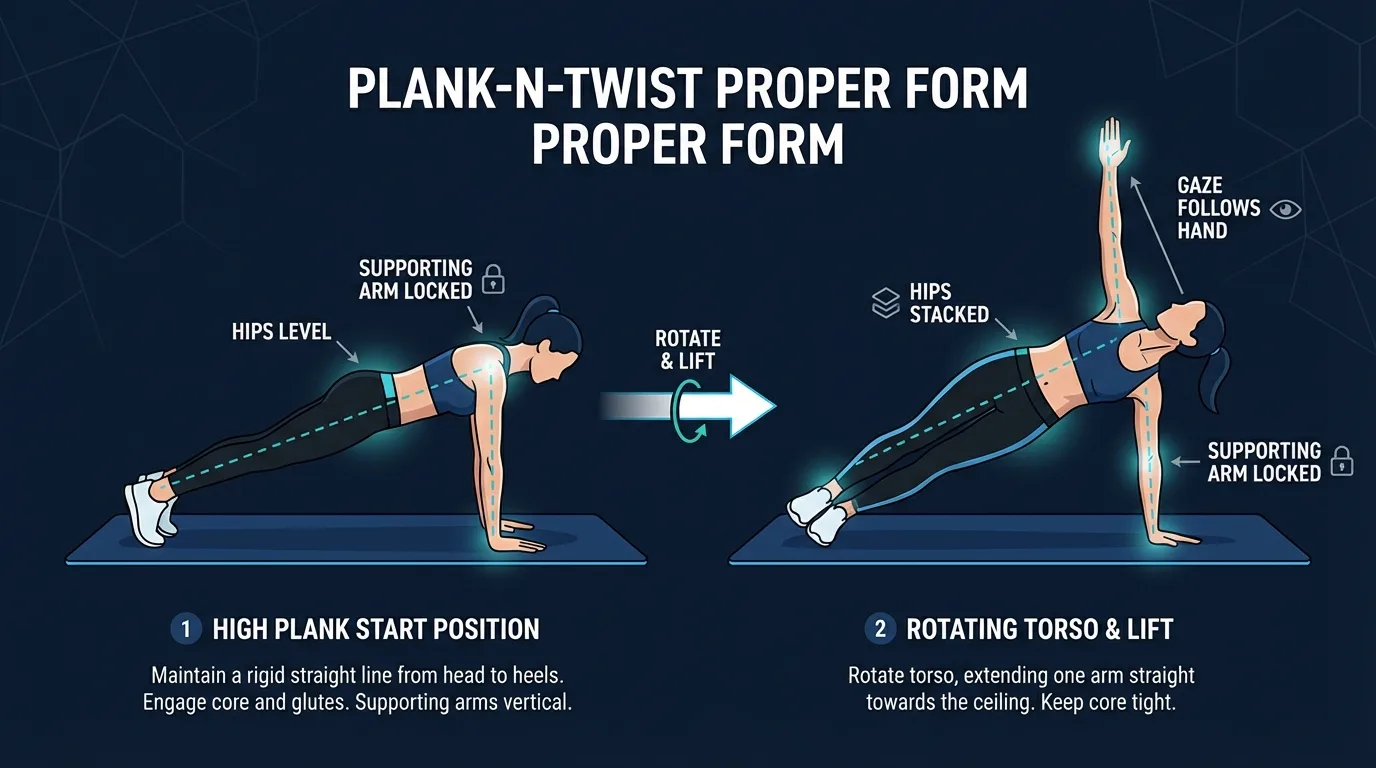
Common Mistakes
- Letting the hips sag. When the hips drop, the lower back absorbs the load. Fix it by squeezing your glutes before each rep and stopping the set when you cannot hold a straight plank.
- Piking the hips up. Hiking the hips turns the movement into a shoulder balance drill and reduces the core demand. Keep ribs, pelvis, and heels in one long line.
- Twisting from the shoulder. The reach should follow ribcage rotation. If the arm flies up while the trunk barely moves, slow down and rotate the chest first.
- Rushing the switch. Fast alternating reps hide loss of control. Count one beat up, one beat at the top, and two beats back down.
- Collapsing into the supporting wrist. A passive hand makes the wrist cranky. Spread your fingers, press the knuckles down, and use a forearm or knee variation if the wrist still complains.
- Holding your breath. Breath holding spikes tension and makes the brace less repeatable. Exhale during the twist, then inhale as you return to center.
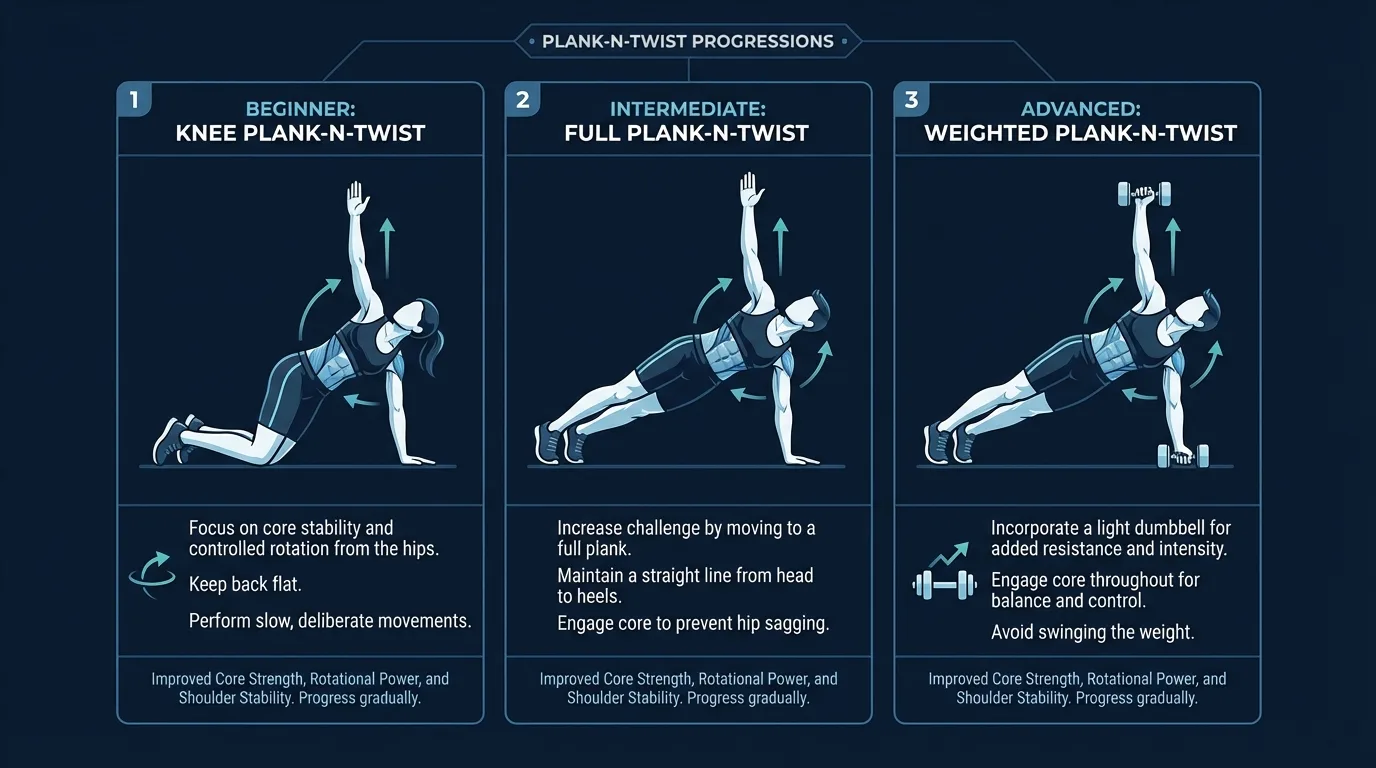
Plank-N-Twist Variations: Regressions and Progressions
Pick the version that lets you rotate cleanly without wrist pain, shoulder wobble, or lower-back extension.
Knee Plank-N-Twist
Set up from your knees instead of your toes. This shortens the lever arm and lets you learn the ribcage rotation before the full plank load gets involved.
Standard Plank-N-Twist
Use the full high-plank version from your toes. Keep the feet hip-width or slightly wider if balance is the limiting factor.
Paused Plank-N-Twist
Hold the top T-position for 2 to 3 seconds before returning to the floor. This turns the rep into a stability test instead of a quick reach.
Light Dumbbell Plank-N-Twist
Hold a very light dumbbell in the moving hand and reach it toward the ceiling. Start lighter than you think, because the shoulder and trunk stability demand rises fast.
When to Avoid or Modify Plank-N-Twist
Plank-N-Twist is safe for many healthy adults, but the combination of wrist loading, shoulder support, trunk rotation, and bracing means a few situations call for a regression. Always consult your physician or physical therapist for personalized guidance.
- Acute lower-back pain or known disc pathology. Rotation under plank tension can aggravate symptoms. Use deadbugs, bird-dogs, or short forearm planks until bracing is pain-free.
- Wrist pain, carpal tunnel symptoms, or recent wrist irritation. The high-plank setup loads the wrist in extension. Try a knee version, use push-up handles if available, or swap to plank twists on the forearms.
- Current shoulder pain or recent shoulder surgery. One arm briefly supports most of your upper-body weight. Rebuild with hand planks and side planks, then add rotation once the shoulder is cleared and stable.
- First 6-8 weeks postpartum or active diastasis recti. Rotational core work can increase abdominal pressure and doming. Restore deep-core control first with breathing, deadbugs, and bird-dogs.
- Recent abdominal surgery or hernia. Get medical clearance before loaded bracing or rotation. Most return-to-exercise plans progress from breathing to gentle bracing before dynamic plank work.
- Pregnancy, pelvic-floor dysfunction, or pelvic-organ prolapse. Use lower-pressure core options and work with a qualified clinician. Rotational plank work can be too demanding when pressure management is the priority.
Related Exercises
These exercises build the same trunk control or give you a cleaner regression path:
- Same rotation family: Plank Twists, Russian Twists, and Standing Twists train trunk rotation with different body positions and loading demands.
- Plank progressions: Hand Planks, Forearm Planks, Plank Walks, and Spider Planks build the shoulder and core base this move depends on.
- Lateral core stability: Side Planks teach the hip and oblique control needed to keep the pelvis from dropping during the twist.
- Foundational bracing: Deadbugs and Bird-Dogs are lower-pressure options for learning rib-to-pelvis control before rotating from a full plank.
- Compound carryover: Push-Ups use the same high-plank base and reward the same straight-line body control.
How to Program Plank-N-Twist
Core programming still follows progressive overload principles: start with a variation you can control, add reps or time gradually, and keep enough recovery between hard sessions. The ACSM Position Stand on resistance training outlines progression through volume, intensity, and frequency based on training level (Ratamess et al., 2009).
| Level | Sets × Reps | Rest between sets | Frequency |
|---|---|---|---|
| Beginner (knee variation) | 2-3 × 6-8 per side | 45-60 seconds | 2-4 sessions/week |
| Intermediate (standard) | 3 × 8-12 per side | 45-60 seconds | 3-5 sessions/week |
| Advanced (paused or light loaded) | 3-4 × 10-15 per side | 60 seconds | 4-6 sessions/week |
Where in your workout: place Plank-N-Twist near the end of a strength session, in a dedicated core block, or as a controlled core finisher after pressing work. Avoid doing it before heavy squats, deadlifts, or overhead pressing because trunk and shoulder fatigue can reduce stability for those lifts.
Form floor over rep targets: stop the set when hips sag, the supporting shoulder shrugs, the wrist collapses, or the twist turns into a fast arm swing. Fewer clean reps beat a longer set with compensation.
How FitCraft Programs This Exercise
Knowing how to do Plank-N-Twist is the first layer. Knowing when to use it, how much to do, and when to regress it is where programming matters.
FitCraft's AI coach Ty uses your personalized diagnostic assessment to match core exercises to your level, goals, and available equipment. A user who needs more foundation work may see hand planks, forearm planks, deadbugs, or bird-dogs first. A stronger user may get rotating plank work later in a balanced core block.
As you build consistency, Ty adjusts the variation and volume to match your level. Every program is designed by an Ivy League-trained exercise scientist and NSCA-certified strength coach using evidence-based periodization, then adapted to you by the AI.
Frequently Asked Questions
What muscles does Plank-N-Twist work?
Plank-N-Twist primarily works the obliques, rectus abdominis, and transverse abdominis. The supporting shoulder, serratus anterior, rotator cuff, glutes, and quadriceps stabilize the plank while the trunk rotates.
Is Plank-N-Twist good for beginners?
Most beginners should build up to it. Start with hand planks, side planks, and knee Plank-N-Twists before doing the full alternating version from the toes.
How many Plank-N-Twists should I do?
Beginners using the knee version can start with 2 to 3 sets of 6 to 8 reps per side. Intermediate trainees can use 3 sets of 8 to 12 per side. Advanced athletes can use 3 to 4 sets of 10 to 15 slow reps per side.
What is the difference between Plank-N-Twist and plank twists?
Plank twists usually rotate the hips side to side from a forearm plank. Plank-N-Twist rotates the torso open from a high plank while one hand reaches toward the ceiling, so it adds more shoulder stability and balance demand.
Can I do Plank-N-Twist with lower-back pain?
Modify it or skip it if twisting or bracing aggravates your back. Start with deadbugs, bird-dogs, forearm planks, or a knee Plank-N-Twist, and work with a physical therapist if pain persists.