Swing-N-Lunges are built for dense, low-impact conditioning. One rep asks you to step back, control a single-leg descent, reach overhead, then stand tall and repeat on the other side. Your legs do the heavy work, but your shoulders, trunk, and breathing have to keep up.
The move looks simple until fatigue shows up. Then the front knee starts drifting, the arms bend, the ribs flare, and the lunge gets shallow. Treat it like a skill first and a cardio drill second. Clean reps are the point.
Quick Facts: Swing-N-Lunges
- Equipment needed: None
- Difficulty: Intermediate to Advanced
- Modality: Cardio / conditioning
- Body region: Full body, lower body dominant
- FitCraft quest category: Cardio
Muscles & Systems Worked
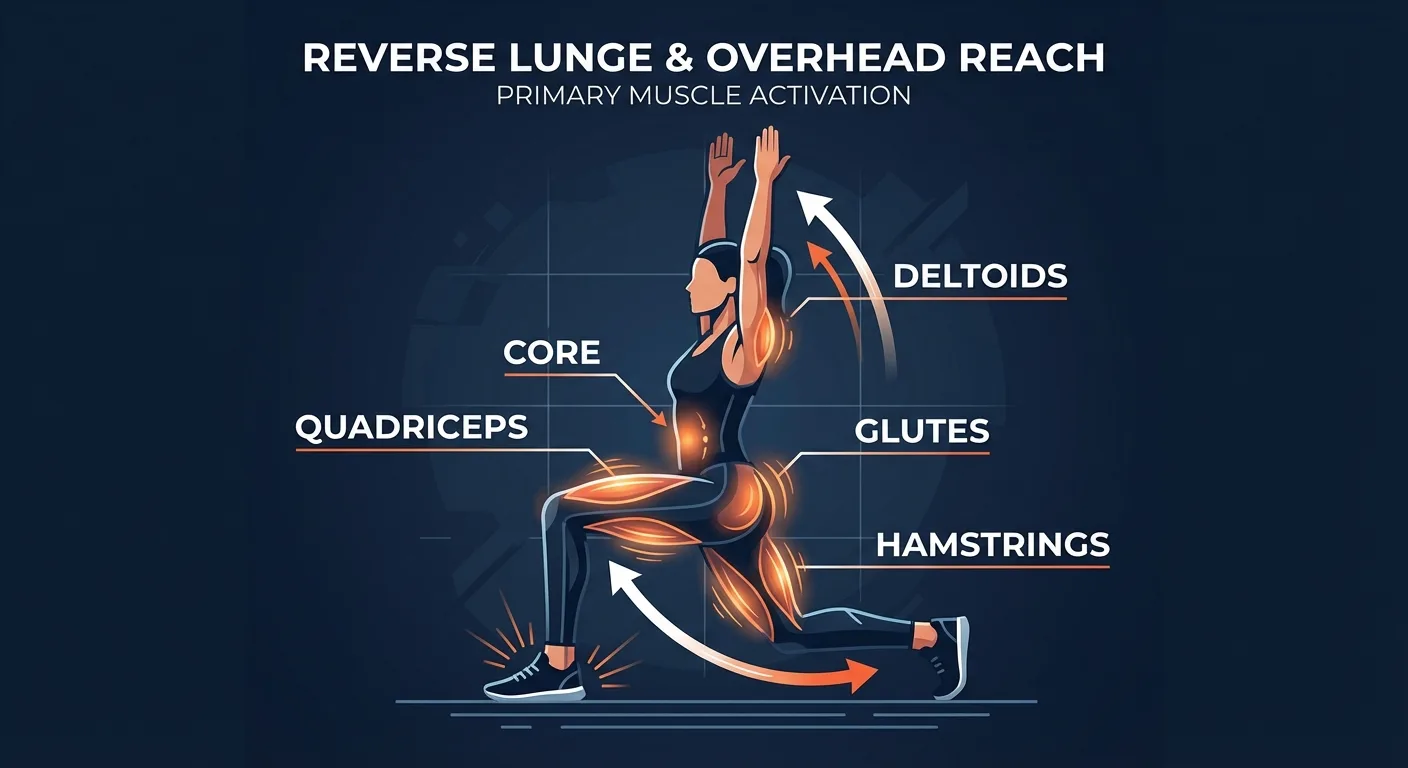
Primary movers: the quadriceps extend the front knee as you stand, while the gluteus maximus and hamstrings extend the hip. They work eccentrically as you lower into the reverse lunge, then concentrically as you drive back to standing.
Secondary movers: the adductors help the front leg stay centered, the calves control foot pressure, and the deltoids lift the arms overhead. The upper back and rotator cuff help keep the shoulders organized as the arms move through a large arc.
Stabilizers: the rectus abdominis, transverse abdominis, obliques, spinal erectors, ankle stabilizers, and hip stabilizers work isometrically to keep the trunk tall and the front knee from collapsing inward. The cardiovascular system, lungs, phosphocreatine system, glycolytic system, and oxidative system all contribute as the interval gets longer.
Why it feels like cardio: Swing-N-Lunges use large lower-body muscles, alternating sides, and continuous arm motion. That combination raises oxygen demand quickly. There is no exercise-specific PubMed, PMC, or DOI citation for Swing-N-Lunges in the verified FitCraft citation library, so this section uses mechanism-based biomechanics and conditioning physiology instead of a proxy citation.
Step-by-Step: How to Do the Swing-N-Lunge
- Set your stance. Stand tall with your feet about hip-width apart and arms relaxed at your sides. Brace lightly before you move.
- Step back into a reverse lunge. Step one foot straight back and lower until your back knee moves toward the floor. Keep the front foot planted and the front knee tracking over the middle toes.
- Swing your arms overhead. As you descend, reach both arms up in a smooth arc. Keep the ribs down so the reach comes from your shoulders instead of your lower back.
- Drive back up. Push through the front heel and midfoot to stand tall. Bring the arms back down as the back foot returns under you.
- Switch sides and keep cadence. Alternate legs every rep. Exhale as you stand, inhale as you step back, and stop before your form turns into a rush.
Get this exercise in a personalized workout
FitCraft, our mobile fitness app, uses its AI coach Ty to program conditioning work like this into your plan at the right volume and intensity, based on your level, goals, and equipment. Ty was designed and trained by Domenic Angelino, MPH (Brown University) and NSCA-CSCS, with research published in the Journal of Strength and Conditioning Research and Medicine & Science in Sports & Exercise.
Take the Free Assessment Free · 2 minutes · No credit card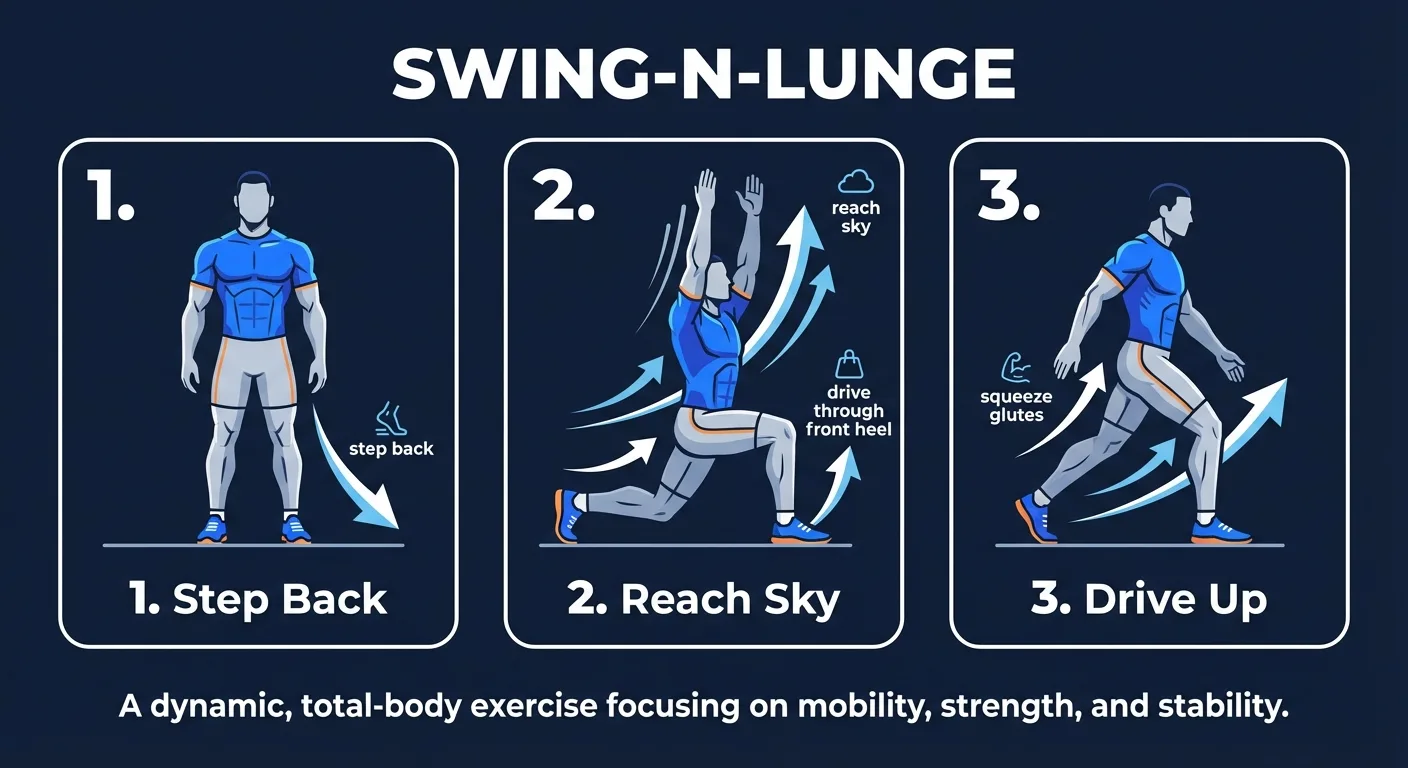
Common Mistakes (and How to Fix Them)
- Letting the front knee cave inward. The knee drifts toward the big toe as you stand. Fix it by slowing down and keeping the knee aligned over the middle toes.
- Taking too short a step. A short step forces the front knee far forward and makes depth feel cramped. Step back far enough that the back knee drops mostly straight down.
- Arching to reach overhead. If the ribs flare and the low back extends, the shoulders are no longer doing the reach cleanly. Keep your ribs stacked over your pelvis and use a smaller arm swing if needed.
- Letting speed erase depth. Fast reps with a tiny lunge turn this into loose cardio. Keep the range you can control, even if that means fewer reps in the interval.
- Crashing the back knee. Tapping the floor lightly is different from dropping into it. Lower with control and stop the set if you can no longer decelerate.
- Holding your breath. Breath-holding makes a conditioning drill spike harder than it needs to. Exhale as you stand and reset your breath every few reps.
Swing-N-Lunge Variations: Regressions and Progressions
Pick the version that lets you keep balance, lunge depth, and overhead reach under control.
Marching in Place with Arm Reach
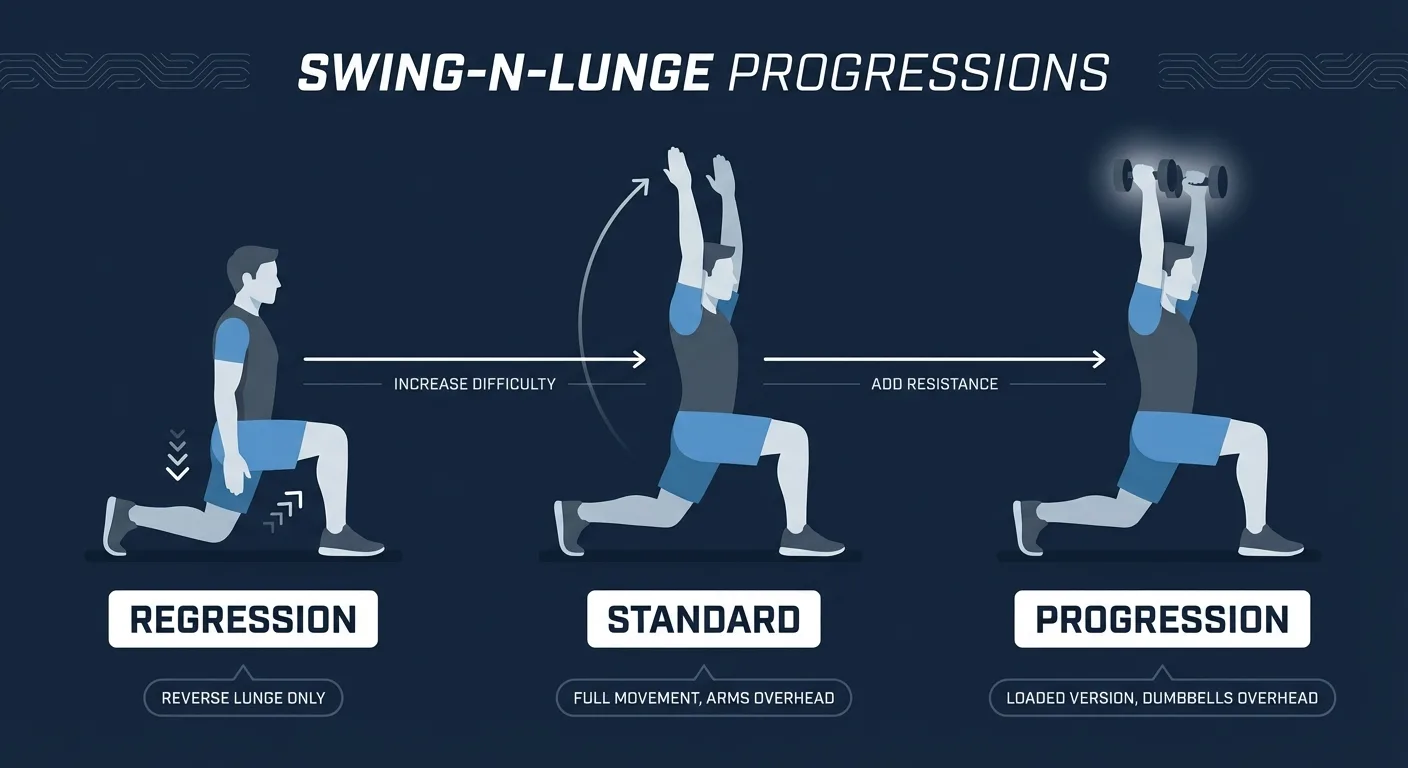
Marching in place with an overhead reach keeps the rhythm and arm action while removing the lunge. Use it when balance, knee tolerance, or fatigue makes the full move sloppy.
Step-N-Lunge
Step-N-Lunge keeps the standing cardio feel with a simpler arm pattern. It is the cleanest bridge between marching drills and full Swing-N-Lunges.
Standard Swing-N-Lunge
Alternate reverse lunges with a smooth overhead arm swing. Start slow enough that the front knee, rib position, and arm reach stay consistent from the first rep to the last.
Bottom-Pause Swing-N-Lunge
Pause for one second at the bottom before standing. This removes momentum and makes the front leg, glutes, and core earn every rep.
Loaded Swing-N-Lunge
Hold very light dumbbells only after the bodyweight version is stable. Keep the load light enough that the overhead reach stays smooth and the lower back does not arch.
When to Avoid or Modify Swing-N-Lunges
Swing-N-Lunges are safe for many healthy adults, but they do combine single-leg balance, shoulder mobility, and fast breathing. Modify early, and consult your physician, physical therapist, or qualified healthcare provider when symptoms or medical history make high-intensity movement questionable.
- Known cardiovascular disease or uncontrolled hypertension. Conditioning intervals can spike heart rate and blood pressure. Get medical clearance and stay within your prescribed intensity range.
- Active knee, hip, ankle, shin, or foot pain. The reverse lunge needs controlled single-leg loading. Use marching in place or step-n-lunges until stepping, depth, and drive feel pain-free.
- Shoulder pain or limited overhead range. The arm swing should not make your ribs flare or your shoulder pinch. Use a lower arm reach or switch to squat twists while shoulder motion calms down.
- Pregnancy or early postpartum recovery. Balance, joint laxity, pelvic-floor tolerance, and abdominal pressure all matter. Use low-impact alternatives and get individualized clearance before returning to faster lunge intervals.
- Stress incontinence or pelvic-floor symptoms. Even without jumping, repeated fast lunges can aggravate leakage or pressure symptoms. Slow the cadence, reduce range, or use marching drills while you rebuild tolerance.
- Vertigo, balance disorders, asthma, or exercise-induced bronchoconstriction. Fast alternating steps and breath demand can create problems. Use support, lengthen the warm-up, keep medication accessible when prescribed, and choose a lower-intensity substitute when needed.
Related Exercises
If Swing-N-Lunges fit your training, these exercises cover the same conditioning pattern, supporting strength, and movement prerequisites:
- Lower-impact conditioning pattern: Step-N-Lunge and Reach-N-Lunge keep the lunge-plus-arm-action idea with less coordination demand.
- Simple cardio substitute: Marching in Place and High Knees let you raise heart rate without the reverse-lunge depth.
- Lower-body strength foundation: Squats build the knee and hip extension strength that helps each lunge rep stay controlled.
- Core stability foundation: Forearm Planks teach the rib-and-pelvis control you need to reach overhead without arching.
- Advanced conditioning progression: Jump Squats add impact and power once your lower-body control and landing mechanics are ready.
How to Program Swing-N-Lunges
Swing-N-Lunge programming is time-based because the goal is conditioning quality rather than a perfect rep max. The broader progression model from the American College of Sports Medicine supports matching volume, rest, and frequency to training status (Ratamess et al., 2009).
| Level | Sets × Reps | Rest between sets | Frequency |
|---|---|---|---|
| Beginner regression | 20-30 seconds of marching, step-n-lunge, or shallow reps | 60-90 seconds | 2-3 sessions/week |
| Intermediate | 30-45 seconds of alternating Swing-N-Lunges | 45-60 seconds | 3-4 sessions/week |
| Advanced | 45-60 seconds of standard, paused, or light loaded reps | 30-45 seconds | 3-5 sessions/week |
Where in your workout: use Swing-N-Lunges in a standalone HIIT circuit, after resistance training, or as a 5-10 minute metabolic finisher. Avoid placing them before heavy squats, deadlifts, or loaded lunges because they can drain leg drive and balance.
Form floor over time targets: end the interval when knee tracking, lunge depth, overhead reach, or breathing control breaks down. A clean 25-second interval beats a 45-second scramble.
How FitCraft Programs This Exercise
Knowing the exercise is useful. Knowing where it belongs in a week is the harder part.
FitCraft uses its personalized diagnostic to match your level, goals, and equipment, then Ty adjusts the variation and volume to fit your training plan. For a move like this, that can mean starting with a lower-impact lunge pattern, using short intervals, or saving it for a finisher after strength work.
Frequently Asked Questions
What muscles do Swing-N-Lunges work?
Swing-N-Lunges train the quadriceps, gluteus maximus, hamstrings, and adductors through the reverse lunge. The overhead swing adds the deltoids, upper back, rotator cuff, and core stabilizers. Because the move is continuous and full-body, it also trains your cardiovascular system and short-interval energy systems.
Are Swing-N-Lunges good for beginners?
Most beginners should build toward Swing-N-Lunges rather than start with the full version. Learn a clean reverse lunge first, then practice marching in place with an overhead reach. Once balance, lunge depth, and shoulder reach feel controlled, combine them at a slower cadence.
Can I do Swing-N-Lunges with knee pain?
Modify or skip Swing-N-Lunges if knee pain changes your depth, knee tracking, or ability to drive through the front foot. Use a shorter step, reduce the range, hold a wall for support, or switch to step-n-lunges. If pain persists, get assessed by a qualified healthcare provider or physical therapist.
Can Swing-N-Lunges replace cardio?
They can work as a short cardio interval or conditioning finisher because they use large lower-body muscles with continuous arm motion. For longer aerobic sessions, use them as one station in a circuit rather than your only cardio tool.
How many Swing-N-Lunges should I do?
Use time-based intervals instead of chasing a fixed rep count. Beginners can use 20 to 30 seconds of work with 60 to 90 seconds of rest. Intermediate trainees can use 30 to 45 seconds with 45 to 60 seconds of rest. Advanced trainees can use 45 to 60 seconds with 30 to 45 seconds of rest.