The Z sit bend exposes hip rotation limits quickly. One side usually folds forward with room to spare, while the other side feels like it has a parking brake on.
That asymmetry is normal. The job is to keep the stretch in the hip and outer glute without borrowing motion from the knee or lower back. Smaller, cleaner range beats a deeper-looking fold that irritates the wrong joint.
Quick Facts: Z Sit Bend
- Equipment needed: Yoga mat, folded blanket, or cushion optional
- Difficulty: Intermediate to Advanced
- Modality: Mobility
- Body region: Hips, glutes, and lower back
- FitCraft quest category: Mobility
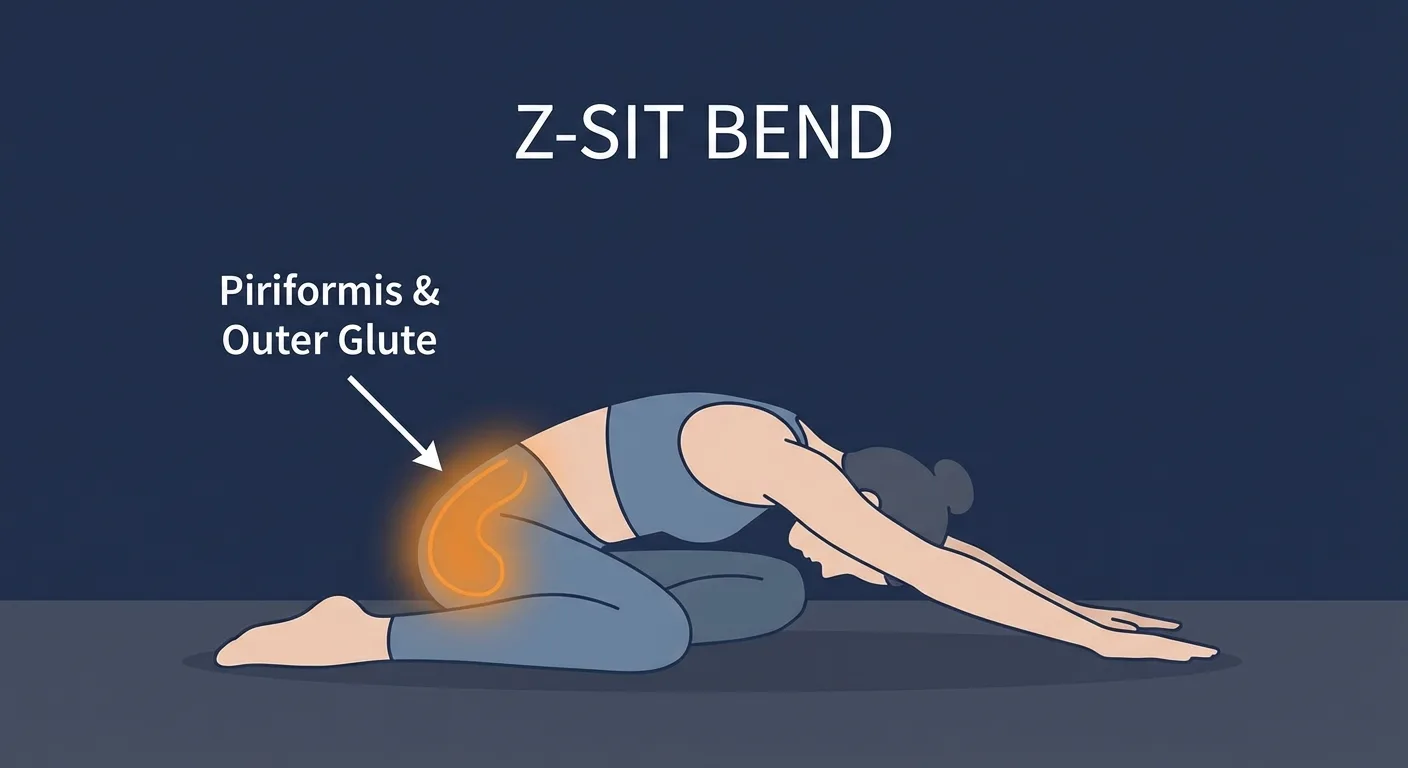
Areas Stretched & Mobilized
Primary target areas: the outer glute, piriformis, deep hip external rotators, and posterior hip capsule of the front leg. The forward fold increases hip flexion and external-rotation demand, so these tissues lengthen as you hinge forward and stay under gentle tension during the hold.
Secondary areas: the adductors, hamstrings, and inner thigh tissues may contribute depending on your shin angle and hip anatomy. The back-leg hip also gets a mild internal-rotation and hip-flexor challenge, especially if that side wants to lift off the floor.
Stabilizers: the low back, obliques, and deep abdominal muscles work quietly to keep the trunk long while the hips move. This is not a strength brace. It is just enough control to keep the stretch from collapsing into the lumbar spine.
Mechanism: the Z sit bend uses a fixed seated hip position plus a forward hinge to bias the posterior and lateral hip. Because the knee is folded while the hip rotates, knee comfort matters. A cushion under the hips, a shorter fold, or a return to the base Z sit keeps the stress where it belongs: in the hip.
Step-by-Step: How to Do the Z Sit Bend
- Start in the Z sit. Sit with one leg folded in front and the other folded behind so both knees are bent. Lift your chest, settle both sit bones as evenly as you can, and keep the front shin in a comfortable angle instead of forcing a perfect shape.
Coach Ty's cue: "Get tall before you fold."
- Hinge from the hips. Tip your torso forward from the hip joints while keeping your spine long. Lead with the chest and ribs instead of dropping your head or rounding through the lower back.
Coach Ty's cue: "Chest forward, spine long."
- Walk your hands forward. Place your hands on the floor in front of you and walk them forward only as far as your hip range allows. Stop before the back hip pops up, the front knee feels pinched, or your spine starts to curl.
Coach Ty's cue: "Stop at the first clean stretch."
- Breathe at your edge. Hold the forward fold where the stretch feels strong but manageable in the front hip, outer glute, and deep hip rotators. Breathe slowly and keep the jaw, shoulders, and hands relaxed.
Coach Ty's cue: "Let the breath make the space."
- Return and switch sides. Walk your hands back toward your body and rise with control into the base Z sit. Switch the legs and repeat on the other side, expecting one side to feel tighter than the other.
Coach Ty's cue: "Come out as slowly as you went in."
Get this exercise in a personalized workout
FitCraft, our mobile fitness app, uses its AI coach Ty to program mobility work like this into your plan at the right volume and intensity, based on your level, goals, and equipment. Ty was designed and trained by Domenic Angelino, MPH (Brown University) and NSCA-CSCS, with research published in the Journal of Strength and Conditioning Research and Medicine & Science in Sports & Exercise.
Take the Free Assessment Free • 2 minutes • No credit card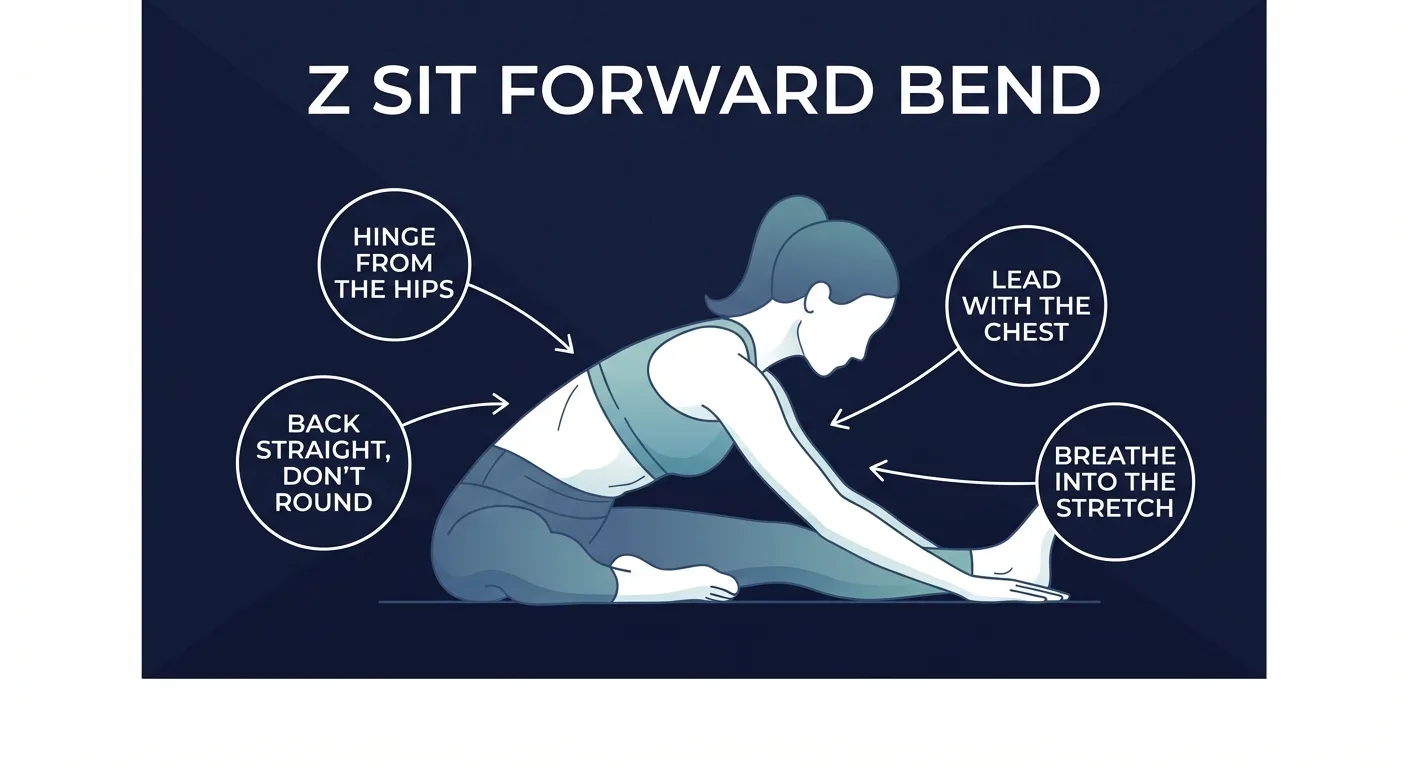
Common Mistakes (And How to Fix Them)
Rounding the Back
What it looks like: The upper back domes, the head drops, and the fold turns into a slump.
Why it's a problem: Rounding shifts the sensation out of the hip and into the low back or neck. It also makes the fold look deeper than it really is.
The fix: Lead with your chest. If you can only move an inch with a long spine, use that inch.
Forcing Depth
What it looks like: You crank yourself forward, grip the floor, or push through a sharp stretch.
Why it's a problem: Hip rotators tend to guard when you force them. The stretch gets louder, but the range does not improve cleanly.
The fix: Work at a strong but calm stretch. Add time and consistency before you add depth.
Letting the Back Hip Pop Up
What it looks like: The rear hip lifts off the floor as soon as you start the fold.
Why it's a problem: The pelvis rotates away from the target, and the stretch becomes a twist instead of a hip hinge.
The fix: Place a folded blanket under the hips or shorten the forward fold until both sides feel supported.
Ignoring Knee Signals
What it looks like: You feel pinching, pressure, or twisting inside the front or back knee.
Why it's a problem: The knee is not supposed to be the limiting joint here. Knee discomfort usually means the hip position is too aggressive.
The fix: Change the shin angle, elevate the hips, or switch to butterfly pose or hip abductor stretch.
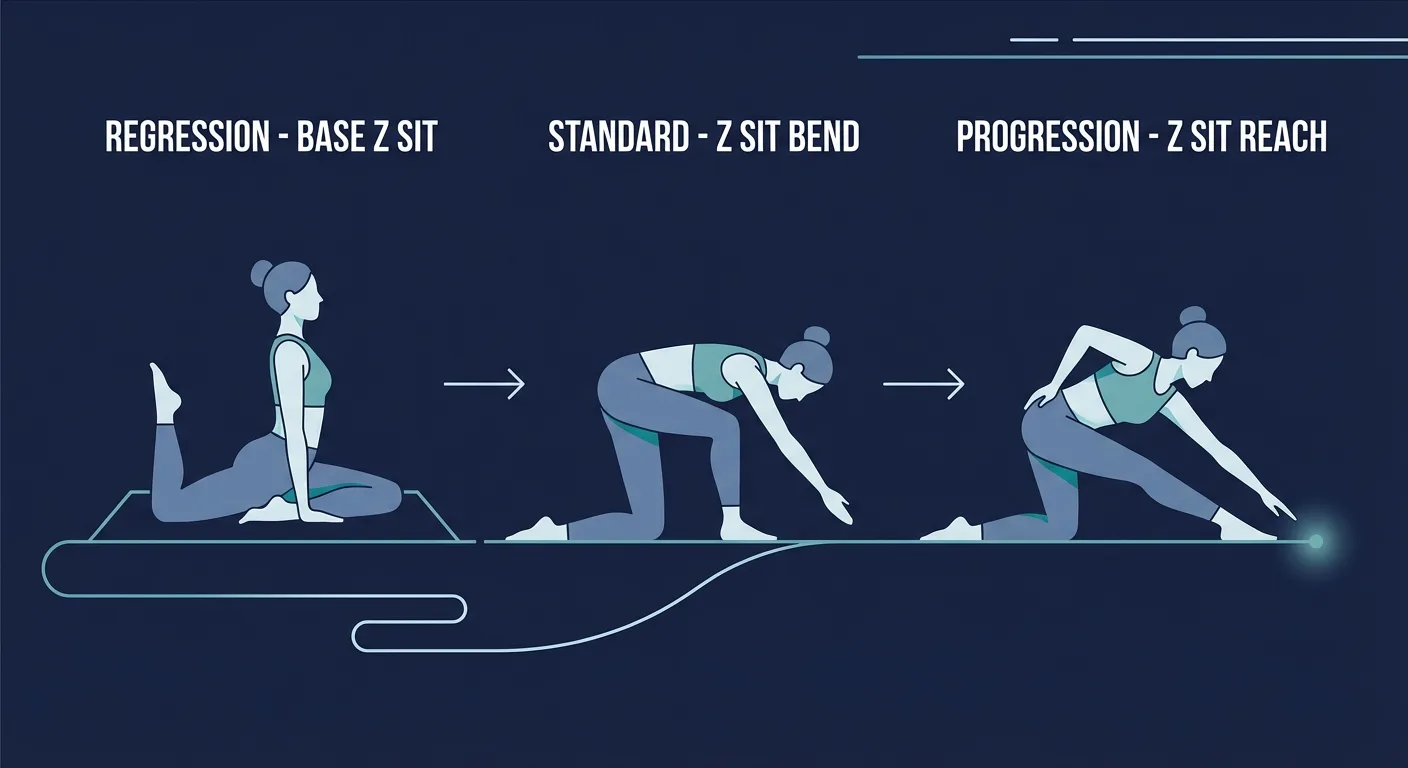
Z Sit Bend Variations: Regressions and Progressions
Easier (Regression)
- Base Z Sit. Stay upright and focus on settling both hips before adding the forward fold. This is the right starting point if the bend pulls into the knee or lower back.
- Supported Z Sit Bend. Place pillows, a bolster, or yoga blocks in front of you and rest your forearms on the support. The support lets you stay longer without hanging from your low back.
Harder (Progression)
- Z Sit Reach. Add a diagonal reach from the folded position to lengthen through the side body, shoulder, and hip at the same time.
- Pigeon Pose. Use this deeper yoga hip opener when the Z sit bend feels controlled and you want a stronger front-leg external-rotator stretch.
Alternative Exercises
- Butterfly Pose. A symmetric inner-thigh and groin stretch that is usually easier on sensitive knees.
- Cat-Cow. A gentle spinal mobility pairing that helps you separate hip motion from low-back rounding.
When to Avoid or Modify the Z Sit Bend
The Z sit bend is useful for hip mobility, but it asks a lot from the hips and knees. Always consult your physician or physical therapist before returning to deep hip rotation after injury, surgery, or persistent pain.
- Acute hip, knee, or lower-back injury. Wait for medical clearance before using deep folded positions. Use gentle cat-cow or pain-free walking until deeper mobility is cleared.
- Meniscus irritation, ligament injury, or recent knee surgery. The folded knee position can create rotational stress. Elevate the hips, reduce knee bend, or choose butterfly pose.
- Hypermobility or connective tissue disorder. Avoid hanging passively at end range. Keep the fold small, active, and controlled, or work with a physical therapist who understands hypermobility.
- Acute muscle strain around the hip or glute. Stretching a fresh strain can worsen the injury. Reintroduce gentle range only after the acute phase settles.
- Pregnancy, especially the second and third trimesters. Pelvic and SI joint laxity can make aggressive hip stretching risky. Use a supported range and get prenatal-specific guidance.
- Disc pathology or active sciatica. Forward-folding positions can aggravate symptoms for some people. Keep the spine neutral, shorten the range, or use spinal twist only if it is symptom-free.
Related Exercises
- Same hip complex: Z sit builds the base hip position before the fold.
- Progression: Z sit reach adds a diagonal reach once the bend feels stable.
- Similar stretch direction: Pigeon pose targets the outer hip and deep rotators with a stronger yoga-style setup.
- Knee-friendlier alternative: Butterfly pose opens the hips without the same Z-shaped leg position.
- Active mobility pairing: Cat-cow helps you practice spinal motion before and after the static hold.
- Adjacent mobility drill: Hip abductor stretch pairs well with the Z sit bend for a broader hip mobility session.
How to Program the Z Sit Bend
Mobility training uses different levers than strength training, but progression still matters. The ACSM position stand from Ratamess et al., 2009 supports progressive overload as the broad principle: start with a tolerable dose, then increase challenge as your body adapts.
| Level | Sets x Hold | Rest between sets | Frequency |
|---|---|---|---|
| Beginner | 1-2 x 15-30 seconds per side | 30-45 seconds | 5-7 sessions/week |
| Intermediate | 2-3 x 30-60 seconds per side | 15-30 seconds | 5-7 sessions/week |
| Advanced | 2-4 x 30-90 seconds per side | 15-30 seconds | Daily |
Where in your workout: use the Z sit bend after a warmup, after lower-body training, or as part of a standalone mobility session. Long static holds usually fit better after training or on recovery days than right before heavy strength or power work.
Form floor over hold targets: the hold time only counts while the stretch stays in the hip, the breath stays steady, and the knee feels calm. If any of those change, shorten the hold or use support.
FitCraft's AI coach Ty can place hip mobility drills into programs based on your level, goals, and equipment. For the Z sit family, that means earning the base position first, then adding range and reach only when the movement stays controlled.
Frequently Asked Questions
What is the difference between Z sit and Z sit bend?
The Z sit is the base seated position with one leg folded in front and one leg folded behind. The Z sit bend adds a forward hip hinge from that position, which deepens the stretch in the front hip, outer glute, and deep hip rotators.
Should I master the Z sit before trying the Z sit bend?
Yes. If you can't sit upright in the base Z sit without knee discomfort, hip pinching, or one hip floating far off the floor, build the base position first. The bend should feel like a controlled progression, not a workaround for missing hip range.
Why should my back stay long in the Z sit bend?
A long spine keeps the forward fold aimed at the hip instead of turning it into a low-back slump. If your spine rounds early, reduce the depth, put your hands on blocks or pillows, and work from a smaller range.
Can I do the Z sit bend with knee pain?
Be cautious. The Z sit position can place rotational stress on the knees, especially with meniscus irritation, ligament injury, or a recent knee surgery. Use a higher hip support, reduce the knee bend, or choose butterfly pose or hip abductor stretch instead. Stop if the knee feels sharp, pinchy, or unstable.
How long should I hold the Z sit bend?
Start with 15 to 30 seconds per side and use a supported range. Build toward 30 to 60 seconds for two or three rounds per side. Advanced mobility work can use holds up to 90 seconds when the stretch stays calm and controlled.