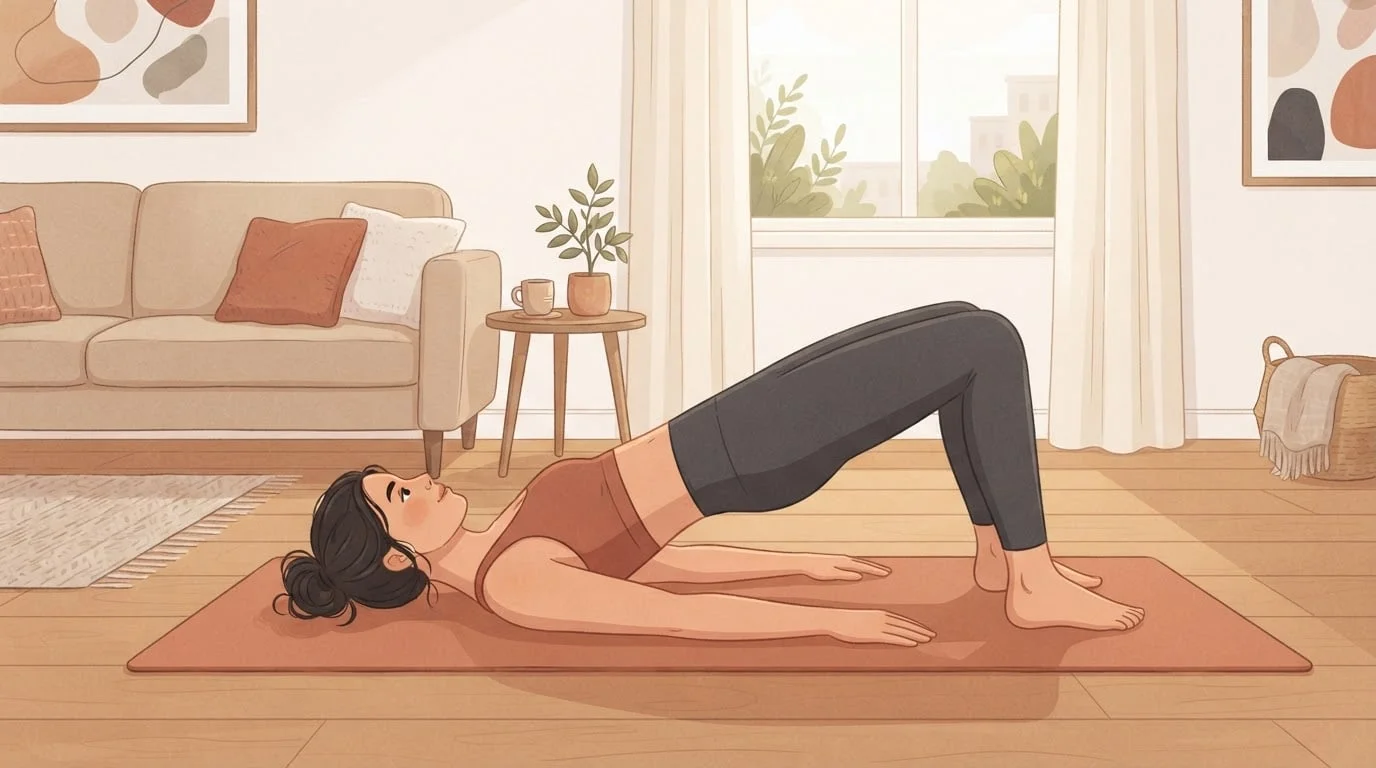
You've seen both on your feed: someone lifting their hips off the floor, and someone with their back on a bench and a bar across their lap. They look nearly the same, yet the comments can't agree. One says bridges are only a warm-up. Another says hip thrusts are a gym thing. If you train at home, it's easy to assume you're stuck with the lesser version.
That worry can stall you twice. You wait until you own the right equipment, or you keep doing easy bridges and wonder why nothing changes. Neither problem means you aren't trying hard enough. Most home glute plans simply never show you how to make the move harder.
This guide compares range of motion, muscles worked and the growth evidence, answers whether you can sub a glute bridge for a hip thrust, and shows how to load both with dumbbells and bodyweight.
Hip Thrust vs Glute Bridge at a Glance
| Glute bridge | Hip thrust | |
|---|---|---|
| Setup | Head, shoulders and upper back on the floor | Upper back on a bench or sofa |
| Equipment | None; a dumbbell when you're ready | A sturdy bench or sofa; a dumbbell when you're ready |
| Distance the load travels | 15.5 cm | 35.7 cm at the same load |
| Lifting time at the same load | 0.58 seconds | 0.80 seconds |
| Main muscles | Glutes, hamstrings and the muscles along your spine | Gluteus maximus first, then the spinal erectors and hamstrings |
| Glute activity | 23% of maximum at body weight; 40% on one leg | 75% averaged across loaded versions |
| Growth evidence | No imaging study found; daily bodyweight bridges built strength, not girth | Barbell hip thrusts matched squats on MRI |
| Best for | Beginners, warm-ups and training with no equipment | More range, more load and progress once bridges feel easy |
The activity row compares bodyweight bridges with loaded thrusts, so it overstates the gap between the two movements. The next sections explain why.
What Is the Difference Between a Hip Thrust and a Glute Bridge?
The difference is where your upper back sits. In a glute bridge it stays on the floor, so the floor stops your hips early. In a hip thrust it rests on a bench, which leaves room for your hips to drop lower and travel farther.
Zabaleta-Korta and Fernández-Peña (2024) ran the only direct comparison we found. Ten resistance-trained men did both exercises with the same barbell load, 80% of their hip thrust one-rep max, while a camera tracked the bar.
- Vertical bar travel: 35.7 cm in the hip thrust and 15.5 cm in the bridge.
- Lifting time: 0.80 seconds and 0.58 seconds.
- Total impulse, a measure of force applied over time: 1,422 and 1,024 newton-seconds, about 39% more in the hip thrust.
The authors concluded that the hip thrust suits training from a more bent hip and through a bigger range, while the bridge allows more force close to lockout. It's a small study of men with no muscle activity data, so it describes the movement and doesn't show which one builds more.
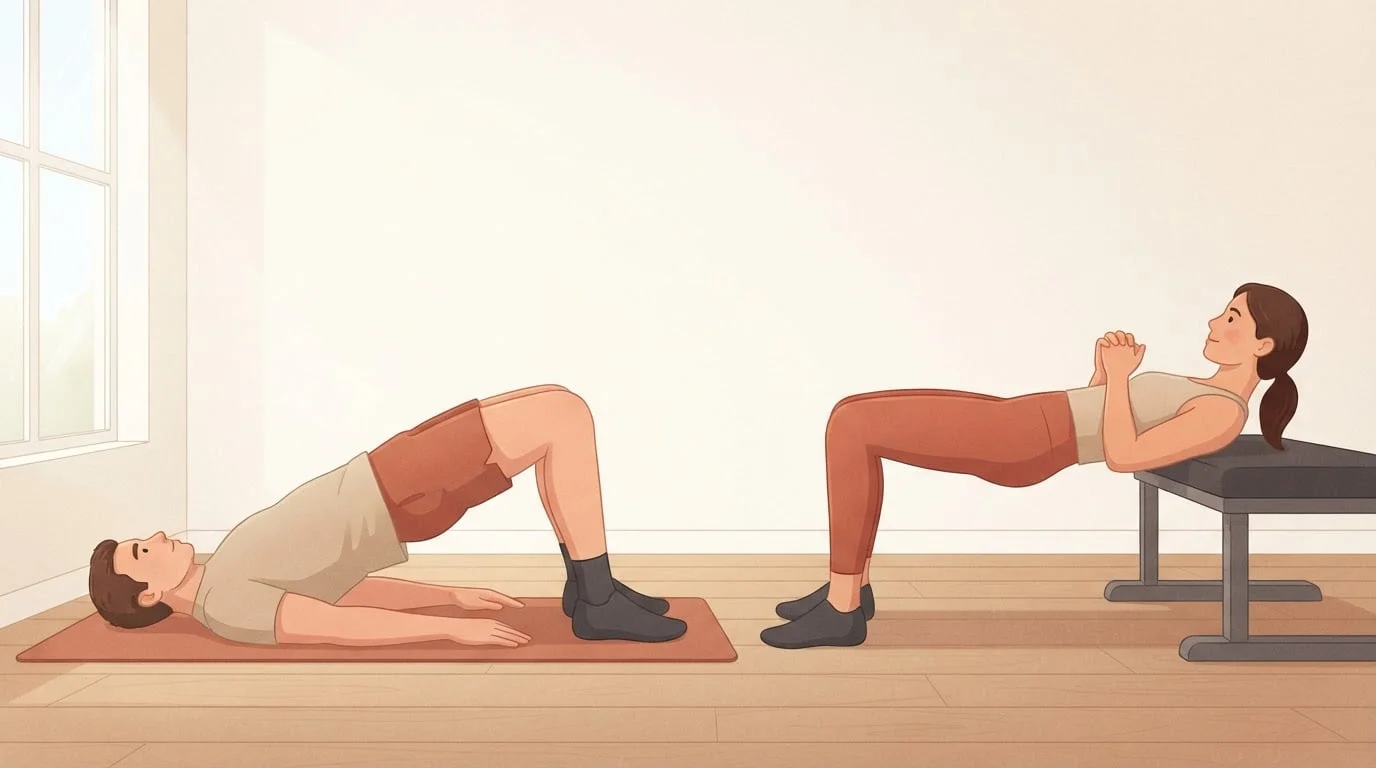
Do Glute Bridges and Hip Thrusts Work the Same Muscles?
Yes. Both straighten the hip against resistance, so the gluteus maximus leads, with the hamstrings and the muscles along your spine helping. A 2019 systematic review of the barbell hip thrust found activity ran gluteus maximus first, then the spinal erectors, hamstrings and quadriceps. The same review notes that demand on the glutes and hamstrings is highest near the top of the rep, where your hips are straight. A bridge keeps that part of the movement.
How hard the glutes work depends heavily on load. Here's what electromyography (EMG) shows, as a percentage of a maximal contraction:
- Two-leg bridge, body weight: 23% on average across 6 studies, ranging from 16 to 42% (Macadam and Feser 2019).
- Single-leg bridge, body weight: 40% on average across 6 studies, ranging from 33 to 54%.
- Hip thrust, loaded: 75% on average across 5 studies, ranging from 49 to 105% (Krause Neto 2020).
These numbers come from different studies and different loads, so they don't show that a bridge is a weak exercise. They show what happens when you add resistance. We found no study that put a loaded bridge and a loaded hip thrust side by side with EMG.
Find out what's really holding you back
FitCraft, our mobile fitness app, pairs you with an AI coach who builds you a personalized plan around your goals, schedule, and fitness level. Every FitCraft program is designed by Domenic Angelino, MPH (Brown University) and NSCA-CSCS, with research published in the Journal of Strength and Conditioning Research and Medicine & Science in Sports & Exercise.
Take the Free Assessment Free • 2 minutes • No credit cardAre Glute Bridges Just as Effective as Hip Thrusts?
We don't know yet, because we found no trial that compared them for growth. A 2025 review and meta-analysis of 12 studies and 318 people found that resistance training grows the gluteus maximus, and its trial list includes barbell hip thrusts but no glute bridges. The evidence around that gap still points in a useful direction:
- Hip thrusts can add growth. Kassiano and colleagues (2024) trained 33 untrained young women for 10 weeks. Adding barbell hip thrusts to leg presses and stiff-leg deadlifts raised the gain in glute thickness from 6.0% to 9.3%.
- Easy bridges may fall short. Lehecka and colleagues (2019) had 32 students do bodyweight bridges or glute squeezes daily for 8 weeks. The bridge group gained hip extension strength, but their hip girth didn't change significantly, though a tape measure is a crude test of muscle size.
- EMG doesn't settle it. In the Plotkin 2023 trial, hip thrusts beat squats on glute EMG and still produced similar growth on MRI, as our glute growth guide explains.
- Light loads can work. Across 21 studies, light and heavy loads built similar muscle when sets went to failure (Schoenfeld 2017). Our review of light weights covers that research.
Put together, a hard bridge is a real glute exercise and an easy one mostly isn't. The hip thrust's advantage is that it stays hard for longer as you get stronger.
Is Hip Thrust Good for Hamstrings?
It works them, but it may not grow them. Barbell hip thrusts drew 40.8% of maximal biceps femoris activity against 14.9% for back squats in 13 trained women (Contreras 2015). Yet in the Plotkin trial, neither exercise produced meaningful hamstring growth over 9 weeks.
Foot position changes the hamstrings' share. In one study covered by the 2019 review, moving your feet farther from the bench raised hamstring activity and lowered quadriceps activity. In single-leg bridges, bringing the heel closer to the hips cut biceps femoris activity from 75% to 23% of maximum, while glute activity stayed at 47 to 51% (Lehecka 2017). So if your hamstrings cramp, move your heels in. For hamstring size, add a Romanian deadlift.
How to Load Hip Thrusts and Glute Bridges at Home
The studies above used a barbell because that's what labs and gyms have. At home, the goal is the same, a set that ends close to failure, and you get there with body weight and dumbbells. Work up this ladder, training twice a week and ending each set with one to three good reps left.
| Step | Exercise | Sets x reps | Move on when |
|---|---|---|---|
| 1 | Glute bridge | 3 x 15 to 20 | 20 reps feel easy with a two-second squeeze at the top |
| 2 | Dumbbell glute bridge | 3 x 10 to 15 | 15 reps feel easy with your heaviest dumbbell |
| 3 | Single-leg glute bridge | 3 x 8 to 12 per side | 12 clean reps per side, with your hips level |
| 4 | Bodyweight hip thrust | 3 x 15 to 20 | 20 reps feel easy |
| 5 | Dumbbell hip thrust | 3 x 8 to 15 | 15 reps feel easy with your heaviest dumbbell |
| 6 | Single-leg hip thrust | 3 x 8 to 12 per side | Slow the lowering to three seconds to keep it hard |
Going to one leg is the cheapest upgrade: pooled glute activity rose from 23% in the two-leg bridge to 40% in the single-leg bridge. No dumbbells yet? Use steps 1, 3, 4 and 6.
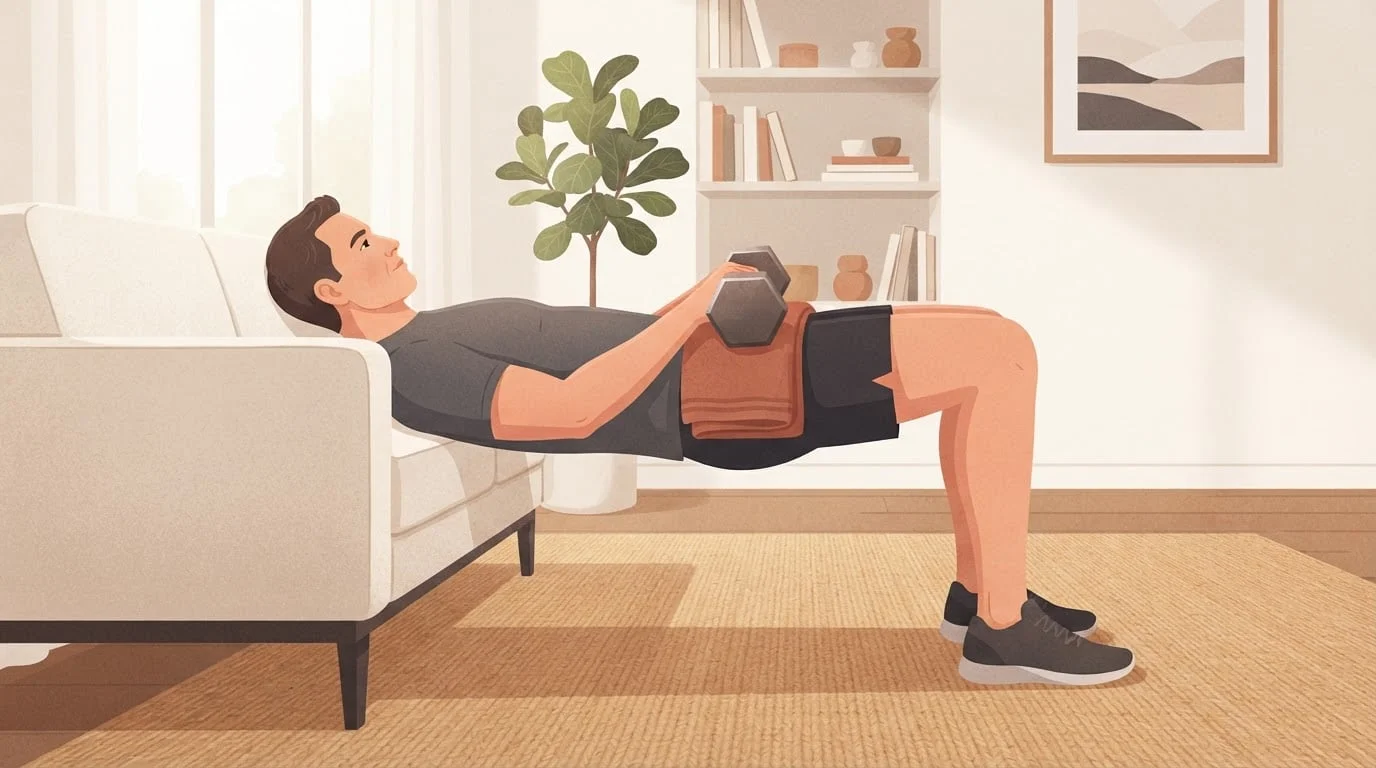
For a hip thrust, push a sturdy sofa or bench against a wall so it can't slide, and rest the bottom of your shoulder blades on the edge. Lay a folded towel across your hips under the dumbbell and hold it with both hands. Drive up until your hips are straight, squeeze for a second, and stop before your lower back arches. Our glute bridge guide covers the floor version step by step.
Elevated Glute Bridge and KAS Glute Bridge
Two variations sit between these exercises. We found no published study comparing either one with a hip thrust, so choose by what you have.
- Elevated glute bridge: your shoulders stay on the floor and your feet go on a step or low bench, which adds some hip range without a bench under your back.
- KAS glute bridge: your upper back stays on a bench as in a hip thrust, and you move through only the top part of the rep.
Hip Thrust or Glute Bridge: Which Should You Do?
Most people should start with one and graduate to the other. Pick by where you are:
- New to glute training: start with bridges. They need no setup, and they teach you to finish the rep with your glutes.
- Bridges feel easy: add a dumbbell or go to one leg before you worry about a bench.
- You have a sofa and a dumbbell: make the hip thrust your main glute exercise and keep bridges as a warm-up, using our glute activation guide.
- No equipment at all: single-leg bridges done close to failure are your best option.
- Your lower back takes over: stay on the floor, lighten the load and stop as soon as your hips are straight.
Knowing the ladder is the easy part. Climbing it twice a week for months is where most home plans fall apart. In FitCraft, your AI coach demonstrates each exercise with an interactive 3D demo you can zoom in on and says your name while you train. Your program adapts as you progress, and streaks and calendar tracking keep the sessions visible. If you train with little or no equipment, a home workout app with no equipment can carry the plan for you.
The Bottom Line
Hip thrust vs glute bridge: start with the bridge and move up to the thrust. Both train the glutes first. The hip thrust moves your hips more than twice as far and stays hard for longer, and the glute bridge needs nothing but a floor. We found no trial comparing them for growth.
Practical rule: keep your sets close to failure. When 20 reps feel easy, add a dumbbell, go to one leg, or raise your upper back onto a sofa.
You're not doing the lesser version. A hard bridge on your living-room floor counts, and a sofa and one dumbbell take you a long way. As Stacy put it: "After my second kid, I needed something stupidly simple."
Frequently Asked Questions
Can I sub glute bridge for hip thrust?
Yes. A glute bridge trains the same muscles over about half the distance, so add a dumbbell or go to one leg to keep it hard. In a study of 10 trained men, the bar traveled 15.5 cm in a bridge and 35.7 cm in a hip thrust at the same load.
Do glute bridges grow glutes?
They can, when the sets are hard. Light loads build muscle when sets end near failure, but easy bodyweight bridges may not do it: eight weeks of daily bridges raised hip strength without a significant change in hip girth in a study of 32 students. Add a dumbbell or go to one leg once 20 reps feel easy.
What is the #1 best glute exercise?
No single exercise holds that title. Hip thrusts draw very high glute activity, but hip thrusts and squats grew the glutes by similar amounts on MRI in a 9-week trial of 34 adults. The best one is a hip exercise you can keep making harder and keep doing every week.
Can you do hip thrusts without a bench?
Yes. The edge of a sturdy sofa pushed against a wall works well at home. If you have nothing to lean on, a single-leg glute bridge on the floor is the closest option.
How much weight should I use for a glute bridge?
Pick a dumbbell you can bridge for 10 to 15 reps with one to three reps left. When you reach 15 on every set, go heavier, or move to one leg if you've run out of dumbbells.
Are hip thrusts bad for your back?
They don't have to be, but your back muscles do work hard. The spinal erectors ranked second in activity in a 2019 review of barbell hip thrusts. Stop when your hips are straight, don't arch to finish the rep, and get any back pain checked before you add load.