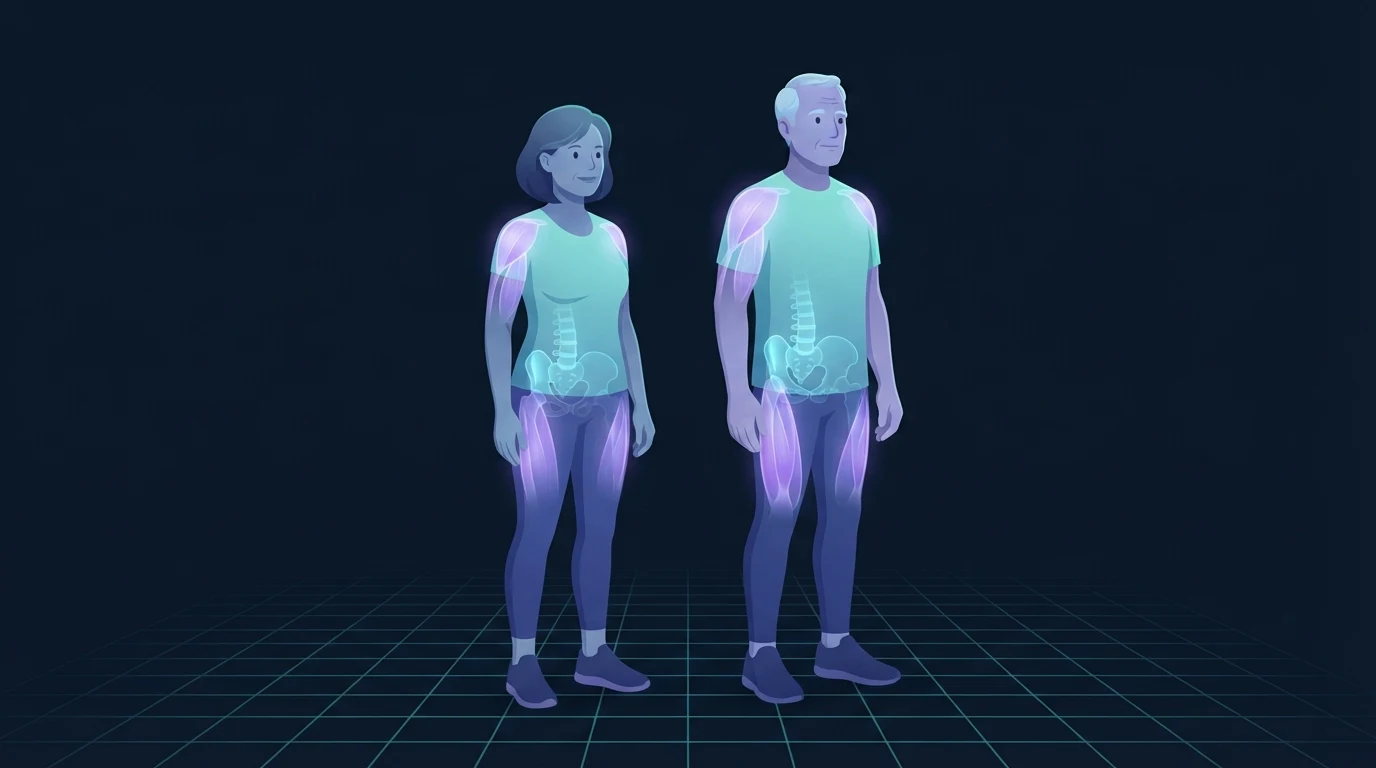
You've probably done this before. At 30 you cut the bread and ran a few times a week and the weight came off, and the whole thing took about six weeks and no real planning. At 55 that same approach produces a stubborn scale, a sore knee, and a level of tiredness that doesn't feel like it's worth the reward.
Here's what nobody mentions. The approach that worked at 30 wasn't just less effective now, it was quietly expensive. A hard diet with no resistance training strips muscle and bone alongside fat at every age, and before 40 you rebuilt most of it without noticing. After 50 you don't. What you lose during a crash diet at 55 is largely gone.
So the question changes. It stops being how fast you can make the number fall and becomes how much of the weight you lose can be fat. That's a solvable problem, and the solution is unglamorous: enough protein, twice-weekly resistance work, a lot of walking, a modest deficit and decent sleep.
What Actually Changes After 50
Muscle leaves faster, and strength leaves faster still
The slow drift that started in your forties picks up pace. A quantitative review by Mitchell and colleagues put the median cross-sectional rate of muscle loss at 0.47 percent per year in men and 0.37 percent in women, but longitudinal data at age 75 shows 0.80 to 0.98 percent a year in men and 0.64 to 0.70 percent in women. Strength falls faster than size: 3 to 4 percent a year in men and 2.5 to 3 percent in women at that age, which is two to five times the rate at which the muscle itself disappears.
That gap between size and strength is the practical story of this decade. You can look roughly the same and be meaningfully weaker. The accumulation of that loss is sarcopenia, and our review of the resistance training research on sarcopenia covers how reversible it is, which is more than most people assume.
Bone becomes something a diet can cost you
Before 50 you can usually ignore bone. After it, especially for postmenopausal women, it becomes a line item in any weight-loss decision. Villareal and colleagues randomized 48 adults with a mean age of 57 to one year of calorie restriction, one year of regular exercise, or a healthy-lifestyle control. Both active groups lost similar weight, 10.7 percent and 8.4 percent. Only the dieting group lost bone: about 2.2 percent at the total hip and 2.2 percent at the spine. The exercising group lost no bone mineral density at any measured site despite losing nearly as much weight.
One year, one diet, two percent of your hip. That's the cost of doing this the old way.
Medications and joints set the terms
By 55, most people are managing something. Blood pressure medication changes your heart rate response, so heart-rate training zones can read wrong. Some cholesterol medications produce muscle aching that gets blamed on the new program. GLP-1 medications produce rapid weight loss with a substantial lean-mass share unless protein and resistance training are deliberately protected, which our review of the GLP-1 muscle loss research goes through in detail. Diuretics change how thirst and hydration behave during exercise.
Joints set their own terms. Knee and hip osteoarthritis are common in this decade, and they mostly rule out running and jumping while leaving walking, cycling, swimming and every seated or supported strength movement completely available. A knee that hates a jog is usually fine with a seated strength routine. The plan below is built to work around those limits rather than pretend they aren't there.
Metabolism, finally, does slow down
This is the decade when the thing everyone blames becomes real, just not yet. Pontzer and colleagues measured total daily energy expenditure in 6,421 people across 29 countries and found that, adjusted for fat-free mass, it holds flat from age 20 to age 60 and then declines at about 0.7 percent a year. At 52 your engine is still running at the same rate per unit of lean tissue it did at 25. At 68 it isn't, and by the nineties the requirement is roughly a quarter lower than in midlife.
The practical reading of that: in your fifties the problem is still muscle and movement, not the furnace. Which is good, because those are the two things you can do something about.
Why a Deficit on Its Own Backfires After 50
The strongest evidence for what a weight-loss plan should look like at this age comes from a trial that tested exactly this question. Villareal and colleagues enrolled 160 obese older adults in the New England Journal of Medicine and randomized them to a weight-management program plus aerobic training, plus resistance training, plus both, or to a control group with neither. Over six months, the combination group improved their Physical Performance Test score by 21 percent, against 14 percent for each single-mode group and far less in the control group.
The line that matters most is in the conclusion. Reductions in lean mass and bone density were attenuated but not prevented in the exercise groups. Even with training, dieting after 50 costs you some muscle and some bone. Training shrinks the bill; it doesn't cancel it. That's the reason the rate of loss below is slower than you've seen recommended elsewhere, and the reason protein sits at the top of the plan.
Find out what's really holding you back
FitCraft, our mobile fitness app, pairs you with an AI coach who builds you a personalized plan around your goals, schedule, and fitness level. Every FitCraft program is designed by Domenic Angelino, MPH (Brown University) and NSCA-CSCS, with research published in the Journal of Strength and Conditioning Research and Medicine & Science in Sports & Exercise.
Take the Free Assessment Free • 2 minutes • No credit card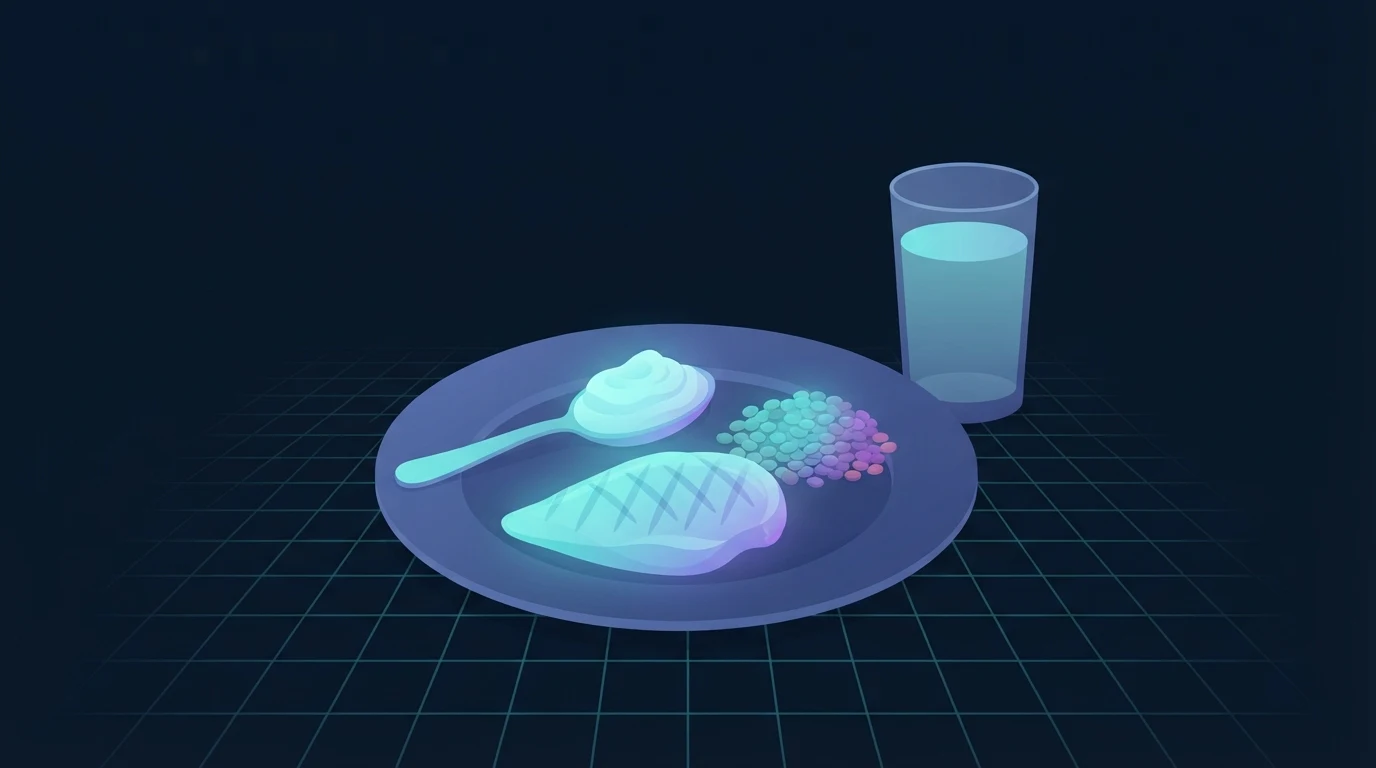
Protein: The Number That Decides What You Lose
Target 1.2 to 1.6 grams of protein per kilogram of body weight per day while you're in a deficit. For a 75 kg adult that's 90 to 120 grams; for a 90 kg adult, 108 to 144.
The baseline comes from the PROT-AGE position paper, an international expert group that reviewed the evidence and recommended 1.0 to 1.2 g/kg/day for healthy adults over 65, at least 1.2 g/kg/day for those who are exercising, and 1.2 to 1.5 g/kg/day for people managing acute or chronic illness. Older bodies need more than younger ones for the same result, because of higher splanchnic extraction and a weaker anabolic response to each meal. A deficit raises the requirement again, which is why the range in this guide sits at the upper end of theirs.
The payoff is measurable. Kim and colleagues pooled 20 randomized trials of adults over 50 who were deliberately losing weight and concluded that the higher-protein groups retained more lean mass and lost more fat mass than the lower-protein groups at the same weight loss. Same scale reading, better body.
Per-meal size matters as much as the daily total after 50. Moore and colleagues analysed muscle protein synthesis responses across their labs' studies and found the response plateaued at about 0.40 g per kilogram of body mass per meal in older men, against 0.24 in younger men. Roughly 30 to 40 grams per meal, three times a day, for most people. A 10-gram breakfast followed by a 70-gram dinner adds to the same total and does noticeably less.
Practical sources that don't require a blender: eggs, Greek yogurt, cottage cheese, tinned fish, chicken, lean beef, tofu, lentils, milk. If chewing or appetite is a limiting factor, which it often is at this age, a protein drink at one meal is a reasonable fix rather than a compromise.
Resistance Training at Home: Dumbbells, Bodyweight, and a Chair
Two sessions a week, full body, is the floor and it's enough. Peterson and colleagues pooled 49 studies covering 1,328 adults aged 50 and over and found an average gain of 1.1 kg of lean body mass, with higher-volume programs producing more and older participants gaining somewhat less. That's a meta-analysis of ordinary older adults doing ordinary programs, not athletes.
Six patterns cover everything you need:
- Squat pattern. Sit-to-stand from a sturdy chair, progressing to a goblet squat with one dumbbell held at the chest.
- Hinge pattern. Hip hinge to a countertop, progressing to a dumbbell Romanian deadlift with a short range.
- Push. Wall push-up, then incline push-up on a counter, then a dumbbell floor press.
- Pull. One-arm dumbbell row braced on a chair, or a band row anchored in a door.
- Carry. Walk 20 to 30 metres holding a dumbbell in each hand. This one does more for grip, posture and balance than it looks like it should.
- Balance. 30 seconds standing on one leg per side, holding a counter as needed. Not strength, but it's the thing that keeps a stumble from becoming a fracture.
Two to three sets of eight to twelve reps per pattern, stopping two reps short of failure, with a minute or two of rest between sets. Add a little weight or a rep or two whenever a session feels comfortable. If you're starting from years of no training, the on-ramp in our guide to fitness over 60 works just as well at 52, and our review of strength training after 60 covers what the trials show about how much is recoverable.
Walking Volume, and Why It Beats Another Cardio Class
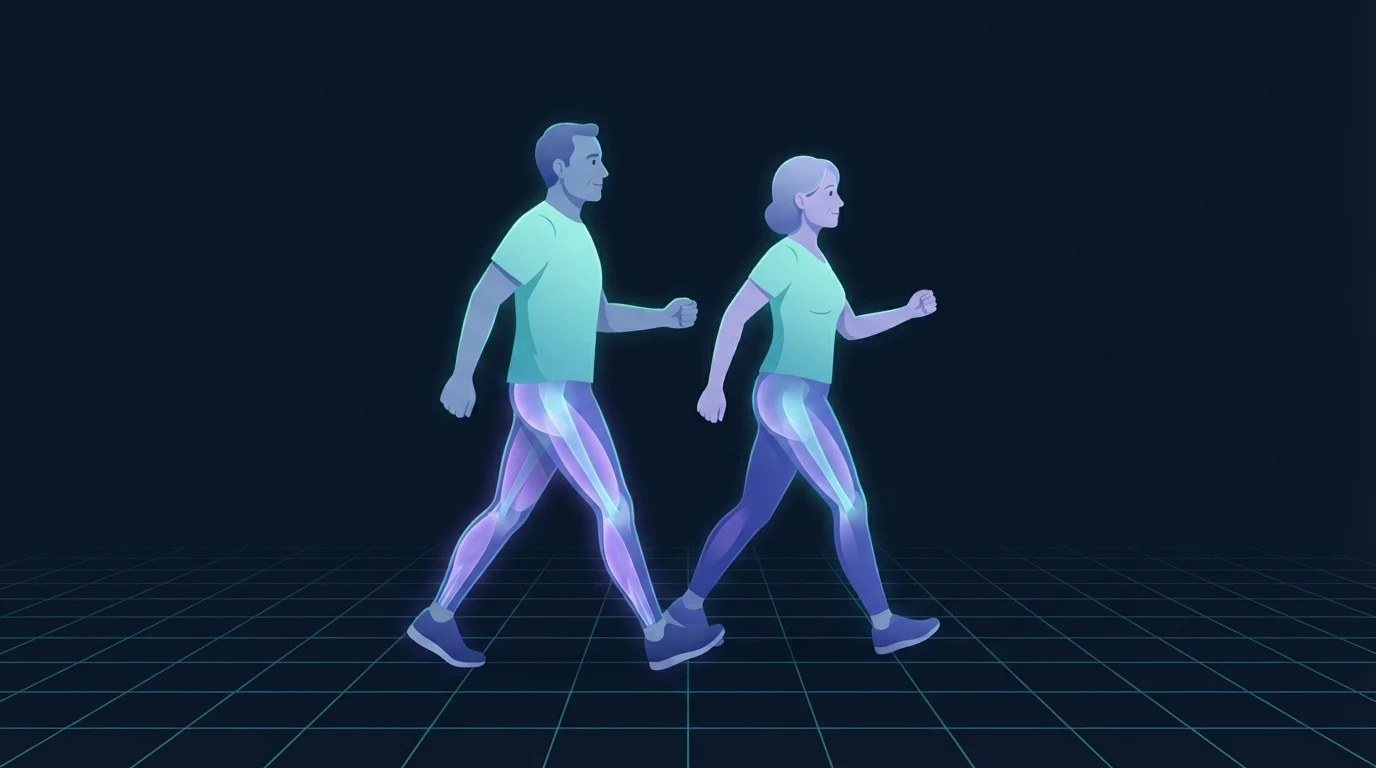
Aim for 6,000 to 8,000 steps on most days. Paluch and colleagues pooled 15 cohorts and 47,471 adults in Lancet Public Health and found mortality risk falling progressively with more steps up to about 6,000 to 8,000 a day in adults aged 60 and over, and 8,000 to 10,000 in adults under 60. Comparing the most active quartile with the least, the hazard ratio was 0.47. The curve flattens after that, so more steps aren't wasted, they're just not buying much.
Walking earns its place in a weight-loss plan for a different reason than a cardio class does. It adds energy expenditure without adding much to the recovery bill, which matters when you're already asking two resistance sessions a week from a body in a deficit. It also loads the hips and spine gently and repeatedly, which is the kind of signal bone responds to. Split it up if that's easier: three ten-minute walks land the same as one thirty-minute walk.
How Fast Should You Actually Lose Weight After 50?
Set the rate at 0.25 to 0.5 percent of body weight per week. For a 85 kg adult that's 200 to 425 grams, or roughly half a pound to one pound. In calories it usually means 250 to 400 below maintenance, not the 1,000 that makes for a dramatic first fortnight.
Younger adults are typically told 0.5 to 1 percent a week, and the evidence for going slower is good even there. After 50 the case is stronger, because the muscle and bone you sacrifice to speed aren't coming back on their own. Our guide on how to lose weight after 40 works through the trial evidence on slow versus fast loss in detail; the short version is that two groups can arrive at the same scale weight with very different amounts of lean tissue.
Judge progress on a weekly average from several morning weigh-ins, never a single day, and give any change three weeks before you act on it. Weight after 50 is noisier than it used to be: medication, salt, sleep, joint swelling and hydration all move it by a kilo in either direction without touching fat.
Sleep, Medications, and When to Involve a Clinician
Sleep is part of the program, not a bonus. Nedeltcheva and colleagues ran the same 14-day calorie restriction on 10 adults twice, once with 8.5 hours of sleep opportunity and once with 5.5. Total weight lost was identical. Fat loss fell by 55 percent and lean-tissue loss rose by 60 percent on the short-sleep arm, with more reported hunger. Sleep after 50 is often genuinely disrupted rather than merely neglected, which makes it worth raising with a clinician rather than pushing through.
Involve your doctor before you start if you take medication for blood pressure, blood sugar, cholesterol or thyroid function, if you're on a GLP-1 medication, if you have osteoporosis or a previous fracture, if you have kidney or liver disease, or if you have chest pain or unusual breathlessness on exertion. Two specific reasons, beyond the general one: blood pressure and diabetes medication doses often need adjusting as weight comes off, and protein targets have to be set individually in kidney disease rather than taken from a guide. Unexplained weight loss you didn't intend is its own reason for an appointment, not a success.
A 12-Week Outline
Two strength sessions a week on non-consecutive days, walking most days, and a deficit that only opens once the habits are in place.
| Weeks | Strength | Walking | Nutrition focus |
|---|---|---|---|
| 1-2 | 2 sessions, 1-2 sets per pattern, bodyweight and chair versions | Current average plus 1,000 steps | Hit the protein target. No deficit yet. |
| 3-4 | 2 sessions, 2 sets, add light dumbbells where movement is clean | 5,000-6,000 steps | Open a 250 kcal deficit. Weigh several mornings a week. |
| 5-6 | 2 sessions, 3 sets, add the carry | 6,000 steps | Hold. Check each meal clears 30 g of protein. |
| 7-8 | 2 or 3 sessions, first meaningful load increases | 7,000 steps | Deficit to 400 kcal only if loss is under 0.2%/week. |
| 9 | Easy week: same sessions, about 60% of the usual load | Hold | Eat at maintenance for the week. |
| 10-12 | 2 or 3 sessions, back to full load, push the top set | 7,000-8,000 steps | Return to the deficit. Reassess at week 12. |
What to Expect
Weeks 1 to 3. Very little on the scale, because there's no deficit yet, and that's deliberate. What does change is that the movements stop feeling awkward and getting out of a low chair gets easier. Some muscle soreness in the first fortnight is normal and settles.
Weeks 4 to 6. The scale starts moving at its real rate, which will look slow. Two to three hundred grams a week is on target. Loads climb faster than the weight falls, which is the signal you want.
Weeks 7 to 9. Two to three kilos down. Clothes change before the mirror does. Stairs and shopping bags feel different, and that functional change usually arrives before any visible one.
Weeks 10 to 12. Three to four kilos down in total, with strength up across every pattern. That combination is the proof that the lost weight was mostly fat. End the block here, hold at maintenance for four to six weeks, then decide whether to run another one.
The Bottom Line
Losing weight after 50 is harder because the old method carried a hidden cost you used to be able to absorb and now can't, not because your body stopped cooperating. Protein at 1.2 to 1.6 g/kg in meals big enough to matter, two resistance sessions a week, 6,000 to 8,000 steps most days, a deficit slow enough to keep the muscle, and sleep treated as part of the plan. That's the whole thing, and it works at 52 and at 72.
If you'd rather have the structure handed to you than assemble it, our roundup of the best fitness apps for people over 50 compares how the main options handle progression, joint-friendly substitutions and the strength side specifically.
Frequently Asked Questions
How much protein should I eat to lose weight after 50?
Between 1.2 and 1.6 grams per kilogram of body weight per day while you're in a deficit, which for a 75 kg adult is roughly 90 to 120 grams. The PROT-AGE study group recommends 1.0 to 1.2 g/kg/day as a baseline for healthy adults over 65 and at least 1.2 g/kg/day for those who are exercising, and a deficit pushes the requirement up rather than down. Split it across three meals of at least 0.4 g/kg each, because older muscle needs a bigger single dose to respond at all. The exception is severe kidney disease, where protein intake has to be set by your clinician.
How fast should you lose weight after 50?
About 0.25 to 0.5 percent of your body weight a week, which is slower than the rate usually recommended to younger adults. That works out to roughly a quarter to half a kilo, or half a pound to one pound, for most people. The reason isn't caution for its own sake. Muscle and bone are both harder to rebuild after 50, so anything you lose during an aggressive deficit is unlikely to come back, and a slower rate combined with resistance training changes what the lost weight is made of.
Does losing weight after 50 weaken your bones?
Dieting alone can. Villareal and colleagues randomized 48 adults with a mean age of 57 to a year of calorie restriction, a year of regular exercise, or a healthy-lifestyle control. Both groups lost similar amounts of weight, but only the calorie-restriction group lost bone: about 2.2 percent at the total hip and 2.2 percent at the spine. The exercise group lost weight and lost no bone density at any site. That's the clearest argument there is for making training a required part of a weight-loss plan after 50 rather than an optional extra.
What is the best exercise for weight loss over 50?
The combination of resistance training and walking beats either one alone. In a trial of 160 obese older adults on a weight-management program, the group doing both aerobic and resistance exercise improved their physical performance score by 21 percent over six months, against 14 percent for aerobic alone and 14 percent for resistance alone. Reductions in muscle and bone were reduced but not eliminated in every group, which is why the diet also has to be modest. Two resistance sessions a week plus 6,000 to 8,000 steps most days is the practical version.
Can you still build muscle after 50 while losing fat?
Yes, though more slowly than at 30. Peterson and colleagues pooled 49 studies covering 1,328 adults aged 50 and older and found an average gain of 1.1 kg of lean body mass from resistance training, with higher-volume programs producing more. Gains were smaller in older participants, not absent. Beginners and people returning after a long layoff see the most, and adding muscle while losing fat is most realistic in that group when protein and training volume are both adequate.
When should I talk to a doctor before starting a weight-loss plan after 50?
Before you start, ideally, and definitely if any of the following apply: you take medication for blood pressure, blood sugar, cholesterol or thyroid function, you're on a GLP-1 medication, you have osteoporosis or a prior fracture, you have chest pain or unusual breathlessness on exertion, you have kidney or liver disease, or you've been losing weight without trying. Several common medications change how your body responds to exercise or to a lower food intake, and doses sometimes need adjusting as weight comes off.