Nothing announced itself. There was no month where you started eating differently. The same routine that held your weight steady through your thirties is still running, and the number has drifted up eight or ten pounds anyway, and the clothes tell the story before the scale does.
Then you try what used to work. More cardio, fewer carbs, the thing your friend did. Two weeks of decent effort produce almost nothing, and the conclusion writes itself: my metabolism is broken now. That belief is doing more damage than the extra weight, because it points you at a problem that mostly isn't there and away from three that are.
Here's what the measurement data actually shows about the body at 45, what moves fat loss at that age, and a twelve-week structure you can run at home with a pair of dumbbells.
What Actually Changes After 40
Four things shift in the decade between 40 and 50. None of them is your resting metabolic rate doing something dramatic.
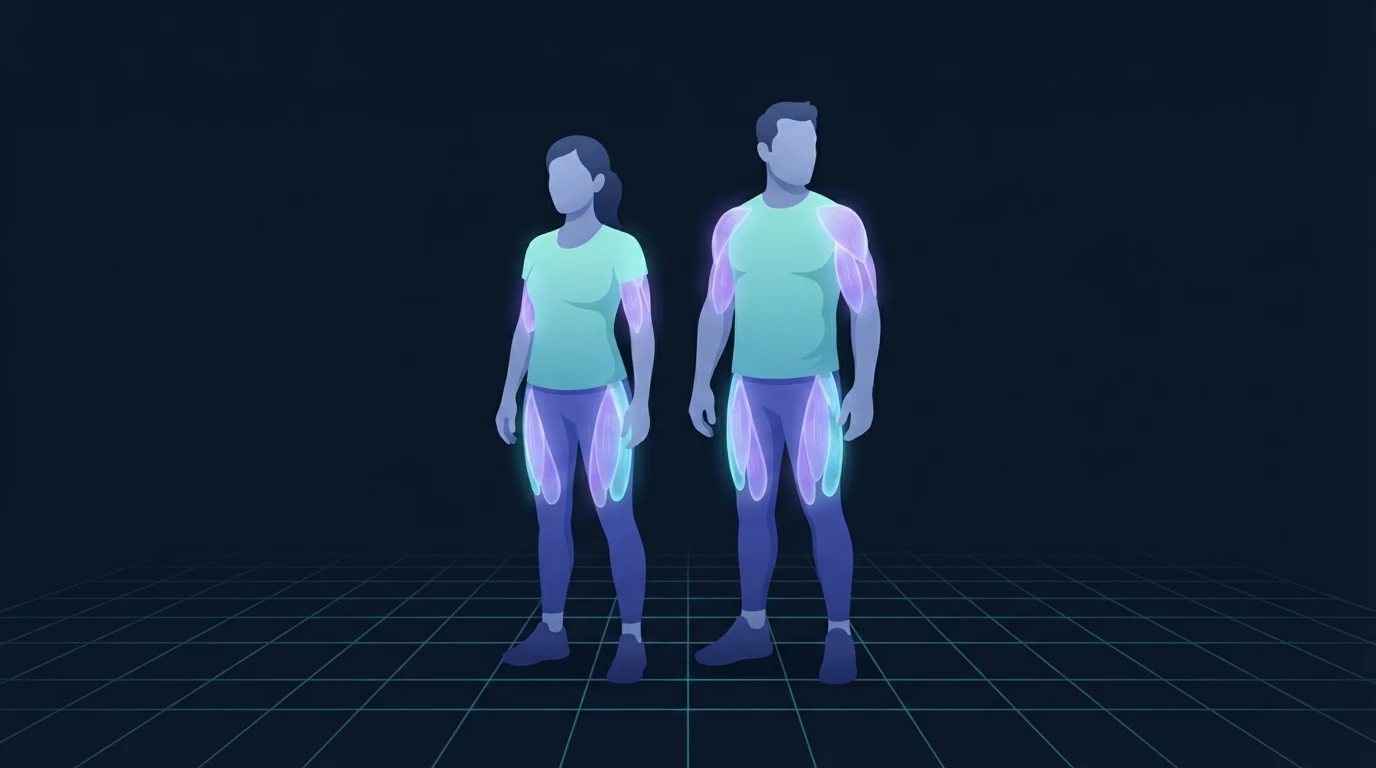
You're losing muscle, slowly and invisibly
This is the big one, and it's the one nobody notices because it happens at a rate of about half a percent a year. A quantitative review by Mitchell and colleagues in Frontiers in Physiology put the median rate of muscle loss across the available studies at 0.47 percent per year in men and 0.37 percent per year in women. That's a rounding error in any given month and roughly five percent of your muscle over a decade.
Strength leaves faster than size does. The same review found that in longitudinal data, strength declines two to five times faster than muscle mass, which is why a 48-year-old can look much the same as at 38 and still struggle with a suitcase. Less muscle also means a slightly smaller engine, a slightly worse day-to-day glucose response, and less of the tissue that makes a calorie deficit produce fat loss instead of shrinkage. The condition this eventually becomes has a name, sarcopenia, and your forties are where the slope starts.
Hormones move, and they move differently by sex
For women, the menopause transition is the single sharpest change in the whole timeline. Greendale and colleagues tracked body composition in 1,246 women in the SWAN cohort and found that fat and lean mass both rose before the transition, then at the start of the transition the rate of fat gain roughly doubled to about 1.7 percent a year while lean mass began declining at about 0.2 percent a year. The shift kept going until roughly two years after the final period, then flattened. If you want the training side of that, our guide on strength training for women over 40 covers the specific program adjustments.
For men the curve is gentler and longer. The Massachusetts Male Aging Study followed 1,156 men for seven to ten years and measured a within-person decline in total testosterone of about 1.6 percent a year, with bioavailable testosterone falling two to three percent a year. One detail from that paper is worth holding onto: men in apparent good health, meaning no chronic illness, no prescription medication, no obesity and no heavy drinking, carried androgen levels 10 to 15 percent higher. Some of the hormonal decline attributed to age is actually attributable to what happened to health in those years.
Your sleep gets worse, and that costs you fat
Sleep in the forties gets shorter, lighter and more interrupted, and the cost lands directly on body composition. Nedeltcheva and colleagues put 10 overweight adults with a mean age of 41 through two identical 14-day calorie-restriction periods, one with 8.5 hours of sleep opportunity and one with 5.5. Total weight lost was the same in both. The composition was not. Fat loss fell by 55 percent, from 1.4 kg to 0.6 kg, and the loss of fat-free mass rose by 60 percent, from 1.5 kg to 2.4 kg. Hunger went up too.
Read that twice, because it reframes the whole project. Short sleep doesn't stop you losing weight. It changes what the weight is made of, and it does that while making the diet harder to hold.
You move less than you think, in ways no app counts
NEAT stands for non-exercise activity thermogenesis: the calories you burn standing, walking to the printer, taking stairs, cooking, fidgeting. It's the most variable component of daily energy expenditure between two people of the same size, and it tends to fall through the forties as jobs get more sedentary and joints get less enthusiastic. In a classic overfeeding study by Levine and colleagues, 16 volunteers were fed 1,000 extra calories a day for eight weeks. Two-thirds of the increase in their total daily energy expenditure came from NEAT, and differences in NEAT alone explained a tenfold spread in how much fat each person actually stored.
Why "My Metabolism Slowed Down" Is Mostly Wrong Before 60
This is the belief worth dismantling, because it's load-bearing for a lot of giving up.
In 2021, Pontzer and colleagues published the largest analysis of human energy expenditure ever assembled in Science: doubly labelled water measurements from 6,421 people across 29 countries, ranging from eight days old to 95 years. Doubly labelled water is the gold standard, measuring every calorie you actually burn over days of ordinary life rather than a treadmill estimate.
The result surprised almost everyone. Once expenditure is adjusted for fat-free mass, it climbs steeply in infancy, declines through childhood, and then sits flat from roughly age 20 to age 60. Not through your thirties and then down. Flat. Pregnancy doesn't move it either. Only after 60 does it begin to fall, and then by about 0.7 percent a year, which is why someone in their nineties needs roughly a quarter fewer calories a day than someone in midlife.
So the engine in a 45-year-old body burns fuel at the same rate per unit of lean tissue as it did at 25. What shrank is the amount of lean tissue and the amount of movement wrapped around it. That's good news dressed as bad news: you can't negotiate with age, but you can add muscle and steps. If you want the deeper version of this argument, our review of what actually boosts metabolism goes through the levers one at a time.
Find out what's really holding you back
FitCraft, our mobile fitness app, pairs you with an AI coach who builds you a personalized plan around your goals, schedule, and fitness level. Every FitCraft program is designed by Domenic Angelino, MPH (Brown University) and NSCA-CSCS, with research published in the Journal of Strength and Conditioning Research and Medicine & Science in Sports & Exercise.
Take the Free Assessment Free • 2 minutes • No credit card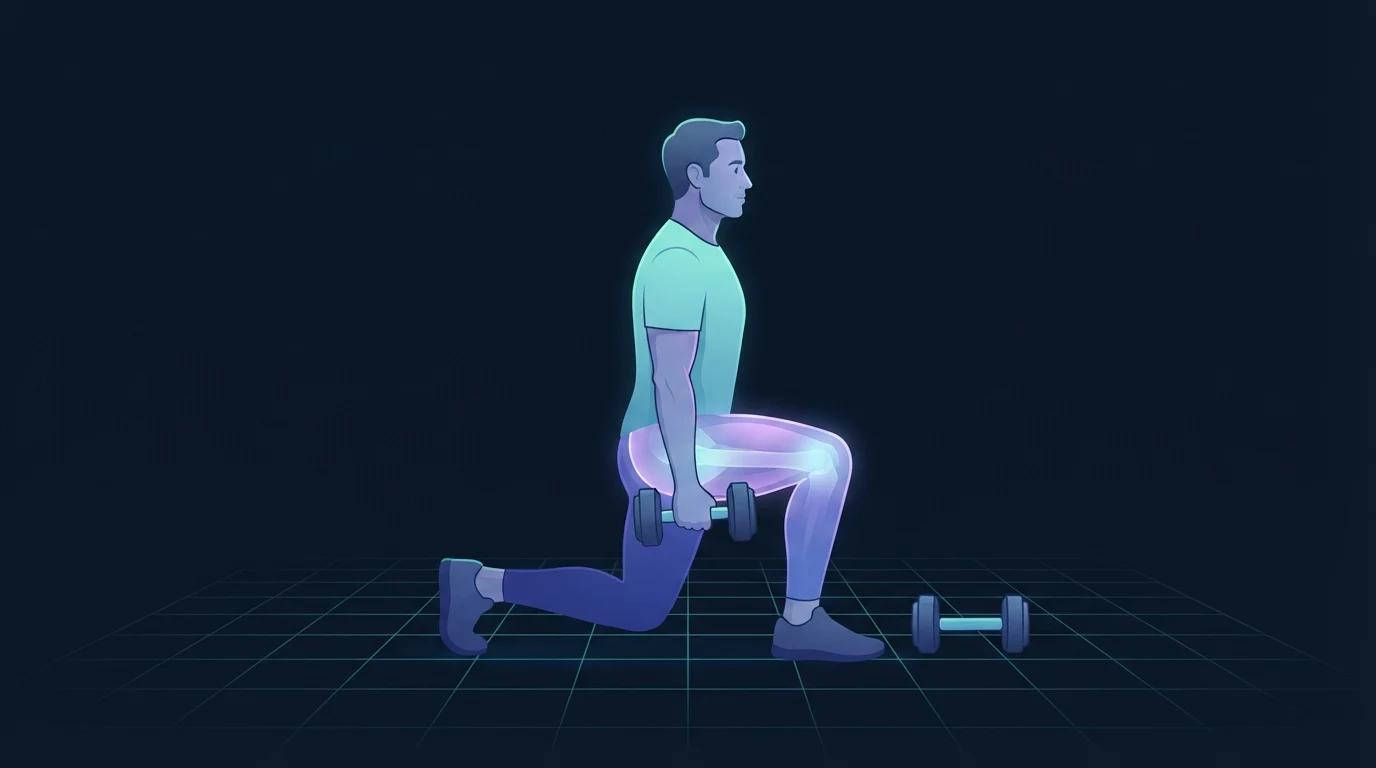
The Plan: Protein, Strength, a Modest Deficit, Sleep
Four levers, in priority order. Walking gets its own section below because it's doing something different from the rest.
1. Protein at roughly 1.6 g per kilogram
For an 80 kg adult that's about 128 grams a day, split across three or four meals of 30 to 40 grams each. The number isn't arbitrary. Morton and colleagues pooled 49 trials and 1,863 participants in the British Journal of Sports Medicine and found that protein supplementation reliably increased fat-free mass and one-rep-max strength during resistance training, and that intakes beyond roughly 1.62 g/kg/day added nothing further. The same meta-regression found the benefit shrank with increasing age, which is an argument for hitting the target rather than hoping you're close.
Distribution matters more after 40 than before it. Three or four solid protein hits beat one enormous dinner, because each meal has to clear a threshold before it stimulates muscle protein synthesis at all. Our review of protein distribution research has the per-meal numbers.
2. Two or three strength sessions a week
This is the lever that decides whether the weight you lose is fat or muscle, and it's the one most people skip because cardio feels more like weight loss. Two full-body sessions a week is the floor. Three is better if the schedule allows. Six patterns cover everything: a squat, a hinge, a push, a pull, a carry and something for the core.
You don't need a barbell or a gym. A pair of adjustable dumbbells and a bench, or dumbbells and a sturdy chair, covers every pattern for years. Our guides on a workout plan for men over 40 and losing fat without losing muscle lay out the session structure in detail. Keep sets in the five to twelve rep range, leave one or two reps in reserve, and add weight or reps whenever a session feels easy. That's progressive overload and it's the whole technical requirement.
3. A deficit slow enough to protect muscle
Target 0.5 to 0.75 percent of your body weight per week. For most people that's half a kilo or about a pound, and it usually means eating 300 to 500 calories a day below maintenance rather than the 1,000 the internet suggests.
The case for going slow is unusually clean. Garthe and colleagues randomized 24 athletes to lose either 0.7 percent or 1.4 percent of body weight a week, with four resistance sessions a week in both groups. Both lost the same total body weight and a similar share of fat. The difference was lean mass: the slow group gained 2.1 percent, the fast group lost 0.2 percent. Same destination on the scale, different body when you get there. After 40, when muscle is already leaking at half a percent a year, that difference compounds.
4. Seven to nine hours of sleep, treated as part of the program
Nedeltcheva's crossover trial is the reason sleep sits in the plan rather than in the lifestyle-tips box. Two weeks of identical calorie restriction produced less than half the fat loss and 60 percent more lean tissue loss when sleep was cut to 5.5 hours. If your week has room for either an extra workout or an extra hour of sleep, and you're currently sleeping six hours, take the sleep.
How Much Walking, and Why Steps Beat Another Cardio Session
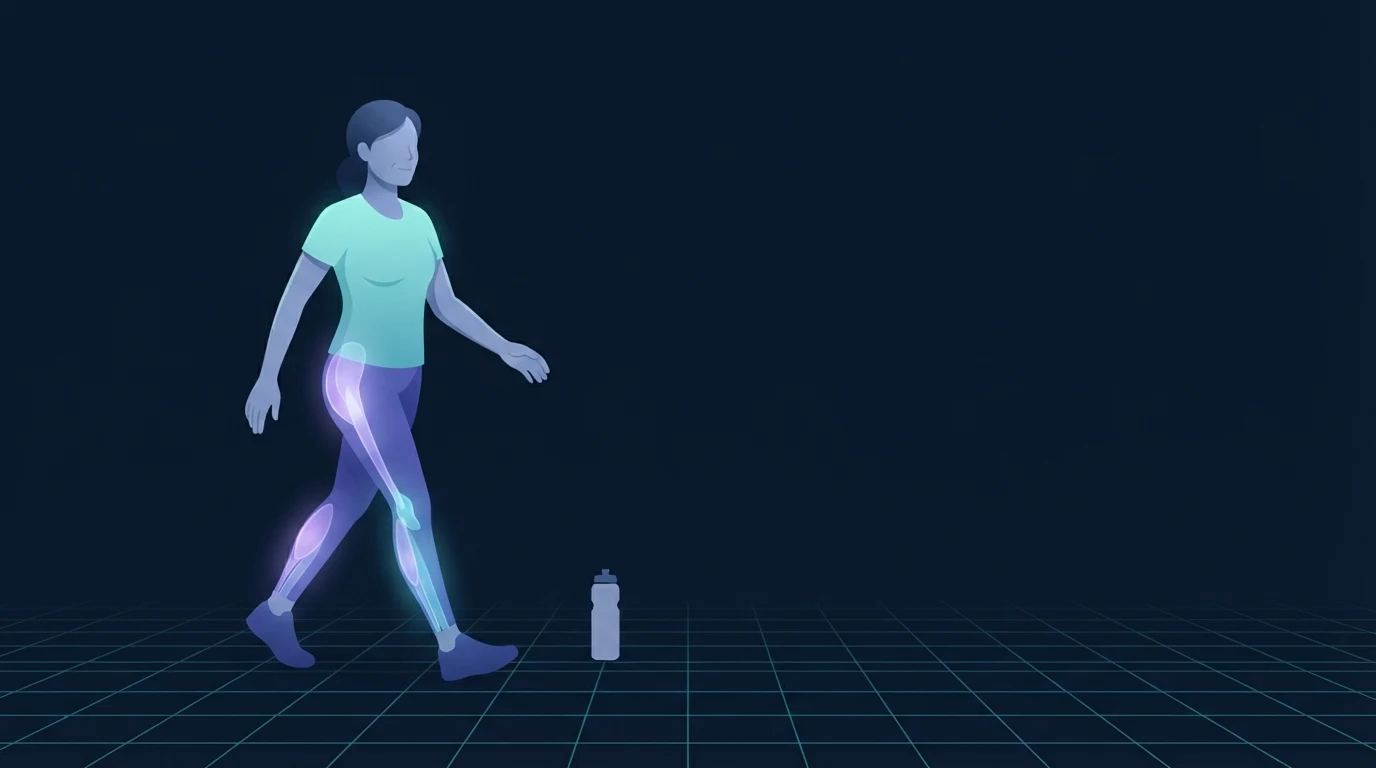
Aim for 7,000 to 10,000 steps on most days. That range comes from mortality data rather than weight-loss data, but it lands in the right place for both. Paluch and colleagues pooled 15 cohorts and 47,471 adults in Lancet Public Health and found risk falling progressively with more steps up to about 8,000 to 10,000 a day in adults under 60, and 6,000 to 8,000 in adults over 60. Compared to the least active quartile, the most active had roughly half the mortality rate.
For fat loss specifically, steps do something a cardio session can't: they rebuild the NEAT that quietly disappeared. A 45-minute spin class three times a week is about 90 minutes of elevated expenditure. Adding 3,000 steps to every single day is a change to the baseline, and baselines are what body weight responds to. It also barely costs recovery, which matters when you're already asking two or three strength sessions of a body that's holding a deficit. Our guide on how many miles to walk a day converts steps to distance and time.
A 12-Week Outline
Three phases. Everything below runs at home with two adjustable dumbbells, and nothing in it requires a gym.
| Weeks | Strength | Steps | Nutrition focus |
|---|---|---|---|
| 1-2 | 2 full-body sessions, 2 sets per pattern, learn the movements | Current average plus 1,000/day | Hit protein target only. No deficit yet. |
| 3-4 | 2 sessions, 3 sets per pattern, add weight where easy | Plus 2,000/day | Open a 300 kcal deficit. Weigh weekly, same conditions. |
| 5-6 | 2 or 3 sessions, 3 sets, first real load increases | 7,000 minimum | Deficit to 400-500 kcal if loss is under 0.4%/week. |
| 7-8 | 3 sessions, add a carry and a single-leg pattern | 8,000 minimum | Hold. Check protein is still landing at 1.6 g/kg. |
| 9 | Deload: same sessions, 60% of the usual load | Hold | Eat at maintenance for the week. |
| 10-12 | 3 sessions, back to full load, push top sets | 8,000-10,000 | Return to the deficit. Reassess at week 12. |
Two rules for the whole block. Weigh yourself under the same conditions several mornings a week and judge the seven-day average, never a single day. And if the weekly average hasn't moved in three consecutive weeks while sleep and steps are on target, cut another 200 calories rather than adding another workout.
What to Expect, Week by Week
Weeks 1 to 2. Scale weight drops two to four pounds and almost none of it is fat. That's water and gut contents responding to the diet change. Strength goes up fast because your nervous system is learning the patterns. Enjoy it, and don't extrapolate from it.
Weeks 3 to 5. The honeymoon ends. Weekly loss settles to its real rate, which will look disappointingly small next to weeks one and two. This is where most people over 40 quit, which is exactly wrong, because it's the first stretch where the number on the scale is telling the truth. The week three motivation dip is predictable enough to plan around.
Weeks 6 to 8. First visible change, usually in the face and around the waistband rather than anywhere you were hoping. Workout loads have climbed noticeably. Sleep quality often improves on its own here, which makes everything else easier.
Weeks 9 to 12. Six to ten pounds down in total, with the lifts still climbing, which is the signal that the lost weight was mostly fat. Clothes fit differently. This is roughly where a 12-week block should end and a maintenance stretch should begin.
What Most People Get Wrong After 40
Cutting too hard, too fast. An aggressive deficit at 45 costs more muscle than the same deficit at 25, because there's less to spare and the rebuilding signal is weaker. Garthe's data is the argument.
Replacing strength with cardio. Cardio is not a substitute for the thing that keeps muscle. If the week collapses to one session, make it a strength session.
Treating protein as optional. Most people over 40 eating in a deficit land somewhere around 0.8 to 1.0 g/kg. That's roughly half of what the trials use, and it's usually the single biggest gap between a plan that works and one that doesn't.
Blaming an age you can't change. Pontzer's data says the metabolic slowdown you're blaming doesn't arrive until 60. That's genuinely good news. It means the target is muscle, movement and sleep, and all three respond to work.
Changing the plan every three weeks. Programs don't fail in your forties because they're the wrong program. They fail because they get abandoned in week four and replaced by a different program that also gets abandoned in week four.
The Bottom Line
The body at 45 burns energy per unit of lean tissue about as well as it did at 25. What changed is that there's less lean tissue, less sleep and less incidental movement wrapped around it, and every one of those is a thing you can put back. Protein at 1.6 g/kg, two or three strength sessions, 7,000 to 10,000 steps, a deficit slow enough to keep the muscle, and seven to nine hours in bed. That's the plan, and twelve weeks of it beats another decade of starting over.
If you'd rather have the structure handed to you than build it, our roundup of the best workout apps for weight loss compares how the main options handle progression, protein tracking and the deficit side. And if you're reading this at 52 rather than 42, the emphasis shifts enough that we wrote it separately: see how to lose weight after 50.
Frequently Asked Questions
Is it harder to lose weight after 40?
It's harder in practice, but not because your metabolism collapsed. Pontzer and colleagues measured total daily energy expenditure in 6,421 people across 29 countries and found that once you adjust for fat-free mass, expenditure holds steady from roughly age 20 to age 60 and only starts falling after that, at about 0.7 percent a year. What changes in your forties is the inputs: less muscle, worse sleep, less incidental movement, and a schedule that makes all three easy to neglect. Those are fixable in a way that age is not.
How much protein do I need to lose weight after 40?
Aim for roughly 1.6 grams per kilogram of body weight per day, spread over three or four meals of 30 to 40 grams each. Morton and colleagues pooled 49 trials and 1,863 participants and found that protein intakes beyond about 1.62 g/kg/day added nothing further to fat-free mass during resistance training, which makes that number a sensible ceiling as well as a target. In a calorie deficit, protein is the single variable that decides how much of the weight you lose is fat rather than muscle.
How fast should you lose weight in your 40s?
About 0.5 to 0.75 percent of your body weight a week, which for most people works out to half a kilo or one pound. Garthe and colleagues randomized 24 athletes to lose 0.7 percent or 1.4 percent of body weight per week alongside four resistance sessions a week: the slower group gained 2.1 percent lean body mass while the faster group lost a little. Same total fat loss, different body at the end. Faster is not better when muscle is already the tissue you're trying to protect.
Does menopause make weight loss impossible?
No, but it changes the slope you're working against. In the SWAN cohort of 1,246 women, the rate of fat gain doubled to about 1.7 percent a year once the menopause transition began, and lean mass declined at roughly 0.2 percent a year, with the shift continuing until about two years after the final period. That's a real headwind, and it's also the strongest argument for adding resistance training and protein rather than adding more cardio.
Is cardio or weights better for losing weight after 40?
Do both, but make resistance training the part you protect when the week gets short. Cardio burns more calories in the session. Resistance training is what keeps the muscle you already have, and muscle is the tissue that's quietly leaving in your forties at roughly 0.4 to 0.5 percent a year. Two or three short strength sessions plus a lot of walking beats five cardio sessions and no lifting for almost everyone over 40.
Why am I gaining weight in my 40s when nothing changed?
Something usually did change, it was just invisible. Non-exercise activity thermogenesis, the calories you burn fidgeting, standing and moving through an ordinary day, varies enormously between people and drifts down as jobs get more sedentary and knees get creakier. In Levine's overfeeding study, differences in that one variable explained a tenfold spread in how much fat 16 people stored on identical surplus calories. A desk promotion can be worth more weight gain than a change in appetite.