- Three strength sessions a week. Roughly 45 minutes each, a full rest day between them. Two is the workable minimum, four is the ceiling for most men over 40.
- Six movement patterns every week. Squat, hinge, push, pull, single leg, and core. Everything else is optional decoration.
- Two to three sets of 8 to 12 reps, stopped two to three reps short of failure. Heavy enough to be hard, controlled enough that your form never breaks down.
- An 8-minute warm-up you actually do. This is the single habit that separates men who train for a decade from men who train for six weeks.
- Add reps before you add weight. Hit the top of the rep range on every set for two sessions in a row, then add the smallest increment you own.
- 1.6 g of protein per kg of body weight per day, and a lighter week every 8 to 12 weeks. Recovery is the variable that changed most after 40, so it gets planned, not improvised.
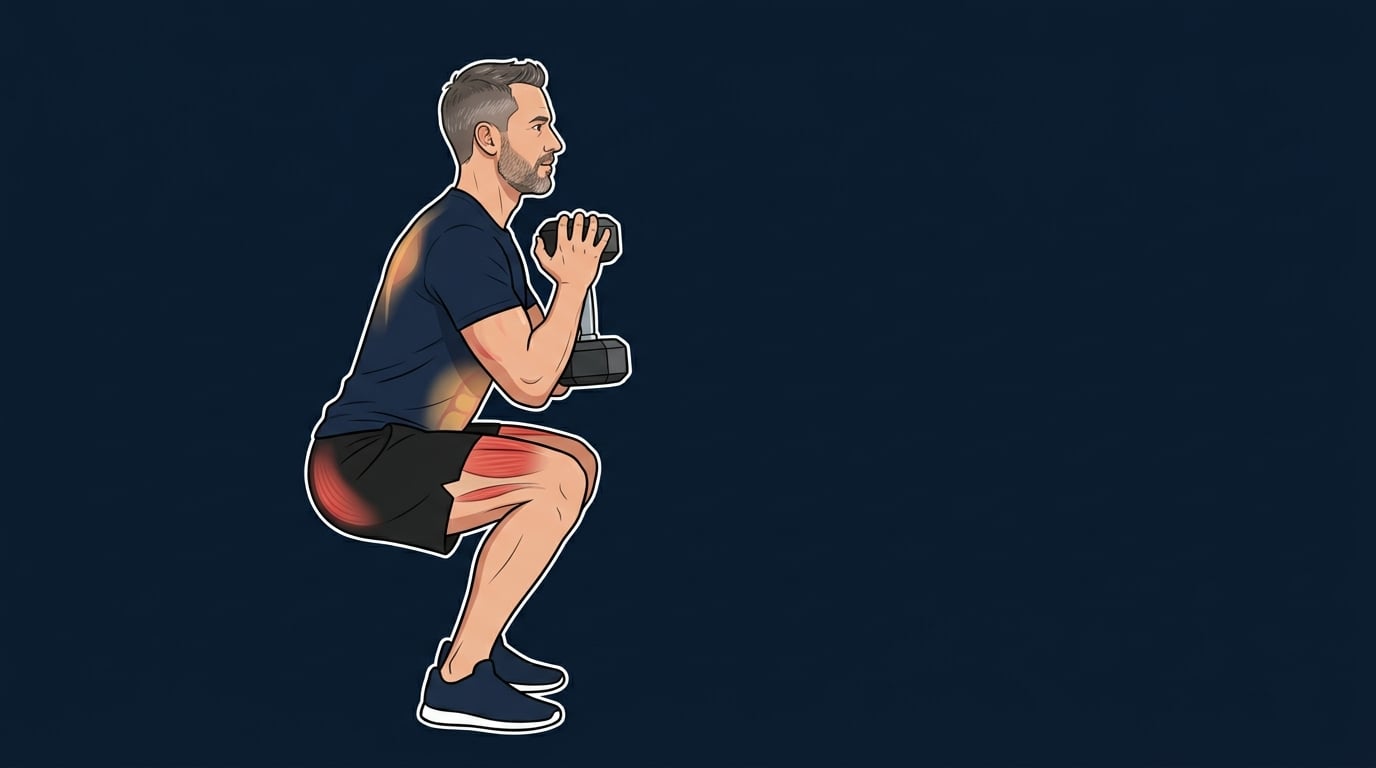
Most workout plans written for men over 40 fall into one of two camps. Either they treat you like you're fragile, prescribing endless light circuits that never make you stronger, or they hand you the same five-day bodybuilding split you failed at when you were 27 and hope this time is different. Neither one accounts for what actually changed.
Here's the honest version. Some things really are different at 45 than at 25. Your recovery window is longer. Your tendons are less forgiving of sudden jumps in load. You lose muscle passively if you do nothing. But the thing that most often ends a training restart at 42 is not any of that. It's week three, when work gets busy, you miss two sessions, and the whole thing quietly stops.
So this guide does two jobs. First, it tells you exactly what the research says changes after 40 and what follows from it. Then it gives you a specific plan: three days, named exercises, sets, reps, and rules for progressing through months one, two, and three. You can run it at home with dumbbells or in a gym with anything you like.
What actually changes after 40
The popular story is that everything falls off a cliff at 40. The longitudinal data says something more useful and considerably less dramatic.
Muscle mass leaks if you leave it alone
Adults lose muscle mass steadily from around the third decade onward if nothing intervenes, a process that accelerates later in life. Volpi, Nazemi, and Fujita (2004) in Current Opinion in Clinical Nutrition and Metabolic Care laid out the pattern that underpins the modern understanding of sarcopenia. The key word is "passively." This is loss by default, not loss by destiny. Resistance training is the intervention that reverses the default.
The decline curve is gentler than the headlines suggest
A 47-year Swedish longitudinal study (Westerstahl et al., 2025) tracked physical capacity in a general population across decades. Right after peak, decline ran roughly 0.3 to 0.6 percent per year. That is invisible at the individual level. You would not feel it. The slope steepens with age, reaching around 2 to 2.5 percent a year by 63, but a 43-year-old is still living in the gentle part of the curve. We broke down the full dataset in our piece on when physical decline actually starts.
Testosterone drifts down about one percent a year
The Baltimore Longitudinal Study of Aging (Harman et al., 2001) followed 890 men and found total testosterone declining by about 0.124 nmol/L per year, with free testosterone falling faster. Roughly 20 percent of men over 60 met hypogonadal criteria on total testosterone, rising to about 30 percent over 70. That's a real trend, but note what it isn't: a cliff at 40. For most men in their forties the change is small enough that training and sleep quality move the needle more than the number does.
Recovery takes longer, and this is the one that bites
Fell and Williams (2008) reviewed the evidence on aging and recovery in the Journal of Aging and Physical Activity and found that older trainees generally take longer to restore function after damaging exercise, particularly after eccentric and high-intensity work. This is why the guy who trains hard four days in a row at 44 feels wrecked by Thursday and quits by Sunday. Not weakness. Arithmetic.
Tendons age differently than muscle
Muscle adapts fast. Tendon does not. Svensson and colleagues (2016) in the Journal of Applied Physiology reviewed tendon aging and found that while tendon size and collagen content stay largely stable, glycation-derived cross-links accumulate substantially and mechanical properties including modulus and strength decline. Practically, that means your muscles will be ready to add weight before your connective tissue is. Most over-40 training injuries live in exactly that gap.
Five principles that follow from the biology
Every design choice in the plan below traces back to one of these.
- Progress joint-friendly, not linear-forever. Because tendon adapts slower than muscle, add reps before load, and add load in the smallest increment available. A 2.5 lb jump you keep is worth more than a 20 lb jump that costs you an elbow.
- Warm up like it counts, because now it does. Eight minutes of general warming, hip and thoracic mobility, and one light ramp set per main lift. At 25 you could skip it. At 45 it's the cheapest injury insurance you can buy.
- Two to four days a week, three is optimal for most. Weekly volume drives results more than frequency does. Schoenfeld, Grgic, and Krieger (2019) pooled 25 studies and found frequency had no significant independent effect on muscle growth once weekly sets were equated. Our page on training frequency research goes deeper.
- Recovery gets scheduled. A full rest day between lifting sessions, a lighter week every 8 to 12 weeks, and seven-plus hours of sleep as a training variable rather than a lifestyle bonus.
- Protein is not optional after 40. The Morton et al. (2018) meta-analysis of 49 studies in the British Journal of Sports Medicine found total daily protein was the strongest dietary driver of resistance-training gains, with benefits plateauing near 1.62 g per kg per day. The PROT-AGE position paper (Bauer et al., 2013) pushes older adults who exercise above 1.2 g per kg as a floor. Our guide to how much protein per day has the practical math.
How much volume do you actually need?
Less than the internet says. A 2025 network meta-analysis of 151 randomized trials covering 6,306 adults over 60 (Radaelli et al.) in Sports Medicine found that even lower-volume programs reliably improved lean mass and muscle size, while higher volumes were needed to maximize strength and walking speed. Translation: two or three hard sets per movement pattern, three times a week, is a real dose. You don't need to train like a bodybuilder to change your body.
Find out what's really holding you back
FitCraft, our mobile fitness app, pairs you with an AI coach who builds you a personalized plan around your goals, schedule, and fitness level. Every FitCraft program is designed by Domenic Angelino, MPH (Brown University) and NSCA-CSCS, with research published in the Journal of Strength and Conditioning Research and Medicine & Science in Sports & Exercise.
Take the Free Assessment Free • 2 minutes • No credit card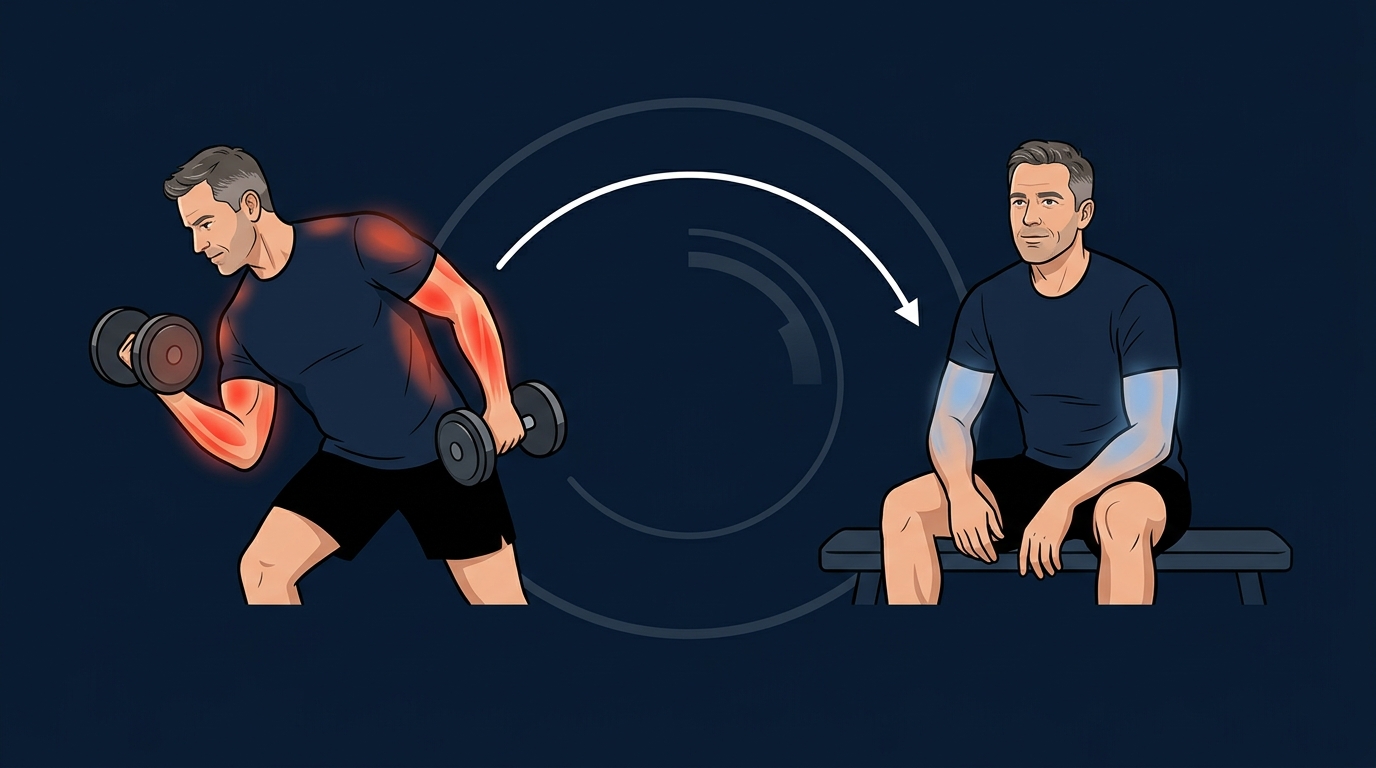
The weekly plan
Three lifting days, two easy movement days, one day you enjoy, one day off. Adjust the calendar to your life. The only fixed rule is a rest day between lifting sessions.
| Day | Session | Time |
|---|---|---|
| Monday | Day A: lower body emphasis | ~45 min |
| Tuesday | Easy walk or bike at conversational pace | 30-45 min |
| Wednesday | Day B: upper body emphasis | ~45 min |
| Thursday | Easy walk or 10 minutes of mobility | 30-45 min |
| Friday | Day C: full body and single leg | ~45 min |
| Saturday | Something you actually like: hike, bike, golf, pickup basketball | Your call |
| Sunday | Rest | Light movement only |
The warm-up (do this before every lifting day)
Eight minutes. Non-negotiable. The injury-prevention evidence is strongest for strength training itself, but a warm-up costs almost nothing and makes the first working set of every lift feel like the third.
- Marching in place or an easy bike, 3 minutes, until you're breathing slightly harder
- Cat cow, 8 slow reps
- Half kneeling hip flexor stretch, 30 seconds per side
- Hip abductor stretch, 30 seconds per side
- Band pull aparts, 15 reps
- One light ramp set of the first exercise of the day, about half your working weight
Day A: lower body emphasis
| Exercise | Sets x reps | Notes |
|---|---|---|
| Goblet squat | 3 x 8-10 | The friendliest squat pattern for most over-40 knees and backs |
| Romanian deadlift | 3 x 8-10 | Hinge at the hips, keep the bar or dumbbells close to your legs |
| Split squat | 2 x 8-10 per side | Hold a rack or doorframe for balance if you need it |
| Glute bridge | 2 x 12-15 | Two-second squeeze at the top |
| Calf raise | 2 x 12-15 | Full range, pause at the bottom |
| Dead bug | 2 x 8 per side | Ribs down, lower back flat on the floor throughout |
Day B: upper body emphasis
| Exercise | Sets x reps | Notes |
|---|---|---|
| Dumbbell chest press | 3 x 8-10 | Neutral or slightly angled grip is kinder to older shoulders |
| Bent-over row | 3 x 8-10 | Swap to a supported row if your lower back complains |
| Incline push-up or push-up | 2 x 6-12 | Pick the version where rep 8 is genuinely hard |
| Dumbbell shoulder press | 2 x 10-12 | Seated with back support if standing bothers your spine |
| Rear delt raise | 2 x 12-15 | Light. This is joint health work, not an ego lift |
| Forearm plank | 2 x 20-40 sec | Squeeze glutes, stop the set when your hips start to sag |
Day C: full body and single leg
| Exercise | Sets x reps | Notes |
|---|---|---|
| Rear lunge | 3 x 8 per side | Stepping back loads the knee less than stepping forward |
| Single leg deadlift | 2 x 8 per side | Light weight, slow tempo. Balance is a trainable skill |
| Supported row | 3 x 10-12 | Pull to the ribs, pause for a beat at the top |
| Good morning | 2 x 10-12 | Very light. This is a hamstring and lower back builder, not a max lift |
| Dead hang | 3 x 20-30 sec | Excellent for grip and shoulder decompression. Feet can stay on the floor |
| Side plank | 2 x 20-30 sec per side | Knees down is a legitimate version |
Every exercise here has a dumbbell version, so the whole plan runs in a spare bedroom with one adjustable pair. If that's your setup, our dumbbell workout app page shows how the same six patterns get programmed for home training. If you own nothing at all, the no-equipment version uses the bodyweight variants of the same list. Want the six patterns laid out for your own equipment and days before you commit? Our free AI workout generator drafts a weekly plan from your goal, days per week, equipment, and session length.
Progression rules for months 1 through 3
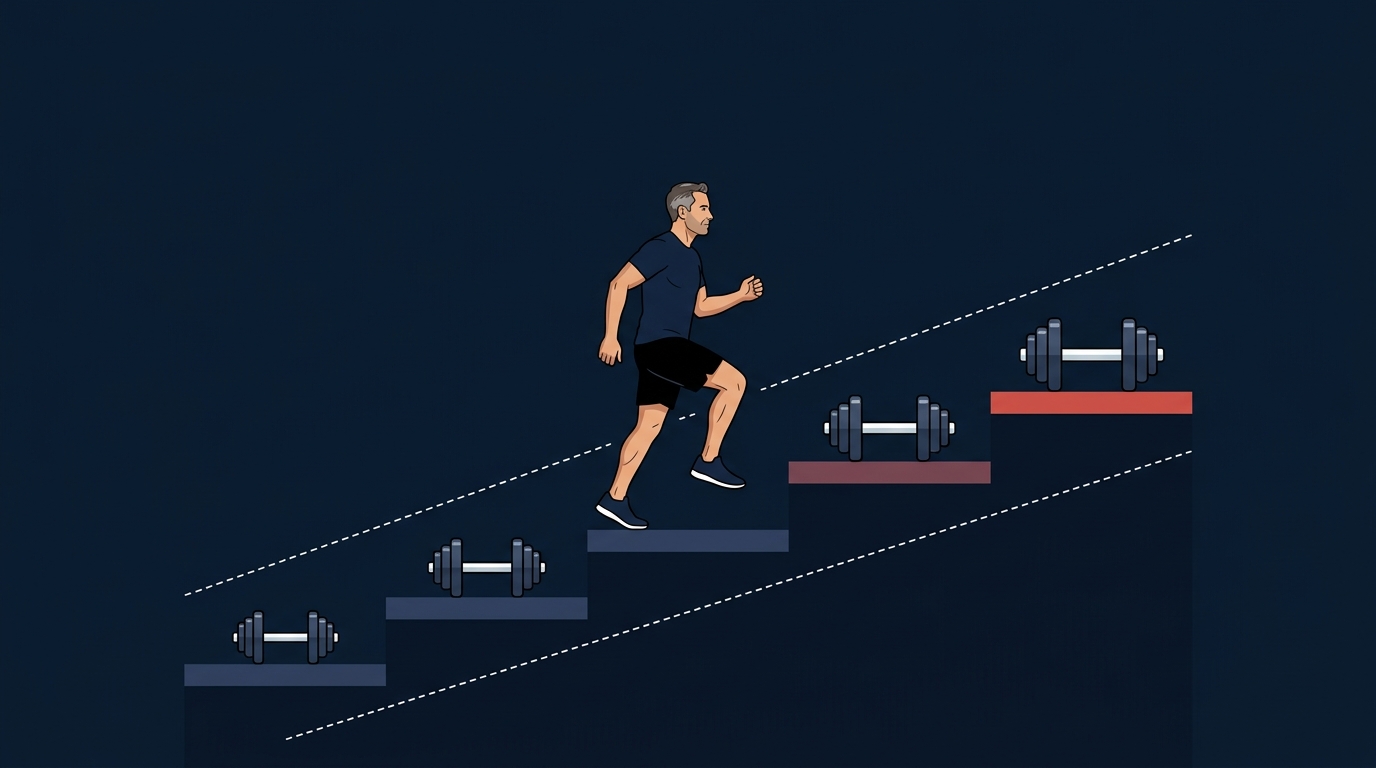
This is where most over-40 plans fail, and it's the part almost nobody writes down. The rule is simple: your muscles will want to progress faster than your tendons can. Let the schedule, not your enthusiasm, decide.
| Phase | Goal | What to do |
|---|---|---|
| Month 1 Weeks 1-4 |
Groove the movements, build the habit | Stop every set 3 to 4 reps short of failure. Keep the weight the same for the whole month if the reps go up. Do not add sets. The goal for month one is twelve completed sessions, not a personal record. |
| Month 2 Weeks 5-8 |
Start adding real load | Move to 2 to 3 reps in reserve. Use double progression: when you hit the top of the rep range on every set for two sessions in a row, add the smallest increment you own and drop back to the bottom of the range. |
| Month 3 Weeks 9-12 |
Push the first lift, protect everything else | Take the first exercise of each day to 1 to 2 reps in reserve. Everything else stays at 2 to 3. Add a third set to one exercise per day if recovery is holding up. |
| Week 12 or 13 | Reset | Take a deload: same exercises, same weights, half the sets. You'll come back stronger and your joints will thank you. Then restart the cycle from month two. |
That gradual approach is just progressive overload applied with a longer time horizon than a 25-year-old needs. If you want the fundamentals, our progressive overload guide for beginners covers the mechanics.
Five mistakes that end over-40 training restarts
1. Training like you're 25
The most common version: a five-day split copied from a bodybuilding site, run at full intensity from day one, abandoned by week three because everything hurts. The volume isn't the problem in the abstract. The problem is that it assumes a recovery capacity you had two decades ago. Three sessions you complete beat five you plan.
2. Confusing pain with discomfort
Muscular burn, general fatigue, and soreness that shows up a day later and fades over two days are normal training signals. Sharp pain, pain located at a joint line, pain that gets worse mid-set, and pain that's still there the next morning are not. The rule that keeps men training into their sixties is swap, don't skip. If barbell back squats hurt your knees, use goblet squats. If flat bench hurts your shoulder, use dumbbells with a neutral grip. Our guide to training around joint pain covers the substitutions in detail.
3. The all-or-nothing restart
This is the big one, and it has nothing to do with your age. You miss Monday because of a work thing, then Wednesday because Monday's session is now "owed," then the week is a write-off and you tell yourself you'll start clean next month. Three months later you start clean again, from zero, having lost the adaptation you'd built.
Look at what the research keeps finding: consistency, not program design, is what separates outcomes. The Swedish longitudinal data found that participants who moved from inactive to active gained 6 to 7 percent in aerobic capacity and around 11 percent in bench press strength, in their forties, fifties, and sixties. Those gains came from becoming a person who trains, not from finding the right split.
That's the honest case for using an app instead of a spreadsheet at this stage of life. Not because an app knows more about exercise science than you can learn in an afternoon, but because the failure point is showing up on a Wednesday in month two. FitCraft was built around exactly that problem: a 3D AI coach who demonstrates the movements on interactive 3D models, structured multi-week programs that adapt as you progress, and gamification (levels, calendar rewards, collectible cards) that gives the boring middle of a training block something to pull against. If that's the part you keep losing, the motivation-focused breakdown explains how the system works. We also ranked the field in our roundup of the best workout apps for men over 40, including where FitCraft is the wrong pick. For the wider field without the age filter, see the best workout apps for men.
4. Skipping the warm-up because it feels like wasted time
Eight minutes is about 3 percent of your weekly training time. It's the highest-return 3 percent you have after 40, largely because of the tendon story above. Cold connective tissue plus an aggressive first working set is the exact recipe that produces a six-week layoff.
5. Training hard and eating like it's still maintenance
Two or three sets of goblet squats won't build anything if your protein intake is 70 g a day at 90 kg. The target is roughly 1.6 g per kg, spread across your meals. Sleep is the other half of that equation, and it's the one men over 40 most often treat as negotiable.
What to expect
Weeks 2 to 4: the weights feel lighter before they look different. That's neural adaptation, and it's real progress. Weeks 6 to 8: your working weights are meaningfully higher and daily things (stairs, luggage, getting off the floor) feel easier. Weeks 8 to 12: visible change in body composition for most men, especially through the shoulders and midsection.
Across 12 to 24 weeks, the trial data is encouraging. Peterson, Sen, and Gordon (2011) pooled resistance-training studies in aging adults and found average lean body mass gains of about 1.1 kg over roughly 20 weeks of supervised training. And Peterson et al. (2010) found that every incremental increase in relative training intensity produced about 5.3 percent more strength gain, which is the evidence-based argument against the "light weights and high reps are safer after 40" advice you'll hear at every gym.
None of that happens in four weeks. All of it happens by month six if you keep showing up.
The bottom line
You're not training around a broken body. You're training around a longer recovery window, slower-adapting tendons, and a default muscle-loss curve that resistance training reverses. Three sessions a week, six movement patterns, small increments, real protein, and a warm-up you don't skip covers all of it.
The plan isn't the hard part. Being the guy who does it on the third Wednesday in November is. Build for that, and the rest takes care of itself.
Frequently Asked Questions
What is the best workout plan for a 40 year old man?
Three full-body resistance sessions per week covering six movement patterns (squat, hinge, push, pull, single leg, and core), each 40 to 50 minutes, with two or three sets per exercise in the 8 to 12 rep range stopped two to three reps short of failure. Add an 8-minute warm-up, two easy cardio sessions, and about 1.6 g of protein per kg of body weight per day. Progress by adding reps before adding weight, and take a lighter week every 8 to 12 weeks. That structure delivers enough weekly volume to build muscle while leaving the recovery margin a 40 year old body actually needs.
How many days a week should a man over 40 work out?
Three strength sessions a week is the sweet spot for most men over 40, with two as a workable minimum and four as a ceiling for anyone with a demanding job or poor sleep. Total weekly volume matters far more than how many days you split it across: the 2019 Schoenfeld meta-analysis pooled 25 studies and found no significant frequency effect on muscle growth once weekly sets were equated. Three days gives you a full rest day between sessions, which matters more after 40 because recovery from hard training slows with age. Easy walking or cycling on the off days is beneficial and doesn't spend your recovery budget.
Can a man over 40 still build muscle?
Yes. Peterson, Sen, and Gordon's 2011 meta-analysis in Medicine and Science in Sports and Exercise found aging adults gained roughly 1.1 kg of lean body mass over about 20 weeks of supervised resistance training. A 2025 network meta-analysis of 151 randomized trials covering 6,306 adults over 60 confirmed reliable gains in lean mass, muscle size, strength, and walking speed, and found that even lower-volume programs drove lean mass gains. It's slower than it was at 22 and it needs a real training stimulus plus adequate protein, but the capacity is intact well into old age.
Should men over 40 lift heavy weights?
Yes, with the caveat that heavy means challenging for you, not heavy in absolute terms. Peterson and colleagues (2010) found that for every incremental increase in training intensity as a percentage of one-rep max, older adults gained about 5.3 percent more relative strength, so training light and endless isn't the safe option people assume. Aim for a load where the last rep of a set of 8 to 12 is genuinely hard but your form stays clean. What to avoid is maximal single-rep attempts and grinding compound lifts to complete failure, which carry most of the injury risk and add little to the muscle-building signal.
How long does it take to get in shape at 40?
Expect neural strength gains in weeks 2 to 4 (the same weights start feeling lighter), visible body composition change around weeks 8 to 12, and meaningful strength increases across 12 to 16 weeks of consistent training. Most resistance-training trials in adults over 40 run 12 to 24 weeks and report lean mass and strength improvements in that window. What decides your result is how many of the scheduled sessions you actually complete over three months.
What exercises should men over 40 avoid?
Very few exercises are off limits by age alone, but four categories deserve caution: maximal one-rep attempts on compound lifts, behind-the-neck pressing and pulldowns, high-volume plyometrics started without a base, and any movement that produces sharp joint-line pain. Upright rows and deep dips bother a lot of older shoulders and are easy to substitute. The better rule is swap rather than skip. If barbell back squats hurt your knees, use goblet squats or split squats. If flat barbell bench press hurts your shoulder, use dumbbells with a neutral grip. The movement pattern matters, the specific implement rarely does.
References
- Harman SM, Metter EJ, Tobin JD, Pearson J, Blackman MR. "Longitudinal effects of aging on serum total and free testosterone levels in healthy men. Baltimore Longitudinal Study of Aging." Journal of Clinical Endocrinology and Metabolism. 2001;86(2):724-731. DOI: 10.1210/jcem.86.2.7219
- Westerstahl M, Jornaker G, Jansson E, et al. "Rise and Fall of Physical Capacity in a General Population: A 47-Year Longitudinal Study." Journal of Cachexia, Sarcopenia and Muscle. 2025. DOI: 10.1002/jcsm.70134
- Volpi E, Nazemi R, Fujita S. "Muscle tissue changes with aging." Current Opinion in Clinical Nutrition and Metabolic Care. 2004;7(4):405-410. DOI: 10.1097/01.mco.0000134362.76653.b2
- Fell J, Williams D. "The effect of aging on skeletal-muscle recovery from exercise: possible implications for aging athletes." Journal of Aging and Physical Activity. 2008;16(1):97-115. DOI: 10.1123/japa.16.1.97
- Svensson RB, Heinemeier KM, Couppe C, Kjaer M, Magnusson SP. "Effect of aging and exercise on the tendon." Journal of Applied Physiology. 2016;121(6):1353-1362. DOI: 10.1152/japplphysiol.00328.2016
- Peterson MD, Sen A, Gordon PM. "Influence of resistance exercise on lean body mass in aging adults: a meta-analysis." Medicine and Science in Sports and Exercise. 2011;43(2):249-258. DOI: 10.1249/MSS.0b013e3181eb6265
- Peterson MD, Rhea MR, Sen A, Gordon PM. "Resistance exercise for muscular strength in older adults: a meta-analysis." Ageing Research Reviews. 2010;9(3):226-237. DOI: 10.1016/j.arr.2010.03.004
- Radaelli R, Rech A, Molinari T, et al. "Effects of Resistance Training Volume on Physical Function, Lean Body Mass and Lower-Body Muscle Hypertrophy and Strength in Older Adults: A Systematic Review and Network Meta-analysis of 151 Randomised Trials." Sports Medicine. 2025;55(1):167-192. DOI: 10.1007/s40279-024-02123-z
- Schoenfeld BJ, Grgic J, Krieger J. "How many times per week should a muscle be trained to maximize muscle hypertrophy?" Journal of Sports Sciences. 2019;37(11):1286-1295. DOI: 10.1080/02640414.2018.1555906
- Morton RW, Murphy KT, McKellar SR, et al. "A systematic review, meta-analysis and meta-regression of the effect of protein supplementation on resistance training-induced gains in muscle mass and strength in healthy adults." British Journal of Sports Medicine. 2018;52(6):376-384. DOI: 10.1136/bjsports-2017-097608
- Bauer J, Biolo G, Cederholm T, et al. "Evidence-based recommendations for optimal dietary protein intake in older people: a position paper from the PROT-AGE Study Group." Journal of the American Medical Directors Association. 2013;14(8):542-559. DOI: 10.1016/j.jamda.2013.05.021
- Lauersen JB, Andersen TE, Andersen LB. "Strength training as superior, dose-dependent and safe prevention of acute and overuse sports injuries." British Journal of Sports Medicine. 2018;52(24):1557-1563. DOI: 10.1136/bjsports-2018-099078
- Currier BS, D'Souza AC, Fiatarone Singh MA, et al. "American College of Sports Medicine Position Stand. Resistance Training Prescription for Muscle Function, Hypertrophy, and Physical Performance in Healthy Adults." Medicine and Science in Sports and Exercise. 2026;58(4):851-872. DOI: 10.1249/MSS.0000000000003897