Quick comparison
| App | Best for | Built around | What is free | The honest catch |
|---|---|---|---|---|
| FitCraft | Men who have started before and quit | AI coach plus gamified multi-week programs | Free version available | It's a coach, not a barbell logbook |
| Fitbod | Gym lifting when you want the plan handed to you | Algorithmic programming that tracks muscle fatigue | A few sample workouts only | It assumes the habit already exists |
| Hevy | Logging sessions you already know how to run | Fast manual tracking, charts, and a social feed | Strong free tier with capped routines and history | It records. It won't tell you what to do |
| Nike Training Club | Trainer-led variety at zero cost | A library of video sessions from Nike trainers | Everything, with nothing locked | No personalization and no progression system |
| Freeletics | Bodyweight and high-intensity work at home | Adaptive plans built for no equipment | A handful of sessions; the coach is paid | Intensity-first by design, which not every body wants |
| Caliber | Free structured strength training | Evidence-based plans plus optional human coaching | Full free tier, no ads, no time limit | Nothing pushes you on a bad week |
| Future | One-on-one human coaching | A real certified coach who adjusts your week | Nothing. Paid only | The biggest commitment on this page |
Position 7 isn't a verdict on quality. The order reflects how many men each app fits, and Future fits fewer men only because it asks for the most up front.
What the research actually says about men and fitness programs
Two findings should shape how you read the rest of this page.
The first is that men have been an afterthought in this field for a long time. Pagoto et al. (2012) reviewed 244 randomized controlled trials of lifestyle weight loss programs covering more than 95,000 participants and found the samples averaged 27 percent male. Only 5 percent of those studies recruited men exclusively, against 32 percent that recruited only women. A lot of the advice aimed at men was never tested on men.
The second finding is more useful. The ROMEO project, a systematic review of men-only trials by Robertson et al. (2017), found that retention across those programs averaged 78 percent, and hit 89 percent in a program run through football clubs. Their conclusion was blunt: getting men to start is the hard part, and once they are genuinely engaged they commit. The review also found men respond to simple, fact-based framing, individual feedback, and personal goal-setting rather than generic plans.
So the real question is whether the app you pick is designed to get you engaged in the first place, or whether it just hands you a library and hopes. That distinction runs through every ranking below.
How we evaluated
Five criteria, in the order they actually matter:
- Does it decide for you? Some apps program your session. Others record it. Both are useful, and confusing the two is the most common bad purchase in this category.
- Goal fit. Building muscle, losing fat, and simply not quitting are three different jobs, and almost no app is best at all three.
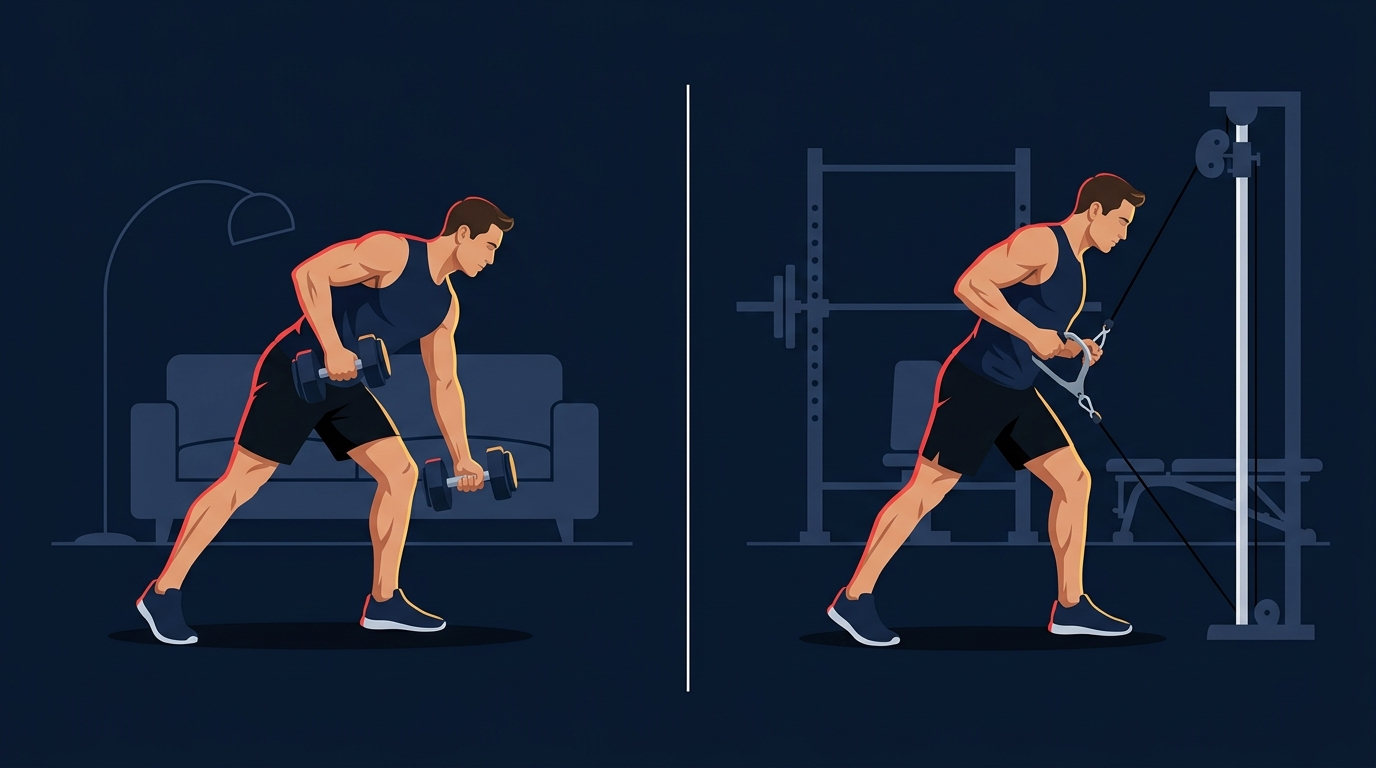
- Home or gym. An app built for a commercial gym is dead weight in a living room, and the reverse is also true.
- What you actually get free. Described as structure, not numbers, because prices move.
- Restart cost. What happens after a week off for work travel or a sick kid. Apps that punish lapses lose men fast.
Feature claims were checked against each app's own current listing and recent independent reviews in August 2026. We haven't run every app for a full year, and we're not going to pretend otherwise.
Full disclosure: FitCraft is our app. We built it for people who struggle to stay consistent, and we've genuinely evaluated every other option here. Several of them win their categories outright, and we say so.
FitCraft Studios publishes this site and makes FitCraft; the ranking on this page reflects the criteria above, and the fairest way to judge any of these apps, ours included, is to run their free trials yourself.
The rankings
1. FitCraft: best overall for men who have quit before
Most men do not fail at training. They fail at week four, when the novelty is gone and the calendar wins. FitCraft is aimed at that exact moment. Your sessions are led by an AI coach, a 3D character who talks you through the workout, demonstrates every exercise on an interactive 3D model you can pinch, rotate, and zoom, and motivates you by name. That 3D demo layer is also how the app teaches technique, which matters if nobody has ever shown you how to hinge or press properly. Programs run multiple weeks and cover strength with dumbbells, barbells, bands, or bodyweight, plus mobility, yoga, and cardio. Workouts adapt as your progress advances, and a layer of XP, levels, collectible cards, and calendar rewards gives you a reason to open the app on the days motivation is absent. There's a free version, on iOS and Android.
The behavioral case here isn't marketing. A 2022 meta-analysis of 16 randomized controlled trials by Mazeas et al. found gamified interventions produced a small-to-medium improvement in physical activity across 2,407 participants (Hedges' g = 0.42), rising to g = 0.58 against inactive controls, with gamified participants averaging 1,421 more steps per day. In the BE FIT trial (Patel et al., 2017), gamified participants hit their step goal on 53 percent of days against 32 percent for controls. Our breakdown of the gamification research goes through the mechanisms in detail.
The honest catch: FitCraft is a coach, not a lift tracker. If what you want is a spreadsheet-style logbook with personal record charts for a barbell progression, a dedicated tracker will serve that better. Nobody reviews your form on video either.
2. Fitbod: best for gym lifting when you want the plan handed to you
If you train in a commercial gym and want the machines, cables, and dumbbells organized into a coherent session, Fitbod is the strongest algorithmic lifter here. It tracks how fatigued each muscle group is from your recent training and steers volume toward the recovered ones, then picks exercises and prescribes sets, reps, and load. A library of more than 1,600 movements means a joint-hostile exercise always has a substitute, and equipment profiles flip between full gym, home setup, and hotel room. Warm-ups, mobility, and stretching work are built in rather than bolted on.
The honest catch: beyond a few sample workouts, Fitbod is paid only, and it does nothing to get you through the door. It assumes the habit exists and optimizes from there. If your problem is showing up rather than programming, you'll pay for a very good plan you don't follow.
3. Hevy: best free logger for men who already know their program
If you have a program you trust and you just want to record it, Hevy is the cleanest logbook in the category. Entering a set takes two taps, the progress charts are genuinely good, and the free tier includes unlimited workout logging with no ads. Its exercise library runs past 900 movements with video references, it syncs across phone, web, and watch, and the social feed has built a real community of lifters who follow each other's sessions. Fitness subreddits recommend it constantly, and that word of mouth is earned.
The honest catch: the free tier caps how many routines you can save and how far back your graph history goes, so heavier users hit a wall. More importantly, Hevy is a notebook. It will faithfully record a bad program forever without ever suggesting a better one.
See what FitCraft would build for you
FitCraft, our mobile fitness app, pairs you with an AI coach who builds you a personalized plan around your goals, schedule, and fitness level. Every FitCraft program is designed by Domenic Angelino, MPH (Brown University) and NSCA-CSCS, with research published in the Journal of Strength and Conditioning Research and Medicine & Science in Sports & Exercise.
Take the Free Assessment Free • 2 minutes • No credit card4. Nike Training Club: best fully free trainer-led library
Nike dropped the paywall on Nike Training Club years ago and never put it back. Everything is free: hundreds of trainer-led sessions across strength, bodyweight, HIIT, yoga, and mobility, filmed to Nike's production standard and taught by Nike Master Trainers. Multi-week plans give the library some structure, Apple Watch support is solid, and there's no account friction or upsell once you are inside. For a man who owns nothing but a floor and wants a competent workout in the next fifteen minutes, it is genuinely hard to beat.
The honest catch: nothing here is personalized to you, and nothing tracks whether you came back. The plans are pre-made and static, there's no progression system, and nothing notices you've vanished. Free solves the access problem. It doesn't solve the week-four problem.
5. Freeletics: best for bodyweight and high-intensity training at home
The whole identity of Freeletics is training hard with nothing. Its AI coach builds adaptive plans that respond to your performance and feedback, the exercise library runs past 700 movements with high-quality tutorial video shot from several angles, and roughly 60 percent of its users train bodyweight-only. Barbell, dumbbell, and gym variants exist, and a nutrition add-on sits alongside the training. Badges, streaks, and skill levels supply a light layer of gamification.
The honest catch: Freeletics is intensity-first. That's a feature if hard sessions are what motivate you, and a problem if your history is starting too hot and burning out by week three. The free tier is a small sample and the coach itself is paid.
6. Caliber: best free structured strength training
Caliber gives away more real strength training than anyone else on this page. The free tier includes a workout builder, unlimited logging, hundreds of exercises with video instruction, and progress tracking, with no ads and no expiry. Its programming philosophy leans on controlled tempo and sensible progressive overload rather than max-out bravado. If you later decide you want a person involved, group and one-on-one coaching sit on top of the same app.
The honest catch: on the free tier nobody adjusts anything for you and nothing chases you. Caliber hands you excellent tools and waits. Whether you open it on a wet Tuesday in February is entirely your problem.
7. Future: best one-on-one human coaching
Sometimes the right answer is a person. Future pairs you with a real certified coach who builds your program, adjusts it week to week, and messages you when you go quiet. For a man with an old shoulder, a travel schedule, and a history of ignoring apps, that human judgment beats any algorithm at working around real life. The experience is built around the Apple Watch, which your coach uses to confirm you actually trained.
The honest catch: Future is paid only with no free tier, and it's the largest financial commitment on this page. You're paying for a person, and it costs like one.
Match the app to your goal
If you want to build muscle
Fitbod is the strongest gym pick because it chooses the exercises and prescribes the load, and Caliber is the best free version of that job. Hevy works if you already have a program worth logging. Whichever you pick, the variable that actually decides the outcome is months of consistent, progressively harder training, not the app icon. Iversen et al. (2021) found that as few as four hard sets per muscle group per week can drive meaningful strength and size gains, and that supersets can roughly halve session time. Three short, well-built sessions a week beat the sporadic ninety-minute efforts of your twenties. Our guide to building muscle with a fitness app covers what that looks like week to week, and if you train with a rack of dumbbells at home, see how FitCraft builds a dumbbell program that keeps progressing.
If you want to lose weight
No app on this page will out-train your kitchen, and any that claims otherwise is selling. What training does during fat loss is protect the muscle you already have and keep you in the habit long enough for the diet to matter. That argues for whichever app you will do consistently, plus enough resistance work to hold on to lean mass. Nike Training Club and Freeletics are the low-friction home options, and FitCraft is the pick if your history is losing interest before the scale moves. The men-only trials reviewed by Robertson and colleagues reached the same practical conclusion: a reducing diet plus an activity program plus behavior change beats any single lever.
If you just want to stop quitting
This is the honest answer for most men reading this, and it's a different problem from programming. The STEP UP trial (Patel et al., 2019) ran 602 overweight and sedentary adults across 40 states through gamified interventions and found meaningful increases in physical activity that persisted into follow-up. FitCraft is built on that literature, which is why it's our top pick here rather than the better lifting tools above. If you want the diagnosis before the prescription, why you quit working out covers the actual mechanics, and a workout app that keeps you motivated explains how FitCraft applies them.
If you train at home versus in a gym
Home with no equipment: Nike Training Club, Freeletics, and FitCraft all work in a bare room, and FitCraft's no-equipment programs are built for exactly that constraint. Home with dumbbells or bands: FitCraft and Caliber both program around what you own. Commercial gym: Fitbod first, Hevy if you already have a plan, Caliber as the free option. Our home workout guide and the no-equipment app roundup go deeper on the home side.
Free versus paid: what you actually get without paying
Search volume for free workout apps is enormous and the honest answer is nuanced, so here is the structure without the marketing.
- Free and genuinely complete: Nike Training Club. The whole library, no upgrade path, no catch. Caliber is close behind, with unlimited logging, hundreds of exercises, and no ads on its free tier.
- Free tier worth using: Hevy, if you accept caps on saved routines and graph history. FitCraft has a free version if you want coaching rather than a library.
- Free is really a demo: Fitbod gives you a few sample sessions. Freeletics gives you a handful of workouts, with the AI coach behind a paid upgrade.
- Paid only: Future. You are buying a coach's time, so there's no free version and there was never going to be.
Here is the part the "best free app" lists skip. Free is excellent at solving access, and access hasn't been the bottleneck since roughly 2012. YouTube has millions of free workouts. What free libraries almost never include is a mechanism that notices you stopped and does something about it. If you have already downloaded three free apps and abandoned all three, a fourth free library isn't the missing piece. We wrote about that trade-off in free versus paid fitness apps, and the best free workout apps roundup ranks the free field on its own terms.
If you are over 40 or over 50
Training age changes the scoring. Recovery slows, joints get opinions, and session length starts competing with a mortgage and a commute. We rank the same category through that lens in best workout apps for men over 40, which weighs joint impact and recovery-aware programming heavily, and in best fitness apps for over 50, which adds balance and bone loading. If you're 35 and healthy, this page is the right one. If your knees have started filing complaints, start with those.
The bottom line
The Verdict
Pick by your failure mode, not by feature count. If your pattern is enthusiastic starts and quiet disappearances, FitCraft was built for that exact shape of problem, and the gamification research behind it is real rather than decorative. If you already train consistently and want a smarter gym session, Fitbod is the better tool and we'd be lying to say otherwise. If you know your program and want a fast free logbook, Hevy wins.
On zero budget, Nike Training Club gives you the most complete free library on the market, and Caliber gives you the most complete free strength system. If you want a human being accountable for your training, pay for Future and stop reading app rankings.
One last thing worth saying plainly. The ROMEO review found that once men actually engage with a program, roughly four in five stay with it. The gap between men who train and men who mean to train is not discipline. It is whether anything in the system is designed to bring you back tomorrow. Choose accordingly, and if the AI coaching approach is what interests you, see how FitCraft's AI personal trainer works.
Frequently Asked Questions
What is the best workout app for men?
There's no single answer, because the right app depends on your failure point rather than your goal. If you keep quitting around week three, FitCraft is built for that specific problem: an AI coach runs the session, every movement is taught on an interactive 3D model, and the gamified programs give you a reason to open the app on a bad day. If you already train consistently in a gym and just want smarter programming, Fitbod plans better sessions. If you know your program and only need a logbook, Hevy does that job for free.
What is the best free workout app for men?
Nike Training Club is the most generous, with its entire library of trainer-led sessions available at no cost and nothing locked behind an upgrade. Caliber is the best free option for structured strength training, with unlimited workout logging, hundreds of exercises with video instruction, and no ads. Hevy has a strong free tier for tracking gym sessions, though it caps how many saved routines and how much graph history you keep. FitCraft also has a free version if you want coaching rather than a library.
Which workout app is best for building muscle?
For gym-based muscle building, Fitbod is the strongest pick because it selects exercises around recovered muscle groups and prescribes the sets, reps, and load for you. Caliber is the best free alternative for the same job. What matters more than the app is that whichever one you choose applies progressive overload and that you keep training for months rather than weeks, since research on time-efficient training shows even a handful of hard sets per muscle group each week drives meaningful gains (Iversen et al., 2021).
Do I need a gym to use these apps?
No. Nike Training Club, Freeletics, and FitCraft all work with no equipment at all, and FitCraft also builds programs around dumbbells, bands, or a barbell if you have them. Fitbod and Hevy assume access to gym equipment and are a poor fit for a bare living room. Decide where you'll realistically train on a Tuesday in November, then pick from the apps that fit that room.
Why do men quit workout apps so often?
Most workout apps solve access rather than adherence. They hand you a library and assume motivation will carry you, which it does for about three weeks. Research on men-only weight loss and activity programs found that once men are genuinely engaged they stick with it, with average retention around 78 percent, so the hard part is designing something a man will actually keep opening (Robertson et al., 2017). Gamified interventions are one of the few approaches shown in randomized trials to move that number.