Somewhere in your forties the rules change without telling you. The weekly walk that used to keep everything in line stops keeping anything in line. Your arms look different in photos. A suitcase into an overhead bin is suddenly a decision rather than a reflex. Nothing has gone wrong on any single day, and yet the trend line is obvious once you look at it.
The part nobody warns you about is how personal it feels. Women in this decade have usually spent twenty years being told that cardio is the answer and that lifting is for someone else, and when that stops working the conclusion sounds like a verdict on you. It isn't. It's a mismatch between the training you were sold and the biology you now have.
Here's the reframe: this isn't a discipline problem and it isn't an age problem. It's a stimulus problem. Two tissues that used to maintain themselves for free now need a reason to stay, and there's exactly one signal that gives them one. Everything below is about how to send it, at home, in about two and a half hours a week.
What Actually Changes for Women After 40
Three things move at once in this decade, and they interact. Understanding which is which is what tells you where to spend your training time.
Muscle starts leaving on its own
After about age 30, adults lose muscle mass steadily unless something intervenes, and the rate accelerates with each decade (Volpi et al., 2004). The technical name for the advanced version of that decline is sarcopenia, and it doesn't begin at 70. It begins quietly in midlife.
For women there's a second layer. A Finnish follow-up study tracked 234 women from perimenopause through to early postmenopause and measured body composition with DXA and CT scans plus muscle biopsies. Lean body mass, appendicular lean mass, leg lean mass and thigh muscle cross-sectional area all dropped significantly, and menopausal status was a significant predictor for every muscle measure they tested (Juppi et al., 2020). Physical activity was the other significant contributor, which is the part that matters here: it was the one variable in the model anyone could actually change.
Bone loss clusters instead of spreading out
This is the finding that reframes the whole decade. The Study of Women's Health Across the Nation followed 862 women of African American, white, Chinese and Japanese ancestry through their final menstrual period. Bone loss began roughly one year before that date and slowed but didn't stop two years after it. Across the full ten-year window, lumbar spine bone mineral density fell 10.6 percent, and 7.38 percent of that total was lost inside the three-year transmenopause window alone (Greendale et al., 2011). Femoral neck loss ran 9.1 percent across ten years, with 5.8 percent inside the same window.
Read that again, because it changes the planning. Most of a decade's bone loss happens in about three years, and those three years arrive in your late forties or early fifties for most women. Training built before and during that window is worth more than the same training built after it.
Perimenopause makes everything feel less predictable
Sleep fragments. Recovery from a hard session that used to take a day takes two. Joints ache in places that were never on the list. Body composition shifts toward the middle even when the scale barely moves. None of that is imagined, and none of it means training stops working. It means the plan has to tolerate weeks that are worse than the last one. Our guide to training through perimenopause goes deeper on the symptom side, and the research review on the musculoskeletal syndrome of menopause covers the joint and tendon changes specifically.
Why Strength Training Is the Priority, Not Just an Add-On
Walking is good. Cycling is good. Neither one asks your skeleton or your muscle to be bigger than it currently is, and that request is the entire mechanism. Resistance is the only common form of exercise that makes both asks at once.
The bone evidence is the strongest argument. In the LIFTMOR trial, 101 postmenopausal women with low bone mass, average age 65, were randomised to either eight months of supervised twice-weekly resistance and impact training or a home-based low-intensity program. The training group gained 2.9 percent in lumbar spine bone density while controls lost 1.2 percent, and the training group gained on femoral neck density while controls lost there too (Watson et al., 2018). Every functional measure improved: timed up-and-go, functional reach, five-times sit-to-stand, back and leg strength. Worth being straight about the protocol: that trial used heavy barbell lifting under supervision, which isn't what most people start with at home. What it establishes is the direction and the size of the effect, and that loading bone at this age is safe and productive, not fragile territory.
The whole-health case is quieter and broader. A 2022 systematic review pooled 16 prospective cohort studies and found muscle-strengthening activity associated with a 10 to 17 percent lower risk of all-cause mortality, cardiovascular disease, total cancer and diabetes, independent of aerobic activity. The biggest risk reduction landed at roughly 30 to 60 minutes a week, after which the curve flattened (Momma et al., 2022). Thirty to sixty minutes. That's the dose that buys most of the benefit.
And there's a symptom bonus nobody expects. A Swedish randomised trial put 58 postmenopausal women with at least four moderate or severe hot flushes a day into either 15 weeks of resistance training three times a week or unchanged activity. Hot flush frequency dropped 43.6 percent in the training group against 2.0 percent in controls (Berin et al., 2019). That was a secondary reason to lift for most of those women when they enrolled. It ended up being the reason many of them stayed.
Find out what's really holding you back
FitCraft, our mobile fitness app, pairs you with an AI coach who builds you a personalized plan around your goals, schedule, and fitness level. Every FitCraft program is designed by Domenic Angelino, MPH (Brown University) and NSCA-CSCS, with research published in the Journal of Strength and Conditioning Research and Medicine & Science in Sports & Exercise.
Take the Free Assessment Free • 2 minutes • No credit cardHow to Start Strength Training at Home
You need less than the internet implies. Here's the honest equipment list for the first six months.
- One pair of adjustable dumbbells, or two pairs if you're buying fixed weights. Something light enough for shoulder work and something heavier for legs. Most beginners land around 5 to 10 pounds for pressing and 15 to 25 for hinging and squatting within a couple of months.
- A sturdy chair, bench or bottom stair. This is your step-up platform, your split squat rear foot, your row support and your incline for push-ups. It does more work than the dumbbells.
- A mat, if your floor is hard. That's it.
Everything else is optional. A door anchor and a set of bands are useful later if pulling movements feel awkward, but they're not a starting requirement.
The six patterns that cover a whole body
Stop thinking in muscles and start thinking in patterns. Six of them, hit twice a week each, cover everything a general strength program needs.
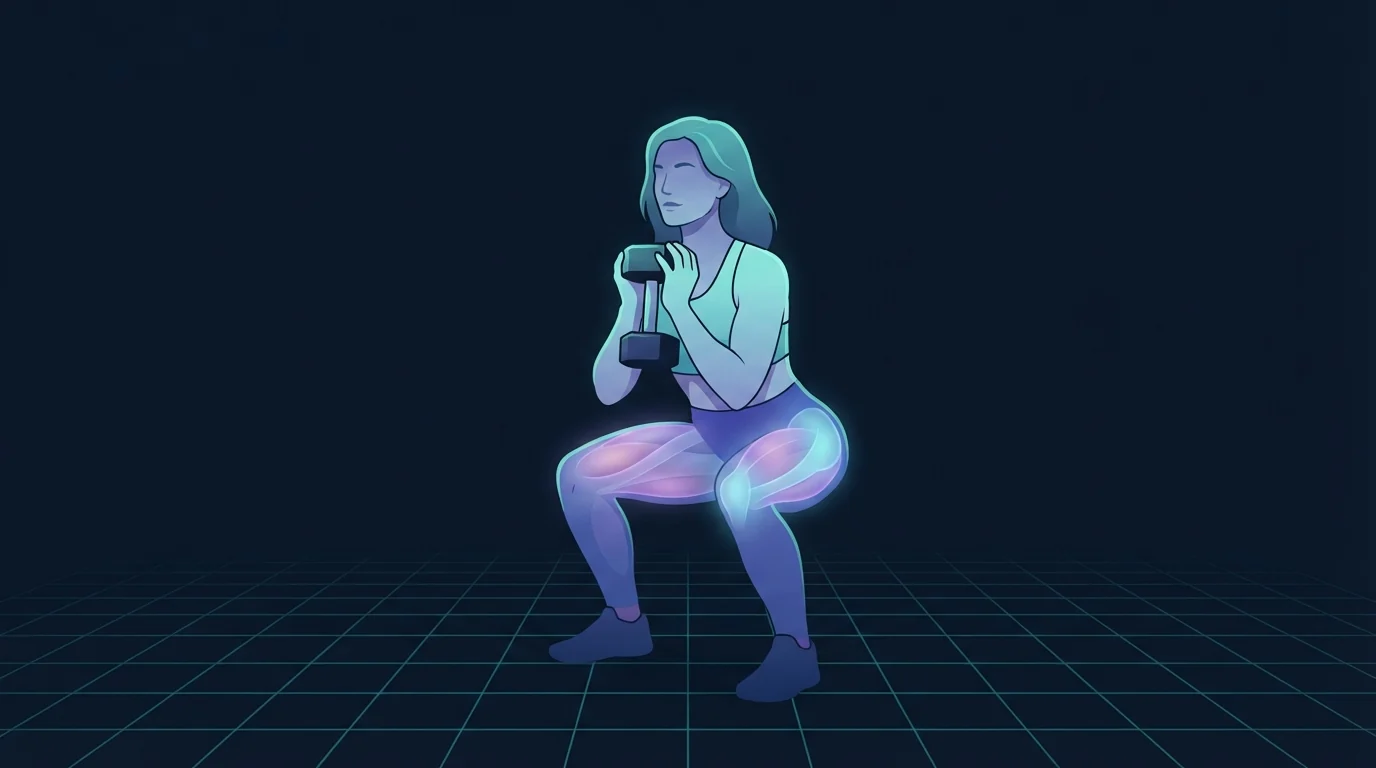
- Squat. Goblet squat, box squat to a chair, split squat. Loads quads, glutes and spine.
- Hinge. Romanian deadlift, hip thrust, good morning. Loads hamstrings, glutes and the whole posterior chain. The most neglected pattern and the one that protects backs.
- Push. Push-up on an incline, floor press, overhead press. Chest, shoulders and triceps.
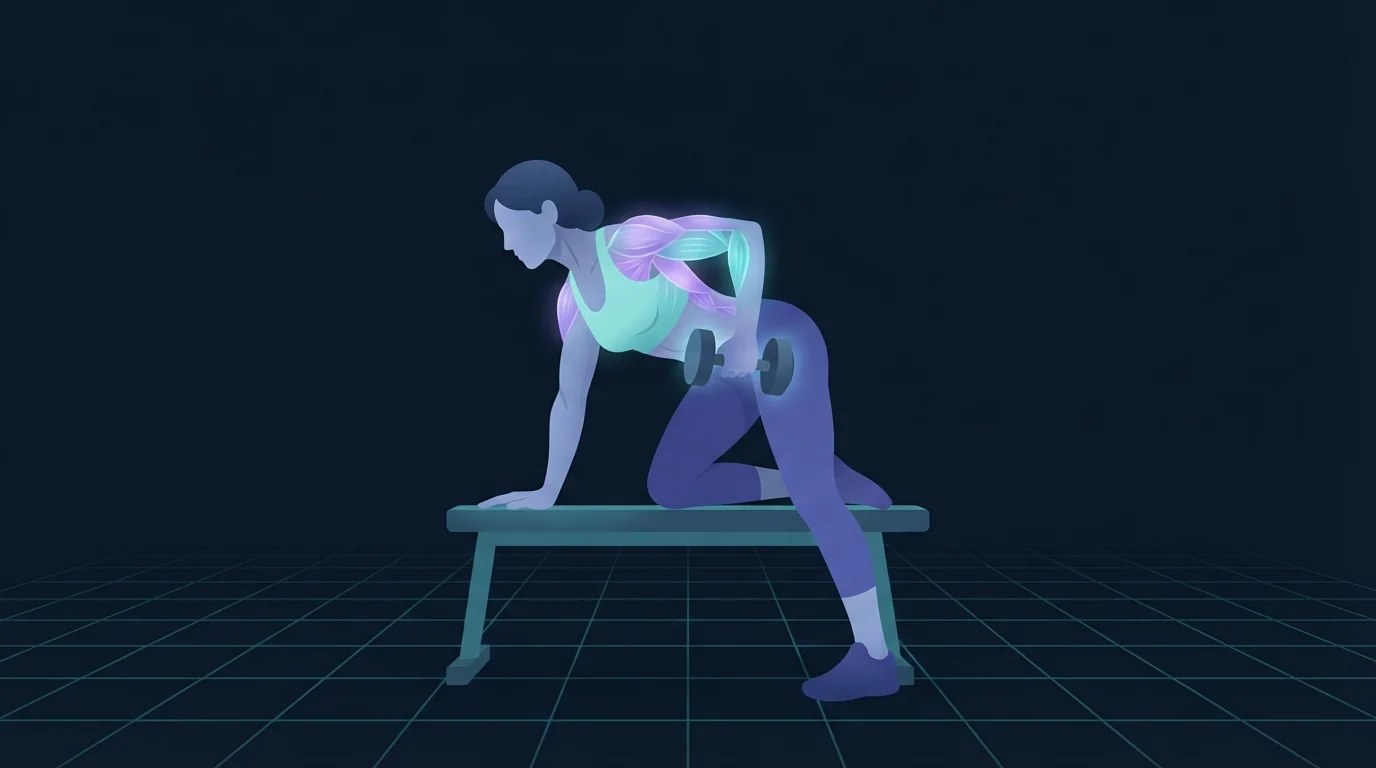
- Pull. One-arm dumbbell row, bent-over row, band pull-apart. Upper back and biceps. This is the posture pattern.
- Carry. Suitcase carry, farmer's walk down a hallway. Grip, core and everything that holds you upright.
- Single-leg. Step-up, lateral lunge, single-leg RDL. Balance, hip stability and the thing that prevents the fall long before bone density matters.
How heavy, honestly
Here's the finding that lets you train hard in a living room. A meta-analysis of 21 controlled trials compared low loads at 60 percent of one-rep max or less against loads above 60 percent, with every set in both conditions taken to muscular failure. Muscle growth was equivalent between the two. Maximal strength gains favoured the heavier loads (Schoenfeld et al., 2017).
Translated: a set of 15 with a weight that genuinely runs out at 15 builds as much muscle as a set of 6 that runs out at 6. What you can't fake is the effort. The last two or three reps of every working set should be slow and visibly difficult. If you finish a set and could have done five more, you did a warm-up.
A 3-Day Weekly Template You Can Run for Months
Three full-body days on non-consecutive days, roughly 40 to 45 minutes each. Rest 60 to 90 seconds between sets. Everything here works with dumbbells, a chair and your own bodyweight.
| Pattern | Day A (Mon) | Day B (Wed) | Day C (Fri) |
|---|---|---|---|
| Squat | Goblet squat, 3 x 8-12 | Box squat to chair, 3 x 10-15 | Goblet squat, 3 x 8-12 |
| Hinge | Dumbbell Romanian deadlift, 3 x 8-12 | Glute bridge or hip thrust, 3 x 12-15 | Dumbbell Romanian deadlift, 3 x 8-12 |
| Push | Incline push-up, 3 x 6-12 | Seated overhead press, 3 x 8-12 | Dumbbell floor press, 3 x 8-12 |
| Pull | One-arm dumbbell row, 3 x 8-12 each | Bent-over row, 3 x 10-12 | One-arm dumbbell row, 3 x 8-12 each |
| Single-leg | Step-up, 2 x 8-10 each | Reverse lunge, 2 x 8-10 each | Lateral lunge, 2 x 8-10 each |
| Carry or core | Suitcase carry, 3 x 30 seconds each side | Dead bug, 3 x 8 each side | Farmer's walk, 3 x 40 seconds |
If three days isn't realistic right now, run Day A and Day B only. Two sessions a week still lands inside the 30-to-60-minute window that produced most of the mortality and disease benefit in the Momma review, and two sessions you actually do beat three you plan and skip. Our guide on why consistency beats intensity exists because this is the decision that sinks most programs.
How to Progress Without Wrecking Yourself
The plan above is a container. Progressive overload is what you put in it, and after 40 the way you apply it matters more than it did at 25, because tendons and joints adapt slower than muscle does.
Use the double progression rule. It's one sentence: add reps until you hit the top of the range on every set, then add weight and drop back to the bottom of the range.
So a goblet squat at 3 sets of 8 with 20 pounds becomes 3 sets of 9, then 10, then 12 across a few weeks. Once all three sets hit 12, the weight goes to 25 and you start again at 8. That single rule will carry you for a year or more without any programming knowledge at all.
Three guardrails on top of it:
- Change one variable at a time. More weight or more reps, never both in the same week.
- Take an easier week every fifth or sixth week. Same exercises, two sets instead of three, lighter loads. A planned easier week is cheaper than a forced one.
- Joint pain is information, not weakness. Sharp pain means change the exercise, not push through it. A goblet squat that hurts becomes a box squat. An overhead press that pinches becomes a floor press. The pattern matters; the specific exercise doesn't.
Protein and Recovery Basics
Training is the signal. Food and sleep decide whether your body can act on it, and both get less forgiving in this decade.
On protein, pooled data from 49 randomised trials with 1,863 participants found that extra dietary protein meaningfully improved gains in fat-free mass and one-rep-max strength during resistance training, with the benefit levelling off around 1.6 grams per kilogram of body weight per day (Morton et al., 2018). The same analysis found the effect shrank with increasing age, which is an argument for landing closer to that number after 40 rather than further from it.
The practical version needs no math and no powder. Put a real protein source at each of three or four meals: eggs, Greek yogurt, fish, chicken, lentils, tofu, cottage cheese. Most women who start paying attention find they were front-loading almost nothing at breakfast and cramming it all into dinner. Fixing breakfast alone usually closes most of the gap. If you'd rather read the research on meal timing, we reviewed it in protein distribution across meals.
On recovery, three things do the heavy lifting:
- Sleep. Muscle repair and the hormonal response to training both happen here, and perimenopausal sleep disruption is a real training variable, not a personality trait. Protect the window even when you can't fix the quality.
- Rest days between sessions. The template is non-consecutive for a reason. Connective tissue takes 48 hours or more to catch up after unfamiliar loading.
- Walking on off days. Easy movement helps you recover and covers the cardiovascular side that lifting doesn't. It's not the main course, but it belongs on the plate.
The Myths That Keep Women Out of the Weight Room
"Lifting will make me bulky"
A meta-analysis covering 12 hypertrophy outcomes and 42 strength outcomes compared men and women following identical resistance training protocols. There was no significant sex difference in muscle growth, no significant difference in lower-body strength gain, and a significant effect favouring women for relative upper-body strength (Roberts et al., 2020). Similar relative gains, from a much smaller absolute starting mass, at a rate measured in a few pounds a year under good conditions. Nobody has ever woken up accidentally muscular. What most women actually notice first is that clothes fit differently at the same body weight, which is muscle replacing fat, not adding to it.
"Cardio is better for losing weight"
Cardio burns more calories per session. That's true and it's also the wrong frame, because the thing that determines what your body looks like at a given weight is how much muscle you kept. Weight loss without resistance training takes a meaningful share of that loss out of lean tissue, which lowers your metabolic rate and sets up the regain. Do both if you can. If you can only do one while eating less, lift.
"It's too late for me"
The LIFTMOR participants averaged 65 years old and had osteopenia or osteoporosis at enrolment. They improved bone density, strength and function in eight months. Starting at 42 or 48 is a substantially easier problem than the one that trial solved. Our review of the menopause and strength training statistics collects the rest of the numbers on this.
"I need a gym and a coach to do this safely"
A gym helps and a coach helps more, but neither is the gate. The six patterns above are learnable from good demonstrations, and the loads a beginner uses at home are forgiving. If choosing what to do each session is the part that stalls you, an app that hands you the plan removes that decision; we compared how the main options handle programming for women in our roundup of the best fitness apps for women.
What to Expect, Month by Month
Weeks 1 to 3. Almost everything you feel is neurological. You'll add reps quickly, sometimes weight, and none of it is new muscle yet. It's your nervous system learning to recruit what you already have. Soreness peaks after session two and settles down. This is the stretch where most people quit because nothing visible has happened.
Weeks 4 to 8. Strength gains keep coming and the first real structural change starts. Stairs feel different. Carrying groceries in one trip stops being a gamble. Body composition begins to shift before the scale reflects anything, which is why the scale is a poor instrument here.
Months 3 to 6. Visible change. Shoulders and arms look different, posture sits differently, and your working weights have usually doubled from where you started. This is also where hot flush and sleep improvements showed up in the Berin trial timeline.
Months 6 to 12 and beyond. Bone. Skeletal adaptation is the slowest of the three and runs on a scale of eight to twelve months, which is exactly why the LIFTMOR trial ran eight. You won't feel this one. It's the reason to still be training in month ten.
The Bottom Line
Strength training for women over 40 isn't a nice extra on top of cardio. It's the specific intervention for the specific tissues that this decade takes, and the dose that buys most of the benefit is 30 to 60 minutes a week of real effort. Two or three full-body sessions, six movement patterns, one progression rule, dumbbells and a chair.
You haven't lost your ability to change. You've lost the free maintenance that was covering for a training style that never really suited you. Ask your body for something specific and it will still answer. If you want the version tuned for after the transition rather than through it, our week-by-week starting plan for after menopause picks up where this one leaves off.
Frequently Asked Questions
How often should a woman over 40 strength train?
Two to three full-body sessions a week, on non-consecutive days, covers almost everyone. Three is the sweet spot for someone with 45 minutes to spare; two still produces most of the strength and bone benefit if that's what fits. What matters far more than the number is whether the same six movement patterns come back every week with slightly more work than last time.
Will lifting weights make a woman over 40 bulky?
No. A 2020 meta-analysis of resistance training trials found that men and women gain muscle at similar relative rates, which sounds alarming until you notice what relative means: women start from a much smaller absolute muscle mass, so the same percentage gain adds a few pounds over months, not a visible bulk. Adding muscle is slow, deliberate work that nobody does by accident.
Do you need heavy weights to build muscle after 40?
Not for muscle. A meta-analysis of 21 trials found that light loads taken close to failure produced the same muscle growth as heavy loads, though heavy loads were better for maximal strength. A pair of adjustable dumbbells and a step will build real muscle after 40. Bone responds to higher loads more specifically, which is why the plan above adds load over time rather than only adding reps.
Is strength training better than cardio for women over 40?
They do different jobs and the honest answer is that you want both, but if you only have time for one, start with strength. Cardio doesn't defend muscle mass or bone density, and those are the two things that fall fastest in the 40s and 50s. A 2022 meta-analysis of 16 cohort studies found muscle-strengthening activity was linked to a 10 to 17 percent lower risk of all-cause mortality and major disease independent of aerobic exercise.
How much protein do women over 40 need when lifting?
More than the official minimum and less than the internet suggests. Pooled data from 49 resistance training trials found the benefit of extra protein for lean mass flattened out around 1.6 grams per kilogram of body weight per day. Spreading it across three or four meals with a solid protein source at each is the practical version. Talk to your doctor before changing intake if you have kidney disease.
Is it too late to start strength training at 45 or 50?
No, and the trials on this are unusually clear. In the LIFTMOR trial, postmenopausal women averaging 65 years old with low bone mass improved spine bone density and every measure of physical function in eight months of twice-weekly training. Untrained muscle responds at any age. The first three months are usually the fastest progress a person will ever make.