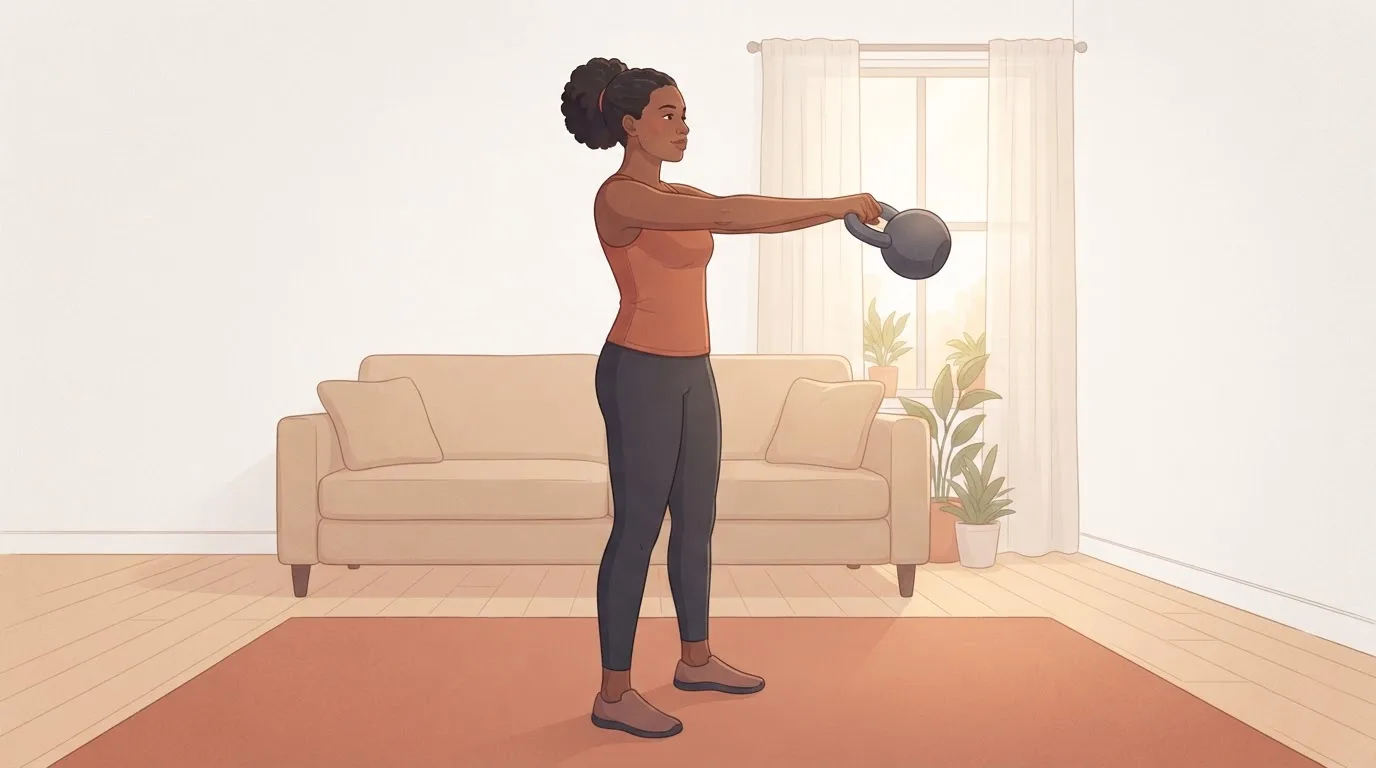
You bought a kettlebell, or you're about to, and every video makes it look like a blur of swinging iron. You're not sure which bell to buy, whether your back can take it, or what a beginner kettlebell workout should even include. So the bell sits by the door, and you feel a little guilty every time you walk past it.
This kettlebell workout plan fixes that. You'll learn the kettlebell exercises for beginners in the order to learn them, get a straight answer on starting weight, practice the hinge that protects your lower back, and follow a 6-week routine built on what worked in beginner trials. Each session takes 20 to 25 minutes and fits in a living room.
7 Kettlebell Exercises for Beginners, in the Order to Learn Them
Learn them from the top down. The first three build the hip hinge and the squat that everything else depends on. The last four add pulling, pressing, carrying and a lunge, so the plan trains your whole body.
| # | Exercise | What it trains | Beginner sets x reps |
|---|---|---|---|
| 1 | Kettlebell deadlift | Glutes, hamstrings and grip, and it teaches the hinge | 3 x 8-10 |
| 2 | Goblet squat | Thighs, glutes and upper back | 3 x 8-10 |
| 3 | Two-handed swing | Glutes, hamstrings, grip and heart rate | 5-10 sets of 10 |
| 4 | One-arm row | Lats and upper back | 3 x 8-10 per side |
| 5 | Half-kneeling press | Shoulders, triceps and trunk | 2-3 x 5-8 per side |
| 6 | Suitcase carry | Grip, obliques and hips | 3 x 30 sec per side |
| 7 | Goblet reverse lunge | Thighs, glutes and balance | 2-3 x 6-8 per side |
1. Kettlebell deadlift
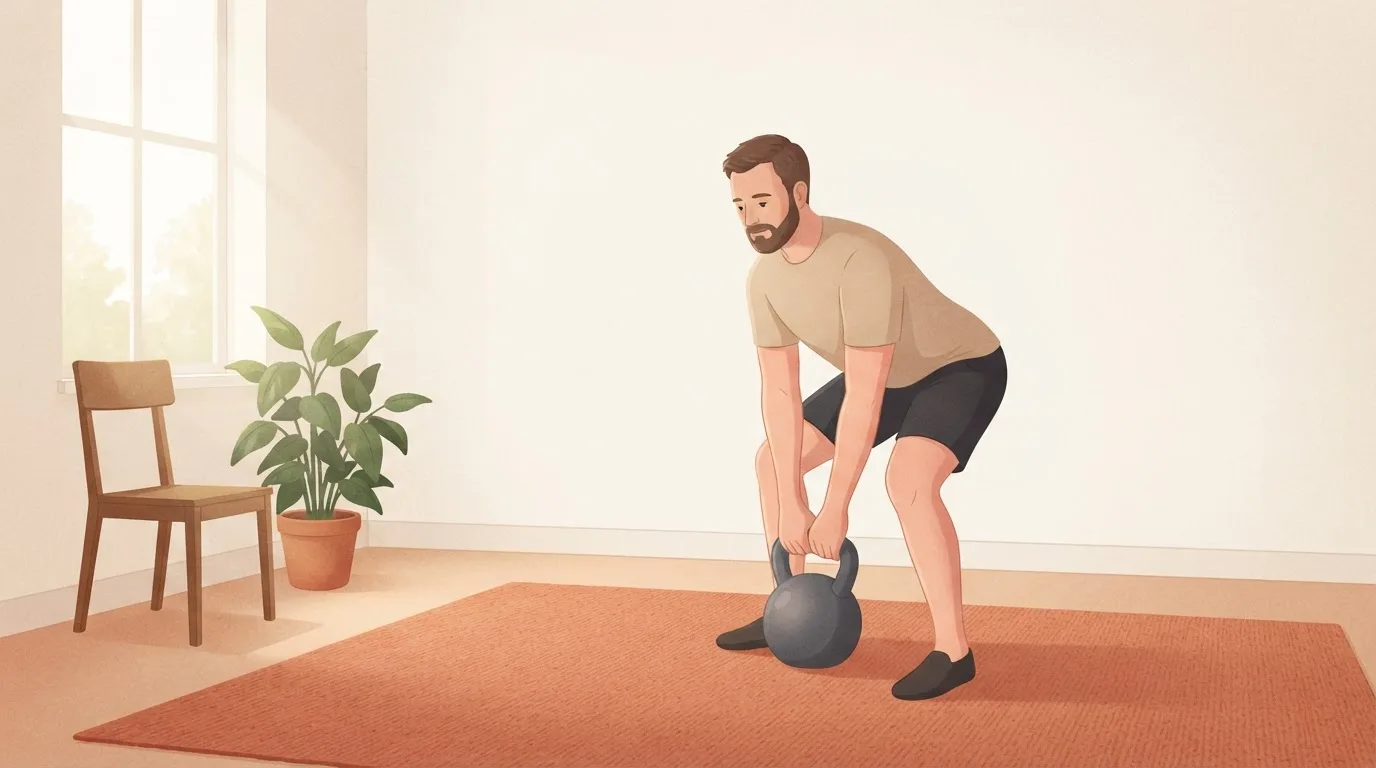
Stand with the bell on the floor between your feet. Push your hips back until your hands reach the handle, keeping your back flat and your shins close to vertical, then stand up by driving your hips forward. In the beginner trial run by Jay and colleagues (2011), the deadlift was the step between an unweighted practice swing and the real swing.
2. Goblet squat
Hold the bell by the horns, the two sides of the handle, close to your chest. Sit down between your heels with your chest up and your elbows inside your knees, then stand. The weight in front acts as a counterweight, so many beginners squat deeper with the bell than without it. Our goblet squat page shows each step.
3. Two-handed swing
Hike the bell back between your thighs, then snap your hips forward so it floats up to chest height. Your hips do the lifting and your arms stay long and relaxed. Start swinging only when your deadlift feels automatic, and use the step-by-step guide in the hinge section below.
4. One-arm row
Put one hand on the seat of a sturdy chair, step back into a hinge with a flat back, and pull the bell from under your shoulder up to your hip with the other hand. Keep your elbow close to your ribs and your hips square to the floor.
5. Half-kneeling press
Kneel on one knee and hold the bell at the shoulder on the same side as the knee that's down. Squeeze the glute of that leg and press straight up until your arm is beside your ear. Kneeling stops you from leaning back to cheat the press, and it calls for a lighter bell than your swing.
6. Suitcase carry
Hold the bell at your side like a suitcase and walk tall for 30 seconds, then switch hands. Don't lean toward the bell or away from it. The muscles at the side of your waist and hip work to keep you level, and your grip gets stronger with every lap of the room.
7. Goblet reverse lunge
Hold the bell at your chest, step one foot back and lower that knee toward the floor, then push through your front foot to stand. Stepping back instead of forward makes the lunge easier to control. Keep your front knee in line with your toes.
What Weight Kettlebell Should I Start With?
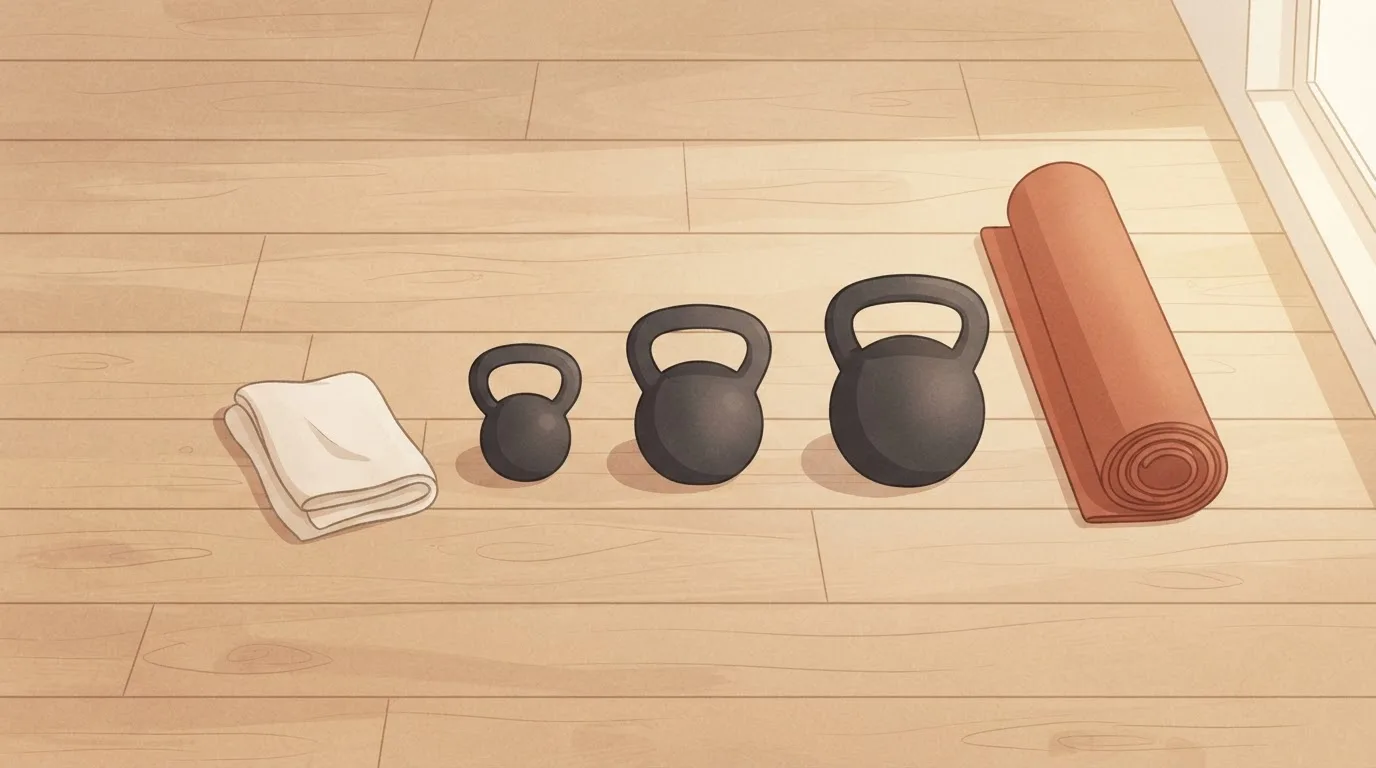
Start with an 8 kg (18 lb) kettlebell if you're a woman who is new to lifting, and a 12 kg (26 lb) bell if you're a man. Those were the starting bells in the Jay trial, chosen from the usual advice for kettlebell novices. If you already lift or do heavy physical work, start one size up.
| Your starting point | Main bell for deadlifts, squats, swings, rows and carries | Press bell |
|---|---|---|
| A woman new to lifting | 8 kg (18 lb) | 4-6 kg (9-13 lb) |
| A man new to lifting | 12 kg (26 lb) | 8 kg (18 lb) |
| A woman who already exercises | 12 kg (26 lb) | 8 kg (18 lb) |
| A man who already exercises | 16 kg (35 lb) | 12 kg (26 lb) |
Two checks tell you the main bell fits. You can deadlift it 10 times with a flat back, and when you swing it, your hips have to work to float it up. A bell that's too light tempts you to lift it with your arms, and one that's too heavy pulls your back round at the bottom.
Bell weight also changes what the swing trains. In a lab study of 16 men swinging 16, 24 and 32 kg bells, Lake and Lauder (2012) found the lightest bell moved fastest, while the heaviest made the men push hardest against the floor. A lighter bell suits learning the pattern, and a heavier one makes your hips work harder later.
Buy for the swing and expect to move up. Most kettlebells jump 4 kg from one size to the next. In the Jay trial, the average bell for two-handed swings rose from 8.3 kg to 12.4 kg in eight weeks, one full size. Your first bell often becomes your press bell by month three.
How to Use a Kettlebell: Learn the Hinge Before the Swing
The hinge is a bow from the hips with a flat back, and it's the movement behind both the deadlift and the swing. Most swing problems are hinge problems, so give it a week before you load it. Practice it in three steps.
- Find the wall. Stand about one foot-length in front of a wall, facing away from it, with your feet hip-width apart and your hands on your hips.
- Reach back. Push your hips back until they touch the wall, letting your knees bend a little and your chest tip forward with your back flat. You should feel a stretch behind your thighs.
- Stand by squeezing. Drive your hips forward and squeeze your glutes to stand tall, without leaning back at the top. When 10 reps feel easy, step a few inches farther from the wall.
Once you can hinge smoothly at two foot-lengths from the wall, you're ready for the deadlift. Once the deadlift feels automatic, you're ready to swing.
The two-handed swing, step by step
- Set the bell on the floor about a foot in front of your toes, with your feet a little wider than your hips.
- Hinge, grip the handle with both hands and tip the bell toward you.
- Hike it back and up between your thighs, as if passing a football to someone behind you. Keep the bell above your knees.
- Snap your hips forward and squeeze your glutes. Let the bell float to chest height, and breathe out sharply.
- Let the bell fall. Wait until your forearms meet your thighs before you hinge again, then repeat.
- To finish, hike the bell back one last time and set it down in front of you with a flat back.
Chest height or overhead?
Swing to chest height. Bullock and colleagues (2017) tested 15 healthy adults and found an overhead swing took 34 percent longer per rep than a swing to shoulder height, with the same peak joint angles and almost the same load on the hips. In a 2025 study of 15 active women swinging 12 and 16 kg bells, Murphy and Riemann suggested moving up a bell size before switching to the overhead style. The higher swing adds time per rep and takes your shoulders overhead, while the work for your hips stays about the same.
What the swing works
The swing is a hamstring and glute exercise far more than an arm exercise. In 16 female handball and soccer players, Zebis and colleagues (2013) recorded very high activity in the inner hamstring during kettlebell swings and Romanian deadlifts, from 73 to 115 percent of a maximal contraction. If your shoulders burn and your hamstrings don't, your arms are lifting the bell.
Find out what's really holding you back
FitCraft, our mobile fitness app, pairs you with an AI coach who builds you a personalized plan around your goals, schedule, and fitness level. Every FitCraft program is designed by Domenic Angelino, MPH (Brown University) and NSCA-CSCS, with research published in the Journal of Strength and Conditioning Research and Medicine & Science in Sports & Exercise.
Take the Free Assessment Free • 2 minutes • No credit cardThe Beginner Kettlebell Routine: 3 Days a Week for 6 Weeks
Train on three days with a rest day between them, such as Monday, Wednesday and Friday. Each session starts with 5 minutes of marching, arm circles, bodyweight squats and wall hinges. This beginner kettlebell routine follows the order used in the Jay trial, with hinges and deadlifts first, two-handed swings next, and one-handed swings only after the two-handed version is solid.
| Exercise | Weeks 1-2 | Weeks 3-4 | Weeks 5-6 |
|---|---|---|---|
| Wall hinge drill | 2 x 10 | 1 x 10 | Warm-up only |
| Kettlebell deadlift | 3 x 10 | 2 x 10 | Warm-up only |
| Goblet squat | 3 x 8 | 3 x 10 | 3 x 10 |
| One-arm row | 3 x 8 per side | 3 x 10 per side | 3 x 10 per side |
| Half-kneeling press | None yet | 2 x 5 per side | 3 x 6 per side |
| Goblet reverse lunge | None yet | None yet | 2 x 6 per side |
| Suitcase carry | 2 x 30 sec per side | 3 x 30 sec per side | 3 x 30 sec per side |
| Two-handed swing | None yet | 5 sets of 10 | 8-10 sets of 10 |
| Rest between sets | 60-90 sec | 60 sec | 30-45 sec between swing sets |
Stop every set with two or three good reps left. Move on to the next column only when the current one feels comfortable for two sessions in a row. Add reps first, then sets, then cut the rest, and change to a heavier bell last. The trial worked the same way, and participants earned a heavier bell by finishing all 10 intervals with the hardest swing version.
The 15-minute interval version
If you'd rather watch a clock than count reps, run your swings the way the Jay trial did, three times a week. Swing for 30 seconds, then rest for 60 seconds, for 10 rounds. From week 5, cut the rest to 30 seconds. The trial let each person choose one of four levels for each round, from an unweighted practice swing to a deadlift, a two-handed swing or a one-handed swing. The whole session, warm-up included, took 20 minutes.
A steady cardio version
Thomas and colleagues (2014) had 10 kettlebell novices, five men and five women, alternate 10 swings and 10 sumo deadlifts without stopping for 10 minutes, three times, with 3 minutes of rest between blocks. Oxygen use, calories burned and blood pressure were about the same as in a brisk treadmill walk up a 4 percent grade, while heart rate and perceived effort ran higher. On a fourth day, or in place of a walk, it's a solid cardio session with one bell.
What Beginner Kettlebell Studies Show
The best evidence for beginners comes from small trials in everyday adults rather than athletes, many of them in their 40s.
- Strength. Manocchia and colleagues (2013) put 23 adults, average age about 41, through 10 weeks of kettlebell classes twice a week and compared them with 14 people who didn't train. Their bench press improved more than the control group's, and their clean and jerk improved over time, but their vertical jump didn't change.
- Balance. Jay and colleagues (2013) studied 40 adults averaging 44 years old, 85 percent of them women, who did swings three times a week for eight weeks. When the researchers knocked them off balance on purpose, the swing group steadied themselves 109 milliseconds faster than the group that didn't train.
- Showing up. In the same trial, people attended 70 percent of the sessions offered, about 2.1 a week, and still improved. Their neck and shoulder pain fell too, and nobody had a lasting injury from the training.
For the swing's heart rate, oxygen use and spine loading, including trials in older adults, read our review of the kettlebell swing research. If you're still choosing equipment, our kettlebell vs dumbbell guide compares the trials on strength and muscle. These beginner studies are small, 10 to 40 people over 8 to 10 weeks. They show that novices get stronger and steadier with a kettlebell, and they don't show that kettlebells beat other equipment.
Kettlebell Workout for Women: Does Anything Change?
Only the starting bell changes. The hinge, the exercises and the 6-week plan are the same for women and men, and the evidence on this page leans female. The Jay trial's participants were 85 percent women with an average age of 44, the hamstring study by Zebis tested female athletes, and Murphy and Riemann studied women's hips during swings.
Most women new to lifting can start swinging at 8 kg and move to 12 kg within about two months, which is what the average participant in the Jay trial did. Press with a lighter bell. If you notice leaking or heaviness in your pelvic floor during swings, especially after having children, stop swinging and see a pelvic health physical therapist. Goblet squats, rows and carries usually carry on while you sort it out.
Kettlebell Safety at Home
A safe kettlebell session at home starts with the room around you. Check these before every session.
- Clear space. Leave at least an arm's length plus a bell length clear in front of you and behind you, and keep children and pets out of the room while you swing.
- The floor. Train on a mat or a rug that doesn't slide, and always set the bell down rather than dropping it.
- Your grip. Train with dry hands and no lotion. If you lose your grip mid-swing, let the bell go and step out of its way. Never try to catch it.
- Your shoes. Flat shoes or bare feet keep your weight balanced through your whole foot. Thick, cushioned running shoes can make you wobble.
- Stop rules. End the set when your back rounds, the bell drops below your knees, or anything feels sharp. A burn in your glutes and hamstrings is normal.
- Your breath. Breathe out at the top of each swing, and don't hold your breath through long sets.
No Kettlebell Yet? Use a Dumbbell
You can run almost all of this plan with one dumbbell. Hold it upright by one end for the goblet squat and the reverse lunge, and use it like the bell for rows, presses and carries. For the swing, hold the dumbbell by its handle with both hands so it hangs straight down. Our dumbbell swing page shows the grip, and it trains the same hinge.
FitCraft programs dumbbells and bodyweight, not kettlebells. If you'd like the dumbbell version planned for you, its strength workouts use dumbbells and bodyweight, your AI coach demonstrates each exercise on an interactive 3D model and says your name during workouts, and your workouts adjust as you progress. Streaks and leaderboards help you keep showing up. Our review of the best strength training apps compares FitCraft with the other options for beginners at home.
The Bottom Line
A kettlebell workout for beginners works when you learn the hinge first, start with a light bell and train three short sessions a week. Deadlifts and goblet squats come first, swings follow once the hinge is automatic, and a heavier bell comes when the routine feels easy for two sessions in a row.
Working out consistently is hard, but it doesn't have to be. As Stacy, 41, put it, "After my second kid, I needed something stupidly simple." Pick three days this week, put the bell where you'll see it, and start with the deadlift.
Frequently Asked Questions
How long does it take to see results from kettlebell workouts?
Most beginners feel stronger and fitter within 6 to 10 weeks of two or three sessions a week. Adults averaging about 41 improved their bench press after 10 weeks of twice-weekly kettlebell classes (Manocchia 2013), and adults averaging 44 regained their balance faster after 8 weeks of swings (Jay 2013). Changes you can see in the mirror take longer and depend mostly on what you eat.
Is a 15-minute kettlebell workout enough for beginners?
Yes. The swing intervals in the Jay trial took 10 to 15 minutes after a short warm-up, three times a week, and the beginners in it got stronger and had less neck, shoulder and lower back pain. A 15-minute session of deadlifts, goblet squats and swings is a complete beginner workout.
Do kettlebell exercises burn belly fat?
No exercise burns fat from one spot, kettlebell swings included. In a 6-week trial, ab exercises five days a week didn't reduce belly fat in people who kept their diet the same (Vispute 2011). Kettlebell workouts help by using energy and building muscle, and your diet decides most of the rest. Our guide to the best exercises to lose belly fat covers what works.
How many days a week should a beginner do kettlebell workouts?
Three days a week on non-consecutive days is a good beginner dose, and two still works. Participants in the Jay trial were offered three sessions a week, averaged 2.1, and still improved. Leave a day between sessions so your lower back and grip can recover.
Should a beginner buy a kettlebell or dumbbells first?
Dumbbells are the safer first buy for most goals, because they cover more exercises and go up in smaller steps. Buy a kettlebell first if you mainly want swings for conditioning and you have clear floor space to swing it. Our kettlebell vs dumbbell guide compares the two in detail.