
You've probably set fitness goals for the new year before. The first week felt great. By the middle of January the plan had slipped, and by March your workout shoes were back in the closet, along with that familiar feeling that you'd failed again.
That pattern says nothing about your character. Most new year fitness resolutions fail for design reasons. They pack in too many goals, aim at results you can't control yet, and have no plan for the week your motivation drops. Willpower can't carry a plan like that past February.
This guide gives you a better design. You'll see how to pick one to three new year fitness goals, what the research on fresh starts says about January, and how to run a 12-week plan from the last week of December to the end of March, with short workouts at home.
What Are Good Goals for a New Year?
Good goals for a new year are specific things you'll do each week, sized to the time and energy you have in January, with a finish line about 12 weeks away. A whole year is too far off to steer by. Twelve weeks is long enough to see change and short enough to stay focused.
Most resolutions can be rewritten that way. The left column shows how a new year fitness resolution usually sounds. The right column turns it into a goal you can start this week.
| If your resolution is | Make your new year fitness goal |
|---|---|
| "Get in shape this year" | Three 20-minute workouts a week on set days, through the end of March |
| "Lose 20 pounds" | Two strength sessions and three brisk walks a week for 12 weeks, with a waist measurement every four weeks |
| "Get stronger" | Learn the squat, push-up and dumbbell row, then add a rep or a little weight every two weeks |
| "Stop being so stiff" | Ten minutes of stretching after each workout and on two rest days a week |
| "Stop skipping workouts" | A 10-minute version of the workout on any planned day when the full session won't fit |
| "Have more energy" | A 15-minute walk outside after lunch on weekdays |
Every goal on the right is something to do rather than something to stop. That's deliberate. Oscarsson and colleagues (2020) followed more than a thousand resolutions for a year and found that goals framed as doing something beat goals framed as avoiding something. Our list of 36 fitness goals examples gives you a longer menu, grouped by aim, with the numbers and deadlines already filled in.
Pick one to three goals from the right-hand column, or write your own in the same style. Fewer is better, and the next section shows why.
How to Pick One to Three New Year Fitness Goals
Fewer goals work better, and there's evidence against long lists. In experiments by Dalton and Spiller (2012), planning when and where to act helped people reach a single goal, but it didn't help people juggling six. Planning made the difficulty of juggling six goals obvious, and people's commitment to them dropped.
Use these steps to choose yours:
- Start from your real December. Count the workouts you did in a typical week this fall. If the answer is zero, your January goal starts at two or three short sessions a week, not five.
- Make the first goal about showing up. Everyone needs this one. It's a set number of sessions a week on days you name. Three 20-minute sessions at home is a good default for a beginner.
- Add a goal you can test, if you want one. Pick one number you can measure on day one and again in week 12, such as push-ups in a row, seconds in a plank or minutes to walk a set route.
- Add a goal for how you feel, if you want one. More energy, better sleep or a looser back keeps you going while the test number moves slowly.
- Choose activities you like. Woolley and Fishbach (2017) found that enjoying the activity predicted who kept going with their New Year's resolutions, while the long-term payoff didn't. If you dislike running, January isn't the month to start.
- Give every goal a day, a time and a place. "Monday, Wednesday and Saturday at 7 a.m. in the living room" works better than "three times a week." Our guide on how to stay consistent with working out covers the research on these when-and-where plans.
Here's how the three goals fit together for a beginner training at home:
| Goal | Example | How you'll know |
|---|---|---|
| 1. Showing up (everyone) | Three 20-minute workouts a week, on Monday, Wednesday and Saturday | Sessions done each week, out of three |
| 2. A test (optional) | Go from 4 to 10 push-ups in a row by the end of March | Retest in weeks 4, 8 and 12 |
| 3. How you feel (optional) | A 15-minute walk after lunch on weekdays | Rate your energy from 1 to 10 every Sunday |
Find out what's really holding you back
FitCraft, our mobile fitness app, pairs you with an AI coach who builds you a personalized plan around your goals, schedule, and fitness level. Every FitCraft program is designed by Domenic Angelino, MPH (Brown University) and NSCA-CSCS, with research published in the Journal of Strength and Conditioning Research and Medicine & Science in Sports & Exercise.
Take the Free Assessment Free • 2 minutes • No credit cardProcess Goals vs Outcome Goals in January
A process goal describes what you'll do, such as three workouts a week. An outcome goal describes the result, such as losing 10 pounds. In January, lead with the process goal and treat the outcome as a checkpoint.
A small trial tested exactly this. Wilson and Brookfield (2009) randomly split 60 recreational exercisers into a process-goal group, an outcome-goal group and a no-goal group for a six-week program. The process-goal group enjoyed the training more, felt less pressure and tension, and stuck with the program better than both of the other groups. Sixty people is a small sample, so read it as a strong hint rather than the last word.
Outcome numbers are also noisy early on. Your weight shifts from one morning to the next with water and food, and in the first weeks much of your progress is learning the movements, which no scale or mirror can show. A process goal gives you a result you can score every single week. Keep your outcome goal, but check it in weeks 4, 8 and 12 instead of every morning.
Whatever you pick, pick it yourself. Our review of self-chosen vs assigned fitness goals explains why a goal you choose tends to work better than one that's handed to you.
What the Fresh Start Research Says About January
The new year gives you a real boost, because people chase their goals harder right after a date that feels like a new beginning. Psychologists call these dates temporal landmarks.
Dai, Milkman and Riis (2014) named this the fresh start effect and measured it three ways. In US Google data, searches for "diet" were 82.1% higher in January than in December. On the goal-setting website stickK, people made 145.3% more commitments at the start of a year. On both measures, the new year beat every other landmark they tested.
Showing up told a different story. The team analyzed 442 days of gym visits by 11,912 undergraduates at one university in the northeastern US. Students were 33.4% more likely to go to the gym on the first day of the week than on the last, and 47.1% more likely in the first month of a semester than in the last. January raised the chance of a visit by just 11.6% over December.
So make your commitment in January, and treat every Monday as a chance to start or restart. You get a fresh start every week, and you never have to wait a year for the next one.
Making the resolution helps too. Norcross, Mrykalo and Blagys (2002) followed 159 New Year's resolvers and 123 people who wanted to change a habit but made no resolution. At six months, 46% of the resolvers said they were still succeeding, compared with 4% of the others. The resolvers who did best already felt confident, ready and able to change before January 1, which is why the plan below starts in late December.
If you want the reasons resolutions fall apart in the first place, our post on why New Year's fitness resolutions fail walks through them.
A 12-Week Plan From January to March
This plan carries your new year fitness goals from the last week of December to the end of March. Those first three months matter most. In records of 5,240 members of a fitness center in Brazil, about 63% stopped exercising before their third month (Sperandei 2016). Get to April and you've cleared the stretch when most people quit.
| Weeks | What you do | What you check |
|---|---|---|
| Test week (late December) | Pick your days and times, try one 10-minute session, and name a support person | Did the times work? Move any that didn't |
| Weeks 1 and 2 | Three 20-minute sessions a week at an easy effort, finishing each one feeling you could do more | Sessions done, out of six |
| Weeks 3 and 4 | The same plan. On rough days, do a 10-minute minimum instead of skipping | Week 4: your first test, such as push-ups, a plank or a timed walk |
| Weeks 5 to 8 | Add a fourth short session, an extra round or a heavier dumbbell, one change at a time | Week 8: your second test and a check-in with your support person |
| Weeks 9 to 12 | Keep the routine steady and choose your next 12-week goals in week 11 | Week 12: your final test, plus your waist or weight if that's a goal |
Before January 1: a test week
Use the last week of December as a dress rehearsal. Book each session for January on a set day and hour, do one 10-minute workout to check the space and the timing, and tell one person what your goals are. You'll start January with a plan you've already tried, and that kind of readiness is what predicted success among Norcross's resolvers.
A first workout for the new year
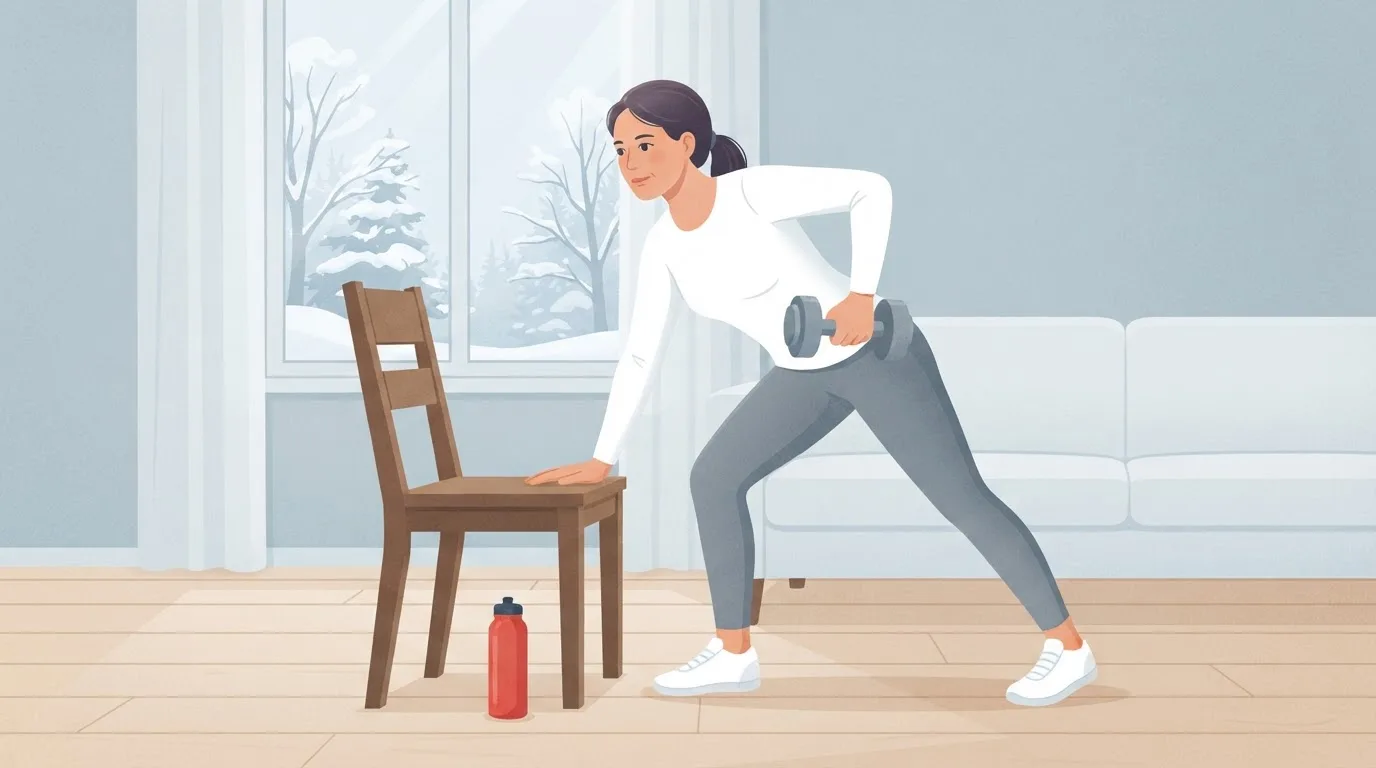
Your first sessions should feel easy. This 20-minute workout for the new year needs a sturdy chair and one dumbbell:
- Warm-up, 3 minutes. March in place, circle your arms, then do 10 slow squats.
- Circuit, 3 rounds. Do 10 squats to a chair, 8 incline push-ups against a kitchen counter, 12 glute bridges, 10 one-arm dumbbell rows per side with a hand on the chair, and a 20-second plank. Rest a minute between rounds.
- Cool-down, 3 minutes. Walk around the room, then stretch your hips and the backs of your legs.
If that feels too easy by week 3, add a fourth round. For a fuller routine with a plan to progress it, see our beginner workout routine, or use the AI workout plan generator to build one around your equipment and your time.
If you'd like a challenge
A new year fitness challenge gives January a finish line. If that helps you, try our January workout challenge or the 30-day workout challenge tracker during the first month, then carry on with this plan from week 5. If you already train regularly, the 75 Soft challenge tracker runs from New Year's Day to the middle of March, with a 45-minute workout every day.
How to Keep New Year Fitness Goals Past March
You keep new year fitness goals past March by getting support, restarting fast after a miss, and making each session pay off on the day you do it.
Name one support person
Oscarsson's trial is the best evidence on support. The researchers split 1,066 people who made resolutions into three groups. The group that named a support person and answered a short check-in every month reported the most success across the year, an average of 62.3%, against 55.9% for a group that got no support. A third group got the same support plus extra lessons on SMART goals, interim goals and motivation, and it did no better than the no-support group, at 52.5%.
So spend your effort on support rather than on more planning. Tell one person your goals and send them a two-line update on the first of every month. A friend who walks or trains with you is even better.
Restart on the next Monday
A missed week doesn't cancel your goals. In Dai's gym data, the start of a week did more for gym visits than the start of the year did, so when a week falls apart, pick the next Monday, write it down and carry on with the plan from where you stopped. Don't wait for next January.
Make each session pay off on the day
Rewards you get right away keep you coming back, which fits what Woolley and Fishbach found about enjoyment. Streaks, points and leaderboards turn each session into a small win you can see, and a 2022 meta-analysis by Mazeas and colleagues of 16 randomized trials found that gamified programs raised physical activity by a small to moderate amount.
A workout app that keeps you motivated can handle that part for you. FitCraft's 3D AI coaches demonstrate each exercise on an interactive model and say your name as you train. Streaks and XP reward the days you show up, your workouts adjust as you progress, and a new quest each month, themed for the season, gives January a target of its own.
The Bottom Line
Pick one to three new year fitness goals you control, write each one as something you'll do, and give it a day, a time and a place. Make your commitment in January, restart on any Monday you need to, and check your numbers at the end of March.
Working out consistently is hard, but it doesn't have to be. As Stacy, 41, a FitCraft user, put it, "After my second kid, I needed something stupidly simple." Keep your goals that simple and let the plan carry you to April.
Frequently Asked Questions
What are some good gym goals for me?
Good gym goals for a beginner pair a showing-up goal with one number you can track, such as three workouts a week for 12 weeks and adding a rep to each set until you can move up a dumbbell size. Both goals work just as well at home with a pair of dumbbells.
What's the latest fitness trend?
Wearable technology is the latest top fitness trend. The American College of Sports Medicine's survey of more than 1,400 fitness professionals ranked it No. 1 for 2027, ahead of mobile exercise apps and balance, flow and core strength, with traditional strength training in fifth place.
How many new year fitness goals should you set?
Set one to three new year fitness goals. In experiments by Dalton and Spiller (2012), planning helped people reach a single goal but not six, because a long list made the work feel harder and commitment dropped. Make the first goal about showing up, and add a test goal or a feel-better goal only if you want them.
When should you start your new year fitness goals?
Start planning in the last week of December and begin on a Monday that suits you. In a 2002 study by Norcross and colleagues, resolvers who felt ready and confident before January 1 were the most likely to succeed. If you miss the start, any Monday works, since the first day of the week lifted gym visits more than January did (Dai 2014).
Do New Year's resolutions actually work?
Yes, more often than their reputation suggests. At six months, 46% of New Year's resolvers were still succeeding, compared with 4% of people who wanted to change but made no resolution, and their most common goals were weight loss, exercise and quitting smoking (Norcross 2002). In a 2020 trial, 55% of the people who answered the one-year follow-up said they had kept their resolution.
What is a good New Year's Eve workout?
A good New Year's Eve workout is short and easy to finish, such as the 20-minute squat, push-up, bridge, row and plank circuit on this page. Treat it as your test-week session, because it shows whether your planned time and space work before January starts.