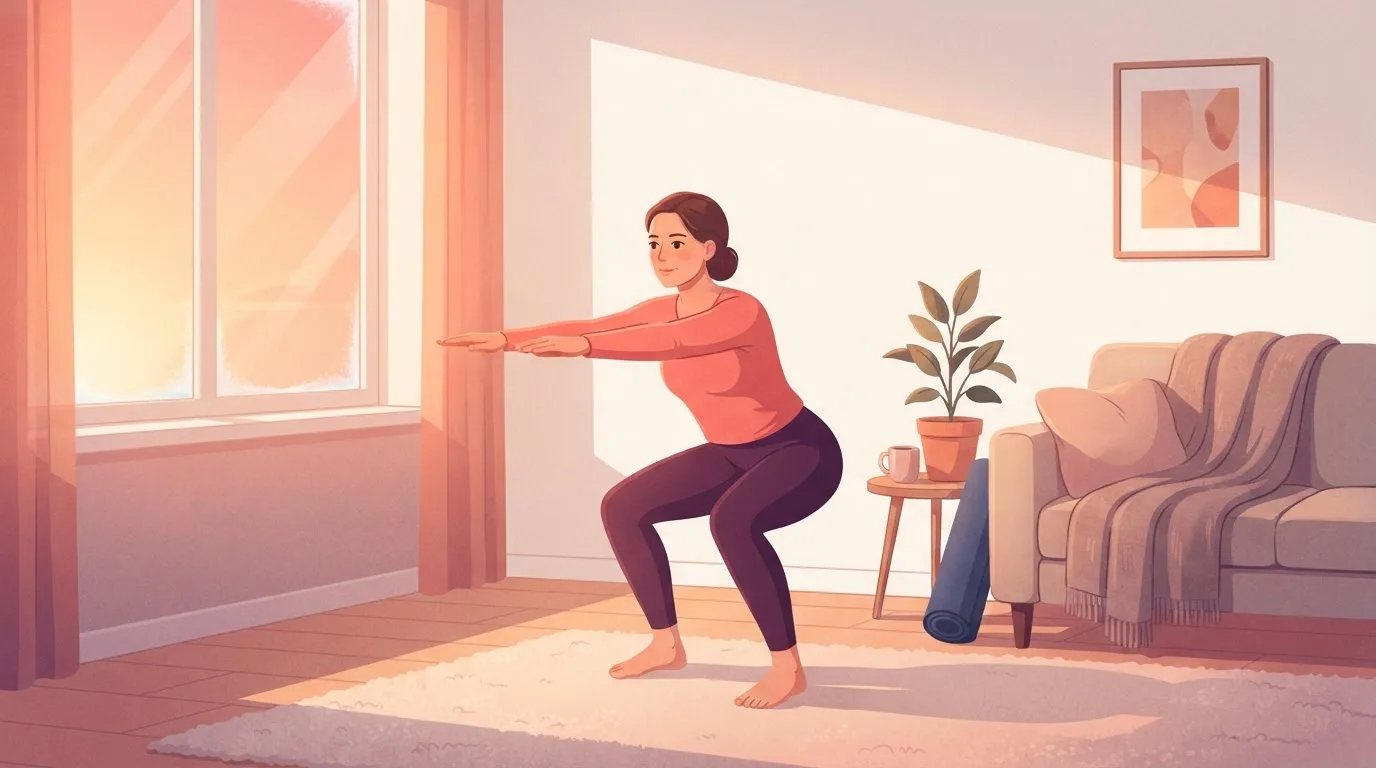
You know how January usually goes. You start on the 1st with a plan that's too big, like 100 squats a day or an hour at the gym. By the second week you're sore and behind, and by February the plan is gone.
If that's happened to you before, it doesn't mean you lack willpower. Most January challenges ask for too much on day 1, skip rest days and have no plan for the days life gets in the way. You've been handed a plan that was hard to finish.
The challenge below is a 31-day fitness challenge for beginners. Sessions start at 10 minutes and grow to 25, two days a week are rest days, and the rules cover missed days. If you'd rather run a classic 30 day workout challenge, our 30-day tool picks one routine, counts your sets and keeps a streak for you. This January version mixes strength, walking and mobility across the week and ends with a plan for February.
The 31-Day January Workout Challenge Calendar
Day 1 is January 1. Each week has two strength days, a walk, a mobility day, a day of your choice and two rest days. The minutes include the warm-up. If you're starting later, begin on any day and count 31 days from there.
| Day | Session | Minutes |
|---|---|---|
| Week 1: learn the moves | ||
| 1 | Check-in, then an easy walk | 15 |
| 2 | Strength A, 2 rounds | 10 |
| 3 | Walk | 10 |
| 4 | Rest | 0 |
| 5 | Strength B, 2 rounds | 10 |
| 6 | Mobility | 10 |
| 7 | Rest | 0 |
| Week 2: add a round | ||
| 8 | Strength A, 3 rounds | 14 |
| 9 | Walk | 15 |
| 10 | Strength B, 3 rounds | 14 |
| 11 | Rest | 0 |
| 12 | Mobility and core | 12 |
| 13 | Your choice | 15 |
| 14 | Rest | 0 |
| Week 3: longer work sets | ||
| 15 | Strength A, 3 rounds, 40 seconds on | 14 |
| 16 | Walk | 20 |
| 17 | Strength B, 3 rounds, 40 seconds on | 14 |
| 18 | Rest | 0 |
| 19 | Mobility and core | 15 |
| 20 | Your choice | 20 |
| 21 | Rest | 0 |
| Week 4: your strongest week | ||
| 22 | Strength A, 4 rounds, 40 seconds on | 18 |
| 23 | Walk with five faster minutes | 25 |
| 24 | Strength B, 4 rounds, 40 seconds on | 18 |
| 25 | Rest | 0 |
| 26 | Mobility and core | 15 |
| 27 | Your choice | 25 |
| 28 | Rest | 0 |
| Days 29 to 31: finish and look ahead | ||
| 29 | Strength A and B, 2 rounds each, 40 seconds on | 18 |
| 30 | Walk | 25 |
| 31 | Check-in again, then an easy walk | 15 |
That's 23 sessions and 8 rest days, about six hours of exercise across the month. Your weekly total grows from about 55 minutes in week 1 to about 100 in week 4.
Two strength days every week meet the US guideline of muscle-strengthening work on 2 or more days a week, set out by Piercy and colleagues (2018). The aerobic part sits below the guideline's 150 minutes a week by design, because the first job in January is a habit you'll keep. February is when you build toward the full amount. If you trained through December with our holiday workout plan, you can start at week 2 and finish a few days into February.
How to Do Each Session in the Challenge
Strength A: squat, push, bridge and plank
Warm up for 2 minutes. March in place, circle your arms and do 5 slow squats. Then work through the four moves for the rounds listed, resting between moves. In weeks 1 and 2 you work for 30 seconds and rest for 30. In weeks 3 and 4 you work for 40 seconds and rest for 20.
- Squats, sitting back to a chair if you need a target
- Incline push-ups with your hands on a kitchen counter or a sturdy table
- Glute bridges, squeezing at the top for a second
- Forearm plank, with your knees down if your hips sag
Strength B: lunge, row and core
Use the same warm-up and the same timing as Strength A.
- Rear lunges, holding a chair back for balance and switching legs halfway
- Bent-over rows with dumbbells, or a backpack filled with books
- Bird dogs, slow and alternating sides
- Side plank from your knees, switching sides halfway
Walk
Walk at a pace where you can talk but couldn't sing. Indoors counts when it's icy or dark. March in place, climb your stairs or walk laps of a mall. On day 23, add five 1-minute stretches of faster walking with easy walking in between.

Mobility and core
Move slowly through cat-cow, a hip flexor stretch on each side, a hamstring stretch and gentle trunk rotations. From week 2, finish with a few minutes of dead bugs and a short plank.
Your choice
Do anything active you enjoy for the minutes listed. A dance video, a bike ride, a swim, sledding with your kids or a hike all count. Pick something you like, because enjoyment matters. In Kaushal and Rhodes' 2015 study of 111 new gym members, enjoyment was one of the factors that predicted who built an exercise habit, along with consistency and keeping things simple.
Check-in on days 1 and 31
Count how many squats you can do in 1 minute with good form, time your plank until your form starts to slip, and note how the walk felt. Write the numbers down. On day 31, repeat the same tests and compare.
Find out what's really holding you back
FitCraft, our mobile fitness app, pairs you with an AI coach who builds you a personalized plan around your goals, schedule, and fitness level. Every FitCraft program is designed by Domenic Angelino, MPH (Brown University) and NSCA-CSCS, with research published in the Journal of Strength and Conditioning Research and Medicine & Science in Sports & Exercise.
Take the Free Assessment Free • 2 minutes • No credit cardThe January Workout Challenge Rules
- Pick your time slot before January 1. Use the same time and the same cue every day, like right after your morning coffee or before the kids get up. In Lally and colleagues' 2010 habit study, people repeated one behavior in the same daily context, and that repetition is how it became automatic.
- Take every rest day. Rest days are part of the challenge, even in week 1 when you feel great. A gentle stroll is fine, but save the harder work for the next session.
- On a bad day, do 5 minutes. One round of the day's strength moves or a 5-minute walk keeps the day on your calendar.
- Never do two sessions in one day. Missed sessions don't get made up. The next section explains what to do instead.
- Track it where you can see it. Cross off each day on a paper calendar on the fridge. If you want the counting done for you, the 30-day challenge tracker keeps a grid, XP and a streak on your device.
- Write your goal as something to do. "Do 23 sessions in January" works better than "stop skipping workouts." In Oscarsson and colleagues' 2020 study of 1,066 people's New Year's resolutions, 58.9 percent of those with a goal to do something were successful a year later, against 47.1 percent of those trying to stop or avoid something.
What to Do When You Miss a Day
Let it go and don't make it up. In Lally's study, missing a single day didn't materially affect how the habit formed. What matters is how fast you come back.
That's also what a large gym experiment found. In a 2021 megastudy by Milkman and colleagues, 61,293 members of a US gym chain were assigned to 54 different four-week programs meant to get them exercising. The program that worked best gave small rewards for coming back after a missed workout. Returning quickly is the skill worth practicing.
- Miss one day. Do the next day on the calendar and let the missed one go.
- Miss two or three days in a row. Go back to the start of the week you were in and repeat it. Your challenge ends a few days into February, which is fine.
- Miss a week or more. Restart at week 1 in your usual time slot. The early weeks will go faster the second time.
- Get sick. Rest until you feel better. No challenge is worth training through a fever, and a few days off cost you very little.
Why January Works, and Why Week 3 Gets Hard
January gives you a built-in fresh start. In three field studies, Dai, Milkman and Riis (2014) found that searches for "diet," gym visits and commitments to goals all rose after dates that feel like a new beginning, such as the start of a week, a month or a year. Starting on January 1 uses that lift.
The lift fades, usually around the third week, when the novelty is gone and the habit hasn't set yet. That's why week 3's strength sessions stay the same length as week 2's and get harder through effort instead of extra minutes. Our guide to the week 3 motivation dip explains what's happening and how to get through it.
What to Do in February
Keep going, because one month is rarely enough to build a habit. In Lally's study, a daily behavior took a median of 66 days to feel automatic, and the range ran from 18 to 254 days. Kaushal and Rhodes found new gym members needed at least four sessions a week for six weeks before exercise became a habit. Our review of how long it takes to form a habit covers that research in depth.
Challenges also tend to fade once they end. In the gym megastudy, only 8 percent of the 54 programs still had a measurable effect after their four weeks were over. A meta-analysis of gamified physical activity programs by Mazeas and colleagues (2022) found a small to medium effect while the programs ran (Hedges g = 0.42) and a smaller one about 14 weeks after they ended (g = 0.15). So keep some structure running after January 31.

A simple February plan looks like this:
- Keep your January time slot. The cue you built is the most valuable thing you made this month.
- Train three days a week. Do Strength A, Strength B and Strength A again, plus two walks.
- Progress slowly. Add a round or 5 minutes every two weeks, and add dumbbells when 40 seconds of a move feels easy.
- Pick your next goal. Our guide to new year fitness goals helps you set one, and a home workout plan for beginners gives you the next block of sessions. If you liked the challenge format and want longer workouts, the 75 Soft challenge runs 75 days with a 45-minute workout each day.
- Use something that rewards showing up. Our ranking of the best gamified fitness apps compares apps that use streaks, levels and rewards to keep you coming back.
FitCraft was built for the point where most workout plans lose you, which for many people is February. An AI coach who says your name leads each workout and demonstrates every move on an interactive 3D model, and your workouts adjust as you progress. Streaks, XP, leaderboards and calendar rewards give you a reason to show up after the challenge ends, and each month brings a new quest themed for the season.
The Bottom Line
A January workout challenge works when it's small enough to finish. Thirty-one days of 10- to 25-minute sessions, two rest days a week and a rule for missed days give you a month you can complete, and February is where the habit sets.
Working out consistently is hard, but it doesn't have to be. As Katie put it, "I've tried everything. This is the first time I've stuck with something past two weeks." Put your time slot on the calendar now, before New Year's Eve.
Frequently Asked Questions
What is a good January workout challenge for beginners?
A good January workout challenge for beginners uses short sessions, planned rest days and a mix of strength and walking. The 31-day calendar on this page starts at 10 minutes, grows to 25, and has two strength days and two rest days every week.
Is there a printable January workout challenge?
Yes. You can print the 31-day calendar on this page from your browser, or copy the days onto a paper calendar and cross each one off as you go. Keeping it on the fridge or by your shoes makes it hard to forget.
Should a January challenge be 28, 30 or 31 days?
Any of them works, but 31 days lines up with the month, so day 1 is January 1 and the last day is January 31. A 28-day challenge leaves three loose days, and a 30-day one ends a day early. Rest days and a plan for February matter more than the exact length.
Can I do the January workout challenge at home with no equipment?
Yes. Every session works at home with no equipment. The rows in Strength B use dumbbells if you have them, or a backpack filled with books if you don't.
What if I start the challenge after January 1?
Start on any day and count 31 days from there. A Monday or the first of a month feels like a fresh start to many people, and Dai and colleagues (2014) found that gym visits rise after dates like those.