Your routine was working in October. Then Thanksgiving week arrives, the calendar fills with travel, cooking and parties, and every workout slides to tomorrow. By New Year's Day it has been five weeks, and January feels like starting over.
If you've ever felt guilty about a December with no workouts in it, you're in good company. Most holiday fitness advice assumes you have an hour, a gym and a quiet house. What you actually have is 15 minutes, a guest room and a houseful of family.
The trouble is a plan built for an ordinary month. A holiday workout has a smaller job than your usual training. It only has to hold the fitness you already have, and research says that takes far less time than most people think.
Below are seven quick holiday workouts for the days the season actually hands you, then a week-by-week schedule and the evidence behind it. If you want something festive on top, our 12 days of Christmas workout runs the whole song as a follow-along that counts your sets for you.
7 Quick Holiday Workouts for Real Holiday Days
Each one fits a different kind of holiday day. None of them needs a gym, and the one that uses dumbbells works with bodyweight too.
| # | Workout | Time | Best for |
|---|---|---|---|
| 1 | One-set strength session | 15 min | A packed week when you can train only once or twice |
| 2 | Quiet guest room circuit | 10 min | Staying at a relative's house |
| 3 | Thanksgiving morning walk | 25 min | The hour before the kitchen gets busy |
| 4 | After-dinner walk | 10-15 min | Any big holiday meal |
| 5 | Christmas morning ladder | 6-12 min | Christmas Day, before the presents |
| 6 | Family follow-the-leader | 15 min | Kids, parents and in-laws together |
| 7 | Travel-day reset | 5 min, every 1-2 hours | Airports, layovers and long drives |
1. The one-set strength session (15 minutes)
This is the workout that holds your strength when the week is packed. Warm up for three minutes by marching in place and doing a few easy squats. Then do one hard set of each move, stopping when you have two or three good reps left in you. If you have time, go through the list a second time.
- Squats, or goblet squats holding one dumbbell at your chest: 10 to 15 reps
- Incline push-ups with your hands on a counter, or regular push-ups: 8 to 15 reps
- Bent-over rows with dumbbells or a backpack full of books: 10 to 15 reps
- Rear lunges: 8 to 12 per leg
- Glute bridges: 15 to 20 reps
- Forearm plank: 20 to 45 seconds
Make every set hard. The last reps should be slow and take real effort, because effort is what keeps your strength when you cut sets and days. The research section below explains why.
2. The quiet guest room circuit (10 minutes)
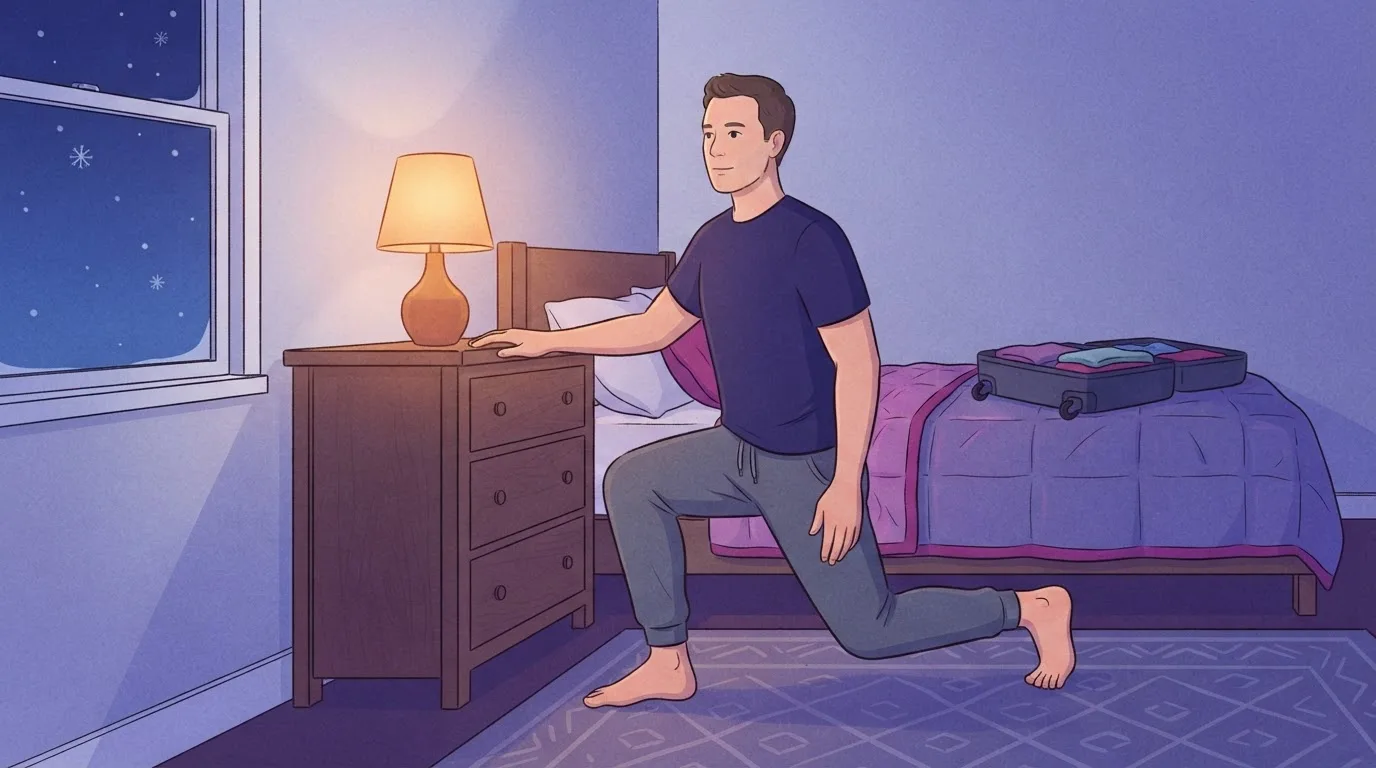
Use this one when you're sleeping in a relative's spare room and someone is always on the other side of the wall. There's no jumping, and all it needs is a floor, a wall and a sturdy dresser or windowsill. Do each move for 45 seconds, rest for 15 seconds, and go through the list twice.
- Split squats with one hand on the dresser for balance, switching legs halfway
- Incline push-ups with your hands on the dresser or windowsill
- Glute bridges on the floor
- Bird dogs, alternating sides slowly
- A wall sit
3. Thanksgiving morning: a 25-minute walk before the kitchen gets busy
The calmest part of Thanksgiving is usually the first hour, so head out before the cooking starts. Walk easy for 5 minutes, then alternate 1 brisk minute with 2 easy minutes six times, and finish with 2 easy minutes. Brisk means you can still talk but couldn't sing.
Bring whoever is awake. If your town runs a turkey trot, walking the 5K counts too. If the sidewalks are icy, do the one-set strength session indoors instead.
4. The after-dinner walk (10 to 15 minutes)
This is the easiest holiday workout to get the whole family to do. Walk at an easy pace for 10 to 15 minutes, starting soon after the meal. A 2022 meta-analysis by Buffey and colleagues pooled seven one-day trials, mostly in adults with overweight or obesity. Short, light walks that broke up long sitting lowered blood sugar and insulin after meals, and they beat standing breaks. Our review of walking after meals covers how much the timing matters.
5. Christmas Day: a 6- to 12-minute ladder before the presents
Christmas morning moves fast once the presents come out, so go first. The 12 days of Christmas workout follows the song: each day adds a new move and counts back down through the earlier ones. Days 1 to 6 take about 6 minutes and days 1 to 9 about 12. There are four levels, and the Beginner level has no jumping.
Save the whole song, about 24 minutes, for a slower day between Christmas and New Year's. On Christmas Day itself, a short ladder before breakfast is plenty.
6. Family follow-the-leader (15 minutes)
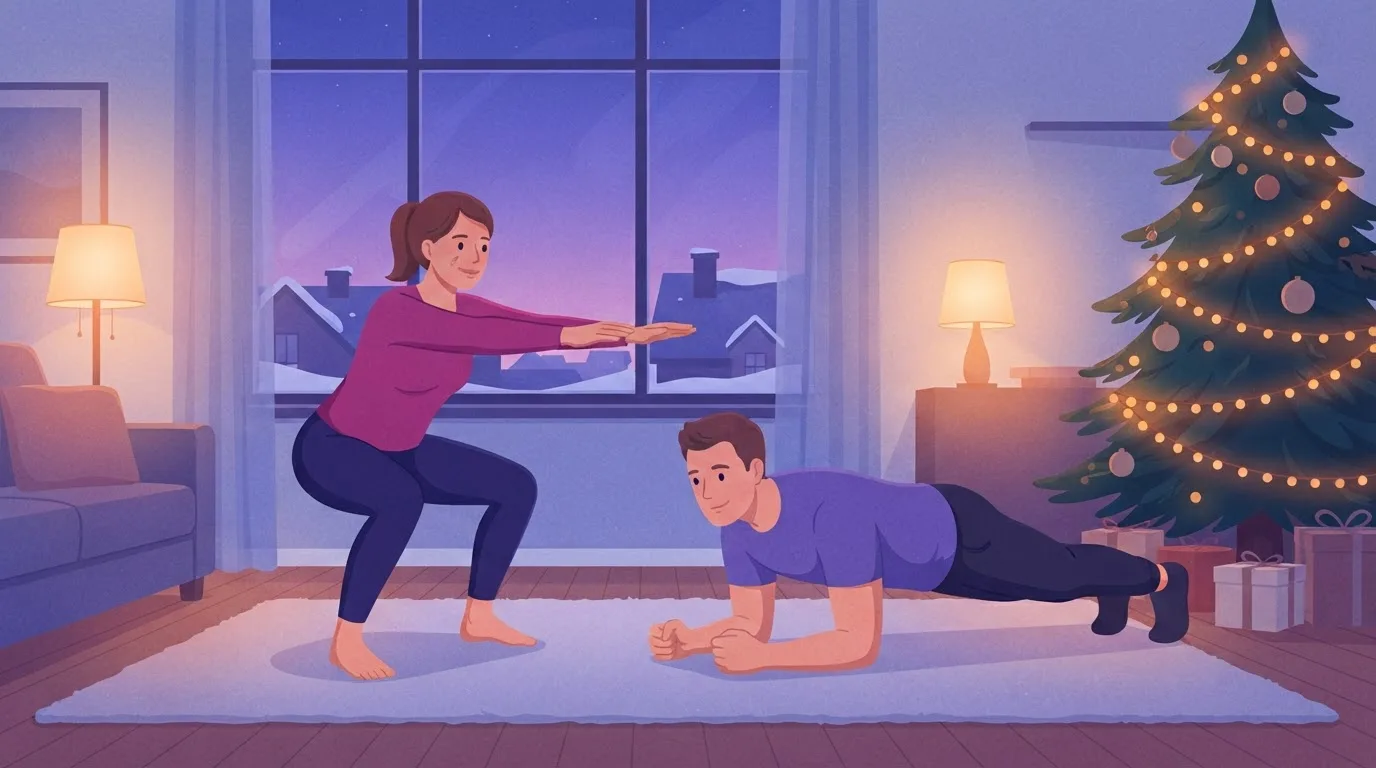
This one works with kids, teenagers and grandparents in the same room. Stand in a circle. One person picks a move, and everyone does their own version of it for 40 seconds. Rest for 20 seconds, then the next person picks. Keep going around the circle for 15 minutes.
Good picks are squats to a chair, wall push-ups, marching in place, arm circles, a plank with knees down, and jumping jacks or step-jacks. Let everyone choose how hard to go. A 7-year-old and a 70-year-old can do the same move at very different sizes, and nobody comments on anyone else's version.
7. The travel-day reset (5 minutes, every hour or two)
Travel days are mostly sitting. Every hour or two, at the gate, on a layover or at a rest stop, walk for 3 minutes, then do 15 calf raises, 10 slow squats and 10 push-ups against a wall. The walking-break trials in item 4 support this, because short, light walks during long sitting kept blood sugar lower after meals.
When you arrive, our hotel room workout has a full 15-minute plan for a small room. If you travel a lot over the holidays, our ranking of the best workout apps for travelers compares which apps work offline and which fit the floor space between a bed and a desk.
Find out what's really holding you back
FitCraft, our mobile fitness app, pairs you with an AI coach who builds you a personalized plan around your goals, schedule, and fitness level. Every FitCraft program is designed by Domenic Angelino, MPH (Brown University) and NSCA-CSCS, with research published in the Journal of Strength and Conditioning Research and Medicine & Science in Sports & Exercise.
Take the Free Assessment Free • 2 minutes • No credit cardA Week-by-Week Holiday Workout Schedule, Thanksgiving to New Year's Day
This year the season runs from Thursday, November 26 to Friday, January 1, a little over five weeks. The schedule plans the busy weeks lighter and the quiet ones closer to normal. The last column is your floor, the least you'll do that week even if everything else falls apart.
| Week | What's going on | Plan | Your floor |
|---|---|---|---|
| Nov 23-29 | Thanksgiving week | One-set strength session on Monday and Saturday, the Thanksgiving morning walk, an after-dinner walk | 1 strength session |
| Nov 30-Dec 6 | A normal week | Your usual routine, or three one-set sessions and two 20-minute walks | 2 strength sessions |
| Dec 7-13 | Parties start | Three short sessions, mixing the one-set session and the guest room circuit | 2 strength sessions |
| Dec 14-20 | Shopping, school events, travel prep | Two one-set sessions and a weekend walk | 1 strength session |
| Dec 21-27 | Christmas week and travel | Travel-day resets, the guest room circuit twice, the Christmas morning ladder, after-dinner walks | 1 strength session |
| Dec 28-Jan 3 | The quiet week | Three sessions and a long walk on New Year's Day | 2 strength sessions |
Add up the floor column and you get nine strength sessions in six weeks, never fewer than one a week. By the numbers in the next section, that's enough to hold your strength, as long as every session is hard.
The week between Christmas and New Year's is often the easiest week of the season to train, because many people are off work. Use it to set up January. If you want a month-long plan after the holidays, our January workout challenge starts on New Year's Day with a 31-day calendar for beginners. For a plan built around your own days and equipment, the AI workout generator turns five answers into a weekly plan with sets, reps and rest.
How Little Training Keeps Your Fitness Through December
It takes much less than most people think. In a 2021 review, Spiering and colleagues gathered the research on the smallest dose of exercise that keeps fitness from fading. As long as the effort stayed high, they found these minimums:
- Strength and muscle in younger adults: one strength session a week, with one set per exercise, kept both for up to 32 weeks.
- Muscle size in older adults: up to two sessions a week and two to three sets per exercise.
- Endurance: two sessions a week, or a third to two thirds less training, kept it for up to 15 weeks. Sessions were as short as 13 to 26 minutes.
The holiday season is about five weeks, well inside each of those windows. The one thing you can't cut is effort. The review's main conclusion was that intensity is the key to keeping fitness, so keep the weights heavy or the reps hard, and trim sets and days instead.
One of the trials behind those numbers is Bickel and colleagues (2011). Seventy adults, aged 20 to 35 or 60 to 75, lifted three days a week for 16 weeks. Then for 32 weeks they either stopped or trained at a third or a ninth of their earlier dose. Both reduced doses kept the younger group's muscle growth but not the older group's, and the strength people had gained was largely kept even by those who stopped. Our page on the science of detraining walks through this trial and how fast each kind of fitness fades.
A full break costs less than you'd fear, too. In a 2013 trial by Ogasawara and colleagues, 14 young men did bench press training for 24 weeks, either straight through or in six-week blocks with three-week breaks between them. By the end, both groups had gained about the same muscle and strength, even though the break group trained six fewer weeks. The real risk in December is drifting into January with no restart date. Our guide on what to do when you miss a workout covers the first session back.
For general health, the bar is lower still. Our review of the minimum effective exercise dose covers how little daily movement it takes to protect your long-term health.
Can a Holiday Workout Burn Off Holiday Food?
Mostly no, and it doesn't need to. In a 2000 study by Yanovski and colleagues, 195 adults gained an average of 0.37 kg, under a pound, between mid-November and early January. That's far less than the 5 pounds people often claim. The catch is that the gain wasn't lost the following spring or summer.
Exercise alone didn't prevent the gain in a later study. Stevenson and colleagues (2013) weighed 148 adults in mid-November and again in early January, and on average they gained 0.78 kg. Regular exercisers, who averaged almost five hours a week, weren't protected. Starting weight predicted who gained, and exercise didn't.
So train over the holidays for strength, energy, mood and the habit you'll want in January. The scale mostly follows what you eat. A walk after dinner won't burn off the pie, but it does help with the rise in blood sugar that follows a big meal.

How to Fit Short Sessions In With Family Around
- Go first. Train before the house wakes up or before the first guests arrive. Later in the day, plans tend to fill every gap.
- Invite people in. The after-dinner walk and follow-the-leader turn your workout into something the family does together, so nobody waits on you.
- Set a 5-minute floor. On the worst days, one round of the guest room circuit or one lap of the block counts. A tiny session still keeps the habit going into January.
- Say it out loud. Tell whoever you're staying with that you'll be gone for 20 minutes at 7. People plan around what they know about.
- Keep your streak where you can see it. Cross off each day on a paper calendar, or let an app count it for you.
If you train with FitCraft, an AI coach who says your name leads each session and demonstrates every move on an interactive 3D model, so a 10-minute workout in a spare room still feels coached. Streaks and calendar rewards make the short days count, and each month brings a new quest themed for the season.
The Bottom Line
A holiday workout only has to hold your fitness, and that takes far less than a normal month of training. Do at least one hard strength session a week, walk after big meals, shrink sessions instead of skipping them, and put your first January workout on the calendar before Christmas.
Working out consistently is hard, but it doesn't have to be. As Stacy, 41, put it, "After my second kid, I needed something stupidly simple." Short and simple is what gets you through the holidays too.
Frequently Asked Questions
How do I stay fit during the holidays?
Do two or three short workouts a week, with at least one hard strength session, and walk after big meals. A 2021 review by Spiering and colleagues found that one strength session a week, with one set per exercise, kept younger adults' strength and muscle for up to 32 weeks. That's far longer than the five-week holiday season.
Is it okay to take a week off from working out over the holidays?
Yes, a week off costs very little fitness. In a 2013 trial by Ogasawara and colleagues, three-week breaks between training blocks didn't reduce muscle or strength gains after 24 weeks. The bigger risk is failing to restart, so put your first session back on the calendar before the break begins.
How long should a holiday workout be?
Ten to 20 minutes is enough on most holiday days if the work is hard. Spiering and colleagues (2021) found that endurance held with sessions as short as 13 to 26 minutes, and strength held with one set per exercise, as long as the effort stayed high.
Can you work off holiday meals with exercise?
Mostly no. In a 2013 study by Stevenson and colleagues, regular exercisers, who averaged almost five hours a week, still gained weight between mid-November and early January, and exercise didn't predict who gained. Holiday workouts keep your fitness, and the scale mostly follows what you eat.
What can I do for exercise with family over the holidays?
An after-dinner walk is the easiest thing to get everyone to do. Indoors, try follow-the-leader: each person picks a move, everyone does their own version for 40 seconds, then the next person picks, for 15 minutes in all.