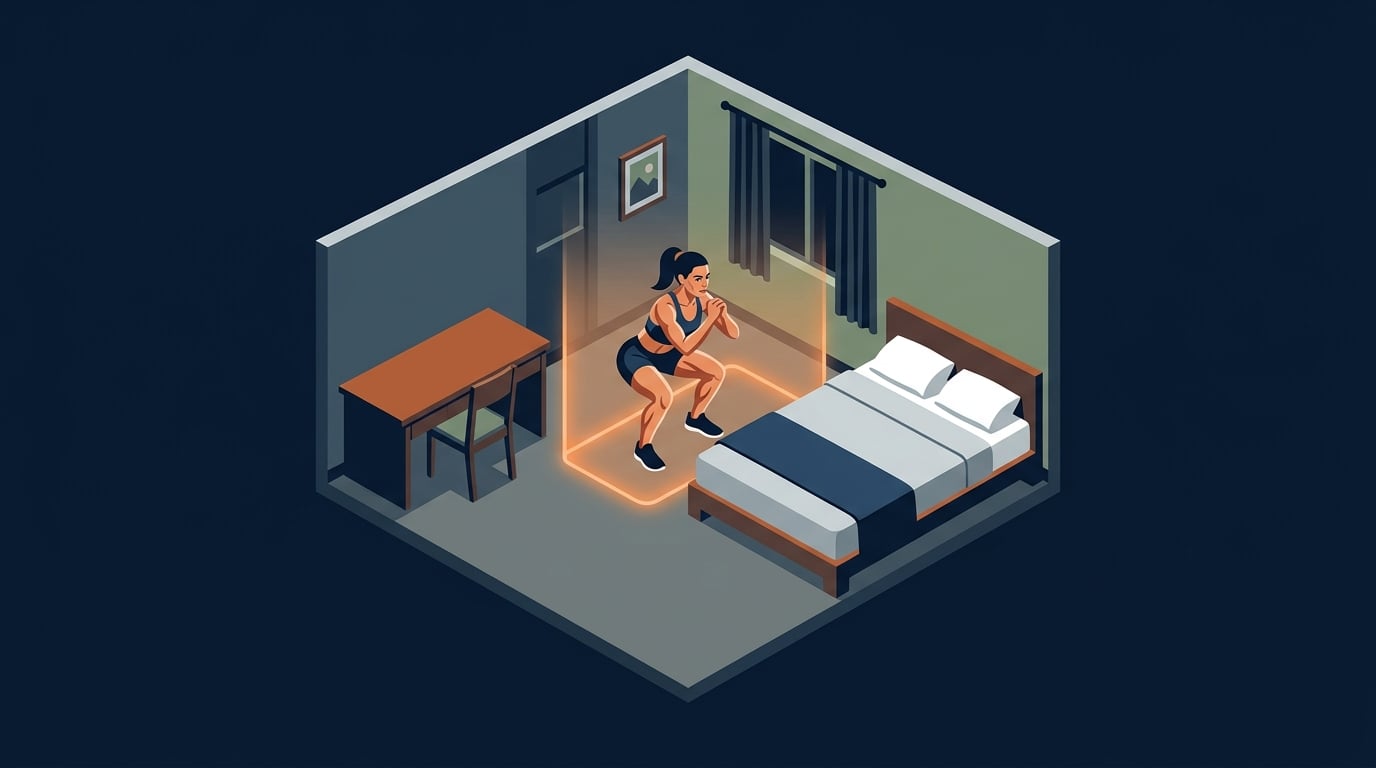
The hotel gym is closed, or it has two treadmills and a single 10 lb dumbbell, or it is on the far side of a lobby you would have to get dressed to cross. You've got a room, a bed, roughly six feet of carpet, and someone sleeping directly underneath you.
This is where most travel routines die. Not because people stop caring, but because the plan they follow at home assumes a rack, a schedule, and a floor nobody else is standing under. None of that came in the suitcase.
So here is a routine designed for the actual constraints. It fits beside the bed, it needs nothing you didn't already pack, and every movement in it is quiet.
What a Hotel Room Actually Gives You
Before the workout, the inventory. Hotel rooms vary wildly, but four things are nearly always present, and each one solves a problem.
- Floor space beside the bed. Usually about six feet long and three feet deep. That's enough for a plank, a lunge, and a push-up, which is most of what you need.
- A wall corner or door frame. This is the piece people overlook, and it's the difference between a decent session and half a session. It gives you a pulling exercise without a single piece of equipment.
- A bed or desk edge. Instant incline for push-ups, which lets you scale the hardest movement in the circuit up or down.
- A wall. Wall sits, wall-supported balance work, and a straight-back reference for form.
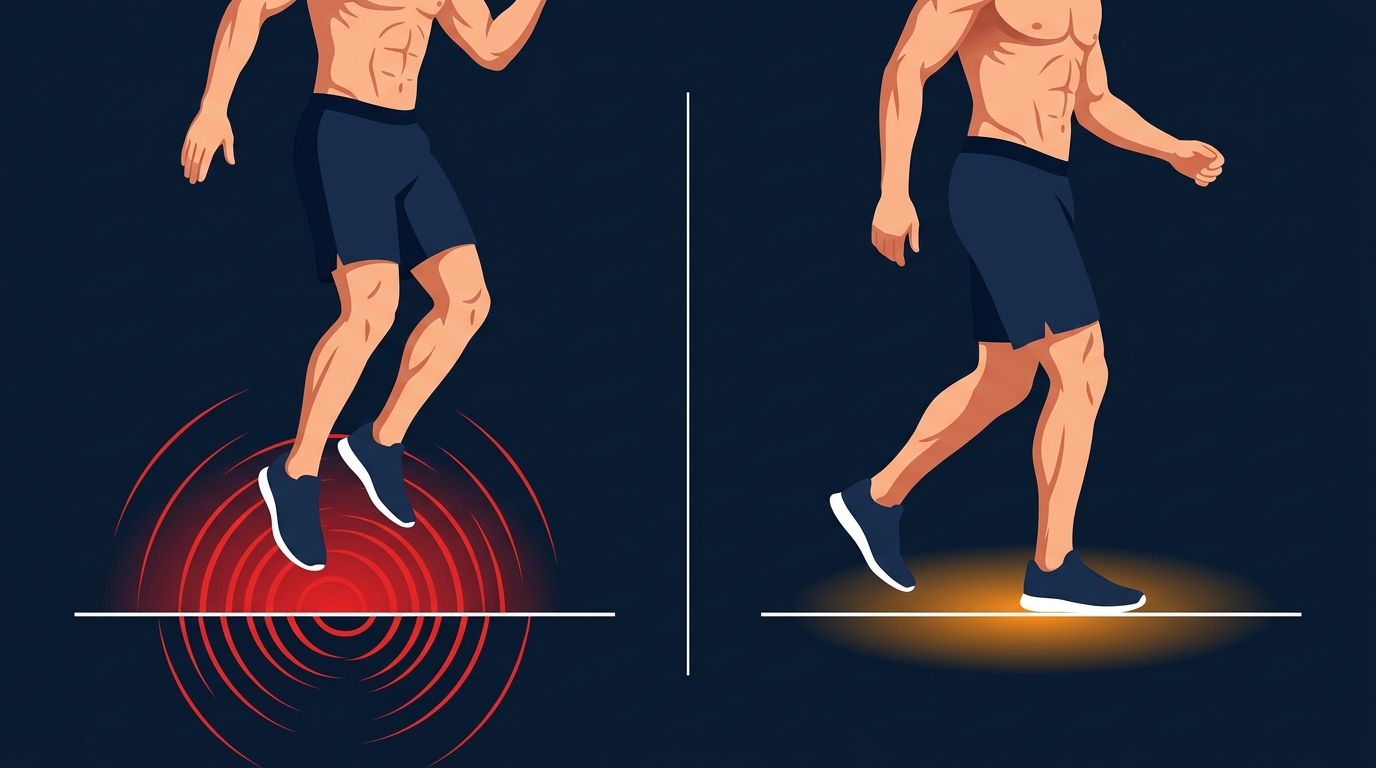
And one constraint that shapes everything: someone is underneath you. Impact travels through hotel floors far better than sound does through walls. That single fact rules out every jump, and it turns out not to cost you much, which we'll get to.
The 15-Minute Hotel Room Workout
Five exercises, 40 seconds of work, 20 seconds of rest, three rounds. Fifteen minutes end to end including the warm-up. This is deliberately built as a circuit rather than straight sets, because circuit-style bodyweight training was designed for exactly this problem: Klika and Jordan's 2013 protocol in ACSM's Health & Fitness Journal used body weight, a chair, and a wall to deliver a full-body session in minutes, and it became the most-shared workout of its decade for a reason.
Warm-up, 2 minutes
- Shoulder rolls, 20 seconds each direction. Undoes some of what the plane seat did.
- Cat cow, 8 slow reps.
- Marching in place, 45 seconds.
- Bodyweight squats, 10 reps, slow and unloaded.
The circuit, 3 rounds
- Squats, 40 seconds. Three seconds down, one second up. The slow lowering is what makes an unweighted squat worth doing.
- Push-ups, 40 seconds. If you fail before 8 reps, put your hands on the desk or the edge of the bed and do incline push-ups instead. Higher surface, easier movement.
- Corner rows, 40 seconds. Stand facing a wall corner or an open door frame, grip the edge, lean back with straight arms, and pull yourself upright. This is your pulling exercise, and it's the reason this circuit is balanced instead of being another push-only travel routine.
- Rear lunges, 40 seconds. Alternate legs. Stepping back rather than forward keeps the load off the front knee and takes less floor space.
- Forearm plank, 40 seconds. Squeeze the glutes so the lower back stays flat rather than sagging.
Rest 45 seconds between rounds. That's the whole session.
Scaling it
- 10 minutes: two rounds instead of three. Still a real workout, and vastly better than the zero you were considering.
- 20 minutes and stronger: four rounds, and swap squats for split squats and push-ups for pike push-ups. Both are meaningfully harder without adding equipment or noise.
- Add a core finisher: glute bridges for 15 reps, side planks for 30 seconds a side, and deadbugs for 10 a side. Roughly three extra minutes.
- Sore from travel: replace round three with bird-dogs, superman holds, and calf raises. Calves in particular take a beating from a long flight and a day in dress shoes.
If short sessions are your normal situation rather than a travel-only one, our guide on quick workouts under 20 minutes goes deeper on how to structure them across a week. For a whole week of short sessions, choose no equipment and 10 to 20 minutes in our generator to get a weekly workout plan built around them.
Find out what's really holding you back
FitCraft, our mobile fitness app, pairs you with an AI coach who builds you a personalized plan around your goals, schedule, and fitness level. Every FitCraft program is designed by Domenic Angelino, MPH (Brown University) and NSCA-CSCS, with research published in the Journal of Strength and Conditioning Research and Medicine & Science in Sports & Exercise.
Take the Free Assessment Free • 2 minutes • No credit cardWhy Bodyweight Work Still Counts
The standard objection is that without weight, none of this does anything. The research says otherwise, and the mechanism is worth understanding because it changes how you run the circuit.
Schoenfeld and colleagues (2017) pooled 21 studies comparing low-load training at 60% of one-rep max or less against heavier training, with all sets taken to momentary muscular failure. Muscle growth was similar between them. Maximal strength favored the heavy loads, as you would expect, but the size outcome held.
The condition attached to that finding is the important part: taken close to failure. A set of 20 easy squats does nothing. A set of squats where the last three are genuinely hard does most of what a loaded set would. So on a travel circuit, effort is the variable you control, not weight.
Which is also why the tempo instruction isn't decorative. Lowering over three seconds instead of one roughly doubles the time under tension per rep and brings a bodyweight set into the range where it actually challenges the muscle. Quiet and hard turn out to be the same instruction.
Training Without Annoying the Room Below
Sound through walls is mostly a non-issue. Impact through floors is the real one, and it's the complaint hotels actually receive. The fix is a set of direct swaps.
- Jumping jacks become step-n-claps. Same arm pattern, same heart rate, one foot on the floor at all times.
- High knees or running in place become marching in place or walking in place.
- Burpees become walk-outs. Walk the hands out to a plank and back instead of jumping into and out of it.
- Jump squats become slow squats with a three-second lowering phase.
- Mountain climbers become deadbugs or bird-dogs when you want the core work without the drumming.
Three more practical notes. Train on the carpet rather than the tiled entryway, since hard floors transmit far more. Keep floor work away from the connecting door, which is the thinnest surface in the room. And if you're in an older building or on a high floor, add a folded towel or a bath mat under your hands and feet, which takes care of the residual thud on planks and push-ups.
The same swap list works in an apartment with downstairs neighbors, which is most people's other version of this problem. Our broader guide to home workouts that actually work covers the progression side of training without a gym.
What Is Worth Packing
Short section, because the honest answer is short: almost nothing, and one thing.
One long resistance band. This is the single item worth the space. It weighs a couple of ounces, packs flat, and genuinely extends what you can train. Lopes and colleagues (2019) reviewed trials comparing elastic resistance with conventional weights and machines and found comparable strength gains across a range of populations and program designs. Bands are not a compromise version of weights for this purpose. They are a different tool with similar output.
A door anchor, if you want pulling. A small nylon strap with a rubber stopper, a few dollars, weighs nothing. Wedge it in the door hinge side and your band becomes rows, pull-aparts, and face pulls. Corner rows already cover you if you'd rather pack nothing at all. If you go the band route, our guide to resistance band workouts has the full movement list.
What to leave home. A jump rope is excellent cardio and close to useless in a hotel room, since most rooms lack both the ceiling height and the neighborly goodwill. Ankle weights are dead weight in a suitcase for what they give you. Sliders work on hard floors and do nothing on the low-pile carpet most rooms have, and a hand towel does the same job on the surfaces where sliding is possible at all.
Suspension trainers sit in the middle. Genuinely capable, genuinely more to carry, and dependent on finding a door that closes securely in the right direction. If you already own one and train with it, bring it. If you're buying one for travel, buy the band first.
Staying Consistent When the Routine Breaks
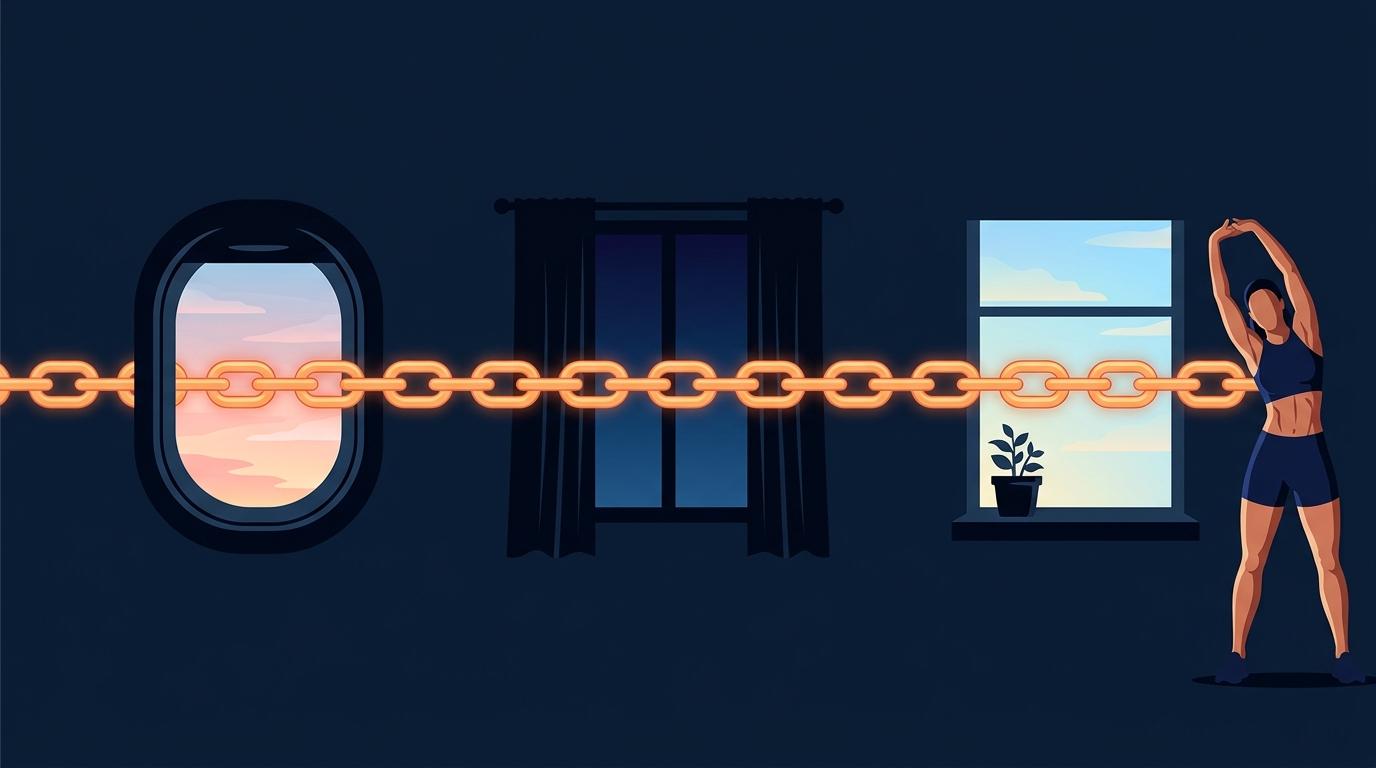
The workout is the easy part. What actually ends travel training is that the structure holding your habit together is made of context, and travel deletes the context.
Behavioral researchers call this the habit discontinuity effect. Verplanken and Roy (2016) tested it in a field experiment and found that when a context change disrupts someone's habits, their behavior stops running on autopilot and becomes a deliberate decision again. That's genuinely useful when you want to change a habit. It's exactly the wrong thing when you want to keep one, because the cue that used to launch the workout without your involvement is now 3,000 miles away.
Three things help.
Anchor to an event, not a clock
Time zones move; sequences do not. "Before my morning shower" survives a flight to Frankfurt. "6:30 am" does not, and after two days it means nothing to your body anyway. Pick a fixed point in your day that travels with you and hang the session off it.
Shrink the session until skipping it is absurd
The right travel session is the smallest one you'll definitely do. Two rounds of the circuit. Or one, on a genuinely brutal day. The version of this workout you complete on the day you land beats the full version you plan for the next morning and then miss because the meeting ran long.
This matters more than people expect, because business travel isn't a neutral environment. Rundle and colleagues (2018) analyzed health records from more than 18,000 employees in a corporate wellness program and found that people away from home 21 or more nights a month were significantly more likely to be sedentary, sleep poorly, and score above clinical thresholds for anxiety and depression symptoms than people traveling one to six nights. The gradient runs through the middle of the range too. The default on the road is doing less, so the plan has to be small enough to beat the default.
Stop treating a missed week as a reset
This is where most of the damage happens, and it's almost entirely a story people tell themselves rather than a physiological fact.
Halonen and colleagues (2024) randomized 55 untrained adults to either 20 continuous weeks of resistance training or a periodic version: 10 weeks on, 10 weeks completely off, then 10 weeks on again. The break group regained its pre-break strength within roughly five weeks of restarting, and both groups finished the study in a similar place. A full 10-week layoff cost them a delay, not their progress.
Set that against a four-night trip and the arithmetic is obvious. Detraining over a week away is a rounding error. The cost isn't the missed sessions. It's the week after, when the streak is broken and restarting feels like starting over, which is the pattern we dug into in the research on streak psychology.
Practically: put the first session back on the calendar before you leave, and make it an easy one. You're not making up for lost work. You're re-establishing the cue.
Where an app helps, and where it doesn't
An app cannot make a hotel room bigger. What it can do is remove the two decisions that kill travel sessions: what to do, and whether today counts.
FitCraft is built around that second problem. Bodyweight is one of its workout types, so the plan doesn't break when the hotel gym does, and there are resistance band workouts too if you packed one. An AI coach takes you through the session as a 3D character rather than a list you have to interpret at 6 am in an unfamiliar room, and the interactive 3D exercise demos let you check a movement you haven't done in a while without hunting for a video. Calendar tracking and calendar rewards keep the trip visible as part of your record rather than a hole in it, and the leveling and XP system means a short session still moves something forward.
If you're comparing options for this specific use case, we ranked them in the best workout apps for travelers, and the no-equipment question has its own page at our home workout app for training without equipment.
The Bottom Line
A hotel room gives you six feet of floor, a wall corner, and a bed edge. That's enough for a balanced 15-minute session that covers every movement pattern, makes no noise, and needs nothing from your suitcase. Run it three rounds when you can, two when you can't, and pack a band if you want to go further.
And on the trips where none of it happens, remember what the detraining research actually says. You haven't lost the work. You've paused it. The only thing that matters is how quickly you start again, and that's a scheduling decision, not a character flaw.
Frequently Asked Questions
What is a good hotel room workout?
A good hotel room workout is a short bodyweight circuit that covers all four movement patterns in the floor space beside the bed. Run five exercises for 40 seconds each with 20 seconds of rest, three rounds through: squats for legs, push-ups for pushing, corner rows against a wall corner for pulling, rear lunges for single-leg work, and a forearm plank for core. That takes about 15 minutes, needs no equipment, and stays quiet enough for the room below because nothing in it involves jumping.
How do I work out while traveling?
Anchor the session to an event rather than a time. Time zones move, but the moment before your morning shower does not, so attach the workout to that cue and it survives the trip. Then shrink the session until it is impossible to skip: 15 minutes of bodyweight circuit work in your room beats a hotel gym visit you keep postponing. Pack one long resistance band if you want more, and accept two or three sessions across a week away rather than trying to replicate your normal schedule.
Can you get a good workout in a hotel room?
Yes, for maintenance and for general fitness. Schoenfeld and colleagues' 2017 meta-analysis found that low-load training taken close to failure builds muscle comparably to heavy training, which is the mechanism that makes bodyweight work count. What a hotel room cannot give you is heavy loading for maximal strength, so treat travel weeks as maintenance rather than progression and resume your normal program when you get home.
How do I work out quietly in a hotel room?
Remove every jump and slow everything else down. Swap jumping jacks for step-n-claps, high knees for marching in place, burpees for walk-outs, and jump squats for squats lowered over three seconds. Slowing the tempo increases time under tension, so the quiet version is often harder than the loud one. Train on the carpet rather than by the door, and keep the plank and floor work away from the shared wall.
What workout equipment should I take when I travel?
One long resistance band, and a door anchor if you want pulling exercises. A band weighs a couple of ounces and packs flat, and Lopes and colleagues' 2019 meta-analysis found elastic resistance produces strength gains comparable to conventional weights. Skip the jump rope, because most hotel rooms have neither the ceiling height nor the tolerant neighbors for it, and skip ankle weights entirely.
Will I lose fitness if I skip workouts for a week of travel?
No. Halonen and colleagues' 2024 trial gave one group a full 10-week break in the middle of a training block, and that group regained its pre-break strength within about five weeks of restarting and finished level with the group that never stopped. A four-day trip is not the problem. The problem is when the trip becomes the reason you never restart, which is why the size of the first session back matters more than the size of the ones you missed.