You bought a stability ball for the living room, and now it mostly sits in a corner. The workout videos move too fast to follow, the ball rolls away the first time you try a plank on it, and you're not even sure it's the right size.
What's usually missing is a plan with real numbers, covering which moves to do, how many reps, and when to make them harder. This guide sets it out in tables you can follow without pausing a video.
An exercise ball goes by plenty of names, including Swiss ball, gym ball, balance ball and fitness ball, and they all mean the same tool. Below are 10 stability ball exercises with sets, reps and form cues, a size chart by height, a 20-minute workout, and what the research says the ball adds.
10 Stability Ball Exercises With Sets, Reps and Form Cues
The list runs from easiest to hardest. Learn each move on the floor first if it has a floor version, and keep the ball near a wall or sofa for your first few sessions so it can't roll far.
| # | Exercise | What it trains | Sets x reps | Level |
|---|---|---|---|---|
| 1 | Seated march | Balance and deep core | 2 x 10 per leg | Beginner |
| 2 | Wall squat with the ball | Quads and glutes | 2-3 x 10-12 | Beginner |
| 3 | Ball glute bridge | Glutes and hamstrings | 3 x 10-12 | Beginner |
| 4 | Ball dead bug | Deep core and front abs | 2-3 x 6-8 per side | Beginner |
| 5 | Ball crunch | Front abs | 2-3 x 10-15 | Beginner |
| 6 | Ball back extension | Lower back and glutes | 2-3 x 10-12 | Beginner |
| 7 | Ball hamstring curl | Hamstrings and glutes | 2-3 x 8-12 | Intermediate |
| 8 | Ball rollout | Abs, obliques and lats | 2-3 x 6-10 | Intermediate |
| 9 | Ball knee tuck, then pike | Abs, hip flexors and shoulders | 2-3 x 8-10 | Intermediate to advanced |
| 10 | Push-up with shins on the ball | Chest, triceps and core | 2-3 x 6-10 | Advanced |
1. Seated march
Sit tall in the middle of the ball with your feet flat and hip-width apart and your hands resting on the ball beside your hips. Brace your stomach lightly, lift one foot an inch or two off the floor, hold for two seconds, and switch. Keep your hips level. In an EMG study by Escamilla and colleagues (2010), the sitting march produced the lowest muscle activity of any move tested, so treat it as a balance warm-up.
2. Wall squat with the ball
Stand with the ball between your lower back and a wall, your feet about a step in front of you and hip-width apart. Bend your knees and let the ball roll up your back as you sit down, stopping when your thighs are about level with the floor or wherever feels steady. Push through your whole foot to stand. Hold the bottom for 20 to 30 seconds to turn it into a ball wall sit.
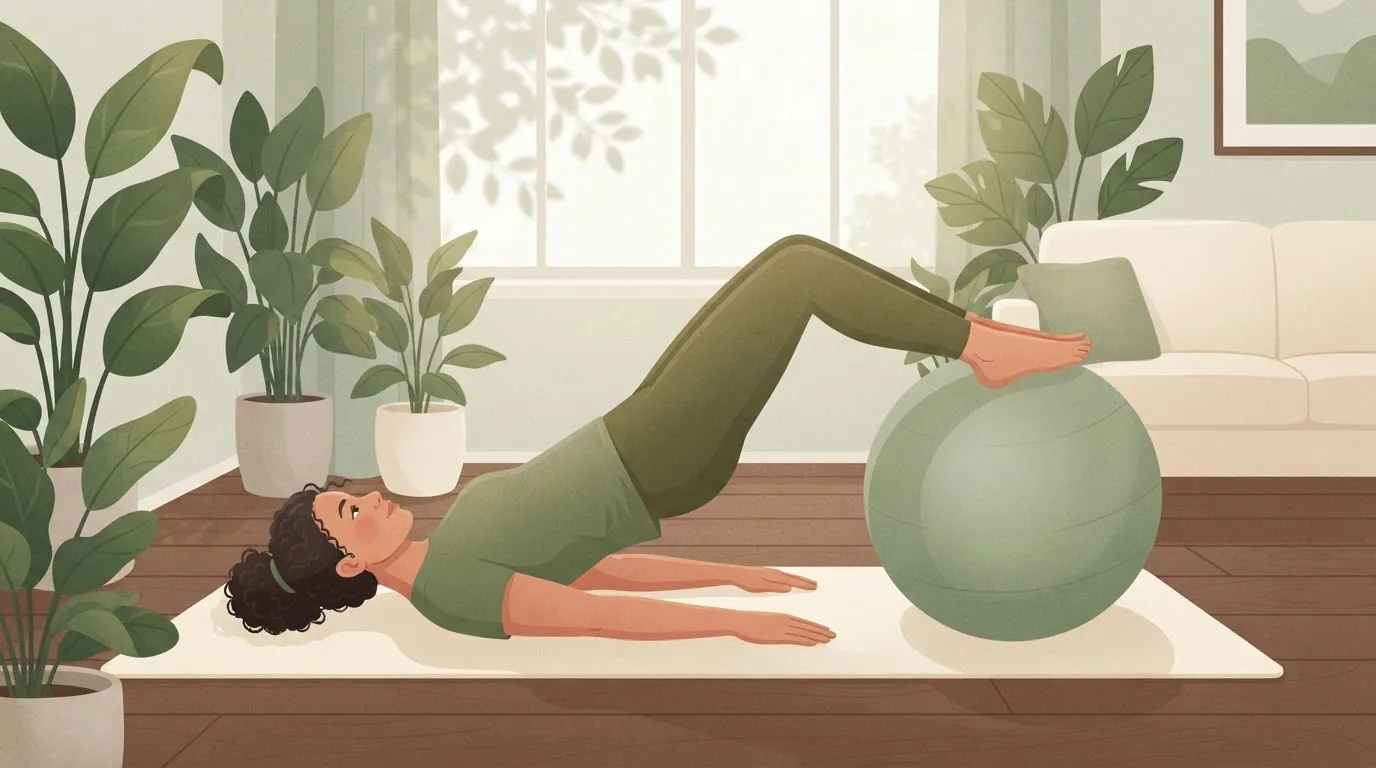
3. Ball glute bridge
Lie on your back with your heels on top of the ball and your arms flat on the floor. Squeeze your glutes and lift your hips until your body makes a straight line from shoulders to heels, pause for a second, then lower. The ball tries to roll sideways, so your hips and trunk work to keep it centered. If it feels too wobbly, start with the floor glute bridge.
4. Ball dead bug
Lie on your back with your hips and knees bent to 90 degrees and the ball held between your hands and knees. Press your lower back gently toward the floor. Straighten your right arm overhead and your left leg out while your other hand and knee keep pressing the ball, then return and switch. If your back arches, shorten the reach. Our dead bug page shows the floor version.
5. Ball crunch
Sit on the ball, then walk your feet forward until it sits under your middle and lower back, with your feet flat and wide for balance. Cross your hands over your chest, curl your ribs toward your hips, then lower back over the curve of the ball. Lowering past flat lets your abs work through a longer range than a floor crunch. Our guide to crunches vs sit-ups compares the floor versions.
6. Ball back extension
Lie face down with the ball under your hips and stomach and your feet wide on the floor, or braced against a wall. Start rounded over the ball, then lift your chest until your body forms a straight line, squeezing your glutes, and lower slowly. Stop at straight instead of arching past it. In the Escamilla study, lower back muscle activity stayed under 10% of maximum in every exercise tested, so this is the move on this list aimed at your back.
7. Ball hamstring curl
Start in the bridge from move 3, with your hips lifted and your heels on the ball. Keeping your hips up, bend your knees to pull the ball toward you, then roll it back out until your legs are straight. Don't let your hips sag between reps. If that's too hard, curl the ball in with your hips on the floor first, then add the lift.
8. Ball rollout
Kneel facing the ball with your forearms on top of it and your body in a line from knees to head. Roll the ball forward by reaching your arms out and letting your hips follow, only as far as you can keep your lower back from sagging, then pull it back with your abs. Start with a short roll, or hold a forearm plank on the ball for 20 seconds.
9. Ball knee tuck, then pike
Walk your hands out from the ball into a push-up position with your shins on top of it and your hands under your shoulders. Pull your knees toward your chest so the ball rolls in, then straighten back out. When that feels easy, try the pike, keeping your legs straight and lifting your hips toward the ceiling. In the Escamilla study the pike reached 84% of maximum in the external obliques, the highest external oblique reading of any exercise tested.
10. Push-up with shins on the ball
Set up as for the knee tuck, with the ball under your shins and your body in one straight line, and do a push-up. The farther the ball sits from your hands, the harder it gets, so start with it under your thighs and move it toward your feet over the weeks. Our push-up page covers floor form.
What Size Stability Ball Do I Need?
Most adults need a 55 cm stability ball if they're 5 feet to 5 feet 7 inches tall, or a 65 cm ball if they're 5 feet 8 to 6 feet 2. The chart below follows a James Madison University kinesiology guide.
| Your height | Ball size |
|---|---|
| Under 5 ft (under 152 cm) | 45 cm |
| 5 ft to 5 ft 7 in (152 to 170 cm) | 55 cm |
| 5 ft 8 in to 6 ft 2 in (173 to 188 cm) | 65 cm |
| 6 ft 3 in and taller (191 cm and up) | 75 cm |
Height is only a starting point. To check the fit, sit in the middle of the inflated ball with your feet flat on the floor. Your knees should bend to about 90 degrees, with your thighs roughly level with the floor. If your knees sit well above your hips, go up a size, and if your feet barely reach the floor, go down one.
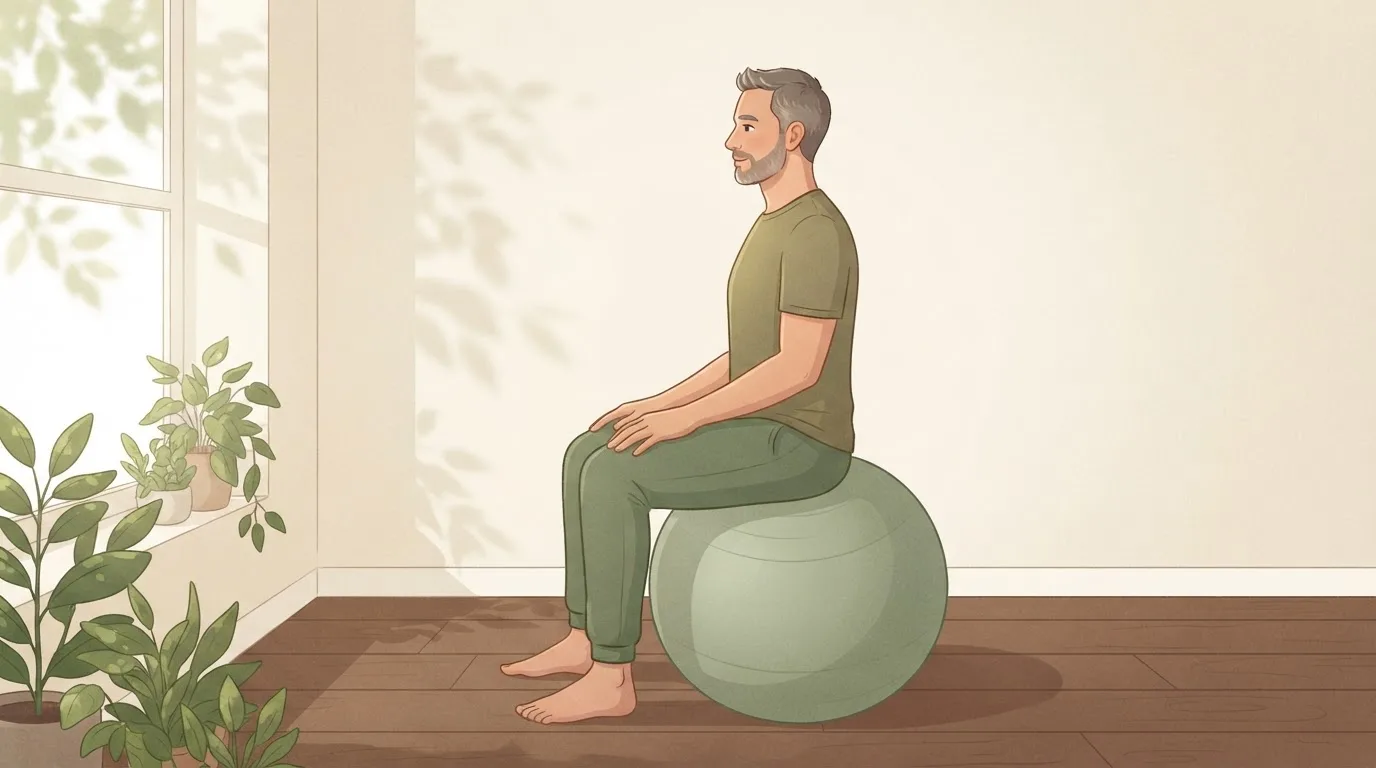
Inflate the ball to the diameter printed on the box and no harder. A soft ball sags under you, and an overinflated one is more likely to burst, as the safety section below explains.
Find out what's really holding you back
FitCraft, our mobile fitness app, pairs you with an AI coach who builds you a personalized plan around your goals, schedule, and fitness level. Every FitCraft program is designed by Domenic Angelino, MPH (Brown University) and NSCA-CSCS, with research published in the Journal of Strength and Conditioning Research and Medicine & Science in Sports & Exercise.
Take the Free Assessment Free • 2 minutes • No credit cardA 20-Minute Stability Ball Workout
This stability ball workout takes about 20 minutes. Do it two or three times a week on non-consecutive days, and keep every rep slow and controlled.
Warm up for 2 minutes with 1 minute of the seated march and 1 minute of slow hip circles while sitting on the ball. Then work through the table in order.
| Order | Exercise | Sets x reps | Rest |
|---|---|---|---|
| 1 | Wall squat with the ball | 2 x 12 | 30 sec |
| 2 | Ball glute bridge | 2 x 12 | 30 sec |
| 3 | Ball hamstring curl | 2 x 8-10 | 45 sec |
| 4 | Ball dead bug | 2 x 6 per side | 30 sec |
| 5 | Ball crunch | 2 x 12 | 30 sec |
| 6 | Ball back extension | 2 x 10-12 | 30 sec |
| 7 | Ball rollout | 2 x 6-8 | 45 sec |
To make it easier, do the bridge, dead bug and crunch on the floor, and hold a forearm plank on the ball instead of rolling it out. To make it harder, add a third set, swap the crunch for knee tucks, and do the bridge and hamstring curl on one leg.
Add one or two reps a week. When you can do the top of a rep range with clean form on every set, move to the harder version of that exercise.
Are Stability Ball Exercises Effective? What the Research Shows
Stability ball exercises are effective for core strength, balance and muscle control, and they're a poor choice for building maximum strength.
The ball makes your abs work harder
Vera-Garcia and colleagues (2000) measured eight men doing curl-ups on the floor and on a ball. With the ball under their upper back, rectus abdominis activity rose from 21% to 35% of maximum, and external oblique activity doubled from 5% to 10%. The Escamilla team then compared eight ball exercises with the crunch and the sit-up in 18 adults. The rollout reached 63% of maximum in the upper abs and the pike 84% in the external obliques, more than most of the other exercises tested.
It improves balance and control, even in beginners
In a 5-week trial by Cosio-Lima and colleagues (2003), 30 untrained women did curl-ups and back extensions either on a ball or on the floor. The ball group improved more on balance tests and in muscle activity, though neither group got measurably stronger in that time. Over a longer run, Sekendiz and colleagues (2010) found that sedentary women doing 45-minute ball core sessions three times a week for 12 weeks improved trunk and leg strength, endurance, lower back flexibility and balance.
In a 7-week trial by Kibele and Behm (2009), 40 people new to resistance training gained about as much from training on unstable surfaces as on stable ones. For a beginner at home, that means a ball program is a reasonable way to start.
It's a poor platform for heavy lifting
When 10 men did a chest press lying on a ball, their maximum force in a static press was 59.6% lower than on a bench, though muscle activity didn't differ significantly (Anderson and Behm, 2004). Uribe and colleagues (2010) found the same muscle activity for dumbbell chest and shoulder presses on a ball as on a bench, at 80% of each man's bench maximum.
The Canadian Society for Exercise Physiology position stand by Behm and colleagues (2010) concludes that unstable surfaces lower force, power, speed and range of motion, so they shouldn't be the main training mode for athletes. It adds that they can help in rehab and for people who'd rather not lift free weights, and that standing free-weight lifts such as squats and deadlifts work the core as hard or harder.
It won't carry over to everything
Stanton and colleagues (2004) split 18 teenage athletes into a control group and a group that did ball training twice a week for six weeks. The ball group's core stability scores improved, but their running economy, VO2max and running posture didn't change. Use the ball for core control and balance, and train other skills directly.
How to Use a Stability Ball Safely
A stability ball is safe for most people when it's the right size, properly inflated and used on a clear floor. These habits cover the common mistakes.
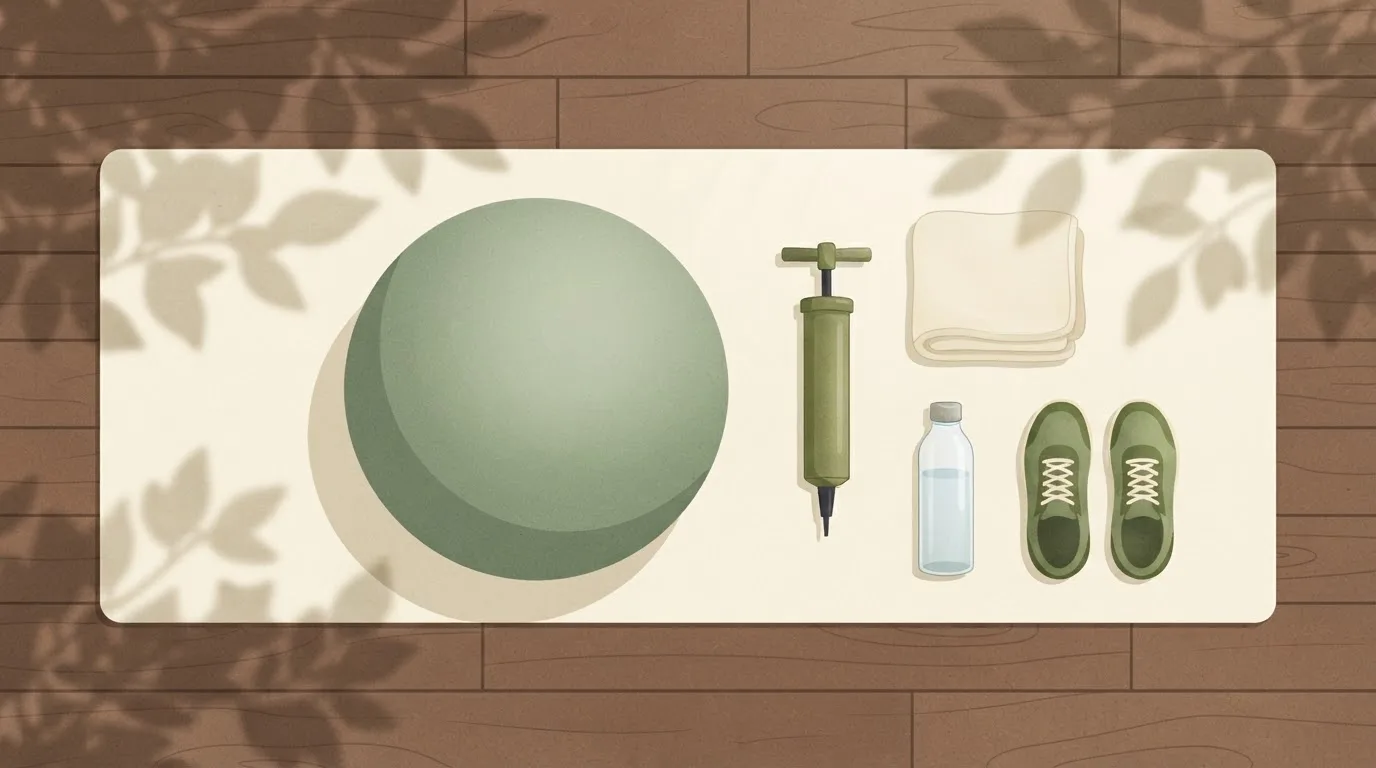
- Buy an anti-burst ball. A ball labeled anti-burst or burst-resistant is designed to deflate slowly if it's punctured instead of popping. Check that its weight rating covers you plus any dumbbells you'll hold.
- Don't overinflate it. In 2009 the U.S. Consumer Product Safety Commission announced a recall of about 3 million fitness balls with new inflation instructions, warning that an overinflated ball can burst during use. The company had 47 reports of bursting balls, including a fracture.
- Clear the floor. Use the ball on a mat or carpet, away from sharp corners, heaters and anything that could puncture it.
- Dress for grip. Wear a shirt, because sweaty skin slides on the ball, and shoes with good grip.
- Start next to a wall. Learn each new move beside a wall or sofa, and never stand or kneel on top of the ball.
- Keep dumbbells light. Hold weights on the ball only once a move is steady without them. Lying on a ball cuts the force you can produce by more than half.
- Check the ball often. Look for cracks, thin spots and slow leaks every few weeks, and replace a ball that won't hold its size.
Where a Stability Ball Fits in Your Week
A stability ball covers core, balance and some leg work, but it can't carry a whole program. Two short ball sessions a week pair well with two strength sessions on solid ground, where you can load your legs, back and arms harder. Our guide to core stability exercises covers the floor-based side of core training, such as the bird dog and side plank.
FitCraft plans that strength side with bodyweight and dumbbell workouts. A 3D AI coach demonstrates each exercise on an interactive model and says your name during the workout, your workouts adjust as you progress, and streaks help you keep showing up. If you're comparing options, our ranking of the best fitness apps for beginners lays them out.
The Bottom Line
Stability ball exercises are an inexpensive, effective way to train your core, glutes, hamstrings and balance at home. Pick the right size, learn each move near a wall, and follow the 20-minute workout two or three times a week, adding reps before harder versions. Keep your heavy strength work on solid ground.
Working out consistently is hard, but it doesn't have to be. As Katie put it, "I've tried everything. This is the first time I've stuck with something past two weeks." Put your first ball session on your calendar for this week.
Frequently Asked Questions
Are stability ball exercises good for beginners?
Yes, as long as you start with the steadier moves. The seated march, wall squat, glute bridge and dead bug keep you close to the floor or against a wall. Learn each move on the floor first, keep the ball near a wall, and add the rollout and knee tuck once those feel steady.
Can stability ball exercises flatten your stomach?
Not on their own. In a six-week trial by Vispute and colleagues (2011), 24 adults who did abdominal exercises five days a week built more ab endurance than a control group but lost no belly fat. A flatter stomach comes from losing body fat overall, while ball work strengthens the muscles underneath.
Is sitting on an exercise ball good for your back?
Sitting on an exercise ball isn't much better for your back than a good chair, and it's often less comfortable. In a study of 14 adults by Gregory and colleagues (2006), an hour on a ball barely changed posture and raised discomfort, and in 10 women typing for an hour, the ball raised lower back muscle activity and spinal shrinkage (Kingma and van Dieen, 2009). Use the ball for short exercise breaks rather than as your all-day chair.
Are stability ball exercises good for seniors?
They can be, with some care. Seated moves like the march and the wall squat with the ball are the safest place to start. Keep a sturdy chair or wall within reach, skip moves that lift your feet off the floor until your balance is steady, and check with your doctor first if you've fallen recently or have osteoporosis.
Can you do Pilates with a stability ball?
Yes. Many Pilates mat moves work on a ball, including the bridge, the roll-up and the pike, and the ball adds a balance challenge to each one. For a no-equipment version, our wall Pilates guide uses the wall the way studio Pilates uses a ball.
How often should you do stability ball exercises?
Two or three times a week works for most people, with a day off between harder sessions. In the Sekendiz trial, sedentary women improved with three 45-minute ball sessions a week for 12 weeks. Gentle balance work like the seated march is fine to do daily.