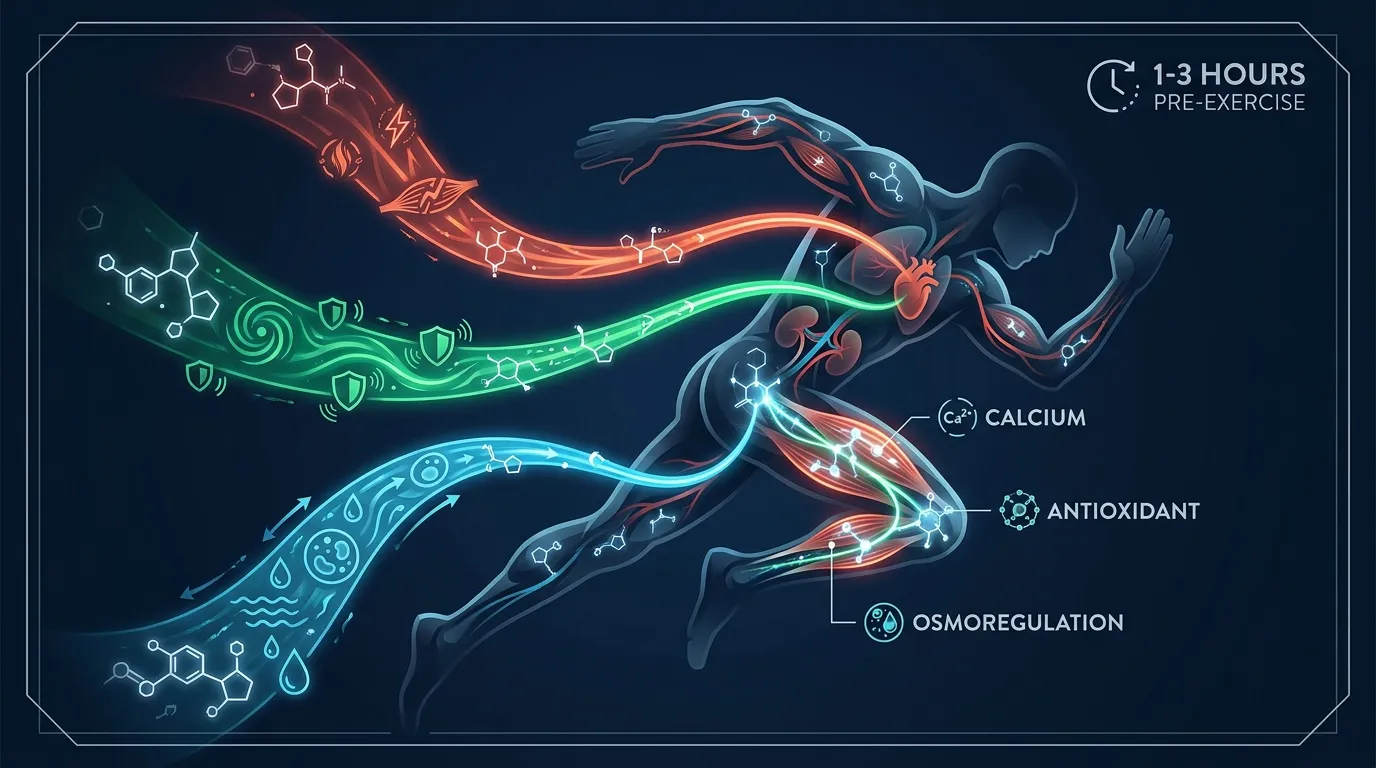
Taurine had a strange decade. For years it was the "and also" ingredient in energy drinks, chased by caffeine and sugar and largely ignored by anyone reading a label. Then a Science paper in 2023 reported that supplementing middle-aged mice with taurine extended their lifespan by roughly 10 to 12 percent, and suddenly taurine was the longevity molecule of the moment. Sales climbed. Podcasters recommended it. Then a 2025 follow-up in the same journal analyzed human, monkey, and mouse data and concluded that taurine levels do not actually drop with age in most populations, and might even rise. The longevity story got a lot more complicated overnight.
The exercise story, meanwhile, has been quietly accumulating for a decade. A 2018 meta-analysis in Sports Medicine pooled 10 endurance trials and found a small but consistent acute performance effect. A 2025 acute-dose meta-analysis in Scand J Med Sci Sports confirmed the signal and extended it to some strength and power tasks. The doses that worked are surprisingly modest, and the timing is different from most supplements. This article walks through the trials, the mechanism, the practical protocol, and where the longevity claim actually stands after the follow-up work.
The short version, in case you skip the rest: taurine is a real but modest ergogenic aid at a 1 to 6 gram acute dose taken roughly 1 to 2 hours pre-exercise. Safety is good at those doses. The lifespan claim is not settled and probably was not the whole story to begin with. Now the details.
The Research: What Studies Show
Waldron 2018: The Endurance Meta-Analysis
The paper that gave the field its first meta-analytic footing is Waldron and colleagues (2018), published in Sports Medicine. They screened the human literature through September 2017 and identified 10 randomized trials of oral taurine in endurance tasks. Doses ranged from 1 to 6 grams, taken as a single pre-exercise bolus or across periods up to two weeks. The pooled effect on overall endurance performance was Hedges' g = 0.40, and a sub-analysis of seven time-to-exhaustion trials showed g = 0.43. Both effect sizes are small-to-moderate and both are statistically significant.
Two features of the analysis matter for anyone deciding how to use it. First, no dose-response relationship emerged within the 1 to 6 gram range, which suggests a threshold rather than a linear curve. The effect at 2 grams looked about the same as the effect at 6 grams. Second, the effect was primarily acute: a single dose taken roughly 1 to 2 hours before exercise produced results comparable to two weeks of daily supplementation. That is unusual for an amino acid, and it changes how you should think about the protocol.
Deng 2025: The Acute-Dose Update
The most recent word is Deng and colleagues (2025), published in the Scandinavian Journal of Medicine & Science in Sports. Their meta-analysis focused specifically on the acute-dose question and pooled trials measuring performance after a single serving. Overall, acute taurine produced small-to-moderate improvements in performance, with clearer benefits in males and across aerobic endurance, strength, power, agility, and coordination tasks. The picture on anaerobic capacity and muscular endurance was less consistent.
The Deng review lines up with Waldron's older synthesis: a single 1 to 6 gram dose works, chronic loading does not add much, and the effect is measurable but modest. This is not creatine, where a daily 5 g habit meaningfully changes body composition and strength over months. Taurine looks more like caffeine in shape (acute, dose-window sensitive, threshold effect) with a smaller ceiling than caffeine on peak performance.
Kurtz 2021: The Systematic Review
Kurtz, VanDusseldorp, Doyle, and Otis (2021), publishing in the Journal of the International Society of Sports Nutrition, ran a narrative and systematic review of taurine in sports and exercise across 19 human trials. They reached the same directional conclusion as the two meta-analyses. Positive effects appeared on time-to-exhaustion, VO2max in some protocols, anaerobic performance in a subset of trials, and recovery markers. Effect sizes clustered small-to-moderate. Formulation and timing were the main sources of variability across studies.
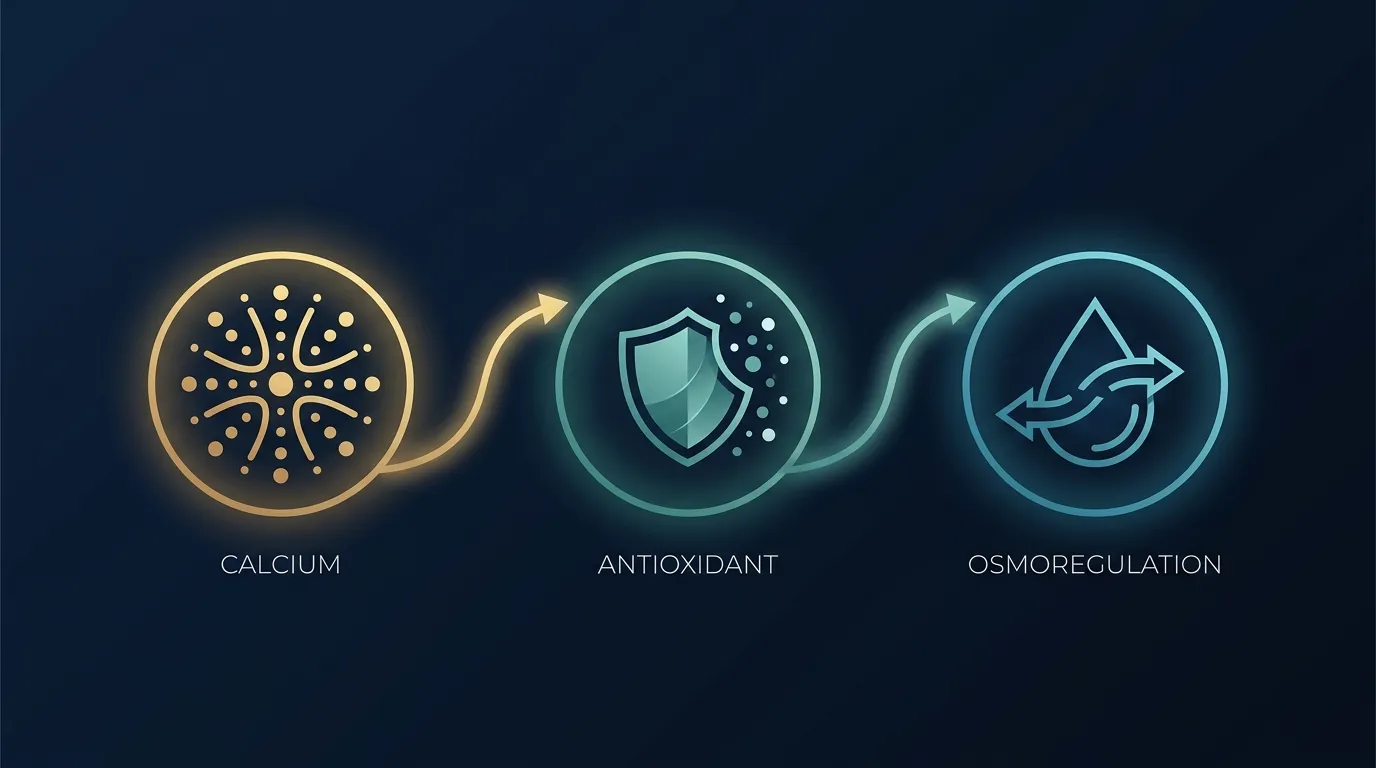
Kurtz and colleagues also compiled the mechanism data, which is where the taurine story gets interesting. Taurine concentrates in skeletal muscle (particularly slow-twitch fibers) and participates in calcium handling at the sarcoplasmic reticulum, antioxidant defense, and osmoregulation. Those are three pathways where fatigue accumulates during endurance and repeated-effort work. If taurine buffers even a small share of the calcium, oxidative, and osmotic stress, the acute effect the meta-analyses see has a plausible mechanistic story behind it.
Singh 2023: The Mouse Lifespan Paper
The reason taurine went from niche to trending is Singh and colleagues (2023), published in Science. Working with roughly 250 middle-aged mice (14 months old, roughly age 45 in human terms), the researchers daily dosed half of them with taurine and the other half with a control solution. Female mice lived about 12 percent longer on average, males about 10 percent. That translated to three to four additional months, equivalent to seven or eight human years if the effect scaled. Alongside the survival curves, the taurine-treated mice showed less cellular senescence, less mitochondrial dysfunction, less DNA damage, and lower markers of inflammaging.
The paper also reported that circulating taurine dropped with age in mice, monkeys, and humans, and framed the taurine-as-lifespan-extender story around a "restore what was lost" logic. Coverage was heavy and largely uncritical. Supplement sales climbed. What did not get much airtime was the caveat baked into the paper itself: mouse lifespan extension is a mechanistic signal, not a clinical result in humans. Almost every intervention that extends mouse lifespan (rapamycin, metformin, caloric restriction, senolytics) either fails to translate or produces smaller effects when tested in longer-lived species.
Fernandez 2025: The Aging Biomarker Challenge
Two years later, the same journal published a direct challenge. Fernandez and colleagues (2025), working with the NIH intramural program, analyzed the Baltimore Longitudinal Study of Aging (humans aged 26 to 100), a rhesus monkey cohort (aged 3 to 32), and a mouse cohort (aged 9 to 27 months). They measured plasma taurine over time. In humans, taurine levels tended to stay flat or rise with age, not fall. In the monkeys, taurine rose with age. In the mice, taurine was flat in males and rose in females. Longitudinal within-person differences in taurine exceeded age-related differences, meaning any single measurement said more about that day than about aging.
Fernandez and colleagues concluded that taurine is unlikely to be a good aging biomarker. That does not disprove that supplementing taurine could help older adults specifically. It does mean the "restore what age took away" framing that carried the Singh paper into the mainstream is not the right description of what is happening in most people. The taurine longevity question is now genuinely open, and the honest reading of the two papers together is: the mouse survival effect is real but the human-translation story needs more evidence than an epidemiological correlation with a signed direction.
How Taurine Actually Works
Taurine is a sulfur-containing amino acid, technically classified as conditionally essential. Adults synthesize small amounts from cysteine and methionine in the liver, and the diet delivers the rest, primarily from meat, seafood, and dairy. Vegans and strict vegetarians have measurably lower plasma taurine because plants contain almost none. Total body pool is roughly 12 to 18 grams in an average adult, concentrated in skeletal muscle, heart, brain, and retina.
Inside muscle, taurine does at least three jobs relevant to exercise. It modulates calcium release from the sarcoplasmic reticulum, which affects how forcefully and how repeatedly a fiber can contract. It donates electrons to reactive oxygen species produced during high-turnover metabolism, working alongside glutathione and other antioxidants. And it participates in osmoregulation, meaning it helps cells maintain volume when the ionic environment shifts during intense or prolonged work. Each of these pathways is a place where fatigue accumulates. A small buffering effect at each spot plausibly adds up to a measurable, if modest, endurance signal.
Two things taurine is not: it is not a stimulant, and it is not a muscle-building amino acid. It does not activate the mTOR pathway the way leucine does, and it does not raise heart rate the way caffeine does. Any tingle or kick you feel after an energy drink is coming from the caffeine, taurine's ride-along, not from the taurine itself. That is why some trials use it as a stand-alone pre-exercise supplement and see a smaller-than-caffeine but still real effect on endurance and repeated-effort work.
The dietary baseline matters more than most people think. A regular omnivore eating meat and seafood a few times a week already brings in roughly 40 to 400 mg of taurine per day, on top of endogenous synthesis. Someone eating shellfish or scallops occasionally can pull in several grams from a single meal. That partly explains why the marginal supplement effect is small in trained omnivores: they are not deficient. It also predicts, correctly, that the vegan trials tend to see larger relative changes in circulating taurine when supplementation starts.
Why This Matters for Your Fitness
The realistic upside for a recreational lifter or endurance runner is a small acute performance edge on the day you take a dose. Waldron's g = 0.40 translates roughly to a 1 to 3 percent improvement in time-to-exhaustion for most people, which is not going to change your life but might get you through the last two intervals of a hard session. If your event happens to be a 45-minute threshold effort, that is a real number. If you are lifting for hypertrophy in an 8-week block, taurine is probably not the lever that moves the needle.
What taurine will not do is fix the actual bottleneck for most trainees. The biggest predictor of fitness outcomes over months and years is whether you keep stringing workouts together. If you are hitting 2 sessions per week when you meant to hit 4, no acute ergogenic aid closes that gap. The reason taurine shows up in the meta-analyses at all is that the trials enforce a real training or performance test with a controlled dose window. Real-world training that skips the fundamentals will not reproduce trial-quality results.
Where taurine sits well in a stack is alongside caffeine, not as a replacement for it. Caffeine is the best-studied acute ergogenic aid we have, with a larger and more consistent effect. Taurine adds a modest amount on top, and the two are already combined in most pre-workout formulas and energy drinks. Whether that combination is meaningfully better than caffeine alone is not settled in the human literature, but it is unlikely to hurt at the doses in question.
The longevity angle is where most of the current marketing lives, and it is where the evidence is weakest for human application. The Singh mouse survival numbers are dramatic. The Fernandez follow-up work in humans is not consistent with the mechanism as originally proposed. Anyone who has been in fitness or supplement research for a decade has seen this pattern before: mouse study reports huge effect, human data eventually shows either smaller effect or no effect at all. The prudent read is that taurine at 1 to 3 g per day is safe, cheap, and might help endurance workouts on the day you take it. Taking it as an anti-aging drug requires more evidence than currently exists.
Get an evidence-based plan built for you
FitCraft, our mobile fitness app, pairs you with an AI coach who builds you a personalized plan around your goals, schedule, and fitness level. Every FitCraft program is designed by Domenic Angelino, MPH (Brown University) and NSCA-CSCS, with research published in the Journal of Strength and Conditioning Research and Medicine & Science in Sports & Exercise.
Take the Free Assessment Free • 2 minutes • No credit cardHow to Use Taurine in Practice
Translating the evidence into a workable protocol:
- Target 1 to 3 grams as a single pre-exercise dose. That covers the low-to-middle of the trial range and sits well under the 6 g upper bound where the effect appears to plateau. There is no measurable benefit to going higher on an acute dose, and no measurable benefit to loading it daily for weeks in advance.
- Take it roughly 1 to 2 hours before the session. Plasma taurine peaks in that broad window after oral dosing, and the trials that reported the timing dosed within a 10-minute to 2-hour pre-exercise window.
- Combine it with caffeine if you already use caffeine. The combined effect appears additive rather than multiplicative, but the human data supports the pairing at typical pre-workout doses (roughly 3 mg/kg of caffeine plus 1 to 3 g of taurine).
- Use isolated capsule or powder for a real dose. A standard 250 ml energy drink contains about 1 g of taurine, which sits at the low end of the effective range. If you want the taurine effect, do not count on drink formulas to get you there consistently. Bulk powders are inexpensive and let you hit an actual clinical dose without the sugar or the caffeine load.
- Skip the loading phase. Two weeks of daily taurine does not outperform a single-dose acute protocol in the human trials. Save the money and take it on days you actually train hard.
- Do not expect a stimulant feeling. Taurine is not a stimulant. If you take 2 g and expect the caffeine-style kick, you will conclude nothing happened. The effect shows up on the test-day measurement, not in a subjective jolt.
Individual Variation: Who Responds Most
Diet
People who already eat meat, fish, or shellfish several times a week bring in enough dietary taurine to keep tissue stores reasonable. Vegans and strict vegetarians have measurably lower plasma taurine and stand to gain more from supplementation in relative terms, though the human trials in vegan athletes are thin.
Training Modality
The clearest signal in the meta-analyses is on endurance and time-to-exhaustion tasks. Strength and power effects are smaller and less consistent. If your training is heavy on threshold or tempo runs, cycling intervals, or repeated-effort conditioning, taurine has a plausible role. If your training is mostly heavy resistance work, creatine is the better-studied choice for that outcome.
Sex
The Deng 2025 meta-analysis noted clearer acute effects in males, but the female data is sparser rather than negative. Do not read this as "taurine does not work for women." Read it as "the trials have not run enough female-only arms yet." Given the mechanism has no obvious sex-specific pathway, the practical takeaway for most women is: same protocol, same expectations.
Common Misconceptions
Misconception 1: "Taurine is what makes energy drinks work."
It is not. The stimulant effect of an energy drink comes almost entirely from caffeine, and often from sugar. The 1 gram of taurine in a standard can sits at the low end of the effective performance range and, more importantly, is not producing the subjective kick people feel. Taurine's effect is on measured performance, not perceived alertness.
Misconception 2: "More taurine is better."
The Waldron 2018 meta-analysis found no dose-response inside the 1 to 6 gram range. A few smaller trials at higher doses (up to 10 g) did not produce clearly larger effects and did produce more reports of gastrointestinal upset. The dose-response looks flat above threshold, which means 2 g works as well as 6 g in most people, and 6 g is the point above which you gain nothing.
Misconception 3: "Taurine extends human lifespan."
No trial in humans has demonstrated that. The 2023 Singh Science paper was a mouse study, and it reported a real mouse survival effect. The 2025 Fernandez follow-up in the same journal found that human circulating taurine does not drop with age the way the original paper implied, undermining the "restore what age took away" mechanism. The honest state of the evidence is: taurine may or may not benefit human longevity, and the current trials cannot answer that yet. Buying it as an anti-aging drug is buying an assumption, not a demonstrated effect.
Misconception 4: "Taurine builds muscle."
It does not. Taurine is not an anabolic amino acid. It does not activate the mTOR pathway the way leucine does, it does not raise growth hormone or IGF-1 meaningfully, and no trial in humans has shown taurine adding measurable muscle mass on top of a resistance program. The acute effect is on endurance and repeated-effort work. Muscle growth requires protein, training, and recovery. Taurine sits outside that stack.
What the Research Suggests Going Forward
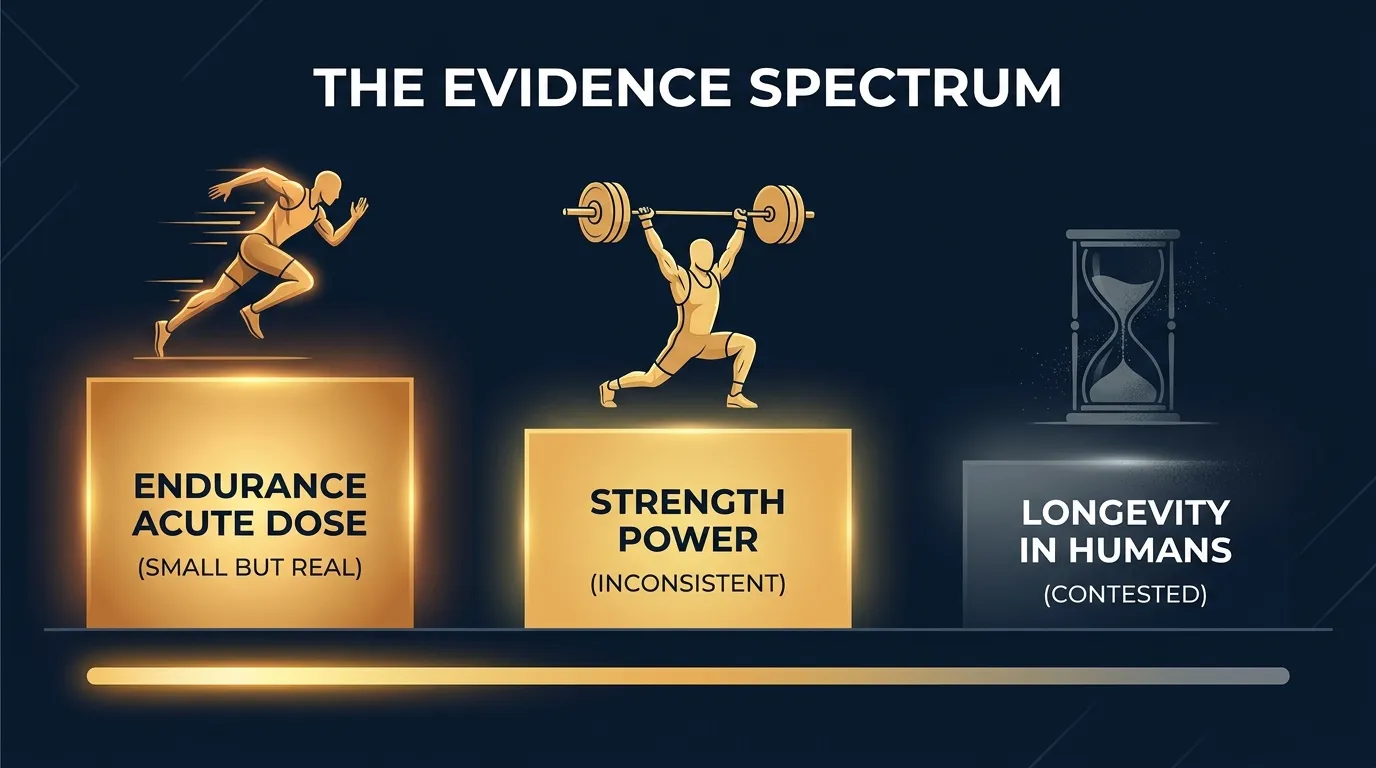
The taurine and exercise literature is in reasonable but not final shape. The direction (small acute improvement in endurance and some strength/power tasks) is consistent across two meta-analyses and a systematic review. Effect sizes are modest, roughly comparable to what you get from beetroot juice and smaller than caffeine. The mechanism story (calcium handling, antioxidant activity, osmoregulation in muscle) is plausible without being fully resolved. Safety at the tested doses is well established over decades of use in the food and beverage industry.
What is still open:
- Whether taurine's acute effect adds meaningfully to caffeine's, or whether caffeine alone captures most of the ergogenic benefit at typical pre-workout doses.
- Whether chronic supplementation confers benefits distinct from acute dosing. Current data leans "no," but longer trials in specific populations (older adults, vegans, endurance athletes in high-heat conditions) could change that.
- Whether the mouse-lifespan effect from Singh 2023 translates to any meaningful human longevity or healthspan outcome. The Fernandez 2025 follow-up made this less likely, not impossible.
- Whether there is a subgroup of older adults with genuinely low tissue taurine who would respond more strongly. Fernandez and colleagues found circulating taurine stays flat or rises with age on average, but averages can hide meaningful individual variation.
The takeaway for someone deciding whether to try it: taurine is one of the cheaper, safer supplements you can add to a pre-workout stack. If you race endurance events, do a lot of intervals, or train in the heat, a 1 to 3 gram dose taken roughly 1 to 2 hours before the session is defensible and low-risk. If you are lifting for hypertrophy, running easy miles most of the week, or hoping for a longevity benefit, the evidence does not currently support the spend.
And if you are not training consistently in the first place, no supplement changes that. Building the habit is a bigger lever than any pill, and it costs nothing.
References
- Waldron M, Patterson SD, Tallent J, Jeffries O. "The Effects of an Oral Taurine Dose and Supplementation Period on Endurance Exercise Performance in Humans: A Meta-Analysis." Sports Med. 2018;48(5):1247-1253. doi:10.1007/s40279-018-0896-2
- Deng H, Song T, Yin M, et al. "Does One Shot Work? The Acute Impact of a Single Taurine Dose on Exercise Performance: A Meta-Analytic Review." Scand J Med Sci Sports. 2025;35(9):e70123. doi:10.1111/sms.70123
- Kurtz JA, VanDusseldorp TA, Doyle JA, Otis JS. "Taurine in sports and exercise." J Int Soc Sports Nutr. 2021;18(1):39. doi:10.1186/s12970-021-00438-0
- Singh P, Gollapalli K, Mangiola S, et al. "Taurine deficiency as a driver of aging." Science. 2023;380(6649):eabn9257. doi:10.1126/science.abn9257
- Fernandez ME, Bernier M, Price NL, et al. "Is taurine an aging biomarker?" Science. 2025;388(6749):eadl2116. doi:10.1126/science.adl2116
Frequently Asked Questions
Does taurine actually improve exercise performance?
The evidence points to a small but real acute effect on endurance. Waldron and colleagues (2018) pooled 10 trials and reported an overall improvement of Hedges' g = 0.40, with a similar g = 0.43 on time-to-exhaustion tasks. The 2025 acute-dose meta-analysis by Deng and colleagues in Scand J Med Sci Sports found small-to-moderate benefits on aerobic endurance and some strength/power tasks. Effect sizes are modest and the strongest evidence is for a single 1 to 6 g dose taken roughly 1 to 2 hours pre-exercise, not for chronic loading.
How much taurine should I take before a workout?
The trial doses cluster at 1 to 6 grams taken roughly 1 to 2 hours before exercise. Waldron and colleagues (2018) found no dose-response within that range, suggesting a threshold rather than a more-is-better curve. Taking more than 6 g does not produce measurably larger effects in the human trials, and the European Food Safety Authority's 2009 opinion set 6 g/day as the point where no safety concern was identified in healthy adults.
Does taurine extend lifespan in humans?
No human trial has shown that. Singh and colleagues (2023, Science) reported that daily taurine extended median lifespan roughly 10 to 12% in middle-aged mice, but that finding does not translate directly to people. The 2025 follow-up by Fernandez and colleagues in Science analyzed the Baltimore Longitudinal Study of Aging (humans 26 to 100), rhesus monkeys, and mice and found that circulating taurine stayed stable or rose with age, and within-person variability exceeded age-related change. Treat taurine as a modest ergogenic aid with reasonable safety, not as a longevity drug.
Is the taurine in energy drinks doing anything?
The dose is usually the issue. A standard 250 ml energy drink contains about 1 gram of taurine, which is at the low end of the trials that showed a performance signal. Most of the acute stimulant kick you feel from an energy drink is caffeine, not taurine. If you want the taurine effect specifically, isolated capsule or powder dosing at 2 to 3 g is more reliable than counting on drink formulas that also load 100 to 300 mg of caffeine and sugar.
Is taurine safe to take daily?
In short-term clinical trials, taurine has been well tolerated at doses up to 6 g per day. The European Food Safety Authority (2009) reviewed the safety data and concluded no safety concern was identified at that intake in healthy adults, and clinical trials have used up to 10 g per day for 6 months without serious adverse events. People with kidney disease, on lithium, or with rare inborn metabolic disorders should talk to a clinician first, and pregnant or breastfeeding people should default to food-source taurine rather than supplements.