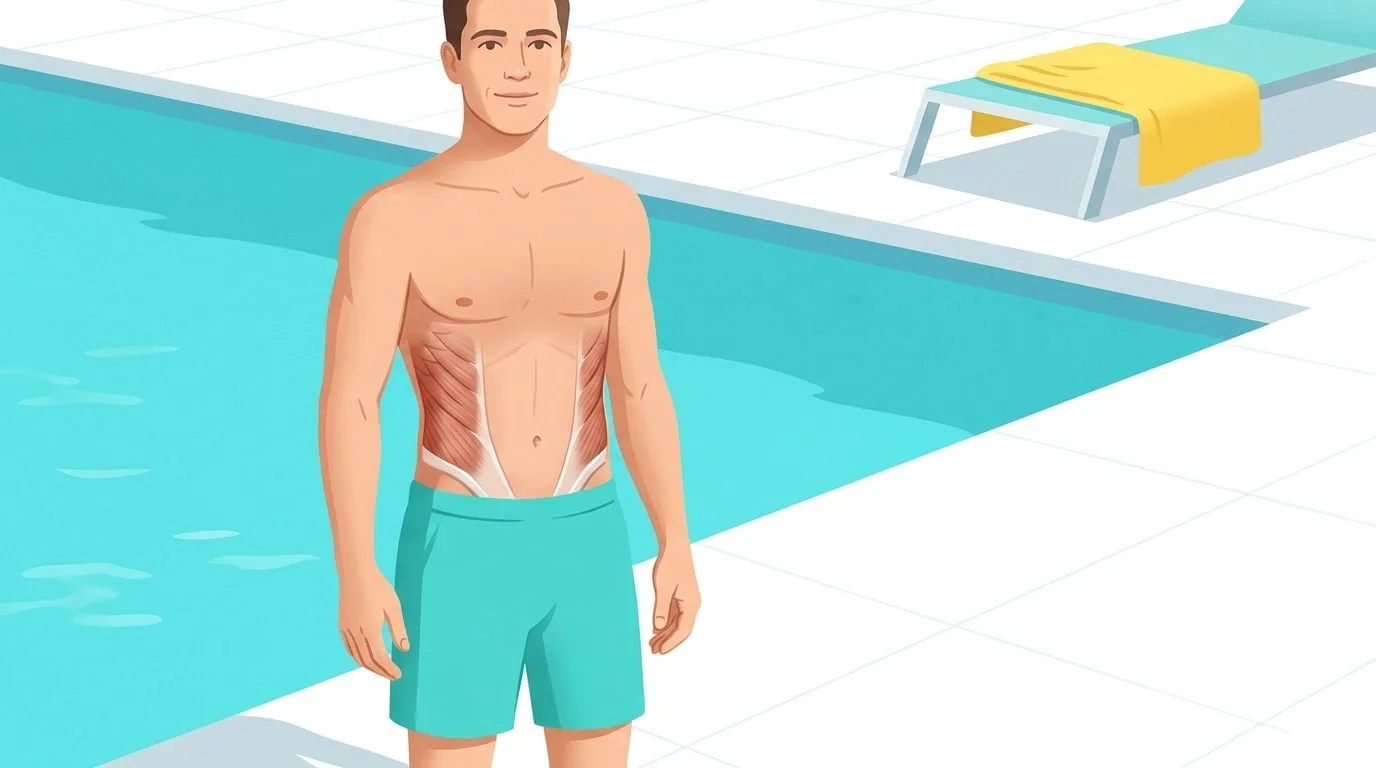
The Adonis belt goes by a lot of names: V lines, V cut abs, Apollo's belt and, in older anatomy books, the iliac furrows. All of them describe the same two grooves. They angle in from the front of your hips toward the middle of your lower belly and give the bottom of your torso its V shape.
If you've done months of ab work and still can't see yours, you haven't failed at anything. The exercises you pick decide very little here. Three other things decide most of it: how thin the fat over your lower belly is, where your genes store fat, and how lean your body can stay without your sleep, energy or hormones paying for it.
This page walks through the anatomy of the V, what the research says about body fat and visibility, how much is genetic, why one side can show more than the other and how the V differs in men and women. It ends with a short home workout for the muscles that frame it.
Adonis Belt Anatomy: Is the Adonis Belt a Muscle?
The Adonis belt has no muscle of its own. The groove follows the inguinal ligament, a tough band of connective tissue that runs from the bony point at the front of your hip, the anterior superior iliac spine, down and in to the pubic tubercle near the midline (Sugumar and Gupta, StatPearls). The ligament is the folded lower edge of the aponeurosis of your external oblique, the flat sheet of tendon the outer oblique muscle turns into as it reaches the front of your body.
Anatomy textbooks still get one detail of this spot wrong. The lowest fibers of the internal oblique and transversus abdominis are usually described as starting from the inguinal ligament itself. When Acland (2008) dissected 15 bodies, he confirmed that those fibers actually arise from a thickened strip of fascia over the iliopsoas, the hip flexor that runs just behind the ligament. For your V lines, the practical point is the same: all three layers of side-abdominal muscle end along that line, and the thigh begins below it.
Which muscles make the Adonis belt?
| Structure | What it is | Its part in the V |
|---|---|---|
| Inguinal ligament | The folded lower edge of the external oblique's tendon sheet, from the front of the hip bone to the pubic bone | The line the groove follows |
| External oblique | The outer layer of muscle on the side of your waist | Its tendon sheet forms the ligament, and a thicker muscle makes a deeper edge above it |
| Internal oblique and transversus abdominis | The two deeper layers, whose lowest fibers start from fascia just behind the ligament | Add thickness to the wall above the line |
| Lower rectus abdominis | The lower part of the six-pack muscle | Fills the space inside the V |
| Scarpa fascia | A membranous layer under the skin that joins the thigh's deep fascia just below the ligament | Probably helps anchor the skin along the crease |
| Fat under the skin | The fatty layer between your skin and the muscles | Decides whether you can see any of it |
Why it shows up as a groove
Above the ligament sits the full thickness of your abdominal wall. From the outside in, that's skin, a fatty layer, a membranous layer called the Scarpa fascia, then the external oblique, internal oblique and transversus abdominis (Joshi and La Rose, StatPearls). About a finger's width below the ligament, the Scarpa fascia fuses with the deep fascia of the thigh. That attachment likely helps hold the skin in place along the crease while the tissue above it changes.
When the fat over your lower belly is thick, it rounds over the crease and hides it. As that fat thins, the edge of the muscle wall stands out against the anchored crease, light catches the step, and you see a line. Nothing underneath has to change for the line to appear or disappear.
What Body Fat Percentage Do You Need to See an Adonis Belt?
No study has measured the body fat percentage at which an Adonis belt appears. Nobody has scanned a group of people as they leaned out and recorded when the lines showed, so every number you see online is an estimate from practice. Ours is too. Our guide to getting abs puts a visible four-pack at roughly 12 to 14% body fat for most men and 20 to 24% for most women, and the V usually needs you at the lean end of those ranges or below.
The reason is where the V sits. It's below your navel, where the fat layer tends to be thicker than over your upper abs. In an ultrasound study of elite judo athletes, the fat at the standard lower-abdomen site, below the navel, was more than twice as thick as at the upper-abdomen site above it, in both the adult women and the adult men (Sengeis and colleagues, 2019).
What the research does have is body fat measurements of people at contest leanness, at the end of a diet for a physique contest where competitors are judged on muscular appearance:
| Who was measured | Body fat at the start | Body fat at the end of the diet |
|---|---|---|
| One drug-free male bodybuilder, aged 26 to 27 (Rossow 2013) | 14.8% | 4.5% |
| 27 female fitness competitors, by DXA (Hulmi 2017) | 23.1% | 12.7% |
| The same 27 women, by bioimpedance | 19.7% | 11.6% |
| The same 27 women, by skinfolds | 25.2% | 18.3% |
Look at the last three rows again. On the same women at the same point in their diet, the three methods disagreed by almost 7 percentage points. So if a chart says the V appears at 10% and your smart scale says 13%, those two numbers may not be measuring the same thing. Pick one method, use it under the same conditions each time, and judge the trend along with the mirror. Our post on what a healthy body fat percentage is explains how far each method can be off.
Muscle plays a smaller part. The groove is an edge between the muscle wall and the crease, so thicker obliques and a thicker transversus abdominis should make that edge deeper. Two people at the same body fat can show different V lines for that reason, and for the genetic reasons below.
Is the Adonis Belt Genetic?
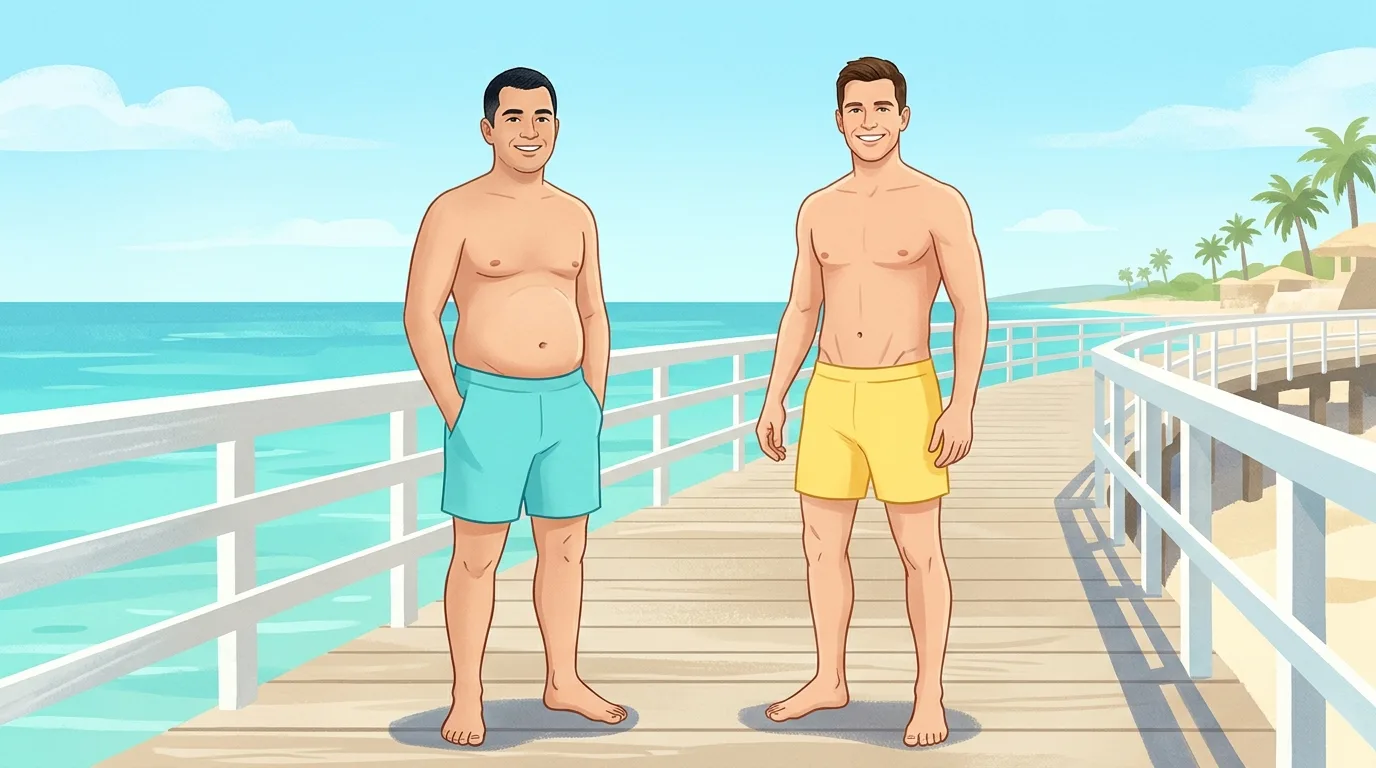
Partly, yes. Everyone has an inguinal ligament and the same three layers of side-abdominal muscle, so the structure isn't something you inherit or miss out on. What your genes shape most is where you store fat, and that decides how lean you need to get before the V shows.
Twin studies put a number on it. In Malis and colleagues (2005), 108 identical and 88 non-identical Danish twins had DXA scans. Genes explained about 82% of the variation in trunk fat percentage among the younger twins, aged 25 to 32, and 85% among the older ones, aged 58 to 66.
An older experiment shows the same thing more vividly. Bouchard and colleagues (1990) overfed 12 pairs of young identical twin men by 1,000 calories a day, six days a week, for 84 days. Weight gain ranged from 4.3 to 13.3 kg, but brothers tended to gain alike. After accounting for how much fat each man gained, the variation between pairs in where the new fat went was about six times the variation within pairs. That study tracked fat going on, not coming off, but it shows how strongly your genes steer where fat is stored.
Sex is part of the genetic picture too. A study of up to 224,459 people found 49 regions of DNA linked to waist-to-hip ratio, a rough guide to where fat sits, after adjusting for BMI. Twenty of them acted differently in men and women, and 19 of those had stronger effects in women (Shungin and colleagues, 2015).
Heritability describes differences between people. It doesn't fix your body fat. You can still lower it. Many people find that the places where they store the most fat are the last to lean out, so if that's your lower belly, the V may be among the last things you see.
Why Does Only One Side of My Adonis Belt Show?
A V line that's sharper on one side is common, and it's usually harmless. Three things tend to cause it:
- Uneven muscle. One-sided sports can build your trunk unevenly. In an MRI study, professional tennis players had 18% more volume in the obliques and transversus abdominis on their non-dominant side than on their dominant side, while soccer players' two sides were similar (Sanchis-Moysi and colleagues, 2013). The same group found tennis players' rectus abdominis was 35% larger on the non-dominant side, with the gap most marked in its lower part (Sanchis-Moysi and colleagues, 2010). These studies measured athletes once rather than training anyone, but they show the two sides of your abdominal wall don't have to match.
- Posture. Standing with your weight on one leg, or with your pelvis turned slightly, stretches the crease on one side and softens it on the other. Check in the mirror with your weight on both feet.
- Light. Light from one side deepens the shadow in one groove and flattens the other. Look again with the light straight in front of you.
One thing deserves a doctor's look. A soft bulge along the line, especially one that grows when you cough, strain or stand and shrinks when you lie down, can be an inguinal hernia. These are common in men: in an English population study, the lifetime chance of having an inguinal hernia repaired was estimated at 27% for men and 3% for women (Primatesta and Goldacre, 1996). Uneven V lines with no bulge and no pain are usually just a difference between your two sides.
Knowing what to do is the easy part.
FitCraft, our mobile fitness app, pairs you with an AI coach who builds you a personalized plan around your goals, schedule, and fitness level. Every FitCraft program is designed by Domenic Angelino, MPH (Brown University) and NSCA-CSCS, with research published in the Journal of Strength and Conditioning Research and Medicine & Science in Sports & Exercise.
Take the Free Assessment Free • 2 minutes • No credit cardAdonis Belt Male vs Female: Can Women Have an Adonis Belt?
Yes, women can have an Adonis belt. Women have the same inguinal ligament and the same oblique and transversus abdominis muscles, so the structure is identical. What differs is how much fat covers it and where that fat tends to sit.
Women carry more fat under the skin than men, even among athletes. In the judo study above, the women's median total across eight ultrasound sites was three times the men's: 66.1 mm against 21.8 mm (Sengeis 2019). Women also store a larger share of their fat on the hips, thighs and lower body, a pattern that sex hormones help shape (Karastergiou and colleagues, 2012). The lower belly and the front of the hips sit close to that zone, which likely explains why V lines tend to be less visible in women.
| Men | Women | |
|---|---|---|
| Inguinal ligament and side-abdominal muscles | Yes | Yes |
| Fat under the skin, median total of eight sites in elite judo athletes | 21.8 mm | 66.1 mm |
| Where extra fat tends to go | Belly and waist | Hips, thighs and lower body |
| End-of-diet body fat in the contest studies above | 4.5% (one man) | 12.7% by DXA (27 women) |
The female competitors in the Hulmi study show what contest leanness can cost. Over a four-month diet their body fat by DXA fell by about 10 points, and 63% reported irregular menstrual bleeding during the diet, against 30% of the women who didn't diet. Most of their hormones returned to normal within 3 to 4 months of eating more, but thyroid hormone (T3) and testosterone hadn't fully recovered. For lean, active women, a faint V in good light is the more common look, and deep, sharp lines tend to come with contest-level leanness.
How to Get an Adonis Belt: Can You Train It?
You can't bring the line into view with ab work alone. Vispute and colleagues (2011) randomly split 24 sedentary adults into two groups. One group did seven ab exercises, 2 sets of 10, five days a week for six weeks, the other did no training, and everyone kept their diet the same. The ab group's endurance improved more, but the exercises had no effect on body fat percentage, waist size, the abdominal skinfold or the suprailiac skinfold just above the hip bone, the site closest to the V. Fat comes off through a steady calorie deficit across your whole body, and our how to get abs guide covers the pace, the protein and the timeline.
What training can change is the muscle under the line. In the MRI study of athletes, soccer players had built up their obliques and transversus abdominis along the whole length of the muscles, while tennis players had built only the upper part (Sanchis-Moysi 2013). Those athletes were measured once, so the study can't prove cause, but it suggests the lower abdominal wall grows with the work it's given.
The side plank is a good place to start. Ekstrom and colleagues (2007) measured muscle activity in 30 healthy adults during nine bodyweight exercises. The side bridge pushed the external oblique above 45% of its maximum, the level the authors used to mark an exercise as useful for building strength.
So the plan has two parts that run side by side. Lose fat at a pace you can keep, and train the muscles that frame the V two or three times a week so there's more to see when the fat comes off.
Adonis Belt Exercises: A 15-Minute Home Workout
This Adonis belt workout, which some coaches call an Apollo's belt workout, works the three groups under your V lines: the obliques, the transversus abdominis and the lower rectus abdominis. You need a mat, plus a pull-up bar if you have one. Do it two or three times a week alongside your regular full-body strength training. Rest 30 to 45 seconds between sets.
| Exercise | Sets and reps | What it trains | Key cue |
|---|---|---|---|
| 1. Dead bug | 3 x 8 per side | Transversus abdominis, lower abs | Keep your lower back pressed into the floor as each leg lowers |
| 2. Reverse crunch | 3 x 10 to 12 | Lower rectus abdominis | Curl your hips off the floor instead of swinging your legs |
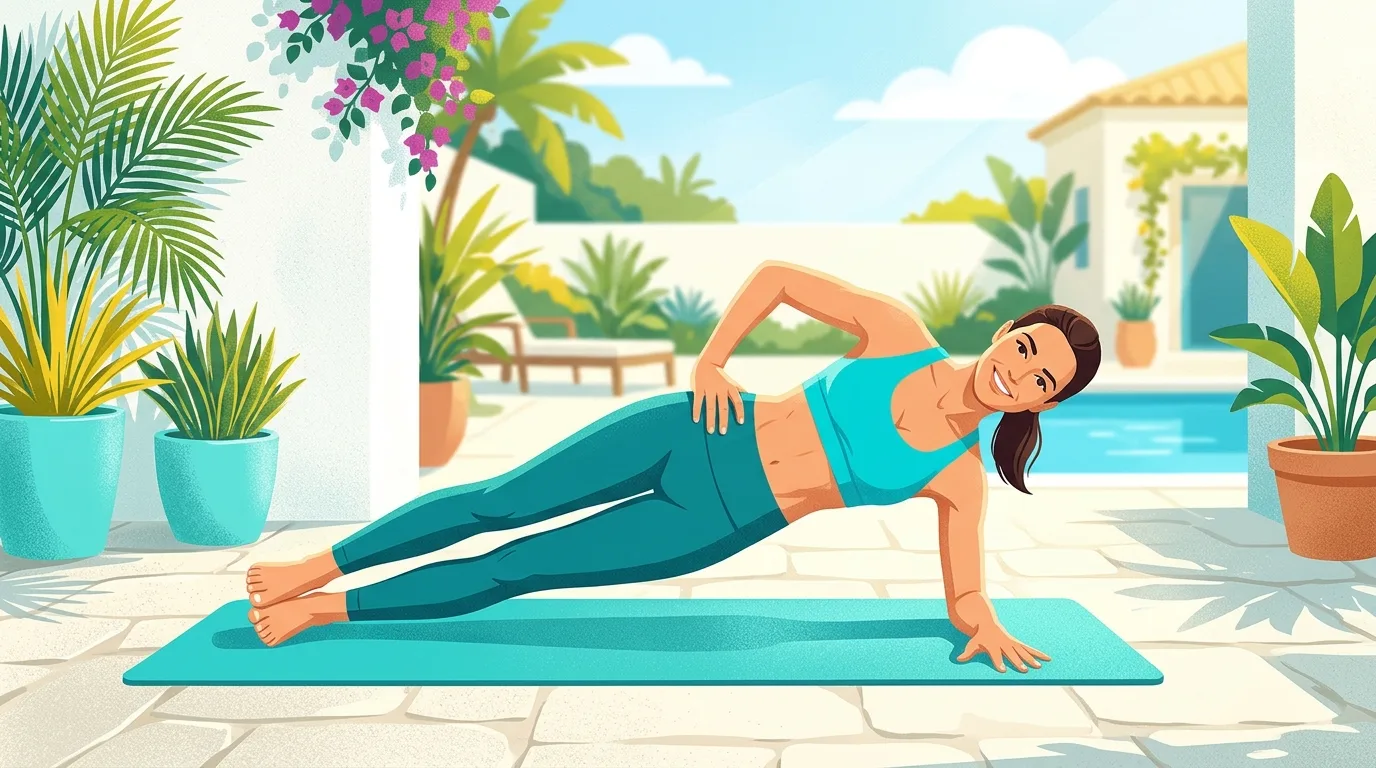
| 3. Side plank | 3 x 20 to 40 seconds per side | External and internal obliques | Hips high, body in one straight line |
| 4. Bicycle crunch | 3 x 12 per side, slowly | Obliques and rectus abdominis | Turn your rib cage toward the knee, not just your elbow |
| 5. Hanging knee raise, or lying leg raise without a bar | 3 x 8 to 10 | Lower abs and hip flexors | Tilt your pelvis up at the top of each rep |
When you can hit the top of every range with clean form, make each move harder. Lift your top leg in the side plank, straighten your legs on the hanging raise, or slow every reverse crunch to a three-second lower. Our guide to lower ab exercises ranks 10 lower-belly moves from easiest to hardest, and our oblique exercises guide sorts the side-waist moves by the job each one does.
Why Is the Adonis Belt Considered Attractive?
Research on attraction doesn't study V lines directly. It does study the two things they signal, low body fat and visible muscle:
- Sell and colleagues (2017) showed raters photos of men's bodies. How strong each man looked explained over 70% of how attractive his body was rated, and adding height and leanness raised that to 80%. The strongest-looking men were rated most attractive in every sample.
- Frederick and Haselton (2007) ran six studies. Women rated muscular men as sexier, but men with moderate muscularity were rated most attractive overall.
- For women's abs, a crowdsourced survey of 976 people rated a female torso with light definition as more attractive than versions with moderate or extreme definition (Bhatia and colleagues, 2026).
So the first two papers disagree on whether more muscle is always better, and the third suggests heavy definition isn't the ideal for women's bodies. These studies rated photos and drawings, and attraction varies a lot from person to person. Most of the appeal of the V lines comes from what they suggest about a lean, trained body.
How Lean Is Too Lean to Keep an Adonis Belt?
The sharpest V lines you see usually belong to people at or near contest leanness, and that level costs something. As the bodybuilder in Rossow's case study dropped to 4.5% body fat, his testosterone fell from 9.22 to 2.27 ng/mL, his resting heart rate from 53 to 27 beats a minute, and his score for mood disturbance rose from 6 to 43. Most of it recovered after the contest, though his strength still hadn't fully returned six months later. The female competitors had the hormonal and menstrual changes described above.
Both studies followed people who planned a few months of dieting and then a recovery. Holding that level all year is rarely healthy, and for women the menstrual changes in the Hulmi study are a common early warning. If you're chasing the lines and notice poor sleep, low sex drive, lost periods, constant hunger or a growing fear of food, your target is too low for you, and it's worth talking to a doctor or a registered dietitian. A faint V that comes and goes with the light, the time of day and the season is what a lean, healthy, trained body usually looks like.
What This Means for You
An Adonis belt comes from a few months of steady work: losing fat at a pace you can keep, training your whole body two to four times a week and giving your obliques and lower abs a few minutes of their own. Your genes decide how lean you need to get and how sharp the lines will look. The part you control is showing up long enough to find out.
That's the hard part for most people in their 30s and 40s. Work and family fill the week, one missed session turns into a missed fortnight, and the plan fades. The usual cause is a plan that was never built around your life.
In FitCraft, an AI coach, a 3D character who talks you through each session, demonstrates every exercise on an interactive 3D model, and the exercise tips name the muscles to focus on. Programs get harder as you progress, and streaks and XP give you a reason to come back the next day. If you're comparing options, our roundup of the best workout apps for men sets FitCraft beside the other popular apps. As Mike put it after four months: "The streak system got me hooked. I didn't want to break my chain."
Frequently Asked Questions
What is an Adonis belt?
An Adonis belt is the pair of V-shaped grooves on the lower abdomen that run from the front of the hip bones toward the pubic bone. The lines follow the inguinal ligament at the bottom edge of the abdominal wall and show when the fat over the lower belly is thin. It's also called V lines, V cut abs or Apollo's belt.
Is the Adonis belt the same as six-pack abs?
No. A six-pack is the rectus abdominis, split into blocks by bands of tendon, while the Adonis belt follows the inguinal ligament along the lower edge of the abdominal wall. Both show at low body fat, but the V sits lower on the belly, so many people see their upper abs well before any V lines.
Do ab exercises give you an Adonis belt?
Ab exercises build the obliques, transversus abdominis and lower abs that frame the V, but they don't remove the fat over it. In a six-week trial of 24 adults, the group that did seven ab exercises five days a week improved their ab endurance, but the exercises had no effect on waist size, body fat or skinfolds. The lines appear when your overall body fat drops.
What are the best exercises for the Adonis belt?
Side planks, dead bugs, reverse crunches, bicycle crunches and hanging knee raises cover the obliques, transversus abdominis and lower abs around the V. Do 3 sets of each two or three times a week and move to harder versions as they get easy. Pair them with full-body strength training and a steady calorie deficit, because fat loss is what makes the lines visible.
Why is it called the Adonis belt?
Adonis and Apollo are figures from Greek myth known for ideal male beauty, and the nicknames tie the grooves to that ideal. Older anatomy books called them the iliac furrows, a term that now turns up mainly in art history.