You've done the crunches. The top of your stomach feels strong, and maybe you can even see a line or two up there, but the area below your belly button looks and feels the same as it did months ago. So you go looking for lower ab exercises, lower ab workouts or lower tummy exercises, and every list promises a different fix.
It's easy to decide your lower abs are broken, or that you're doing something wrong. Usually two facts are missing: what the lower part of the muscle can actually do, and why it's the last part to show.
Below are 10 lower ab exercises ranked from easiest to hardest, the EMG studies on whether the lower abs can be targeted at all, the cue that moves the work from your hip flexors to your abs, why the lower abs show up last, how to progress, and a 10-minute lower ab workout you can do at home.
10 Lower Ab Exercises, Ranked From Easiest to Hardest
Every move on this list either brings your pelvis toward your ribs or holds your pelvis still while your legs move. Your whole rectus abdominis works in both, and the studies below suggest the lower part may do slightly more. Start at the top and move down the list only when the current move feels controlled. In all of them, keep your lower back in contact with the floor, or your pelvis tucked under if you're hanging, and breathe out as you lift.
| # | Exercise | What it adds | Equipment |
|---|---|---|---|
| 1 | Posterior pelvic tilt | The base skill: tucking the pelvis | None |
| 2 | Bent-knee leg lowers | One short lever moving at a time | None |
| 3 | Reverse crunch | The pelvis lifts off the floor | None |
| 4 | Seated knee tucks | A bigger range with no floor support | None |
| 5 | Scissor raises | Two long levers moving in turn | None |
| 6 | Lying leg raise | Both long levers at once | None |
| 7 | Hollow hold | A long hold with arms and legs out | None |
| 8 | Incline reverse crunch | The hips travel uphill | A bench |
| 9 | Hanging knee raise | Your full body weight hanging | A pull-up bar |
| 10 | Hanging leg raise | The longest lever, hanging | A pull-up bar |
1. Posterior pelvic tilt
Lie on your back with your knees bent and feet flat. Breathe out and tilt the top of your pelvis toward your ribs, so the small of your back presses gently into the floor, as if you were zipping up a tight pair of jeans. Hold for 5 seconds, then release. It looks like almost nothing. It's also the movement every other exercise on this list is built on, so learn it first. Do 2 sets of 10.
2. Bent-knee leg lowers
Tilt your pelvis as above and lift your legs into a tabletop, knees bent at 90 degrees and stacked over your hips. Keeping the knee bent, lower one foot slowly until the heel brushes the floor while the other knee stays over your hip, then bring it back up and switch legs. Your lower back shouldn't lift at any point. When it starts to, you've found today's limit. Do 2 sets of 8 to 10 per leg.
3. Reverse crunch
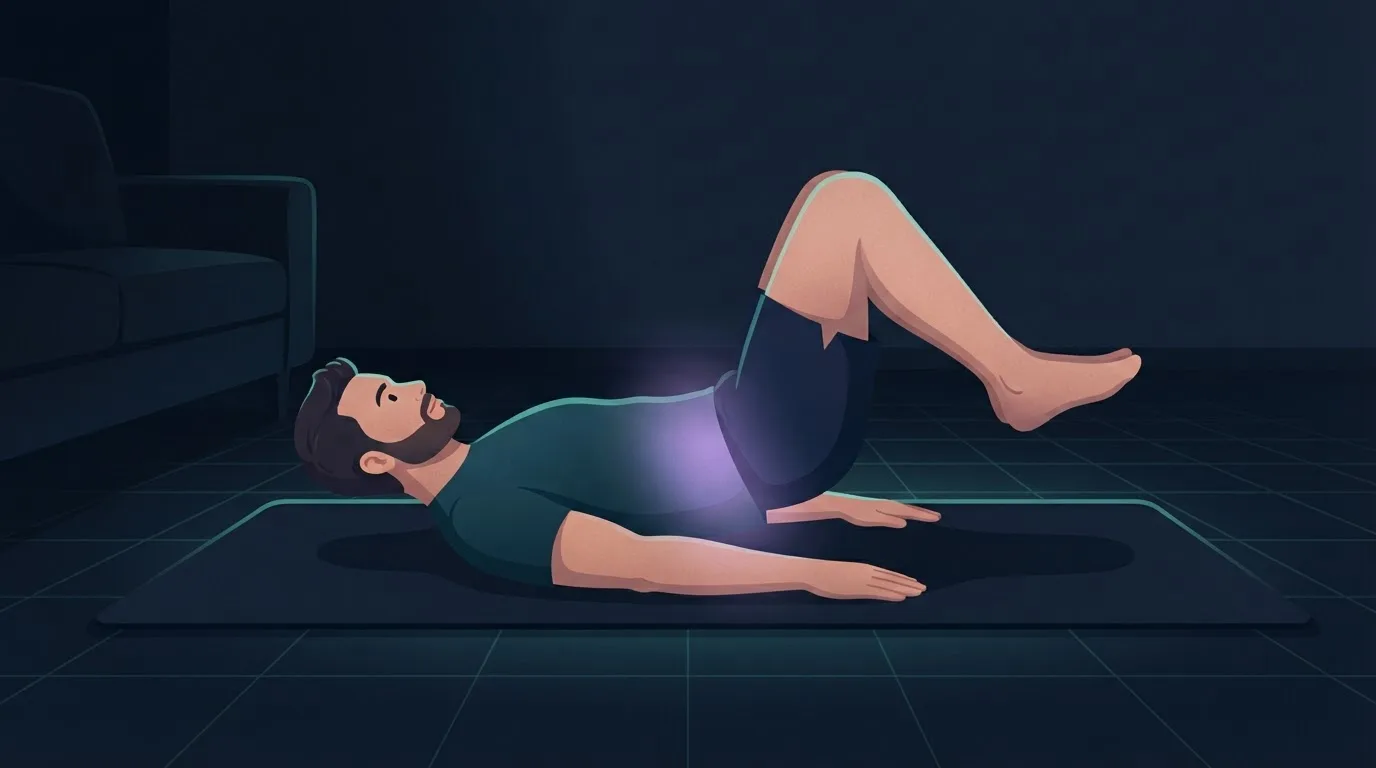
From the tabletop, with your arms flat beside you, curl your hips a few inches off the floor and draw your knees toward your chest. Then lower your hips back down for a slow count of three. The lift comes from your abs pulling your pelvis up, not from swinging your legs, so the movement is small. Domenic's reverse crunch guide has the full form cues. Do 2 to 3 sets of 10 to 12.
4. Seated knee tucks
Sit on the floor, lean back onto your hands and lift your feet. Draw your knees toward your chest as your upper body leans slightly forward to meet them, then push your legs out long without letting your feet touch down. The range is bigger than in the reverse crunch, and your hip flexors work hard too, so end the set when you feel it mostly at the front of your hips. Do 2 sets of 10.
5. Scissor raises
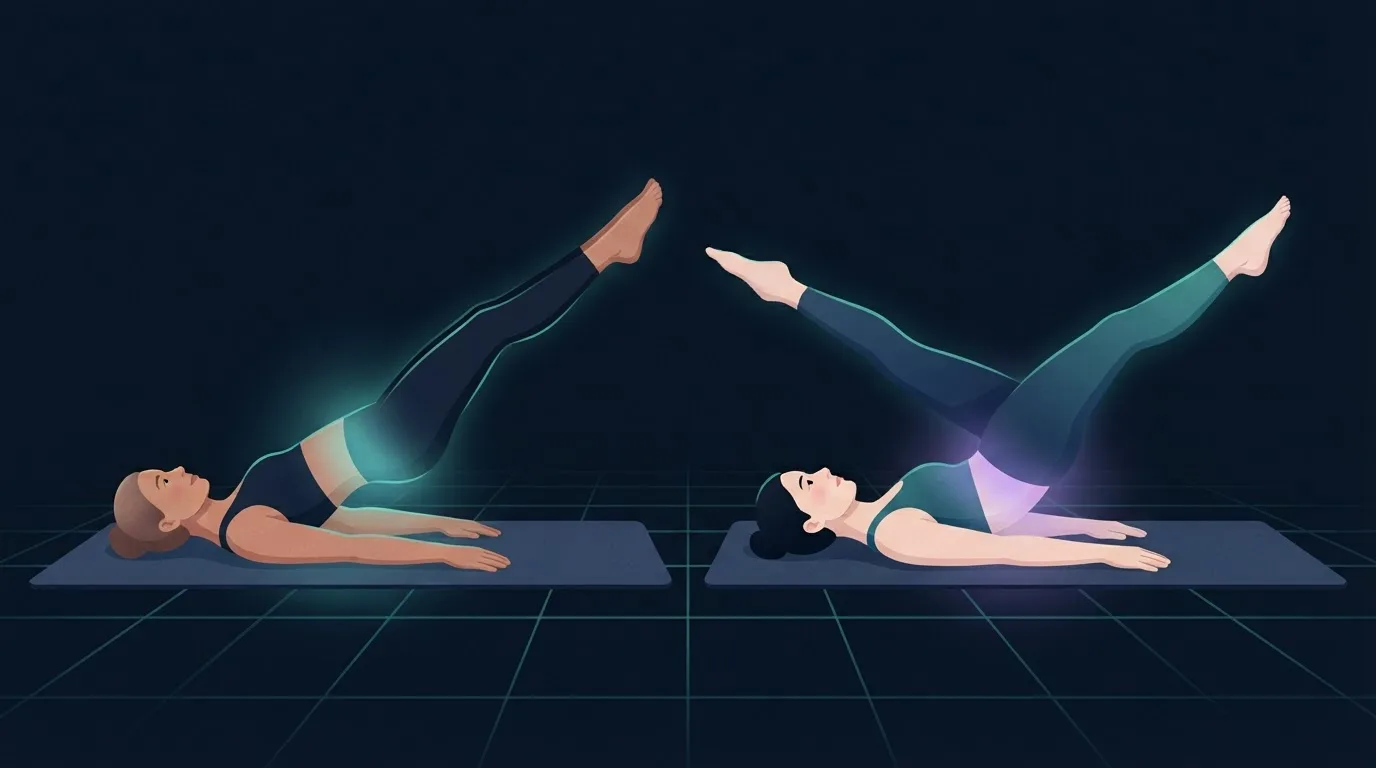
Lie on your back with your hands under your hips or flat at your sides, tuck your pelvis and lift both straight legs. Raise one leg toward the ceiling while the other hovers above the floor, then switch in a slow, smooth scissor motion. The lower the bottom leg goes, the harder it gets, so keep it higher if your back starts to arch. The scissor raise guide covers the details. Do 3 sets of 20 to 30 seconds.
6. Lying leg raise
Lie flat with your legs straight and your hands by your sides. Press your lower back down, raise both legs to vertical and lower them slowly. Stop lowering at the point where your lower back wants to lift, even if that's well above the floor, and bend your knees to make it easier. Domenic's leg raise guide shows the setup. Do 2 to 3 sets of 8 to 12.
7. Hollow hold
Lie on your back, press your lower back into the floor and lift your shoulders and straight legs a few inches, arms reaching past your head, so your body makes a shallow banana shape. Hold it. The whole front of your trunk works to keep your pelvis tucked while your legs pull against it. Tuck your knees or bring your arms to your sides to make it easier. Do 3 holds of 15 to 30 seconds.
8. Incline reverse crunch
Set a bench at a slight incline and lie on it with your head at the high end, holding the bench behind your head. Do a reverse crunch from there. Your hips and legs now travel uphill, which adds load without adding weight. In an EMG study of 21 adults, Escamilla and colleagues (2006) found a reverse crunch on a 30-degree incline among the exercises with the highest upper and lower rectus abdominis activity, alongside ab wheel moves and hanging knee-ups in arm straps. Do 3 sets of 8 to 10.
9. Hanging knee raise
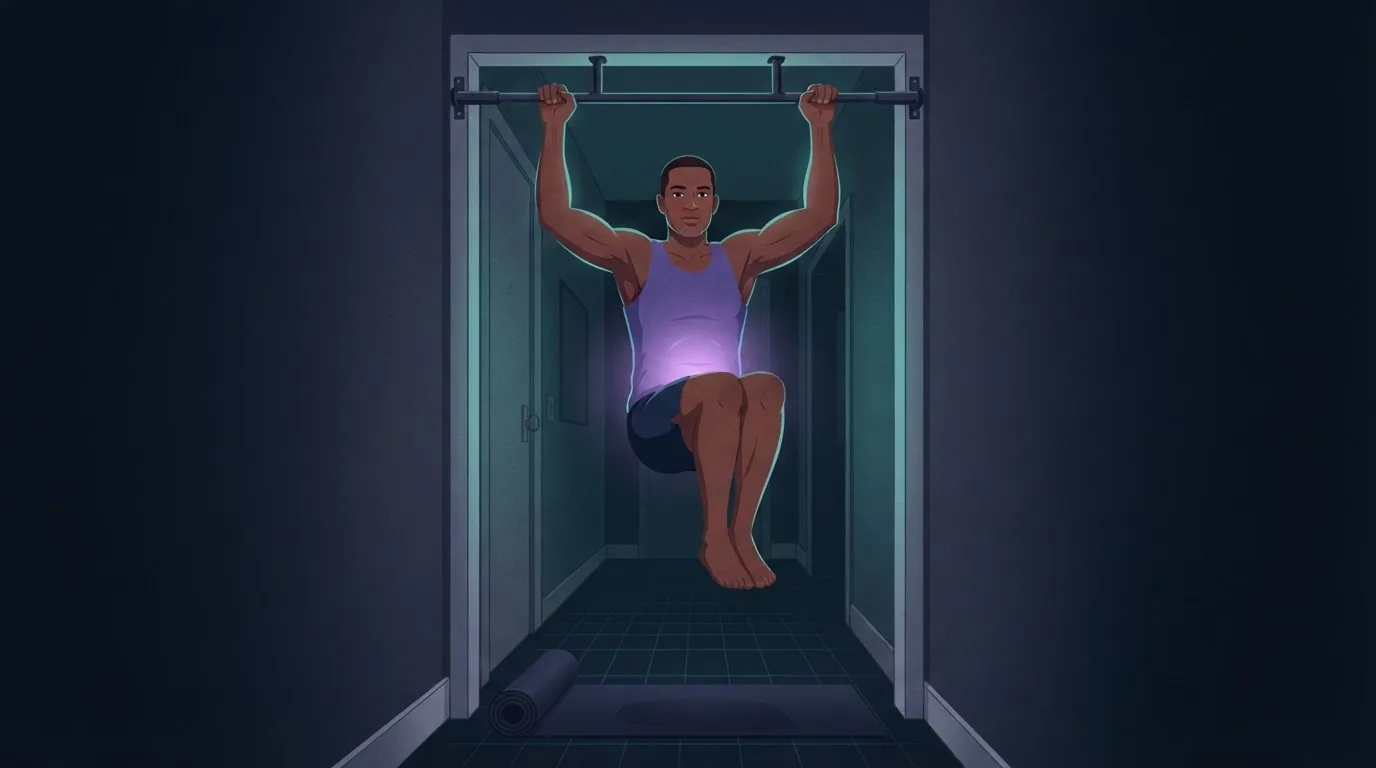
Hang from a pull-up bar with your hands about shoulder-width apart and your shoulders pulled down away from your ears. Without swinging, raise your bent knees to hip height or higher, and at the top curl your pelvis up so your tailbone tips forward. Lower slowly until your legs hang straight. If your grip gives out before your abs do, do fewer reps and rest longer. Do 3 sets of 6 to 10.
10. Hanging leg raise
Do the same movement with straight legs. Raise them to hip height or higher, curl your pelvis up at the top and lower them under control. It's the hardest move here because your abs have to lift your pelvis against the long lever of your legs while you hang. Domenic's hanging leg raise guide breaks down the form. Do 3 sets of 5 to 8.
Can You Target Your Lower Abs? What the EMG Studies Found
Your rectus abdominis is a single muscle that runs from your lower ribs to your pubic bone, crossed by bands of tendon that create the six-pack shape. Its nerves enter at several heights along its length, so the idea that its top and bottom could work a little differently has never been absurd. The research splits into two groups, and the details explain why.
The studies that found no difference
Lehman and McGill (2001) recorded 11 lean, athletic people during curl-ups, leg raises and restricted versions of both, while controlling spine position and range of motion. They found no difference between the upper and lower portions within or between exercises. Clark, Holt and Sinyard (2003) put eight adults through six exercises, including the reverse curl-up and leg lowering, and also found no upper-versus-lower difference. In that study, ordinary curl-ups produced more activity in both regions than the reverse curl-up or leg lowering did.
The studies that found a lower bias
Sarti and colleagues (1996) compared a curl-up with a posterior pelvic tilt in 33 volunteers, grouped by training history and by whether they did the moves correctly. Among people who did them correctly, the curl-up worked the upper portion harder than the lower. In the trained group who did them correctly, the pelvic tilt was more strenuous for the lower portion than the curl-up was. People who did the moves poorly activated both portions about equally.
Willett and colleagues (2001) measured 25 people through five common exercises, and the reverse curl produced the most lower rectus activity of the five. Duncan (2009) found more lower than upper activity in a Swiss ball jackknife, the only one of four exercises where the lower portion came out ahead.
The newest study used ultrasound to watch the muscle change shape. In 15 young adults, Gomirato and Grenier (2023) found the lowest segment thickened the most during a leg raise, while the top segment thickened the most during a crunch. They concluded that some differentiation is possible and that it depends on the exercise, with the muscle working hardest closest to the load.
What it means for your training
The lower abs aren't a separate muscle, and no exercise isolates them. What the evidence does support is a small shift: moving your pelvis toward your ribs, with good technique, seems to put a little more of the work into the bottom of the muscle. A 2009 synthesis of 87 abdominal EMG studies found the field too inconsistent to pool, which is why you'll read confident claims in both directions.
How the signal is processed matters too. In a one-person demonstration, Lehman and McGill (1999) showed that raw EMG made the lower rectus look only 60.9 percent as active as the upper during a trunk curl, and that the two regions were equal once the signal was scaled to each one's maximum. Small study details like that can produce an apparent difference in either direction. So train both directions: crunch-style moves for ribs toward pelvis, and the moves on this list for pelvis toward ribs. Our abs workout at home builds both into one six-week plan. The sides of your waist are a separate job, which our guide to oblique exercises covers.
Find out what's really holding you back
FitCraft, our mobile fitness app, pairs you with an AI coach who builds you a personalized plan around your goals, schedule, and fitness level. Every FitCraft program is designed by Domenic Angelino, MPH (Brown University) and NSCA-CSCS, with research published in the Journal of Strength and Conditioning Research and Medicine & Science in Sports & Exercise.
Take the Free Assessment Free • 2 minutes • No credit cardPosterior Pelvic Tilt: How to Keep the Work in Your Abs, Not Your Hip Flexors
Every leg-raising move pulls on two groups of muscles at once. Your hip flexors, the iliacus and psoas at the front of the hip, lift your legs. Your abs hold your pelvis so the legs have something stable to lift from. When the abs can't hold it, your pelvis tips forward, your lower back arches and the hip flexors end up doing most of the work. That's why some people feel leg raises mostly in the front of the hips and the lower back.
The studies back this up. Andersson and colleagues (1997) placed fine-wire electrodes in the iliacus of six men across 38 exercises. The hip flexors were highly active only when the hip itself flexed, and lifting both legs at once called on the abs, while lifting one leg at a time did not. With electrodes inside the muscle in eight people, Juker and colleagues (1998) found every form of sit-up activated the psoas at 15 to 35 percent of its maximum, against under 10 percent for a curl-up.
Pelvic position changes the picture. Workman and colleagues (2008) had 16 men hold both straight legs just above a board with the pelvis tipped forward, neutral or tucked back. The tucked position produced significantly more upper and lower rectus abdominis activity than the forward tilt, while activity in the rectus femoris, a hip flexor on the front of the thigh, didn't change. So the tuck makes your abs work harder as a whole, upper and lower together. That's why it opens every move above.
How to find and hold the tilt
- Lie on your back with your knees bent and slide one hand, palm down, under the small of your back.
- Breathe out and tilt the top of your pelvis toward your ribs until your back presses lightly onto your hand.
- Keep that pressure while you lift one foot, then the other.
- When the pressure on your hand lets up, the set is over or the lever is too long for today.
The deep muscles under the rectus, including the transverse abdominis and the pelvic floor, help you hold that position. Our guide to deep core exercises covers how to train them.
Signs your hip flexors have taken over
- You feel the exercise mostly at the front of your hips or in your lower back.
- Your lower back peels off the floor as your legs lower.
- You need a swing or a kick to start each rep.
- In a reverse crunch, your feet travel a long way while your hips barely leave the floor.
If you notice any of these, go back one rung on the list, bend your knees or shorten the range. Escamilla's group made the same point from the other side: several of the exercises with the highest ab activity, including the incline reverse crunch, also had some of the highest rectus femoris activity, and the authors noted that this may cause trouble for some people with low back problems.
Why Lower Abs Show Up Last
Are lower abs the hardest to get? For most people, yes, and the reason has little to do with the muscle. It comes down to how thick the fat is over it and how the muscle is built.
Start with the fat. Sengeis and colleagues (2019) measured the fat under the skin by ultrasound at eight sites on 61 competitive judokas. Among the adults, the fat at a site just below the navel was more than twice as thick as at a matching site just above it: a median of 12.1 mm against 4.9 mm in the women, and 5.1 mm against 2.2 mm in the men. So when the fat over your upper abs is thin enough for the muscle to show, the layer over your lower abs is likely still about twice as thick.
Then there's the anatomy. The blocks of a six-pack come from bands of tendon that cross the rectus abdominis. In a dissection study of 54 bodies, Anita and colleagues (2015) found three bands in 52 of them: one just below the breastbone, one midway and one at the level of the navel. Only two had a band below the navel. For most people, then, the muscle below the belly button is one smooth section with no crease to reveal. Strong, lean lower abs look flat and firm rather than like a fourth row of blocks.
More lower ab exercises won't thin that fat faster. In a trial by Vispute and colleagues (2011), 24 sedentary adults were assigned either to seven ab exercises five days a week for six weeks or to no training, with their diets held steady. The exercise group's ab endurance improved, but ab training had no effect on abdominal fat, waist size or skinfolds. Our guide on how to get abs covers the body fat levels and the timeline for the whole midsection.
How to Progress Lower Ab Exercises
Lower ab exercises get harder in five ways. Change one at a time, and only once the current version is clean for two full sets.
- Lengthen the lever. Straightening your legs moves their weight farther from your hips. Bent-knee leg lowers become scissor raises, and the hanging knee raise becomes the hanging leg raise.
- Lower your legs closer to the floor. In leg lowers, scissor raises and the hollow hold, the lower your legs go, the more your abs work to keep your pelvis down.
- Change the angle. Floor first, then an incline, then hanging. Each step makes your hips move against more of your own weight.
- Slow the lowering. Take three to four seconds to lower and pause for a second at the top. It's the cheapest progression there is.
- Add a light weight. Once the reverse crunch and the lying leg raise are easy, squeeze a light dumbbell between your feet. Start light, because the weight sits at the end of the lever.
| Stage | Moves | Typical dose | Move up when |
|---|---|---|---|
| Foundation | 1 to 3 | 2 sets of 10 slow reps | Your lower back stays down on every rep |
| Building | 4 to 6 | 2 to 3 sets of 10 to 12 | 2 sets of 12 with a 3-second lowering |
| Advanced | 7 and 8 | 3 sets of 8 to 10, or 20 to 30 sec holds | 3 clean sets with no swing |
| Hanging | 9 and 10 | 3 sets of 5 to 10 | Stay here and rotate versions |
Most people in their 30s and 40s get what they need from the Foundation and Building stages. The hanging moves are worth working toward if you have a pull-up bar and enjoy a challenge, and your grip and shoulders get a workout on the way.
A 10-Minute Lower Ab Workout You Can Do at Home
Do one of these 2 to 3 times a week, on its own or at the end of a strength session. Rest about 30 seconds between sets. Pick the version that matches your stage above. If getting down on the floor is hard for you, our standing ab workout trains the front and sides of your trunk on your feet.
Beginner lower ab workout (no equipment)
| Exercise | Sets | Reps or time |
|---|---|---|
| Posterior pelvic tilt | 2 | 10 with a 5-second hold |
| Bent-knee leg lowers | 2 | 8 per leg |
| Reverse crunch | 3 | 10 with a 3-second lowering |
| Hollow hold, knees tucked | 2 | 15 to 20 sec |
Advanced lower ab workout (pull-up bar)
| Exercise | Sets | Reps or time |
|---|---|---|
| Hanging knee raise | 3 | 8 to 10 |
| Scissor raises | 2 | 30 sec |
| Lying leg raise, 3-second lowering | 2 | 10 |
| Hollow hold | 2 | 30 sec |
If you'd rather not plan the sets yourself, a home workout app with no equipment can do it for you. FitCraft has the reverse crunch, the leg raise and the scissor raise as exercises with interactive 3D demos you can zoom in on, and the exercise tips name the muscles to focus on. Your workouts adjust as you progress, and streaks help keep short ab sessions from slipping.
The Bottom Line
Lower ab exercises train the same muscle as every other ab exercise, with your pelvis moving instead of your ribs. Tuck your pelvis, move slowly and lengthen the lever one step at a time. The muscle gets stronger within weeks. It shows when the fat over it is thin enough, and below the navel that takes the longest.
Working out consistently is hard, but it doesn't have to be. As Matt put it, "The real win is I actually want to work out now. That's never happened before." Pick your rung on the list and do your first set today.
Frequently Asked Questions
What is the best workout for my lower abs?
The best lower ab workout pairs one move that curls your pelvis toward your ribs, such as a reverse crunch or a hanging knee raise, with one hold, such as a hollow hold, done slowly 2 to 3 times a week. Pick the hardest version you can do with your pelvis tucked on every rep, and make it harder by lengthening the lever one step at a time.
How do I get rid of my lower belly pooch?
A lower belly pooch is mostly the fat layer below your navel, which is thicker just below the navel than just above it, even in elite athletes, so it shrinks with overall fat loss rather than with extra ab exercises. Lower ab exercises strengthen the muscle underneath. After pregnancy, a pooch can also come from a gap between the two sides of the ab muscle, which is worth having checked by a physical therapist.
Are lower abs the hardest to get?
Yes, for most people the lower abs are the hardest abs to get and to see. The fat just below the navel was about twice as thick as just above it in elite judo athletes, and most people have no tendon crease below the belly button, so lean lower abs look flat and firm rather than like a fourth row of blocks. Most lower ab exercises also load the hip flexors, which makes them feel harder to train well.
How do you get a V shape below your abs?
The V shape below the abs is the line that runs from the front of each hip bone down toward the pubic bone, where the abdominal wall meets the top of the thigh. It shows up when the fat around your hips and lower belly is low. Hanging leg raises, reverse crunches and side planks strengthen the muscles that form it, but low body fat is what makes it visible.
What are the best lower tummy exercises?
The best lower tummy exercises are the same as the best lower ab exercises: reverse crunches, bent-knee leg lowers, lying leg raises, hollow holds and hanging knee raises. They strengthen the lower part of the rectus abdominis and the deeper muscles under it. They won't flatten the fat over your lower tummy on their own, which comes from overall fat loss.
What are the best upper ab exercises?
The best upper ab exercises bring your ribs down toward your pelvis, such as crunches, curl-ups and sit-ups. In some EMG and ultrasound studies, crunches and curl-ups worked the top of the rectus abdominis a little more than the bottom, the mirror image of reverse crunches and leg raises. Since it's one muscle, a complete ab routine trains both directions.