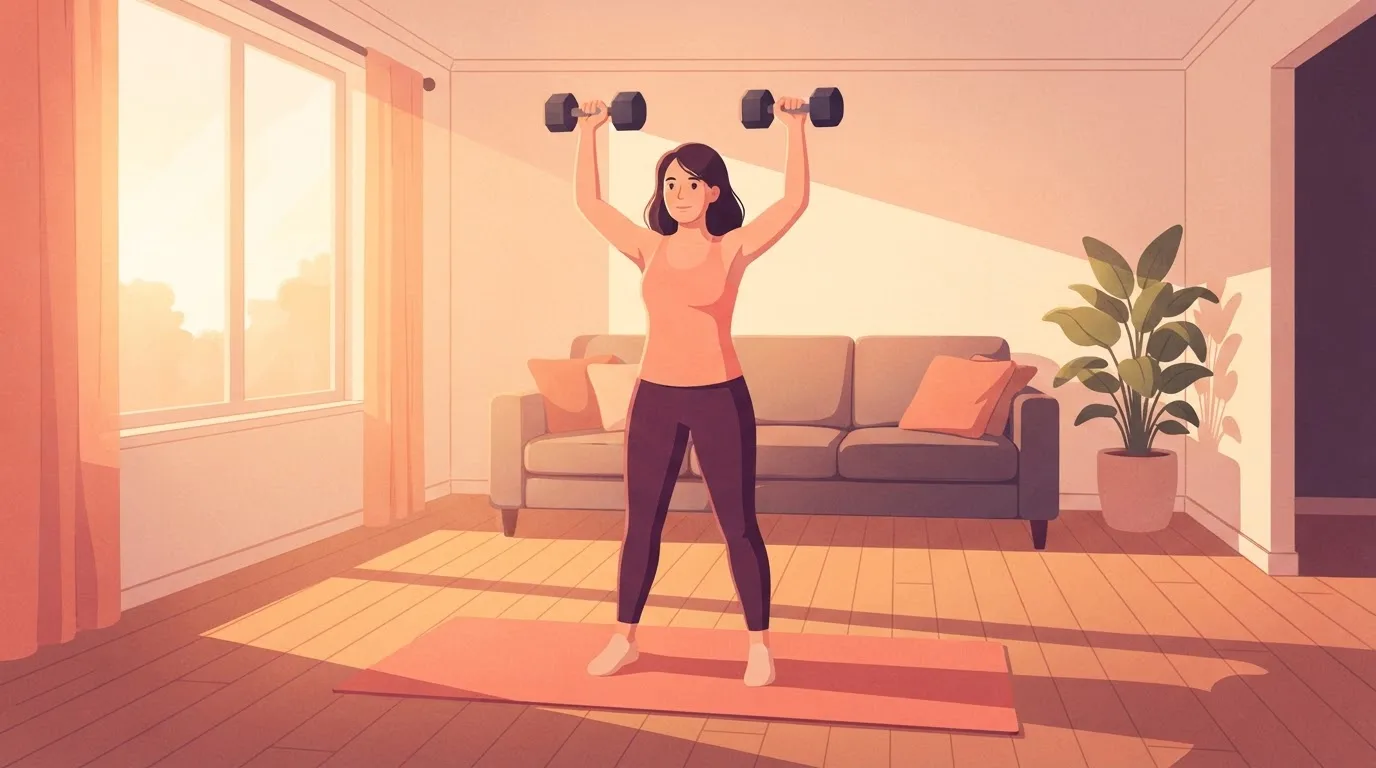
You started lifting in January, three short sessions a week with a pair of dumbbells in the living room. A month later the scale shows the same number it did on New Year's Day, or a pound more. That's usually the week people decide lifting weights to lose weight doesn't work, and they go back to long cardio sessions or stop altogether.
The scale is accurate. It just weighs everything at once: fat, muscle, water, stored carbohydrate and whatever you ate last night. Lifting pushes some of those up and others down, so the total can sit still while your body fat drops. So can you lose weight just by lifting weights? You can, once a modest calorie deficit is part of the plan, and the lifting then makes sure the weight you lose is mostly fat.
This page covers what lifting alone does to your weight, what the number on the scale includes, why it can stall while you lose fat, how to tell it's working, and how to set up the calorie deficit around your lifting. Our page on whether weight lifting burns fat covers the separate question of what each session does to fat burning, the afterburn and belly fat.
Can You Lose Weight by Lifting Weights Only?
Lifting weights only, with no change to what you eat, barely moves your body weight, even though it trims some fat. That's the steady finding when researchers give people a lifting program and leave their meals alone.
Lopez and colleagues (2022) pooled 114 trials with 4,184 people who had overweight or obesity. In the 50 trials that compared resistance training alone with no training, body weight changed by 0.1 kg on average, which is no change at all. Under that flat number, body fat fell by 1.0 kg and lean mass rose by 0.8 kg. The programs in the review ran for about 15 weeks on average.
One long trial shows the same thing in a single group of people. In the eight-month STRRIDE AT/RT study, Willis and colleagues (2012) had sedentary adults with overweight or obesity lift three days a week without dieting. The 44 lifters with complete scans ended up 0.8 kg heavier on average. They had added 1.1 kg of lean mass, and their fat mass didn't change significantly.
That's why the American College of Sports Medicine's position stand on weight loss says resistance training "does not enhance weight loss" but may increase fat-free mass and fat loss (Donnelly and colleagues, 2009). The fat-burning side is real. A review of 58 studies in healthy adults found that resistance training lowered body fat percentage by about 1.5 points compared with not exercising (Wewege and colleagues, 2022). The scale can't show it, because muscle and water arrive at the same time.
Scale Weight vs Body Composition: What the Number Includes
Your body weight is your fat mass plus everything else, which researchers call fat-free or lean mass: muscle, organs, bone, blood and a lot of water. Lean tissue is about 73% water (Wang and colleagues, 1999), so when your lean mass changes, much of what the scale picks up is water moving with it. Body composition is how your total splits between fat and lean mass, and it's the part lifting changes most. Losing fat while adding a little muscle has a name, body recomposition, and on a scale it can look like nothing is happening.
| Part of your weight | How fast it can change | What lifting does to it |
|---|---|---|
| Body fat | Slowly, about a pound a week at the start of a 500-calorie daily deficit | Falls when you eat less than you burn |
| Muscle and other lean tissue | Very slowly, about 1 kg over several months in the trials above | Rises a little without a diet and holds steady with one |
| Water in and around trained muscle | Within days | Rises in the first weeks of a new program |
| Glycogen, the carbohydrate stored in muscle | Within a day or two | Rises as trained muscles store more fuel, and it brings water with it |
| Food and fluid in your gut | Within hours | Lifting doesn't change it |
Only the first row is the weight you want to lose. The other four can swing a kilogram or more within a few days, and our guide to how much weight fluctuates in a day shows ordinary swings of 1 to 4 pounds between morning and night. A single weigh-in can't tell you which row moved.
Why the Scale Can Stall While You Lose Fat
If you've started lifting and the scale is stuck, one of these four things is usually behind it, and three of them mean the program is working.
New muscle offsets the fat you lose
Take the average result in the Lopez review: 1.0 kg of fat gone, 0.8 kg of lean mass added, and a scale that moved by about 0.1 kg over several months. That's less than the difference between a morning and an evening weigh-in. The body changed more than the number did.
New training makes your muscles hold water
Unfamiliar exercise causes small amounts of muscle damage, and the repair brings fluid into the muscle. When Damas and colleagues (2016) scanned the thigh muscles of ten untrained young men, the 2.7% growth they measured in the third week of training came with clear signs of swelling, so much of it was probably fluid rather than new muscle. Trained muscles also store more glycogen, and each gram is stored with at least 3 grams of water (Fernández-Elías and colleagues, 2015). Both kinds of water show up on the scale.
Why did I gain 10 lbs after working out?
A 10-pound gain soon after you start working out is almost all water, glycogen and food, because neither fat nor muscle can build up that fast. The lifters in the Willis trial added about 1 kg (2.2 pounds) of lean mass in eight months, and putting on 10 pounds of fat in a few weeks would take well over a thousand extra calories a day.
Give a new program four weeks before you judge the scale. If the number is still climbing after that and your waist is growing too, you're probably eating more than you think. Our guide to why you gain weight while working out goes through each cause and when to change your eating.
The calorie deficit isn't there yet
A lifting session burns less than most people guess. The 2024 Adult Compendium of Physical Activities rates ordinary sets with rest at 3.5 METs. That's about 210 calories in 45 minutes for an 80 kg (176 lb) adult, and you'd have burned about 60 of those sitting on the couch. A post-workout snack can cancel the rest. If the scale and your waist have both stayed put for a month, look at what you're eating before you change your training.
How to Tell You're Losing Fat When the Scale Won't Move
Track the things that fat loss changes and water barely touches, such as these five.
- Your waist. An international panel of obesity researchers called waist circumference a vital sign and named shrinking it a key treatment target for men and women (Ross and colleagues, 2020). Measure at the same spot every two weeks, first thing in the morning, with the tape snug but not pressing in.
- A weekly average. Weigh yourself on three or more mornings a week and compare this week's average with last week's, instead of reacting to one day.
- Your lifts. If you're adding reps or weight while eating less, you're keeping your muscle, so most of what comes off will be fat.
- Your belt and jeans. The notch you use is a decent stand-in for a tape measure.
- Photos. Take them once a month in the same light, the same spot and the same clothes.
If two of these five are moving the right way, the program is working, whatever the scale says this week.
Knowing what to do is the easy part.
FitCraft, our mobile fitness app, pairs you with an AI coach who builds you a personalized plan around your goals, schedule, and fitness level. Every FitCraft program is designed by Domenic Angelino, MPH (Brown University) and NSCA-CSCS, with research published in the Journal of Strength and Conditioning Research and Medicine & Science in Sports & Exercise.
Take the Free Assessment Free • 2 minutes • No credit cardHow Lifting Fits Into a Calorie Deficit
A calorie deficit is what moves the scale, and lifting decides what the lost weight is made of. You need both if you want a lower number and a body that's stronger at the end of it.
How many calories should I consume daily to lose weight?
Start from your maintenance calories and eat about 500 to 750 fewer a day. That's the deficit recommended by the 2013 obesity guideline from the American Heart Association, the American College of Cardiology and The Obesity Society, which also offers fixed targets of 1,200 to 1,500 calories a day for women and 1,500 to 1,800 for men (Jensen and colleagues, 2014). Our TDEE calculator estimates your maintenance number from your size and activity.
Expect the loss to slow as you go. For an average adult with overweight, Hall and colleagues (2011) estimated that each 10 calories a day you cut for good eventually takes off about a pound, but only half of that loss arrives in the first year. That's why the old rule of 3,500 calories per pound predicts about twice the first-year loss that their model does.
Lifting keeps the weight you lose mostly fat
When people diet without exercise, a good share of the weight they lose is muscle and other lean tissue. In a review of 52 studies of adults aged 50 and over, Weinheimer and colleagues (2010) found that 81% of diet-only groups lost at least 15% of their weight as lean mass, against 39% of the groups that also exercised, mostly with aerobic training.
Lifting protects more of it than cardio does. Villareal and colleagues (2017) randomized 160 adults with obesity, average age about 70, to a control group or to the same weight-loss diet with a 500 to 750 calorie daily deficit, plus aerobic training, resistance training or both, three sessions a week for six months. Every exercise group lost about 9% of its weight. The aerobic group lost 2.7 kg of lean mass along the way and the resistance group lost 1.0 kg. The lifters' strength rose 19%, against 4% in the aerobic group. An 18-month trial of older dieters found the same pattern (Beavers and colleagues, 2017).
Lifting protects your resting burn
Dieting usually lowers the calories you burn at rest, partly because you lose lean tissue. Hunter and colleagues (2008) followed 94 premenopausal women with overweight through a diet that took off about 12 kg. The women who lifted kept their fat-free mass, 46.9 kg before and 47.2 kg after, and their resting energy expenditure held steady. The women who did aerobic training or no exercise lost fat-free mass, and their resting burn fell. Lifting held the lifters' resting burn where it started, which spared them the dip that usually comes with weight loss.
Eat enough protein to keep the muscle
Protein is the other half of keeping muscle while you eat less. In a review of 49 trials with 1,863 people who lifted, Morton and colleagues (2018) found that extra protein stopped adding muscle once total intake reached about 1.6 g per kilogram of body weight a day. For a 75 kg (165 lb) adult that's about 120 grams a day, which is easier to reach as a palm-sized portion at each meal than as one big serving.
Which Is Better for Weight Loss, Cardio or Strength Training?
Cardio burns more calories per hour, so it moves the scale faster, and strength training protects your muscle, so more of what you lose is fat. In the Willis trial, the cardio group lost 1.8 kg and the lifting group gained 0.8 kg. The group that did both lost the most fat, 2.4 kg, and still added lean mass, though it trained about twice as long each week. For most people the best answer is both, with two or three lifting sessions a week and walking or other cardio on the days between. Our breakdown of whether cardio or weights is better for fat loss has the full trial table and a weekly split.
Is 2 Days a Week at the Gym Enough?
Yes, two days a week is enough to get stronger and keep your muscle while you lose weight, and it meets the CDC's minimum of at least two days of muscle-strengthening activity a week (CDC). The CDC also asks for 150 minutes a week of moderate activity such as brisk walking, which helps the calorie side.
Twice a week changed body fat in a long trial of women in their late twenties to mid forties. Schmitz and colleagues (2007) randomized 164 women aged 25 to 44 with overweight or obesity to two years of twice-weekly strength training or to brochures about aerobic exercise. Body fat percentage fell 3.7 points in the lifting group and 0.1 points in the brochure group. Deep belly fat rose in both groups, by 7% in the lifters and 21% in the others. The authors point out that American women in this age range typically gain 0.5 to 1 kg a year, most of it fat.
Fitting your exercise into one or two days can work too. In US survey data on 9,629 adults aged 20 to 59, people who got their 150 weekly minutes in one or two sessions had waists about 1.9 cm smaller than inactive adults, similar to people who exercised more often (Lei and colleagues, 2024). That's an observational study, so it shows a link rather than proof.
If you train at home, two sessions of 30 to 40 minutes is a realistic start, and a dumbbell workout app can lay out the exercises and show you the form for each one.
A Simple Week of Lifting to Lose Weight at Home
This beginner week fits around work and family. It uses two full-body dumbbell sessions, an optional third, and walking on the days between. If you've never lifted before, our guide to how to start lifting weights covers choosing dumbbells and learning the basic movements first.
| Day | What to do | Time |
|---|---|---|
| Monday | Session A: goblet squat, dumbbell floor press, one-arm row, glute bridge | 30 to 40 minutes |
| Tuesday | Brisk walk | 30 minutes |
| Wednesday | Rest or an easy walk | Up to 30 minutes |
| Thursday | Session B: split squat, Romanian deadlift, incline push-up, standing overhead press | 30 to 40 minutes |
| Friday | Brisk walk | 30 minutes |
| Saturday | Optional: Session A again, or a longer walk or bike ride | 30 to 45 minutes |
| Sunday | Rest | None |
Do 2 or 3 sets of 8 to 15 reps of each exercise, and end each set when you could still do 1 to 3 more good reps. Rest about a minute between sets. When the top of the rep range feels easy on every set, add a rep or two next time or pick up the next dumbbell. Keep the food side just as plain, with the same 500 to 750 calorie daily cut, protein at every meal and meals you can repeat on a busy Tuesday.
What This Means for You
Lifting weights helps you lose weight in the way that matters most. It makes sure the pounds that come off are mostly fat, and it keeps you strong while you eat less. On its own it won't move the scale much, so pair it with a modest calorie deficit and judge your first month by your waist, your belt and your lifts.
If you quit lifting before because the scale didn't move, you were watching a number that couldn't show your progress. Stacy, 41, lost 22 pounds in four months with FitCraft after her second child. As she put it, "After my second kid, I needed something stupidly simple." In FitCraft, a 3D AI coach demonstrates each dumbbell and bodyweight exercise on an interactive model so you can learn the form, says your name during the workout and adapts your workouts as you progress. Streaks and XP give you a reason to keep showing up after the January rush fades.
Frequently Asked Questions
How much weight should I lift to lose weight?
Lift a weight you can handle for 8 to 15 good reps while stopping 1 to 3 reps short of failure. The exact load matters less than the effort. A review of 21 studies found that light and heavy loads built similar muscle when sets were taken to failure, while heavy loads built more maximal strength (Schoenfeld and colleagues, 2017). When the set gets easy, add reps or move up a dumbbell.
What workouts burn the most fat?
Workouts that keep big muscles moving with little rest burn the most calories per minute, such as running, cycling, rowing and circuits. The 2024 Compendium of Physical Activities rates a bodyweight circuit at 6.0 METs against 3.5 for ordinary lifting with rest. Over months, the workout that burns the most fat is the one you keep doing alongside a calorie deficit.
What is the #1 worst food for weight gain?
In three Harvard cohorts of 120,877 US adults, potato chips had the strongest link to weight gain: each extra daily serving went with 1.69 pounds more gain every four years (Mozaffarian and colleagues, 2011). Potatoes, sugar-sweetened drinks and red and processed meats came next, while yogurt, nuts, fruit, whole grains and vegetables went with less gain. The study shows links, not cause and effect.
How long does it take to lose weight by lifting weights?
Expect the first two to four weeks to be confusing, because new training adds water while fat starts to come off. After that, a 500 to 750 calorie daily deficit usually takes off about 1 to 1.5 pounds a week at first, and the rate slows as you get lighter. Judge progress by your four-week trend and your waist, not by single days.
Will lifting weights make me bulky?
No. Muscle comes on slowly. Across 50 trials, resistance training added about 0.8 kg of lean mass in programs that averaged about 15 weeks (Lopez and colleagues, 2022). In a two-year trial of women aged 25 to 44, twice-weekly strength training lowered body fat percentage by 3.7 points, against 0.1 points in the comparison group (Schmitz and colleagues, 2007).