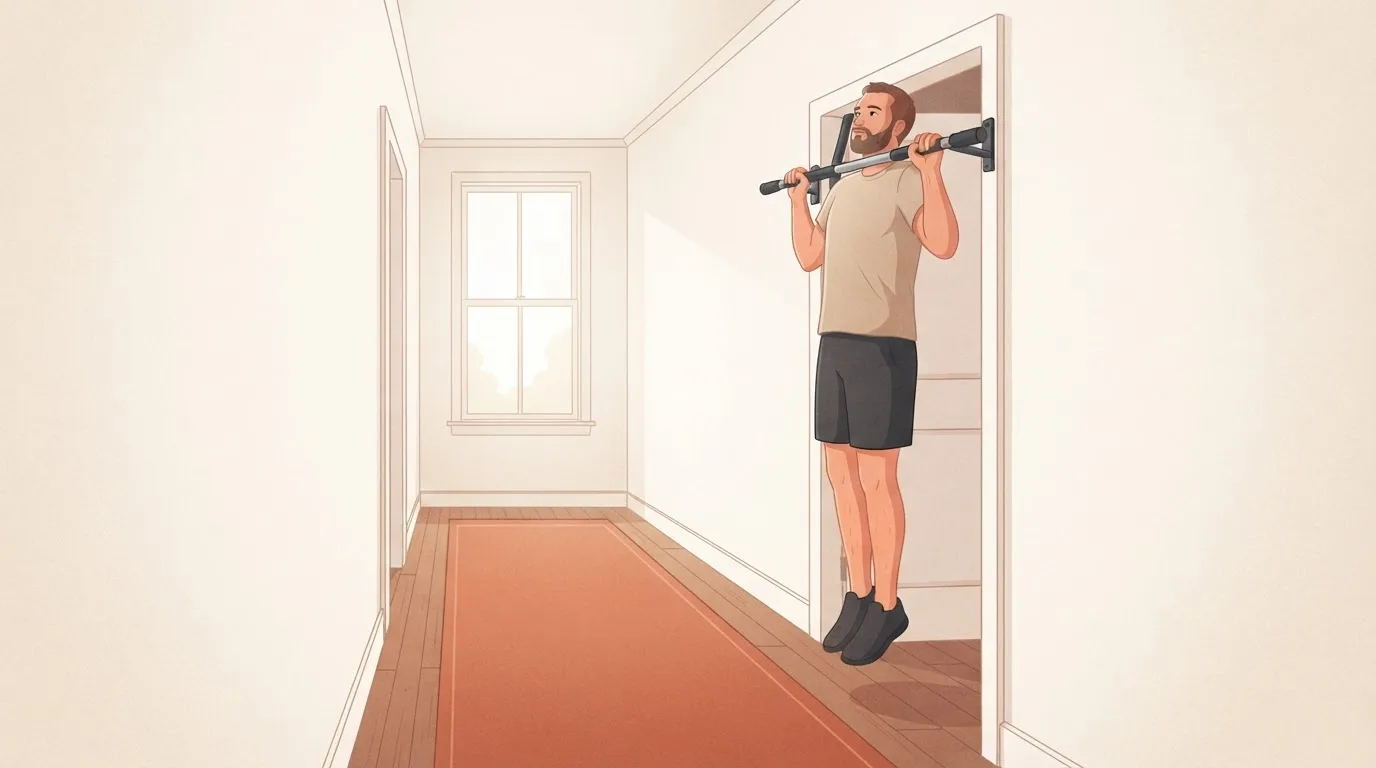
You got your first pull-up, maybe after months of work. Then you got stuck at three or four, and every set since has ended the same way: one slow grinding rep, a half rep and a drop to the floor. Weeks go by and the number doesn't move. It's easy to decide you just aren't built for pull-ups.
You probably are. Most people who stall at a handful of reps train pull-ups the way they test them: one or two all-out sets, a couple of times a week. That builds a little strength and a lot of fatigue. It also gives you very few good reps to practice with, and a pull-up is a skill as much as a strength test.
This page is for people who can already do at least one strict pull-up and want to know how to do more pull ups. You'll see what limits your reps, what the training studies found, three classic rep-building plans, weighted and slow-tempo work, grip and shoulder blade strength, and a 6-week plan with a table.
What Limits How Many Pull Ups You Can Do?
Two things set your pull-up count. The first is how strong your back and arms are compared with your body weight. The second is how long you can repeat that effort before your grip, your shoulder blades or your form gives out.
Strength relative to body weight matters more than raw strength. Sanchez-Moreno, Pareja-Blanco, Diaz-Cueli and Gonzalez-Badillo (2016) tested 25 trained male athletes. Their pull-up count tracked how many lat pulldown reps they could do with a load equal to their own body weight (r = 0.62). It had almost no link with the heaviest weight they could pull down once (r = 0.09). Heavier athletes were stronger on the machine, yet they did fewer pull-ups: the count fell as body mass rose (r = -0.55).
So two people with the same top-end strength can be several reps apart. One carries more weight, and the other has spent more time pulling his own weight for reps. That's why most of your training should be pull-ups at your own body weight, with heavier work as a supplement. Our page on how many pull ups you should be able to do covers body weight, age and the norms in more detail.
Can't Do a Pull Up Yet? Build Your First Rep First
If you can't do a pull up yet, most of the methods on this page come too early, because they need at least one clean rep to work with. Build that rep first with dead hangs, scapular pull-ups, rows, slow negatives and band-assisted reps, about three times a week. Our 12-week plan for your first pull-up lays out each step, and most people get there sooner with chin-ups. Come back when you can do one strict rep from a dead hang.
What the Training Studies Show About Getting Better at Pull Ups
Only a handful of trials have trained pull-ups and counted the reps afterward. Read together, they point to three levers: stronger lats, sets that end before your reps slow badly, and more total practice across the week.
Stronger lats add reps
Li and colleagues (2025) put 34 recreationally active male college students through 8 weeks of lat pulldowns. They trained 3 days a week, doing 4 sets of 12 reps at 65% to 80% of their pulldown max, with each rep lasting about 6 seconds. One group used a normal machine. The other pulled on elastic bands attached to the ends of the bar, an unstable setup that made every rep wobble. Both groups started at about 2 pull-ups. The normal-machine group finished at 5.8 and the unstable group at 8.5.
You don't need a machine to use that finding. Band-assisted pull-ups and slow lowering reps load the same muscles through the same path, and they count as practice on the real movement too.
Stop each set before your reps slow down
In the 2020 velocity-loss trial by Sanchez-Moreno, Cornejo-Daza, Gonzalez-Badillo and Pareja-Blanco, 29 strength-trained men took part. They could already do about 16 pull-ups, and they trained them at body weight twice a week for 8 weeks. One group ended every set once rep speed had dropped by 25%. The other kept going until it had dropped by 50%, which is much closer to failure.
The 25% group improved on every test, max reps included. The 50% group didn't improve on any of them. The difference between the groups was significant on every test except max reps. The extra reps near failure bought nothing and may have held the men back. In practice, end the set when a rep comes up clearly slower than your first one, before the grinding rep.
Frequency helps because it adds practice
A meta-analysis of 22 studies by Grgic and colleagues (2018) found that strength gains grew with the number of sessions per week. When total weekly volume was equal, though, frequency made no significant difference. More sessions help mainly because they let you fit in more good sets. The authors also found that higher frequencies seemed to pay off more on multi-joint exercises in the upper body, which is exactly what a pull-up is.
None of these studies tested grease the groove, ladders or the Armstrong program directly. Those are coaching methods. What the research supports is the idea behind them: more good reps across the week, with most sets ending well short of failure.
Grease the Groove: Many Easy Sets Through the Day
Grease the groove is a method made popular by strength coach Pavel Tsatsouline. You do one easy set of pull-ups many times a day and never go near failure. It treats the pull-up as a skill you practice, the way you'd practice a golf swing.
- How many reps. About half your max per set. If your max is 6, every set is 3 reps.
- How often. Five to eight sets spread through the day, at least 15 minutes apart. A doorway bar you walk under makes this easy.
- How many days. Five or six days a week, then a day off. Retest your max every two weeks and adjust the set size.
- When to back off. If your elbows or the front of your shoulders ache, take two days off and use fewer sets.
Grease the groove fits the frequency research above: it adds 15 to 40 easy reps a day without the fatigue of hard sets. It suits people with a bar at home and a max between about 2 and 10. It builds less muscle than hard sets, so it works best for a few weeks at a time. Our greasing the groove research review covers why it works and where it falls short.
Pull-Up Ladders: More Reps Without Grinding
A ladder climbs one rep at a time with short rests, then starts again from the bottom. You do a single rep, rest, then two reps, rest, then three, up to a top rung of about half your max. Then you start again from a single rep. Rest 20 to 40 seconds between rungs and about two minutes between ladders.
Here's how it adds up. With a max of 6, three ladders that climb to 3 reps give you 18 pull-ups. Two all-out sets would give you about 11, with the last few reps of each slow and ugly. In a ladder only the top rung feels hard, and even that rung stops short of failure, which matches the velocity-loss finding.
To progress, add a ladder each week until you can do five. Then raise the top rung by one rep and drop back to three ladders. If your max is 1 or 2, a ladder is just a single rep, so do 6 to 8 singles with a minute of rest instead.
Knowing what to do is the easy part.
FitCraft, our mobile fitness app, pairs you with an AI coach who builds you a personalized plan around your goals, schedule, and fitness level. Every FitCraft program is designed by Domenic Angelino, MPH (Brown University) and NSCA-CSCS, with research published in the Journal of Strength and Conditioning Research and Medicine & Science in Sports & Exercise.
Take the Free Assessment Free • 2 minutes • No credit cardThe Armstrong Pull-Up Program
The Armstrong program is credited to Major Charles Lewis Armstrong of the US Marine Corps, and many people have used it to prepare for the Marine Corps physical fitness test. It runs five days on and two days off, usually Monday to Friday. Versions online differ in small details, but they agree on this outline:
- Every morning. Three max-effort sets of push-ups.
- Day 1. Five max-effort sets of pull-ups, with 90 seconds of rest between them.
- Day 2. A pyramid. Do one rep, then two, then three, adding a rep each set until you miss one. Rest 10 seconds for every rep in the set you just did, so 30 seconds after a set of 3. Finish with one max-effort set.
- Day 3. Nine "training sets" split across three grips, with 60 seconds of rest. A training set is a fixed number of reps you can repeat for all nine sets with clean form.
- Day 4. As many training sets as you can, 60 seconds apart, stopping when you miss one.
- Day 5. Repeat whichever day was hardest that week.
The plan's strength is structure: you never wonder what to do today. Its weak spot is that Days 1 and 2 go to failure, which runs against the 2020 velocity-loss result. If you run it, stop each max set one rep before a grinding rep. When you can do nine or more training sets on Day 4, add a rep to your training set the next week. It suits people who can already do about 5 or more. For anyone at 1 to 3 reps it's a heavy dose, and ladders are a gentler start.
Weighted and Tempo Pull-Ups
Once bodyweight sets of 8 to 10 reps feel routine, you can make each rep harder. Adding weight and slowing the rep down are the two simplest ways.
Weighted pull-ups
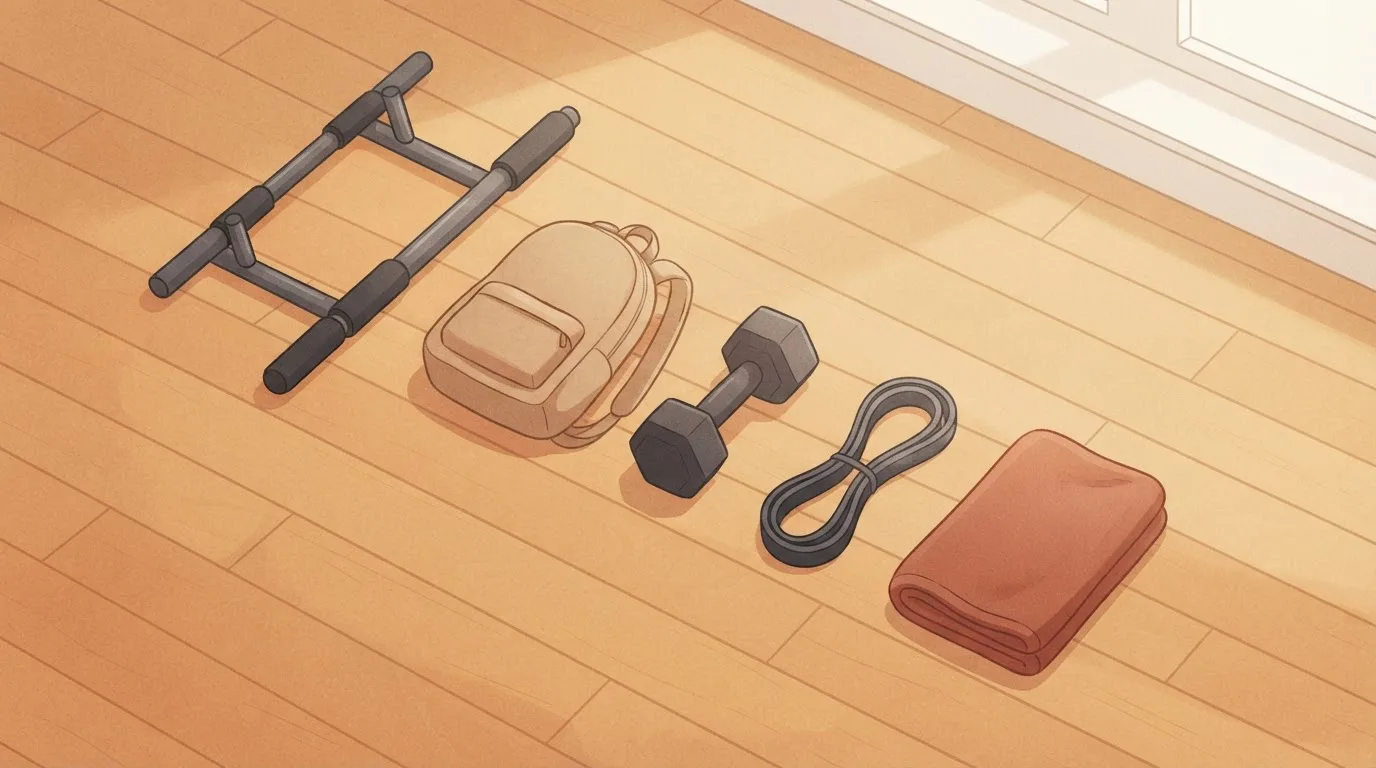
Wear a backpack with a dumbbell inside, starting with about 5% of your body weight, and do 3 to 5 sets of 3 to 5 reps. Heavier sets raise your top-end strength, so each bodyweight rep uses a smaller share of it. The 2016 data above put a limit on that idea, though: top-end strength alone didn't predict reps in trained athletes. Keep weighted work to one session a week and do the rest of your sets at body weight. No study we found has compared weighted with bodyweight pull-up training for building reps, so treat this as standard coaching practice.
Slow lowering and pauses
Lowering for 3 seconds, or pausing for a second with your chin over the bar, makes each rep harder without any equipment. A meta-analysis of 8 studies by Schoenfeld, Ogborn and Krieger (2015) found that muscle growth was similar for reps lasting anywhere from 0.5 to 8 seconds. The authors suggested that very slow reps of more than 10 seconds may build less muscle, though few studies tested them. So a 3-second lowering is a good tool. Whole sets of 10-second reps aren't.
Grip Strength: Why Your Hands Quit Before Your Back
If your fingers open before your back feels tired, your grip is setting your rep count. A 2025 trial shows how much grip work can matter for beginners. Sepehri Rahnama, Ganji, Vadasz and Prokai (2025) gave 30 inactive male students the same pull-up program twice a week for 8 weeks: assisted pull-ups, inverted rows, chin-ups and negatives. Each group added something different.
| Group | Added to the pull-up program | Pull-ups before | Pull-ups after 8 weeks |
|---|---|---|---|
| Forearm | Wrist curls, reverse wrist curls, reverse-grip curls, farmer's walks | 4.0 | 12.9 |
| Core | V-ups, leg raises, cat-cow, planks | 2.7 | 6.5 |
| Intervals | Five 1-minute hard runs | 4.3 | 7.0 |
The forearm group's right-hand grip strength also rose 12%, and only that group improved its right-hand grip significantly. The trial was small, with 10 men per group, and they started untrained, so the exact gap won't hold for everyone. The direction is still useful: if your grip fails first, train it on purpose.
Two easy additions cover most of it. Finish two sessions a week with 2 or 3 farmer's walks, carrying heavy dumbbells for 30 to 40 seconds. Add a timed dead hang at the end of one of them. On the bar, wrap your thumb around it and set the bar low in your palm rather than on your fingertips. Our 6-week grip strength plan has more home exercises.
Shoulder Blade Strength: Start Every Rep From Your Back
A strong pull-up starts at your shoulder blades. Youdas and colleagues (2010) recorded muscle activity in 25 adults doing pull-ups and chin-ups. The lats worked hardest, at 117% to 130% of the level they reached in a maximal test contraction. The timing was the useful part. The lower trapezius, which pulls your shoulder blades down, peaked early in the rep along with the chest muscles, and the biceps and lats peaked later. The lower trapezius also worked harder in the pull-up than in the chin-up.
That's why a rep that starts with a shrug, shoulders up by your ears, feels weak and stalls near the top. Three habits fix it:
- Set before you pull. From a straight-arm hang, pull your shoulder blades down and slightly back until your body rises an inch. Then bend your elbows. That first inch is the scapular pull-up, which our first pull-up guide teaches.
- Warm up with it. Do 2 sets of 5 scapular pull-ups with a one-second hold before every pull-up session.
- Finish the rep. Drive your chest toward the bar at the top and hold for a second. Pausing there trains the shoulder blade muscles where most people give up the rep.
A 6-Week Plan to Do More Pull Ups
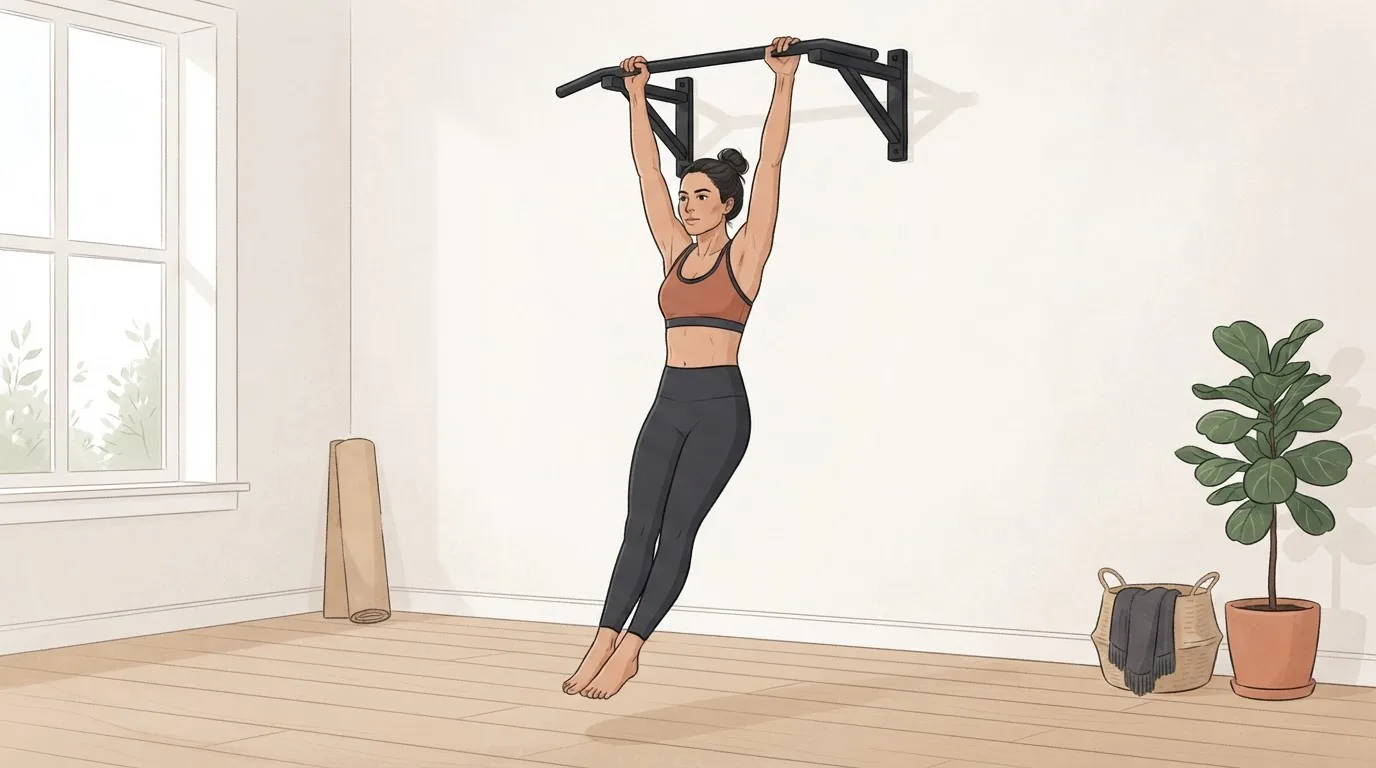
This plan is for anyone who can do 1 to 10 strict pull-ups and has a bar at home or at the gym. It uses three sessions a week, a day apart, and combines the ladders, volume sets and slow or weighted work above.
Before week 1, test your max: start from a dead hang with straight arms, get your chin over the bar and count only full reps. Your training number (T) is half your max, rounded up. A max of 5 gives a T of 3.
| Week | Day A: ladders | Day B: sets of T, 90 seconds apart | Day C: slow or weighted |
|---|---|---|---|
| 1 | 3 ladders up to T | 5 sets | 4 sets of 2 |
| 2 | 4 ladders up to T | 6 sets | 4 sets of 3 |
| 3 | 5 ladders up to T | 7 sets | 5 sets of 3 |
| 4 (lighter) | 3 ladders up to T | 4 sets | 3 sets of 2 |
| 5 | 4 ladders up to T + 1 | 6 sets of T + 1 | 5 sets of 3 |
| 6 | 3 ladders up to T + 1 | 4 sets of T + 1 | Rest two days, then retest your max |
- Day C. If your max is under 8, lower every rep over 3 seconds. At 8 or more, wear a weighted backpack and do 3 to 5 reps per set instead. At a max of 1 or 2, do slow negatives: get to the top and lower over 3 to 5 seconds.
- Every session. Warm up with 2 sets of 5 scapular pull-ups. Finish Days A and C with 2 farmer's walks of 30 to 40 seconds.
- Every set. Stop when a rep comes up clearly slower than your first. If you can't finish the planned sets two sessions in a row, repeat that week.
- Day A at a T of 1. A ladder is a single rep, so do 6 to 8 singles a minute apart instead of the ladders in the table.
- Week 5. Retest your max on the last day of week 4. Use T + 1 only if it's at least two reps below your new max. If it isn't, keep T and add one ladder and one set instead.
- Optional. On two rest days in weeks 1 to 3 and 5, add a few grease-the-groove sets at half your max.
After week 6, set a new T from your new max and run the plan again. How much should you expect? In the 8-week trials above, beginners who started at 2 to 4 reps finished at roughly 6 to 13. People who can already do 10 or more improve more slowly.
Form Fixes That Add Reps Right Away
A few form changes stop wasted effort on every rep, so the strength you already have goes further.
- Keep your body still. Squeeze your glutes and hold your legs together, slightly in front of you. A swinging body leaks force and makes each rep harder to control.
- Use a shoulder-width grip. Prinold and Bull (2016) tracked the shoulder blades of 11 people who did pull-ups regularly. Wide-grip and underhand pull-ups showed movement patterns linked with a higher risk of shoulder impingement than a standard overhand grip. If your shoulders complain, a shoulder-width overhand grip is the safer default.
- Count full reps only. Start each rep from straight arms and finish with your chin over the bar. Half reps inflate your count, but they don't build the bottom of the movement, where most sets fail.
- Mix in chin-ups if your shoulders like them. Most people can do a few more chin-ups than pull-ups, so they're a good way to add practice reps. Our guide to pullups vs chinups compares the muscles and the difficulty.
What This Means for You
Getting better at pull ups comes down to many good reps, spread across the week, that stop before they turn ugly, plus a grip and shoulder blades that can keep up with your back. Picture the day you hang from the bar, pull ten clean reps and drop down with something left in the tank. A plain plan you follow for months will get you closer to that day than a perfect plan you drop after two weeks.
The hard part is showing up three times a week for six weeks, then doing it again. That's where pull-up goals usually stall: a busy week, a missed session, and the plan fades out. If you want help with the showing-up part, FitCraft's strength workouts use bodyweight and dumbbells, and an AI coach demonstrates each exercise on an interactive 3D model. Workouts adjust as you progress, and streaks and leaderboards give you a reason to come back. If you're weighing options, our review of the best strength training apps ranks them by how well each one is built to keep a beginner training at week 8. As one FitCraft user, Matt, put it: "The real win is I actually want to work out now. That's never happened before."
Frequently Asked Questions
How rare are 20 pull-ups?
Twenty strict pull-ups are uncommon, though no survey has counted how many adults can do them. In a 2020 study, 29 strength-trained men averaged 15.9 reps to failure, so 20 clean reps from a dead hang puts you ahead of most people who train.
How rare are 30 pull-ups?
Thirty strict pull-ups are very rare. No survey has measured it, but 30 is nearly double the 15.9 reps that strength-trained men averaged in a 2020 study. Getting there usually takes years of focused pull-up practice and a fairly light body.
What are the different types of pull-ups?
The main types are the overhand pull-up, the underhand chin-up, the neutral-grip pull-up with your palms facing each other, and the wide-grip pull-up. Most people find chin-ups the easiest and wide grips the hardest. Weighted, slow-lowering, archer and L-sit pull-ups make any of them harder.
How do you train for pull-ups at home?
Mount a doorway or wall pull-up bar and train pull-ups three days a week, using ladders and sets that stop short of failure. Add a resistance band for assisted reps, a backpack with a dumbbell inside once you pass about 8 reps, and short grease-the-groove sets on days you walk past the bar.
How do you make pull-ups easier?
The simplest pull-up modifications are a resistance band looped under one knee or foot, a chair under one foot so your leg can help, or a switch to chin-ups, which most people find easier. Use easier versions to add practice reps, and keep at least one set of full pull-ups in every session.
How long does it take to get better at pull-ups?
Beginners can add several reps in 8 weeks. In two 8-week training studies, beginners who started at 2 to 4 reps finished at roughly 6 to 13, depending on the program. Trained people improve more slowly, so expect a few reps per training block once you can already do 10.