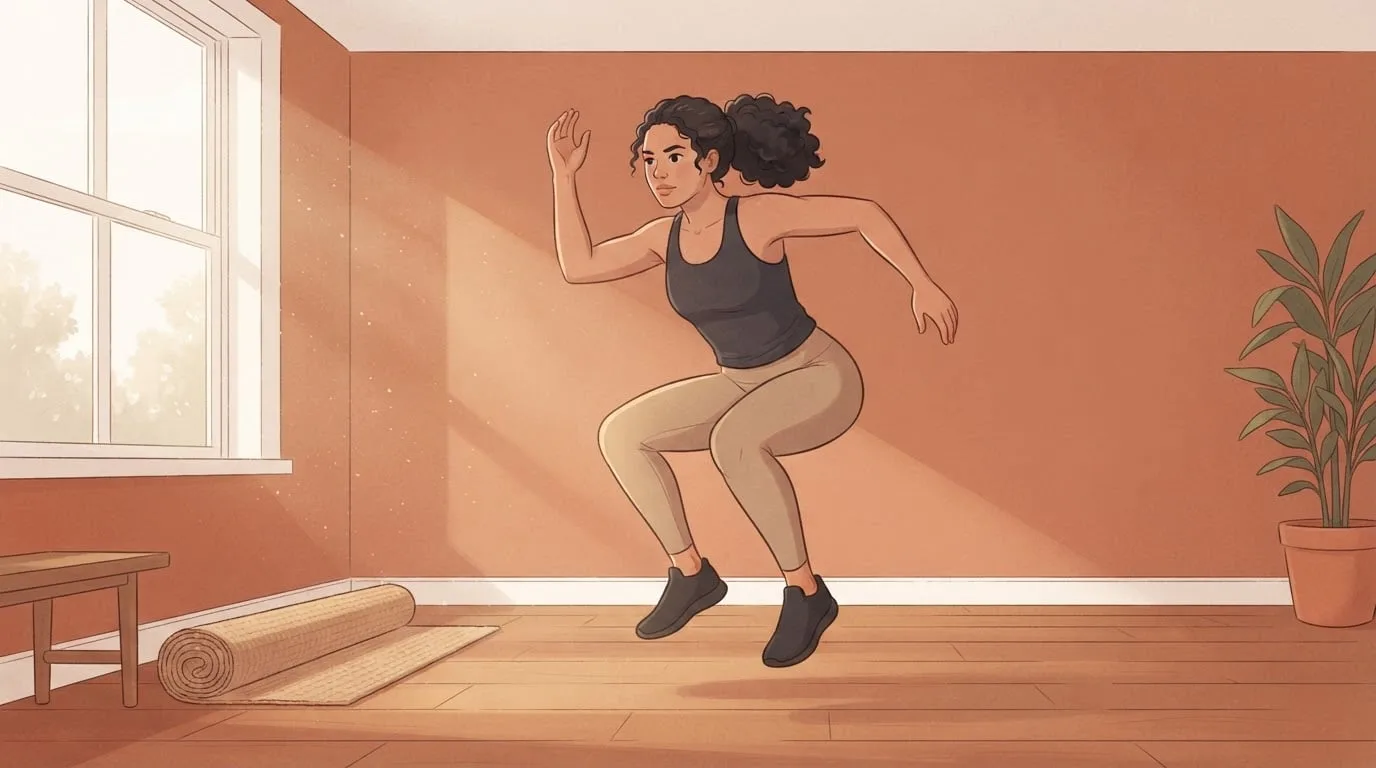
You sprint for a bus, take the stairs two at a time or fight through the last few reps of a set, and within seconds your legs burn and your breathing races to catch up. That's anaerobic exercise. You've been doing it all your life, mostly without a name for it.
The name is where the confusion starts. Fitness advice tends to sort workouts into aerobic and anaerobic as if they ran on two separate engines, one for cardio and one for strength, and then argues about which one burns more fat. Your body actually runs all of its energy systems at the same time and shifts the mix with how hard and how long you go. Once you see that, choosing a workout for the goal you actually have gets a lot easier.
This page covers what makes a workout anaerobic, how long each energy system lasts, aerobic vs anaerobic exercise, what lactic acid does and doesn't do, 10 examples you can do at home or in a gym, the benefits, whether anaerobic exercise helps with weight loss and how to start safely.
What Makes a Workout Anaerobic?
A workout is anaerobic when it asks your muscles for energy faster than your aerobic system can supply it. Muscles run on a molecule called ATP and store only a small amount of it, so they have to remake it as fast as they use it. In their review of muscle energy systems, Baker, McCormick and Robergs (2010) note that intense exercise can raise the rate of ATP demand by up to about 1,000 times its resting level. Your aerobic system makes ATP efficiently but not quickly. When demand outruns it, two faster pathways that don't need oxygen cover the gap.
So anaerobic describes how hard you're working, whatever the exercise. Walking up a hill is aerobic. Sprinting up the same hill is anaerobic. Three signs tell you you're there:
- The effort is close to your maximum. You couldn't keep the pace going for more than a minute or two.
- Each burst is short. All-out efforts last from a few seconds to about 2 minutes before you have to slow down or stop.
- You can't talk. At the end of a hard burst you can get out a word or two at most.
The word anaerobic means without oxygen, which is a little misleading. Your muscles still have oxygen during a sprint. The anaerobic pathways simply don't use it to make ATP, so they can run at full speed before your heart and lungs have caught up. Even an easy jog starts with a small anaerobic share, because oxygen uptake takes time to rise when any exercise begins. In their review of oxygen uptake kinetics, Poole and Jones (2012) explain that the faster your aerobic system responds, the smaller that early oxygen deficit is and the better you tolerate the exercise.
The phosphagen system: the first 10 seconds
For the first few seconds of an all-out effort, phosphocreatine stored in the muscle rebuilds ATP almost instantly. It's the fastest energy system and the smallest. Baker's review describes it as the main source in maximal efforts of up to 5 to 6 seconds, and notes that phosphocreatine can be largely used up within 10 seconds of maximal exercise. A heavy lift, a jump, a throw and the first strides of a sprint all run mostly on it.
It refills quickly, but not instantly. In a classic study by Gaitanos and colleagues (1993), eight men did ten 6-second cycle sprints with 30 seconds of rest between them. In the first sprint, phosphocreatine and anaerobic glycolysis supplied equal shares of the energy, and phosphocreatine stores fell by 57 percent in those 6 seconds. By the tenth sprint, power was down to 73 percent of the first and muscle lactate no longer rose, so most of the energy came from phosphocreatine and aerobic metabolism.
Anaerobic glycolysis: about 10 seconds to 2 minutes
Glycolysis breaks down glucose and stored muscle glycogen without oxygen. It takes longer to get going than the phosphagen system, reaching its top rate after about 10 to 15 seconds of hard work, but it can keep supplying energy for longer. The cost is efficiency. Burning the same glucose with oxygen produces more than 10 times as much ATP, which is why glycolysis runs through your glycogen and builds up byproducts so quickly.
Baker's team estimates that glycolysis supplies about 44 percent of the energy in a 10-second sprint and 49 percent in a 30-second sprint. By 30 seconds, the aerobic system is already providing about 28 percent.
When the aerobic system takes over
Older textbooks described the energy systems switching on one after another: phosphagen, then glycolysis, then aerobic. Gastin's 2001 review in Sports Medicine showed that picture was wrong. All three systems contribute to almost every kind of exercise, and the aerobic system responds faster than the old model assumed. In a maximal effort, aerobic and anaerobic energy contribute equally somewhere between 1 and 2 minutes, most likely at about 75 seconds.
Repeating hard efforts pushes the mix further toward aerobic energy. When Bogdanis and colleagues (1996) had eight men repeat a 30-second sprint after 4 minutes of rest, glycolysis fell by about 45 percent in the second sprint and aerobic metabolism supplied about 49 percent of the energy. A workout made of many anaerobic bursts is partly an aerobic workout too.
| Length of an all-out effort | Where the energy comes from | Examples |
|---|---|---|
| Up to about 6 seconds | Mostly phosphocreatine | One heavy lift, a jump, the first strides of a sprint |
| About 10 seconds | About half phosphocreatine, 44% glycolysis, 3% aerobic | A short sprint, 5 fast jump squats |
| About 30 seconds | 49% glycolysis, 28% aerobic, the rest phosphocreatine | A 200 m sprint, 30 seconds of fast burpees |
| About 75 seconds | Half aerobic, half anaerobic | A hard 400 m to 500 m run |
| 2 minutes or more | Mostly aerobic, and more so the longer you go | An 800 m run, a long hard interval |
The percentages are estimates for truly maximal sprints from the reviews by Baker and Gastin. In real workouts you rarely go completely all-out, so the aerobic share is usually larger.
Aerobic vs Anaerobic Exercise: The Key Differences
Aerobic exercise uses oxygen to burn fat and carbohydrate and can keep going for minutes or hours, while anaerobic exercise breaks down phosphocreatine and glycogen without oxygen and lasts seconds to a couple of minutes. Most real workouts mix the two. Here's how they compare:
| Aerobic exercise | Anaerobic exercise | |
|---|---|---|
| Fuel | Fat and carbohydrate, burned with oxygen | Phosphocreatine and glycogen, broken down without oxygen |
| How long an effort lasts | Minutes to hours | A few seconds to about 2 minutes |
| How it feels | Easy to hard; at easy paces you can talk in full sentences | Very hard to all-out; a word or two at most |
| What builds up | Carbon dioxide and water, which your body clears easily | Lactate and hydrogen ions, which force you to slow down |
| What it trains | Heart, lungs, endurance and VO2 max | Power, speed, strength and the ability to repeat hard efforts |
| Examples | Brisk walking, jogging, cycling, swimming, dancing | Sprints, jump squats, heavy lifts, all-out burpees |
The two systems help each other. Aerobic fitness decides how fast you recover between hard bursts: Tomlin and Wenger (2001) concluded that fitter people likely recover faster from repeated high-intensity efforts, through faster phosphocreatine refilling and a stronger aerobic response, and less certainly through faster lactate removal. Anaerobic training raises aerobic fitness in return. In the study behind the Tabata protocol, Tabata and colleagues (1996) found that six weeks of steady cycling at 70 percent of VO2 max raised VO2 max but didn't change anaerobic capacity. Short intervals above VO2 max intensity raised VO2 max by 7 mL/kg/min and anaerobic capacity by 28 percent. Our review of the Tabata protocol research explains how that study was run.
Aerobic vs anaerobic running
Running shows the mix clearly. Spencer and Gastin (2001) measured 20 highly trained Australian runners in simulated races on a treadmill. The aerobic system supplied 29 percent of the energy in the 200 m, 43 percent in the 400 m, 66 percent in the 800 m and 84 percent in the 1,500 m. Even in the 400 m, aerobic metabolism became the main source after 15 to 30 seconds. So a 200 m sprint is mostly anaerobic, an 800 m is mostly aerobic, and longer races are more aerobic still. A sprint of 10 to 30 seconds is the purest anaerobic run you can do.
Knowing what to do is the easy part.
FitCraft, our mobile fitness app, pairs you with an AI coach who builds you a personalized plan around your goals, schedule, and fitness level. Every FitCraft program is designed by Domenic Angelino, MPH (Brown University) and NSCA-CSCS, with research published in the Journal of Strength and Conditioning Research and Medicine & Science in Sports & Exercise.
Take the Free Assessment Free • 2 minutes • No credit cardLactic Acid, the Burn and the Anaerobic Threshold
The burn in a hard 30-second effort is the best-known feature of anaerobic exercise and the most misunderstood. Glycolysis produces lactate, and at the same time hydrogen ions build up in the working muscle and make it more acidic. For decades, lactic acid took the blame for that acid. A widely cited review by Robergs, Ghiasvand and Parker (2004) argues that the hydrogen ions come from the breakdown of ATP instead, and that making lactate actually slows the acidosis down. Either way, acid and other byproducts build up until you have to ease off, and the burn fades soon after you stop.
Lactic acid doesn't cause next-day soreness either. In a 1983 experiment, Schwane and colleagues measured blood lactate during 45 minutes of running on the level and downhill. Level running raised lactate but left people with no significant soreness. Downhill running never raised lactate, yet it caused significant soreness in the days that followed. Downhill running loads your muscles while they lengthen, and that kind of unaccustomed effort, not lactate, is what makes you sore.
What is the anaerobic threshold?
The anaerobic threshold marks the point where the lactate in your blood stops holding steady and starts to climb. Push past it and the anaerobic share of your energy rises, so every minute costs more and you can't hold the pace for long. Coaches usually call it the lactate threshold, and our lactate threshold glossary entry covers the two thresholds and how to estimate yours without a lab test.
What is the anaerobic heart rate?
Heart rate charts and fitness watches often label about 80 to 90 percent of your maximum heart rate as the anaerobic zone. Treat that as a rough guide. Your heart rate takes time to climb, so during a 10-second sprint it's still rising when you stop, even though the effort was anaerobic from the first stride. For short bursts, judge intensity by effort instead: all-out for 10 seconds, or a pace you couldn't hold for more than a minute or two. To estimate your maximum heart rate by age, use the table in our article on what counts as cardio.
10 Examples of Anaerobic Exercise
Anything you can only do all-out for a few seconds to a couple of minutes counts. These 10 need little or no equipment, and most of them work at home:
- Sprints. All-out runs of 10 to 30 seconds on a flat path or a field, with a slow walk back to recover.
- Hill or stair sprints. The slope makes the effort hard at a slower speed. Walk back down between efforts.
- Jump squats. Sets of 5 to 8 maximal jumps. Each takeoff is an all-out effort lasting well under a second.
- Broad jumps and tuck jumps. Single explosive jumps for distance or height, with a full rest between sets.
- Burpees at full speed. Bursts of 20 to 40 seconds lean heavily on glycolysis.
- Heavy dumbbell lifts. Sets of 3 to 8 hard reps of goblet squats, split squats, presses or rows.
- Explosive push-ups. 3 to 6 reps pushing hard enough for your hands to leave the floor, or with your hands on a bench to make them easier.
- Dumbbell thrusters or snatches. A squat into an overhead press, or a one-arm lift from the floor to overhead, done fast for 20 to 30 seconds.
- Mountain climbers or high knees at top speed. 15 to 20 seconds as fast as you can move.
- Bike or rowing sprints. The 30-second all-out sprint used in labs, called the Wingate test, is the classic anaerobic effort, and it's a good choice if running bothers your knees.
Is weightlifting anaerobic?
Yes, mostly. A set of 1 to 12 hard reps lasts roughly 5 to 40 seconds, so it runs on phosphocreatine and glycolysis while you lift, and your aerobic system pays back the cost during the rest. Scott and colleagues (2011) measured single sets of bench presses taken to failure and found that the anaerobic energy used during the set and the energy used in recovery afterwards were both larger than the aerobic energy used while lifting. That pattern of short bursts, with the aerobic system catching up during each rest, is what separates lifting from steady cardio.
Anaerobic Exercise Benefits
Short, hard efforts do a few things that steady cardio does less well, and they help your aerobic fitness too.
- It raises anaerobic and aerobic fitness at the same time. MacDougall and colleagues (1998) had 12 men sprint all-out on a bike for 30 seconds at a time, three sessions a week for 7 weeks, building from 4 to 10 sprints a session. Peak power, total work in a 30-second test and VO2 max all rose, and muscle samples showed higher activity in the enzymes of both glycolysis and aerobic metabolism.
- It builds strength, speed and power. Heavy lifts, jumps and sprints are the efforts that train these qualities, which matter for everything from carrying shopping up the stairs to catching yourself when you trip.
- It improves blood sugar control quickly. In a study by Babraj and colleagues (2009), 16 young men did six sessions of four to six 30-second cycle sprints over 2 weeks, about 15 minutes of exercise in total. Their insulin sensitivity improved by 23 percent, and the insulin response to a glucose drink fell by 37 percent.
- Strength work is linked to a longer, healthier life. A meta-analysis of 16 cohort studies by Momma and colleagues (2022) linked muscle-strengthening activities to a 10 to 17 percent lower risk of early death, cardiovascular disease, cancer and diabetes, with the largest reductions at about 30 to 60 minutes a week.
- It takes little time. The hard part of an anaerobic session lasts minutes, not hours. Our review of sprint interval training research shows how little all-out work it takes to raise aerobic fitness, and where steady cardio still does better.
Is Anaerobic Exercise Good for Weight Loss?
It helps, though not in the way most people expect. During a sprint your muscles burn phosphocreatine and carbohydrate, not fat, and a short burst doesn't burn many calories on its own. The afterburn adds a little on top, but less than is often claimed, as our review of the EPOC afterburn effect explains.
Over weeks, interval training built on hard efforts does cut body fat. A meta-analysis of 39 studies with 617 people by Maillard, Pereira and Boisseau (2018) found that high-intensity interval training reduced total, abdominal and visceral fat. Running intervals worked better than cycling, and efforts above 90 percent of peak heart rate worked best for total body fat. Compared head to head, interval training and steady cardio lose about the same amount of fat, with intervals taking less time, and our HIIT vs steady-state cardio review has that evidence. What you eat still decides most of the result.
Anaerobic Exercise for Beginners: How to Start at Home
A track or a gym is optional. Start with short bursts and generous rests, because anaerobic work only does its job when each burst is genuinely hard, and that only happens when you're recovered. Here's a simple plan for the first four weeks, two days a week with at least one day between:
- Warm up for 5 to 8 minutes. March or jog easily, then do a few bodyweight squats and lunges and two or three gentle practice bursts.
- Weeks 1 and 2: 6 to 8 bursts of 10 seconds. Use stair sprints, fast step-ups or jump squats, and walk easily for 60 to 90 seconds between bursts.
- Weeks 3 and 4: add 4 bursts of 20 to 30 seconds. Do burpees or mountain climbers after the short bursts, with 90 seconds to 2 minutes of easy walking between them.
- Cool down for 3 to 5 minutes. Keep walking until your breathing settles before you sit down.
Put strength training on two other days, and spend the remaining days walking or doing easy cardio. For complete timed routines, our HIIT workout at home guide has three sessions from 15 to 25 minutes. To match work and rest to power, anaerobic capacity or aerobic fitness, our guide to metabolic conditioning has six bodyweight and dumbbell workouts.
The cool-down matters most after the hardest sessions. Fainting linked to exercise in athletes without heart disease usually happens just after the effort stops, when blood pressure drops, according to a review by Christou and colleagues (2018). A review by Van Hooren and Peake (2018) found that an active cool-down clears lactate from the blood faster than resting but does little for next-day soreness or performance, and whether it prevents fainting hasn't been tested.
If you'd rather follow a plan than write one, an AI personal trainer app can build it around your goals and schedule. In FitCraft, a 3D AI coach shows each exercise on an interactive model you can zoom in on and calls you by name during the workout. Your plan adapts as you get fitter, and a streak tracks every day you train.
What This Means for You
Anaerobic exercise is simply the hard end of the effort scale, and you already reach it every time you run for a bus or push through the last reps of a set. The useful question is how much of it you do on purpose, and how well you recover between efforts.
Imagine where this goes after eight weeks or so: two strength sessions, two short sessions of stair sprints or jumps, and walks in between. Stairs that used to leave you gasping feel ordinary, you can push hard for 30 seconds and recover within a couple of minutes, and the hardest part of each workout is over in minutes. As one FitCraft user, Tim, put it: "I didn't think an app could replace my trainer. My AI coach proved me wrong."
Frequently Asked Questions
Which is better, aerobic vs anaerobic exercise?
Neither is better on its own, because they train different things. Aerobic exercise builds endurance and heart health and can go on for a long time, while anaerobic exercise builds power, speed and strength in short, hard bursts. Most adults do best with both: 150 to 300 minutes of moderate aerobic activity a week, strength training on two or more days, and short hard bursts if your health allows.
Does anaerobic exercise burn fat?
Not much during the effort itself, because short bursts run on phosphocreatine and carbohydrate rather than fat. Over weeks, though, interval training built on hard efforts does reduce body fat: a meta-analysis of 39 studies found it cut total, abdominal and visceral fat. How much fat you lose still depends mostly on your diet and your total activity.
What are 5 examples of anaerobic exercise?
Five common examples of anaerobic exercise are sprinting, jump squats, burpees done as fast as possible, heavy weight lifting and all-out cycling sprints. Each one is a near-maximal effort that lasts from a few seconds to about two minutes before you have to slow down or stop.
What is the most effective anaerobic exercise?
All-out sprinting, whether you run, cycle or row, is the most direct way to train anaerobic power and capacity. For strength, heavy multi-joint lifts such as squats and presses work best. At home without equipment, stair or hill sprints and jump squats come closest to a true sprint.
What is an aerobic run?
An aerobic run is a run easy enough that your aerobic system supplies almost all the energy, so you can keep going for a long time and still talk in full sentences. Most easy runs, long runs and recovery runs are aerobic. A run turns anaerobic when the pace is so hard that you can only hold it for a minute or two, as in a sprint.
How do you improve aerobic capacity?
You improve aerobic capacity, measured as VO2 max, with regular cardio, most of it at an easy to moderate pace, plus one or two harder interval sessions a week. Hard intervals help even though they feel anaerobic: in the study behind the Tabata protocol, six weeks of short intervals raised VO2 max by 7 mL/kg/min.
What not to do immediately after exercise?
Don't stop dead and sit or lie down straight after hard sprints or intervals. In athletes without heart disease, exercise-related fainting usually happens just after the effort stops, when blood pressure drops, so walk easily for a few minutes while your breathing settles. Don't count on a long cool-down to prevent next-day soreness, though, because reviews find it does little for that.