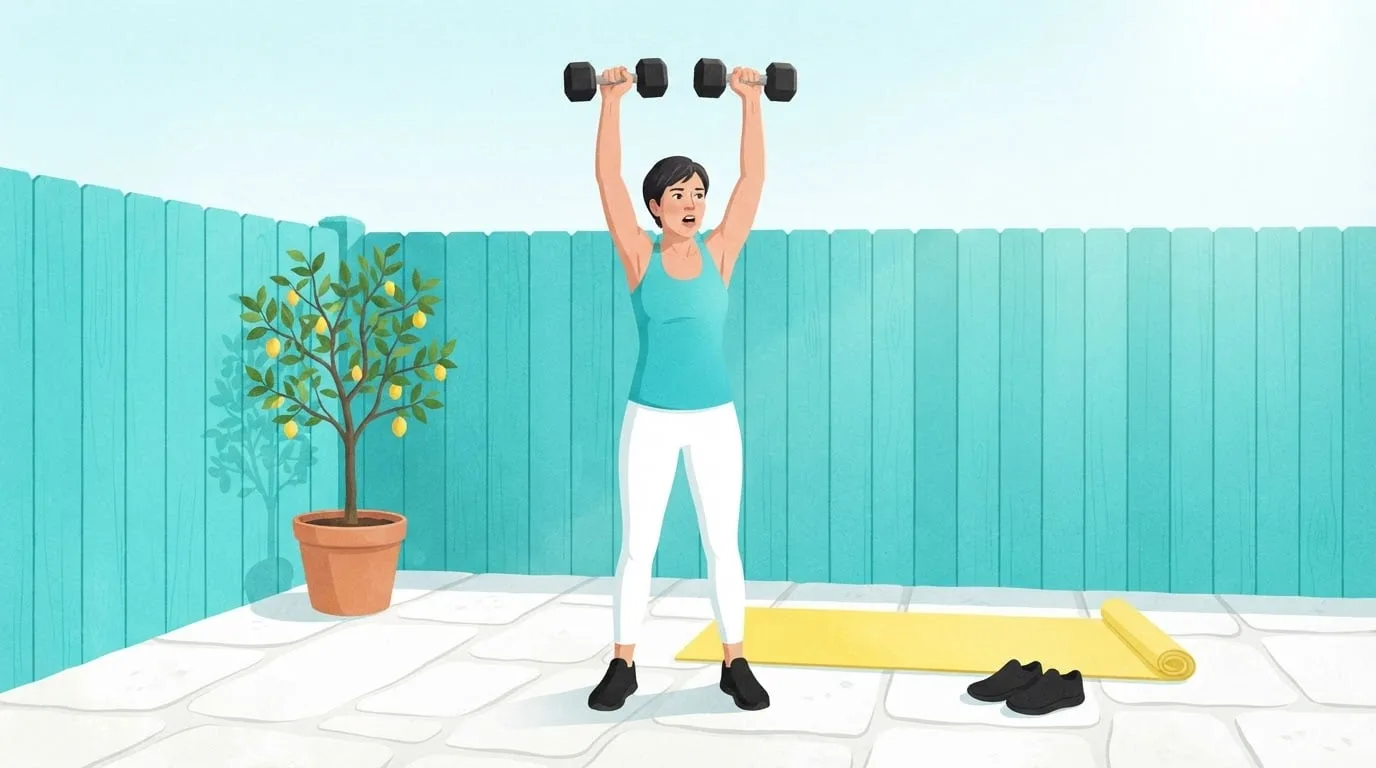
You've probably seen the word metcon on a gym whiteboard or in a workout app: a block of burpees, squats and dumbbell presses against a clock, done until you're bent over with your hands on your knees. It looks brutal, and it's meant to.
The trouble is that most metcons are thrown together at random. The rests are whatever feels right, the moves are whatever looks hard, and the session trains a little of everything and nothing in particular. You finish exhausted, which feels like proof it worked. Three weeks later your fitness hasn't moved, and the sessions have started to feel like punishment. The missing piece is usually the design: how long you work, how long you rest and what the session is for.
This guide explains what metabolic conditioning is and how it differs from HIIT, then shows you how to set work and rest for the energy system you want to train. You'll get six bodyweight and dumbbell metcon workouts, each with its work-to-rest prescription, plus how often to do them, how to progress and who should be careful.
What Is Metabolic Conditioning?
Metabolic conditioning means training built to improve how well your body supplies energy for hard work, so you can push hard, recover quickly and push hard again. In practice, a metcon combines strength and cardio moves, such as squats, push-ups, burpees and dumbbell presses, into timed rounds with planned rest or none at all. People also call it metabolic training or a metabolic workout, and the three names mean the same thing. The term is best known from CrossFit, whose What Is Fitness? essay on metabolic pathways describes metabolic conditioning as the cardio of its workouts and aims to train all three energy pathways without favoring any one.
Those three pathways are the energy systems every metcon draws on at once. Phosphocreatine stored in the muscle covers roughly the first 10 seconds of a maximal burst, anaerobic glycolysis carries hard efforts that last up to a couple of minutes, and the aerobic system takes a growing share the longer you go and the more rounds you repeat. Which one a metcon trains most depends on how long each bout lasts and how much rest follows it. Our explainer on what anaerobic exercise is covers how each system works and how long it lasts.
A metcon done properly is hard. Maté-Muñoz and colleagues (2018) measured three CrossFit workouts in 32 strength-trained young men: a bodyweight workout of pull-ups, push-ups and squats, a jump rope workout and a power clean workout. Heart rate stayed at or above 90 percent of predicted maximum in the middle and at the end of all three, and blood lactate topped 10 mmol/L afterwards in every one. A single metcon works your aerobic and anaerobic systems hard at the same time.
Metcon vs HIIT: What's the Difference?
Classic HIIT repeats short, near-maximal bouts, often of a single activity such as running, cycling or rowing, with enough rest to repeat them. A metcon is defined by its goal, conditioning, and it borrows whatever structure serves that goal. Many metcons are HIIT. Others are longer pieces at a hard, steady pace with no planned rest, and most mix strength moves and cardio moves inside the same work bout.
That mixing is the practical difference, and one trial measured it. Buckley and colleagues (2015) randomly assigned 28 recreationally active women to 6 weeks of either rowing intervals or multimodal intervals that combined several exercises, including strength moves, in each bout. Both groups improved aerobic power, anaerobic threshold, anaerobic power and anaerobic capacity by similar amounts. Only the multimodal group got stronger: squat 1-rep max rose 39 percent, press 27 percent and deadlift 18 percent, and squat endurance nearly quadrupled. The rowing group's strength measures didn't change significantly.
So if you have time for only one kind of hard session, a metcon that pairs strength and cardio moves covers more ground than single-activity intervals. If you want to sharpen one quality, such as VO2 max, classic intervals are the more precise tool, and our HIIT workout at home guide covers them. A circuit is the gentler cousin, the same rotation of moves at a moderate effort for strength endurance, and three of them, from a no-equipment beginner circuit to a dumbbell one, are in our circuit training at home guide.
How to Structure a Metcon Workout
Build a metcon in this order: pick the energy system you want to train, set the bout length and rest to match it, choose a format, then choose the moves. Most people start with the moves and end up with a session that trains nothing in particular.
Set work and rest for the energy system you want to train
| Target | Work bout | Rest | Work-to-rest | Effort | Volume |
|---|---|---|---|---|---|
| Power (phosphagen) | Up to 10 s, all-out | 60 to 120 s | 1:6 to 1:12 | 10 of 10, every rep fast | 6 to 10 bursts |
| Anaerobic capacity (glycolytic) | 20 to 40 s | 2 to 4 times the work | 1:2 to 1:4 | 9 of 10 | 4 to 8 bouts |
| Aerobic power | 40 s to 3 min | Half to equal the work | 2:1 to 1:1 | 8 of 10 | 12 to 20 min of work |
| Aerobic endurance | 10 to 30 min | None planned | Continuous | 6 to 7 of 10 | One long piece |
The long rests in the power row come from how fast your fuel refills. After a 30-second all-out sprint, Bogdanis and colleagues (1995) found phosphocreatine back to 65 percent of its resting level after 90 seconds but only 85 percent after 6 minutes, and sprint power recovered in step with it. In repeated 40 m sprints, Balsom and colleagues (1992) found that with 30 seconds of rest, speed over the last 10 m began to drop after 3 sprints, while 120 seconds of rest held it for 11. Cut the rest short and a power metcon quietly turns into a glycolytic one.
Bout length matters as much as the ratio. Price and Moss (2007) had nine men run the same 1:1.5 ratio two ways for 20 minutes: 6 seconds on and 9 off, or 24 seconds on and 36 off. Heart rate and oxygen uptake were the same, but the longer bouts produced more lactate, a lower blood pH and higher effort ratings. At the same ratio, longer bouts push a metcon further toward glycolysis.
Pick a format
- Intervals. Fixed work and fixed rest, the most precise way to target one energy system. Workouts 1 to 3 below use them.
- EMOM. Every minute on the minute: you start a fixed batch of reps as each new minute begins and rest until the next one. Our EMOM workout guide shows how to pick the reps.
- AMRAP. As many rounds as possible in a fixed time, with no planned rest. It suits aerobic metcons, and our AMRAP workout guide covers pacing and scaling.
- For time. A fixed list of work done as fast as good form allows, like the chipper in workout 6.
- Complex. Several dumbbell lifts in a row without putting the weights down, like workout 4.
- Finisher. A metcon of a few minutes at the end of a strength session. Our finisher workout guide has 12 of them.
Choose moves that pair well
Pair moves that use different muscles, so one group recovers while another works, and put the most explosive or technical move first, while you're fresh. These all work at home:
| Movement | Bodyweight | Dumbbell |
|---|---|---|
| Squat | Air squat, jump squat | Goblet squat, thruster |
| Hinge | Glute bridge, broad jump | Romanian deadlift, dumbbell swing |
| Push | Push-up, explosive push-up | Push press, floor press |
| Pull | Inverted row under a sturdy table | Bent-over row, renegade row |
| Lunge | Reverse lunge, skater jump | Dumbbell reverse lunge, step-up |
| Full body | Burpee, bear crawl | Dumbbell snatch, clean and press |
| Cardio | Mountain climbers, high knees, jumping jacks | Farmer's carry around the room |
Choose a rep count you can finish with good form when you're tired. In a metcon, your last round should look like your first.
Find out what's really holding you back
FitCraft, our mobile fitness app, pairs you with an AI coach who builds you a personalized plan around your goals, schedule, and fitness level. Every FitCraft program is designed by Domenic Angelino, MPH (Brown University) and NSCA-CSCS, with research published in the Journal of Strength and Conditioning Research and Medicine & Science in Sports & Exercise.
Take the Free Assessment Free • 2 minutes • No credit card6 Home Metcon Workouts With Work-to-Rest Prescriptions
Spend 5 to 8 minutes warming up before each one: march or jog in place, then do 10 slow squats, 10 hip hinges, a few push-ups and one easy practice round of the first move. Use effort as your guide. Ten out of 10 means all-out, and 8 out of 10 means hard enough that you can only say a few words.

1. Beginner bodyweight metcon (16 minutes)
Target: a base of aerobic and anaerobic fitness. Work-to-rest: 1:2, with 20 seconds of work and 40 seconds of easy walking. Rounds: 4 rounds of the 4 moves, 16 minutes in all. Effort: 7 to 8 out of 10.
- Squat to a chair: sit back until you touch the seat, then stand up fast.
- Incline push-up: hands on a kitchen counter or a sturdy table.
- Step-back burpee: squat, step back to a plank, step in and stand up, with no jump.
- Fast march: knees up and arms driving.
It uses the same 20-on, 40-off ratio as the opening phase of the 10-month trial described under progression below. When it starts to feel manageable, move to 30 seconds on and 30 off.
2. Power metcon (bodyweight, about 15 minutes)
Target: power, from the phosphagen system. Work-to-rest: about 1:8, with a burst of under 10 seconds and 60 to 90 seconds of slow walking. Rounds: 10, alternating the two moves. Effort: 10 out of 10 on every rep.
- Odd rounds: 5 jump squats, as high as you can, landing softly.
- Even rounds: 4 explosive push-ups, driving up so your hands leave the floor, or from a bench to make them easier.
End the round as soon as a jump gets lower or a push-up gets slower. This workout should never turn into a grind, and the rests are long on purpose.
3. Glycolytic intervals (bodyweight, about 20 minutes)
Target: anaerobic capacity, from glycolysis. Work-to-rest: 1:3, with 30 seconds all-out and 90 seconds of easy walking. Rounds: 6, rotating the three moves twice, 12 minutes plus a warm-up and cool-down. Effort: 9 out of 10.
- Burpees
- Mountain climbers
- Skater jumps, or fast skater steps without the hop
Expect the burn to arrive about 20 seconds into each bout. Count your reps, and if round six falls far short of round one, lengthen the rests to 2 minutes next time.
4. Dumbbell complex (about 18 minutes)
Target: anaerobic capacity and strength endurance. Work-to-rest: about 1:2, with one complex of 60 to 75 seconds and 2 minutes of rest. Rounds: 5. Effort: 8 to 9 out of 10.
Do 6 reps of each lift in order without putting the dumbbells down. Choose a weight you could press overhead about 10 times when you're fresh, because the press is the weakest link.
- Romanian deadlift
- Bent-over row
- Hang clean: pull the dumbbells from knee height up to your shoulders.
- Front squat: dumbbells resting on your shoulders.
- Push press: a small dip of the knees, then drive the dumbbells overhead.
- Reverse lunge: 3 on each leg.
5. Dumbbell triplet, long rounds (about 25 minutes)
Target: aerobic power. Work-to-rest: 2:1, with 3 minutes of continuous work and 90 seconds of rest. Rounds: 4, 18 minutes plus a warm-up. Effort: 8 out of 10, steady from the first round to the last.
For 3 minutes, cycle through these three moves without stopping, then rest:
- 8 dumbbell thrusters
- 8 bent-over rows
- 6 push-ups, from a bench if you need to
Count how many cycles you finish in each 3-minute round. If the fourth round is clearly slower than the first, start slower next time.
6. 20-minute chipper (bodyweight and one dumbbell)
Target: aerobic endurance with a few hard surges. Work-to-rest: continuous, resting only when you need to. Format: for time, with a 20-minute cap. Effort: 6 to 7 out of 10, a pace you could keep going.
- 50 air squats
- 40 mountain climbers, counting each leg
- 30 dumbbell swings, one dumbbell held in both hands
- 20 push-ups, from a bench if needed
- 10 burpees
Work through the list once, in order. Write down your time and the versions you used, then repeat the same chipper in four weeks to see the change.
If you'd rather have someone plan your training and walk you through each session, a bodyweight workout app for home can do that. In FitCraft, you can train strength with dumbbells or just your body weight, plus cardio, yoga and mobility. A 3D AI coach walks you through every exercise, your workouts adapt as you progress, and leaderboards and streaks make it easier to keep showing up.
How Often Should You Do Metabolic Conditioning?
Two or three metcons a week, each followed by an easier day, is the right dose for most people. The trials behind this guide used that dose. In the 10-month trial described below, women trained three times a week with 48 hours between sessions. In a 9-week trial by Sperlich and colleagues (2017), overweight women did three functional circuit sessions a week. Hard sessions on back-to-back days leave you too tired to reach the intensity that makes the next one work.
A balanced week might look like this:
| Day | Session |
|---|---|
| Monday | Strength, with dumbbells or body weight |
| Tuesday | Metcon: power or glycolytic intervals (workout 2 or 3) |
| Wednesday | Walk, easy cardio or mobility |
| Thursday | Strength |
| Friday | Metcon: the complex or the long rounds (workout 4 or 5) |
| Saturday | A longer easy walk, ride or swim |
| Sunday | Rest |
How to Increase Metabolic Conditioning
Your conditioning improves when the work gets a little harder every couple of weeks while the quality of your reps holds. The best long-term example is a 10-month trial by Batrakoulis and colleagues (2018) in 49 previously inactive women with overweight or obesity. The training groups did circuits of 10 to 12 whole-body exercises three times a week, mostly bodyweight moves plus portable gear such as medicine balls, kettlebells, battle ropes and suspension straps. Over the first 20 weeks, the sessions stepped up in three phases:
- Weeks 1 to 7: 20 seconds of work and 40 of rest (1:2), 2 rounds of 10 exercises.
- Weeks 8 to 14: 30 seconds of work and 30 of rest (1:1), 3 rounds of 11 exercises.
- Weeks 15 to 20: 40 seconds of work and 20 of rest (2:1), 3 rounds of 12 exercises.
The women who kept training for the full 40 weeks lost about 6 kg of fat mass, and their VO2 max rose from 26.1 to 33.1 mL/kg/min, about 27 percent. Use the same ladder for your own progression, and change one of these at a time:
- Lengthen the work bout, for example from 20 to 30 to 40 seconds.
- Shorten the rest, but only in aerobic metcons. Power work keeps its long rests.
- Add a round.
- Use heavier dumbbells or a harder version of a move.
- Retest a benchmark every four weeks, such as your chipper time or your cycles in workout 5.
Easy cardio on your other days helps too. A review by Tomlin and Wenger (2001) concluded that a better aerobic base likely helps you bounce back between repeated hard bouts, through a stronger aerobic response and faster phosphocreatine refilling.
Is Metcon Good for Losing Weight?
Metcon can help with weight loss, mainly because it builds fitness and burns plenty of energy in a short session you're likely to repeat. In Sperlich's 9-week trial, the circuit group lost about 1.9 kg of fat mass, raised VO2peak by about 10 percent and more than doubled their push-up and burpee counts. Their sessions were mostly bodyweight work, such as burpees, skipping, one-legged squats and push-ups, many of them in 30-second bouts with 30 seconds of rest, plus some pull-ups and shuttle runs. In Batrakoulis's trial, fat loss reached about 6 kg over 40 weeks.
Two caveats apply. The afterburn adds less than metcon marketing suggests, and our review of the EPOC afterburn research has the numbers. And for fat loss your eating matters more than any single workout, so treat metcon as the fitness half of the plan.
Who Should Be Careful With Metcons
Metcons combine fatigue with speed, and that's exactly when technique slips. A few rules keep them productive:
- Start below your limit. Exertional rhabdomyolysis, a dangerous breakdown of muscle tissue, is rare but tends to follow far more high-rep work than someone is used to. In a review of 523 people treated for injuries from CrossFit at one academic medical center, Hopkins and colleagues (2019) found 11 cases of rhabdomyolysis, and about half of them were beginners. Dark, cola-colored urine and severe muscle pain after a hard session need urgent medical care.
- Scale the move and keep the clock. Swap jumps for step-backs, floor push-ups for bench push-ups and heavy dumbbells for lighter ones, and leave the work and rest times as they are.
- Keep one foot down if jumping hurts. Knee, ankle, hip or pelvic floor problems are a reason to use fast step-ups, squats to a chair and marching instead of jumps. The effort is what makes a metcon work, and you can reach it without leaving the floor.
- Get cleared first if you have a heart condition or high blood pressure, or if you haven't exercised in a long time, and build a few weeks of walking and easy strength work before your first metcon.

The Bottom Line
Metabolic conditioning is hard work with a plan behind it. Pick the energy system first, match the work and rest to it, choose moves that pair well and keep your reps clean. Two or three metcons a week, surrounded by strength work and easy days, are enough to build fitness you can feel on the stairs, in a pickup game or carrying the shopping home.
The workouts only work if you keep doing them. As one FitCraft user, Sarah, put it: "First app that made exercise feel like something I chose, not forced."
Frequently Asked Questions
What is a metabolic workout?
A metabolic workout, also called metabolic training or metabolic conditioning, is a session built to work your energy systems hard. It strings strength and cardio moves such as squats, push-ups, burpees and dumbbell thrusters into timed rounds with short or planned rests, usually for 10 to 30 minutes.
Is MetCon like CrossFit?
Metcon is the conditioning part of CrossFit, so the two overlap, but you don't need CrossFit to do one. CrossFit describes metabolic conditioning as the cardio of its workouts. At home you can build metcons from bodyweight moves and dumbbells, without the barbell lifts and gymnastics many CrossFit workouts use.
Does the 7-minute workout really work?
It works as a short bodyweight circuit, though it's easier than it looks. In a lab test, heart rate during the 7-minute workout averaged 141 beats a minute, against 159 for time-matched cycling intervals, with peaks near 90 percent of maximum (Riegler 2017). In a 6-week trial, doing it every day trimmed waist size by about 4 cm and reduced body fat, but grip strength didn't change (Mattar 2017).
What does metabolic conditioning mean in a boot camp class?
In a boot camp class, metabolic conditioning usually means the fast-paced block of the session: rounds of bodyweight or light dumbbell moves against a clock, with short rests, meant to keep your heart rate high. Ask the coach for the work and rest times, because they tell you whether the block trains power, anaerobic capacity or aerobic fitness.
What is the difference between metabolic conditioning and athletic conditioning?
Athletic conditioning prepares you for one sport, so it copies that sport's pattern of work and rest, such as short repeated sprints for soccer or 3-minute rounds for boxing. Metabolic conditioning trains the same energy systems for general fitness with whatever moves you have. A metcon becomes athletic conditioning when you match its timing to your sport.
Can you do a metcon workout every day?
Not a hard one. Two or three hard metcons a week, with a day between them, lets you reach full intensity each time. On the other days, do strength work, walking or easy cardio. If you want to move every day, keep some sessions short and easy, such as a 10-minute aerobic metcon at an easy, conversational pace.
How long should a metcon be?
Most metcons last 10 to 30 minutes, not counting the warm-up. Power metcons stay short because each burst needs a long rest, while aerobic metcons can run 20 to 30 minutes at a steady, hard pace. If your reps start to fall apart, the metcon is too long for you today.