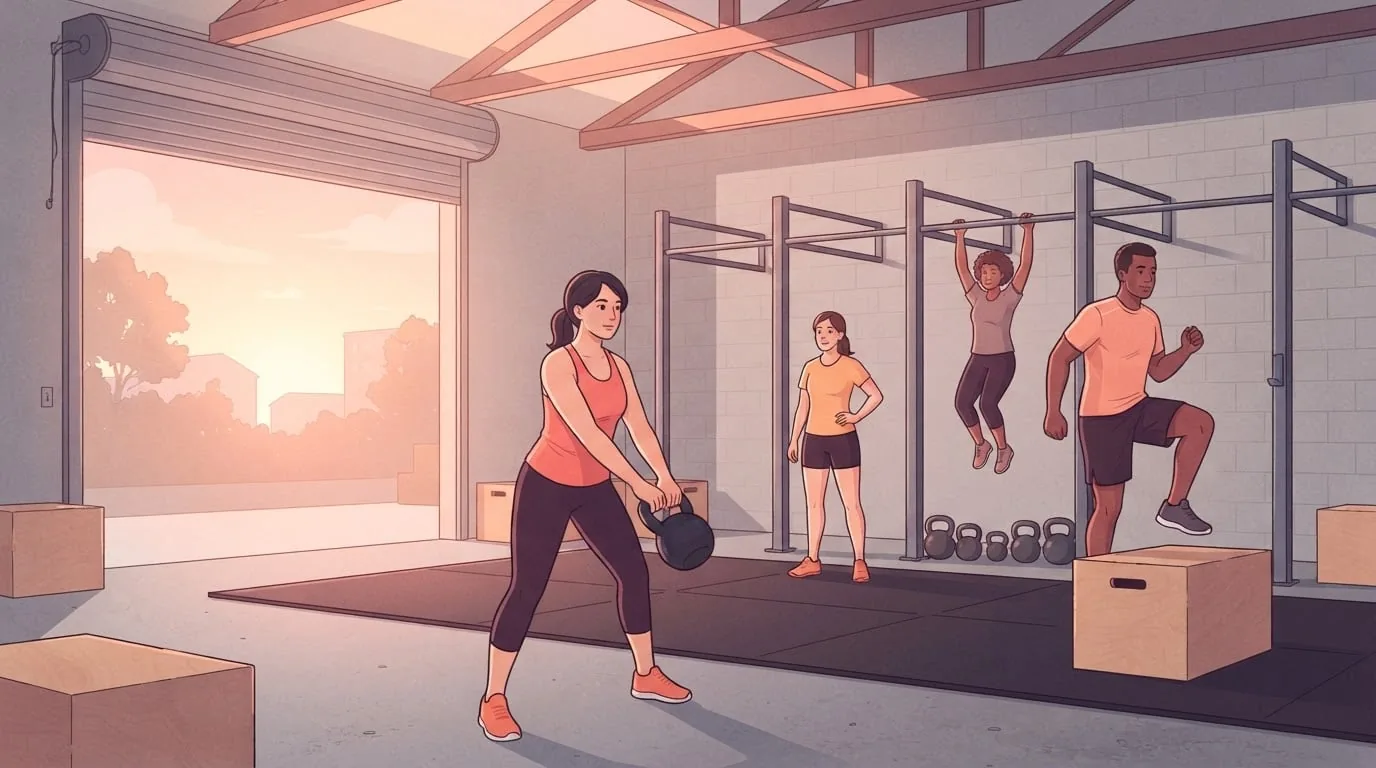
You've probably met someone who can't stop talking about CrossFit, or seen clips of people throwing weights overhead against a clock. It can look like a club for people who were already fit. Maybe you've also heard it will wreck your shoulders.
Most of that is half right. CrossFit can be brutal, it can be scaled for a complete beginner, and it has a real injury record alongside a real ability to keep people showing up. If you've quit programs that left you alone with a plan, the coach and the group may be what interests you most.
What Does CrossFit Mean?
CrossFit means a trademarked style of training built on workouts that change every day, use multi-joint movements and push you hard for your level. The company's current definition is "constantly varied functional movements performed at relative intensity." Older CrossFit pages say high intensity, and that's the wording most people quote.
- Constantly varied. The workout changes daily, so you can't settle into a routine.
- Functional movements. Squats, deadlifts, presses, pull-ups, rowing and running use many joints at once.
- Intensity. The effort is hard relative to your own fitness, so a beginner's load is lighter than a veteran's.
A CrossFitter is anyone who trains this way. Researchers file CrossFit under high-intensity functional training, and our explainer on functional fitness shows how it differs from HIIT. CrossFit is a trademark of CrossFit, LLC, and FitCraft isn't affiliated with it.
Where Did CrossFit Come From?
CrossFit grew out of Greg Glassman's coaching in Santa Cruz, California. The company's own history dates the first workout posted on CrossFit.com to February 10, 2001, and names CrossFit North in Seattle as the first affiliate, in 2004. An affiliate is an independently run gym licensed to use the name, which is why two boxes can feel very different. The company says it reached 15,000 affiliates in 15 years, and its site now lists more than 9,000. The CrossFit Open, an online competition anyone can enter, began in 2011, and top finishers can move on toward the CrossFit Games.
What Is a CrossFit Class Like?
A CrossFit class is a one-hour coached group session with the same structure each day and a different workout. Most of the hour is preparation. The workout itself lasts 10 to 20 minutes.
| Part of class | Time | What happens |
|---|---|---|
| Whiteboard brief | About 5 min | The coach explains the workout and how to scale it |
| Warm-up | 5 to 10 min | You prepare your joints and rehearse the day's movements |
| Skill or strength | 10 to 20 min | You practice one or two movements with coaching |
| Workout of the Day | 10 to 20 min | Everyone does the hard part together against the clock |
| Cool-down | About 5 min | You stretch, put equipment away and record your score |
Coaches expect first-timers. CrossFit's first-class guide says to arrive 10 to 15 minutes early, bring water and fairly flat shoes, and expect to learn barbell movements with a PVC pipe or a very light bar. Your score is a time, a rep count or a load, and it goes on the whiteboard at the end.
CrossFit terms: box, WOD, AMRAP, EMOM and scaling
| Term | What it means |
|---|---|
| Box | A CrossFit gym, usually a plain open space with rigs and free weights |
| WOD | Workout of the Day, the main timed effort |
| AMRAP | As many rounds or reps as possible in a set time. See our AMRAP workout guide. |
| EMOM | Every minute on the minute: set reps at the start of each minute, then rest. See our EMOM workout guide. |
| For time | Finish a set amount of work as fast as you safely can |
| Metcon | A conditioning workout. See our guide to metabolic conditioning. |
| Scaling | Changing the load, movement or reps so the workout fits you |
| Rx | As prescribed: the workout at the listed weights with no changes |
What is a CrossFit workout?
A CrossFit workout is a short, timed mix of weightlifting, gymnastics and cardio. One of the best-known benchmarks is Fran: 21, 15 and 9 reps of barbell thrusters and pull-ups, as fast as you can. A beginner's scaled version might use light dumbbells and ring rows.
Knowing what to do is the easy part.
FitCraft, our mobile fitness app, pairs you with an AI coach who builds you a personalized plan around your goals, schedule, and fitness level. Every FitCraft program is designed by Domenic Angelino, MPH (Brown University) and NSCA-CSCS, with research published in the Journal of Strength and Conditioning Research and Medicine & Science in Sports & Exercise.
Take the Free Assessment Free • 2 minutes • No credit cardWhat Are the Downsides of CrossFit?
The main downsides of CrossFit are a higher injury risk in your first months, a small risk of rhabdomyolysis and a heavy reliance on your coach. Good evidence is scarce: a 2018 review of 31 papers couldn't firmly establish the benefits or the risks, and only two studies combined a high level of evidence with a low risk of bias.
How often do CrossFit athletes get injured?
Experienced members report fewer injuries per hour than many people assume, and novices report far more. These are injuries per 1,000 hours of training, from lowest to highest:
| Who | Injuries per 1,000 hours | Source |
|---|---|---|
| Bodybuilders | 0.24 to 1 | Keogh and Winwood 2017 |
| CrossFit, 3,049 adults surveyed | 0.27 to 0.74 | Feito 2018 |
| CrossFit, first 6 months | 1.15 to 3.9 | Feito 2018 |
| CrossFit, 132 adults surveyed | 3.1 | Hak 2013 |
| Strongman athletes | 4.5 to 6.1 | Keogh and Winwood 2017 |
| Recreational runners | 7.7 | Videbaek 2015 |
| CrossFit novices, first 8 weeks | 9.5 | Larsen 2020 |
| Novice runners | 17.8 | Videbaek 2015 |
Treat this as a rough guide. Each study defines injury differently, most CrossFit numbers are self-reported, and Feito's training hours were estimated. Mehrab and colleagues (2023) cite a range of 0.2 to 18.9 per 1,000 hours. Shoulders, lower backs and knees are the usual sites.
Hak's team judged their rate similar to Olympic weightlifting, powerlifting and gymnastics and lower than rugby. Klimek and colleagues (2018) reviewed three cohort studies and reached much the same view, while warning that none had control groups. Direct comparisons are rarer and less flattering. In a survey of 411 people, Elkin and colleagues (2019) found that 60.7 percent of CrossFit participants reported an injury over 2 years, against 46.7 percent of traditional weightlifters, and injured CrossFit participants sought medical care far more often.
Beginners and coaching
Experience is the clearest protector. In Feito's survey, injury rates were highest in the first 6 months and lowest after 5 years. Larsen's team followed 168 novices at a Copenhagen gym for 8 weeks, and 14.9 percent were hurt badly enough to cut their training for at least a week, most often in the lower back or knee.
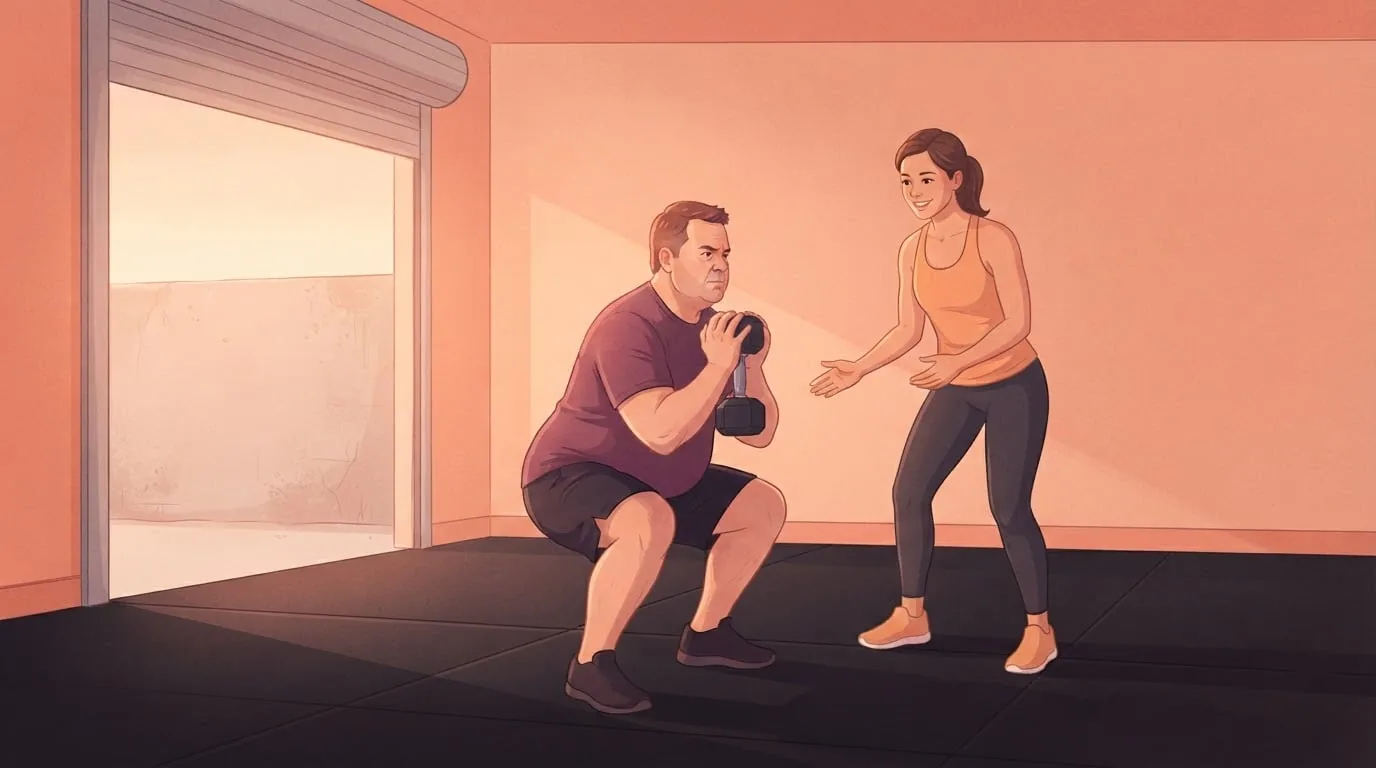
Coaching seems to help. In a survey of 386 members, Weisenthal and colleagues (2014) found injuries in 14.6 percent of those with a trainer involved all of the time, against 31.0 percent of those with a trainer involved only some of the time. A survey can't prove cause, but other cross-sectional studies in Mehrab's review point the same way.
Rhabdomyolysis
Rhabdomyolysis is rare but serious: damaged muscle breaks down fast and can harm your kidneys. At one US academic hospital, Hopkins and colleagues (2019) found 11 cases among 523 patients with CrossFit-related injuries. Six of the 11 were beginners, 10 had dark urine, and hospital stays averaged about 3 days. Get urgent care if your urine turns dark or your muscles swell badly after a hard session.
Urinary leakage
This one rarely comes up in the box. A 2023 meta-analysis of 13 cross-sectional studies, covering 4,823 women who mostly did CrossFit, put the prevalence of urinary incontinence at 44.5 percent, and jumping was a common trigger. Study quality was poor to fair. If it happens to you, tell your coach, scale the jumps and ask a pelvic floor physical therapist for help.
What Results Can You Expect From CrossFit?
You can expect better strength, power and conditioning if you keep showing up, with less certainty about weight loss. Wang and colleagues (2025) pooled high-intensity functional training studies in healthy people and found gains in strength, power, endurance, speed and agility, and the authors suggest programs of 12 weeks or more work better. All of that evidence was rated low certainty, and flexibility didn't change significantly.
Body composition is less clear. Across 10 randomized trials in adults with overweight or obesity, Blanco-Martínez and colleagues (2025) found that weight fell with CrossFit, but the changes didn't differ significantly from those in comparison groups.
The stronger argument may be that people stick with it. In a small 8-week trial, Heinrich and colleagues (2014) randomized 23 inactive adults with overweight to CrossFit sessions or moderate aerobic and resistance training. Adherence was similar at 75 and 82 percent, the CrossFit group spent less time exercising, and more of them planned to continue. Claudino's review also found early signs of a stronger sense of community and motivation among participants.
What Does CrossFit Cost You in Time?
CrossFit costs about 3 to 4 hours of class a week, plus travel. That's the company's suggested start: three to four one-hour sessions with room to recover. Only 10 to 20 minutes of each class is the workout itself, so you're getting 30 to 80 minutes of hard work a week. The rest of the time buys coaching, skill practice and a warm-up you didn't have to plan.
Skills take longer. CrossFit says the patterns often start to click by the third or fourth class, and lifts such as the snatch take far longer to learn safely.
CrossFit Pros and Cons
| Pros | Cons |
|---|---|
| A coach at every class | Beginners get hurt more often |
| A group to train with | Coaching quality varies by gym |
| The workout is planned for you | 3 to 4 hours a week, plus travel |
| Every workout can be scaled | Barbell and gymnastics skills take a long time to learn |
| Short, hard workouts | Little high-quality research |
CrossFit for Beginners: How to Start Safely
You don't need to be fit before you start CrossFit, and the company says most people aren't. What you need is a gym that teaches you first and the patience to scale everything, because the first months carry the most risk.
- Ask how the gym starts new members. Onboarding varies by gym, so look for coached beginner sessions.
- Start with about three classes a week. Keep a rest day between them until you're recovering well.
- Scale for your first month. Pick loads that keep every rep clean, and move up slowly. One study in Mehrab's review linked switching between scaled and prescribed loads with more injuries.
- Tell the coach about injuries before class. They can change the workout for you.
- Stop for sharp pain, dizziness or dark urine. No score is worth it.
How to Try CrossFit-Style Workouts at Home
You can try the format with a pair of dumbbells, your body weight and a timer. Nobody is watching your form, so choose dumbbells you could lift about 15 times when fresh. Start each session with 5 minutes of marching, squats and arm circles, and keep a day off between sessions.
| Day | Format | Workout | Scale it |
|---|---|---|---|
| 1 | 12-minute AMRAP | 6 dumbbell deadlifts, 8 push-ups, 10 reverse lunges | Hands on a bench for push-ups |
| 2 | 12-minute EMOM | Odd minutes: 6 dumbbell push presses. Even minutes: 10 air squats. | Drop to 4 presses and 8 squats |
| 3 | For time | 15, 12 and 9 reps of dumbbell thrusters and bent-over rows | Lighter dumbbells, or 12, 9 and 6 reps |
Write down your rounds or your time, and try to beat them next week. That notebook is your whiteboard.
What This Means for You
CrossFit is a coached group format that rewards people who like a shared challenge and will scale honestly. If a well-run gym is nearby, it's a reasonable way to train, and your first six months deserve extra care. If you like competition with a fixed test, read our guide to HYROX. If you want strength and running together, see what a hybrid athlete trains. Whichever you choose, the results come from showing up week after week.
The whiteboard is a big part of why CrossFit works, because a score turns a hard workout into a game. You can get that pull without a box. A gamified workout app uses the same instinct. In FitCraft, a 3D AI coach demonstrates each dumbbell and bodyweight exercise and says your name during the workout, while streaks, leaderboards, XP and a new quest every month give you a reason to come back. As one FitCraft user, Mike, put it: "The streak system got me hooked. I didn't want to break my chain."

Frequently Asked Questions
Is CrossFit better than gym?
CrossFit isn't better than a regular gym for everyone. It gives you a coach, a plan and a group at every session, while a regular gym lets you train alone at your own pace. In one survey, CrossFit participants reported more injuries than traditional weightlifters, so the better choice is the one you can do safely and keep doing.
Is CrossFit good for beginners?
Yes, CrossFit can be good for beginners if the gym teaches the movements first and scales every workout. Novices get hurt more often than experienced members, so start with about three classes a week and keep the loads light.
Why is CrossFit not popular anymore?
CrossFit is still popular, but it's smaller than it was at its peak. The company has cited 15,000 affiliates and now lists more than 9,000 gyms. Founder Greg Glassman resigned in June 2020 after a tweet about George Floyd led gyms to cut ties, and newer formats such as HYROX now offer a similar group challenge.
Why do people quit CrossFit?
Few studies measure why people quit CrossFit. In one small trial, 25 percent of the CrossFit group didn't keep up with the sessions, and the dropouts had reported lower enjoyment from the start. The injury and time data on this page suggest two more reasons, so choose a format you enjoy and can fit into your week.
Can I lose belly fat with CrossFit?
CrossFit can help you lose body fat overall, but it can't target your belly. In 10 randomized trials in adults with overweight or obesity, weight changes with CrossFit weren't significantly different from those in comparison groups. Fat loss depends mostly on your eating, so pair the workouts with a calorie deficit you can keep up.
Is CrossFit the same as cross-training?
No. Cross-training means mixing different types of exercise, such as a runner adding swimming or strength work. CrossFit is a specific branded program with its own gyms and workouts, although its varied training is one form of cross-training.