
Say the scale shows you're 5 pounds lighter than last month. So when you lose weight, where does it go? The usual guesses are that fat turns into energy or heat, melts away as sweat, leaves in the bathroom or turns into muscle. None of those is the main route. How does fat leave the body, then? You breathe most of it out.
That sounds like a trick answer, but it's plain chemistry. Fat is built from just three elements: carbon, hydrogen and oxygen. When your body burns fat, the energy stored in it is released to power your muscles and keep you warm, but the atoms are still there and have to leave somehow. Most of them leave your lungs as carbon dioxide. The rest become water.
Knowing the route changes what you do about it. It explains why sweat suits and breathing tricks don't work, why the scale can drop faster than your fat does, and why lost fat comes back so easily. This page covers how fat leaves the body step by step, what happens to your fat cells, why breathing harder alone does nothing, where the water goes, which fat goes first and how to keep it off.
How Does Fat Leave the Body?
Fat leaves the body in two steps. First, your fat cells break stored fat into smaller molecules and release them into your blood. Then your muscles, heart, liver and other organs burn those molecules with oxygen to make energy. The burning turns fat into carbon dioxide and water, which leave through your lungs, your kidneys and your skin.
Stored fat is mostly triglyceride, a molecule made of three fatty acid chains joined to a backbone of glycerol. A typical triglyceride has the formula C55H104O6, and burning one molecule of it takes 78 molecules of oxygen:
C55H104O6 + 78 O2 → 55 CO2 + 52 H2O + energy
Scale that up by weight and you get the numbers Meerman and Brown (2014) set out in The BMJ. Burning fat takes far more oxygen than most people would guess:
| Burning 10 kg (22 lb) of fat | Weight | Where it comes from or goes |
|---|---|---|
| Fat burned | 10 kg (22 lb) | Your fat cells |
| Oxygen used | 29 kg (64 lb) | Breathed in |
| Carbon dioxide made | 28 kg (62 lb) | Breathed out |
| Water made | 11 kg (24 lb) | Leaves in urine, sweat, breath, stool and tears |
Both sides balance: 10 kg of fat plus 29 kg of oxygen equals 28 kg of carbon dioxide plus 11 kg of water. To see where the fat itself goes, follow only its own atoms. Every one of its carbon atoms leaves in carbon dioxide, along with most of its oxygen, while its hydrogen ends up in water. Weigh those atoms and about 84 percent of the fat's mass leaves through your lungs, and about 16 percent becomes water. For every pound of fat you lose, roughly 0.84 lb is breathed out.
The energy is where people get tangled up. Burning fat does release energy, but energy doesn't carry away any weight you could measure. The weight was always in the atoms, so the atoms are what have to leave.
When You Lose Weight, Where Does It Go Besides Fat?
Not every pound you lose is fat, especially in the first week or two. Your body stores carbohydrate as glycogen in your liver and muscles, and Kreitzman and colleagues (1992) point out that glycogen is stored with three to four parts water. When you cut calories or carbohydrate, those stores shrink and the water stored with them goes too. That's why the first week of a diet often shows a bigger drop than the weeks that follow.
Some lean tissue goes as well. A long-quoted rule of thumb says about a quarter of the weight lost on a diet is fat-free mass and three-quarters is fat. In a 2014 review, Heymsfield and colleagues traced that rule to its sources and showed that the share shifts with time, age, inactivity and exercise, which makes strength training the lever you control. The carbon from burned glycogen and protein leaves mostly the same way as the carbon from fat, in your breath.
None of it turns into muscle. Fat and muscle are different tissues made of different cells, so one can't become the other, as our article on whether muscle turns into fat explains from the other direction.
What Happens to Fat Cells When You Lose Weight?
Your body fat is stored in fat cells, called adipocytes, each built around a droplet of triglyceride. When you haven't eaten for a while, or when you're using more energy than you take in, hormones signal those cells to release some of it. In their review of the process, Duncan and colleagues (2007) describe how enzymes, starting with one called ATGL, split stored triglyceride into glycerol and fatty acids. These are released into the blood for other organs to use as fuel. Adrenaline and noradrenaline are the main triggers during fasting, and insulin, which rises after a meal, slows the release down.
The fat cell itself stays put and gets smaller. Andersson and colleagues (2014) followed 62 women with obesity for two years after gastric bypass surgery. Their body weight fell by 33 percent, and their fat cells shrank in volume, but the number of fat cells didn't change. Smaller fat cells went with better insulin sensitivity, and that link was closer than the one with the drop in total fat mass.
That fits what Spalding and colleagues (2008) found when they used carbon-14 released by nuclear bomb tests to work out how old human fat cells are. They reported in Nature that the number of fat cells is set during childhood and adolescence, and that in adults it stays constant in lean and obese people alike, even after marked weight loss. As an adult, you mostly gain and lose fat by filling and emptying the cells you already have.
Do Fat Cells Ever Go Away?
Individual fat cells do. Spalding's team found that about 10 percent of fat cells are renewed every year, at every adult age and every body mass index, as old cells die and new ones replace them. The total stays about the same, though. So losing weight empties your fat cells rather than getting rid of them, and removing them for good takes surgery. Even then the body tends to restore its fat, as the liposuction trial further down shows.
What Does a Pound of Fat Look Like?
A pound of body fat looks bigger than most people expect, because fat tissue is lighter than water. That's why it floats. In a study of six male cadavers, Martin and colleagues (1994) measured whole-body fat tissue density at 0.925 to 0.970 grams per milliliter. At that density, a pound of fat tissue fills about 470 to 490 milliliters, roughly 2 cups, or about the size of a grapefruit.
Fat tissue isn't pure fat, either. It also holds water and the working parts of the cells, and in Martin's study fat made up 54 to 85 percent of the tissue's weight. That's one reason the classic figure of 3,500 calories per pound of weight lost is only a rough guide. Hall (2008) showed the rule works reasonably well for people carrying more than 30 kg of body fat but overstates the deficit leaner people need, because more of what they lose is lean tissue, which stores less energy than fat.
Why Breathing Harder Won't Burn More Fat
If fat leaves through your lungs, can you breathe it away faster? No. Your cells make carbon dioxide as they burn fuel, and your breathing simply keeps pace with that output. Breathing faster or deeper on purpose doesn't make your cells burn anything extra. It only blows off carbon dioxide that was already dissolved in your blood.
That's hyperventilating, and your body notices fast. When carbon dioxide in the lungs and blood falls below normal, people feel dizzy and light-headed and get tingling in their hands and feet, symptoms Meuret and Ritz (2010) describe in their review of hyperventilation. Once you stop, your breathing slows until the carbon dioxide builds back up. Over the day, you've breathed out no extra fat at all.
What does raise your carbon dioxide output is movement. Working muscles burn more fuel and hand more carbon dioxide to your blood, so you breathe harder to keep up. The amounts are smaller than people hope, though. Fat holds about 9 calories per gram, so a workout that burns an extra 400 calories would use up about 44 grams of fat, around 1.5 ounces, even if every one of those calories came from fat. In practice a hard session also burns plenty of carbohydrate.
So a single workout barely registers on its own. What decides whether your fat stores shrink is whether you burn more than you eat over days and weeks. Our article on whether muscle burns fat covers the 24-hour calorimeter studies behind that.
Knowing what to do is the easy part.
FitCraft, our mobile fitness app, pairs you with an AI coach who builds you a personalized plan around your goals, schedule, and fitness level. Every FitCraft program is designed by Domenic Angelino, MPH (Brown University) and NSCA-CSCS, with research published in the Journal of Strength and Conditioning Research and Medicine & Science in Sports & Exercise.
Take the Free Assessment Free • 2 minutes • No credit cardSweat, Urine and Breath: Where the Water Goes
The other 16 percent of the fat's mass becomes water, together with some of the oxygen you breathed in, so burning 10 kg of fat makes about 11 kg of water in all. That water mixes with the rest of the water in your body and leaves the usual ways: in urine, in sweat, as moisture in your breath, in stool and in tears.
You won't notice it. Burning 100 grams of fat in a day, which takes a big deficit of about 900 calories, makes roughly 110 milliliters of water, less than half a cup. Adults typically need 2.5 to just over 3 liters of water a day under normal conditions, according to a review by Popkin and colleagues (2010), so the water from burned fat is a small share of what passes through you.
Sweat isn't fat leaving, either. A sweaty workout or a sauna session makes the scale drop because you've lost water, and drinking puts that weight straight back. Our research review on whether sweating burns calories goes through the heat and sauna studies.
Do You Poop Out Fat When Losing Weight?
No, not the fat you've stored. Stored fat leaves your fat cells only as glycerol and fatty acids, which are carried off in the blood and burned, so it exits as carbon dioxide and water. Fat that shows up in stool is fat from food your gut didn't absorb. The same logic applies to urine: you pee out some of the water made by burning fat, but not the fat itself.
Subcutaneous Fat Versus Visceral Fat: Which Goes First?
Subcutaneous fat sits just under your skin. It's the fat you can pinch on your belly, hips and thighs. Visceral fat sits deeper, inside your abdomen around organs such as the liver and intestines. Both kinds are burned the same way and leave through the same exits, but they don't shrink at the same rate.
So do you lose visceral fat first? Often, in proportion, yes. In a systematic review of 61 studies, Chaston and Dixon (2008) found that modest weight loss took off a larger percentage of visceral fat than of subcutaneous fat. The advantage faded as weight loss grew larger, and on very-low-calorie diets the early head start for visceral fat was gone by about 12 to 14 weeks.
Exercise matters more for visceral fat than the scale suggests. In a meta-analysis of 117 studies with 4,815 people, Verheggen and colleagues (2016) found that dieting produced more weight loss than exercise training, but both reduced visceral fat. In studies where people didn't lose weight, exercise was linked to a 6.1 percent drop in visceral fat, while diet barely changed it, at 1.1 percent. The authors pointed out that visceral fat is a stronger predictor of illness and death than the weight changes usually used to judge lifestyle programs, and concluded that total weight loss can be a poor marker of their benefits.
Where Do You Lose Fat First?
The order differs from person to person, and you can't steer it by training one area. Crunches don't pull fat off your belly any more than curls pull it off your arms, and our guide to the best exercises to lose belly fat covers the trials that tested spot reduction. What the research does show is the visceral pattern above: with modest weight loss, the deep fat around your organs tends to shrink proportionally faster than the fat you can pinch.
Why Fat Comes Back After You Lose It
If you've lost weight before and watched it creep back, you're in good company, and it isn't a character flaw. Wing and Phelan (2005) estimated that only about 20 percent of people with overweight manage to lose at least 10 percent of their body weight and keep it off for a year. Your body pushes back in several ways, and most of them start with the fat cells you just emptied.
- The cells are still there. Adults keep about the same number of fat cells after weight loss, so every emptied cell can fill up again.
- Emptier fat cells release less leptin. Leptin is a hormone fat cells make roughly in step with how much fat you carry. Considine and colleagues (1996) found that blood leptin tracked body fat percentage closely in 275 adults and fell when people lost weight.
- Hunger hormones stay shifted. Sumithran and colleagues (2011) put 50 adults with overweight or obesity on a 10-week very-low-energy diet that took off an average of 13.5 kg. Leptin fell and ghrelin, a hormone that stimulates appetite, rose. A year later, these hormones and the participants' hunger ratings still hadn't returned to where they started.
- Appetite rises with every kilogram. Polidori and colleagues (2016) estimated how much 153 people in a year-long drug trial ate as they lost weight without realizing they were in a deficit. For every kilogram they lost, they ate about 100 calories a day more, a push more than three times larger than the slowdown in their metabolism.
- Removing fat cells doesn't stop it. In a randomized trial by Hernandez and colleagues (2011), 14 non-obese women had small-volume liposuction on the lower abdomen, hips or thighs, and 18 had none. A year later the difference in body fat was no longer significant. Their thighs stayed slimmer, but fat had come back in the abdomen.
Our review of set point weight theory covers the rest of that evidence, including how big the metabolic slowdown is and how long it lasts.
None of this means lost fat has to return. In the National Weight Control Registry that Wing and Phelan describe, people who had lost an average of 33 kg and kept it off for more than 5 years reported about an hour of physical activity a day, a low-calorie, low-fat diet, regular breakfasts, regular weighing and the same eating pattern on weekdays and weekends. Those are routines rather than bursts of willpower, and they work against the pull of emptied fat cells.
How to Lose Fat So It Stays Gone
Fat only leaves when you burn more energy than you take in, day after day. The practical steps all follow from that, and none of them needs a gym.
- Run a calorie deficit you can keep. Your body only draws down its fat stores when you burn more than you eat. Pick a deficit you can hold for months rather than one you'll abandon in two weeks.
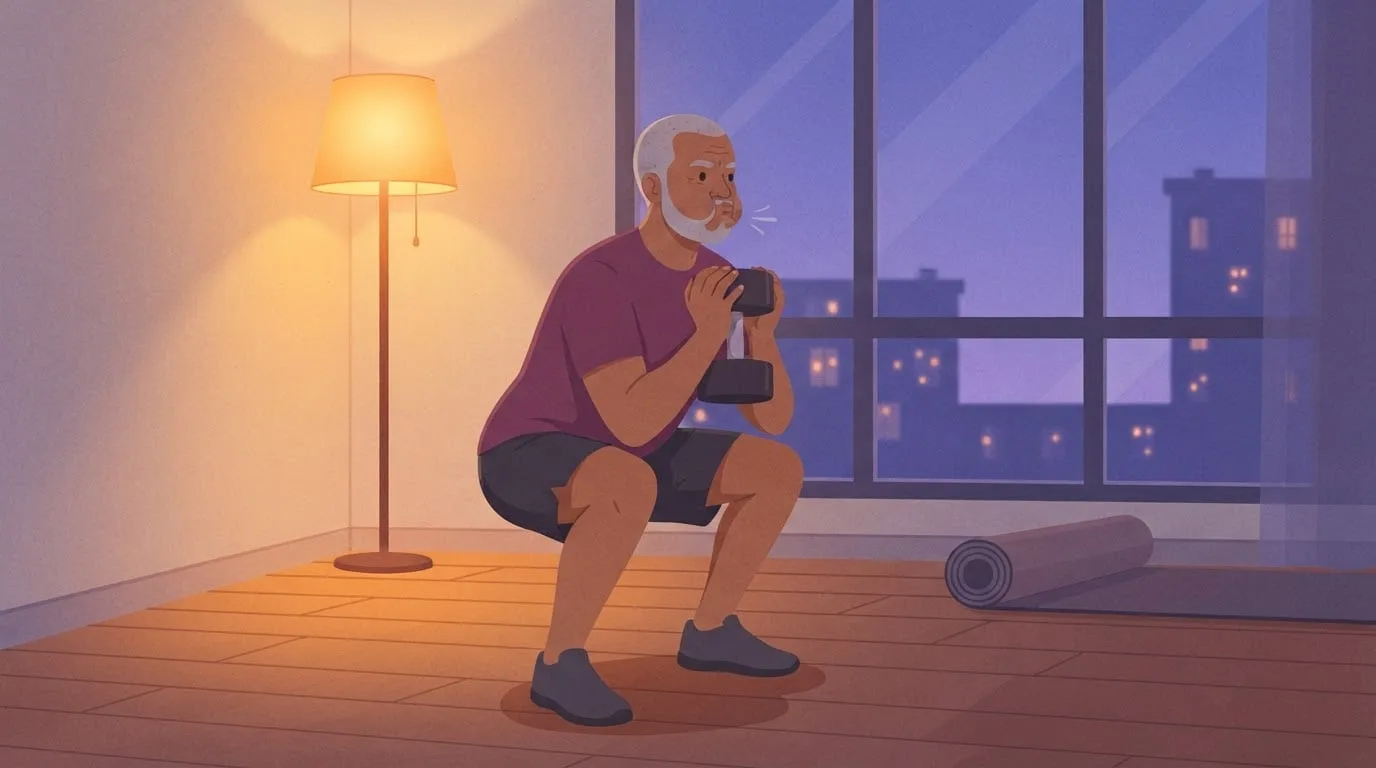
- Strength train two or three times a week. Bodyweight moves and a pair of dumbbells are enough. Exercise is one of the factors Heymsfield's review found shapes how much lean tissue you lose alongside the fat.
- Move every day. Walking adds to the deficit, and the registry members who kept weight off averaged about an hour of activity a day.
- Build meals around protein and vegetables. Keep most of your drinks calorie-free, so the deficit comes from food you'll still enjoy eating.
- Measure more than your weight. Track your waist and how your clothes fit, because the scale swings with water and can miss a drop in visceral fat.
Is It Possible to Burn Fat Without Exercise?
Yes. Eating less than you burn is enough to make your body draw on its fat stores, and in Verheggen's meta-analysis diet alone produced more weight loss than exercise alone. Exercise still earns its place. It trimmed visceral fat even when the scale didn't move, it helps you keep muscle, and daily activity was one of the habits shared by people who kept their weight off.
What Are Signs You're Losing Fat?
The clearest signs are a smaller waist measurement, clothes that fit more loosely and a scale trend that drifts down over several weeks rather than day to day. Strength that holds steady or improves in your workouts suggests you're keeping muscle while the fat comes off. For closer tracking, our guide to measuring body fat at home ranks the methods you can use without a lab.
The hard part is rarely knowing this. It's doing it week after week. If you want help with the training side, our comparison of the best workout apps for weight loss looks at what each app does well. In FitCraft, a 3D AI coach demonstrates every exercise on an interactive model, says your name while you train and adjusts your workouts as you progress. Streaks, leaderboards and a new quest every month give you reasons to come back on the days motivation runs low.
What This Means for You
Fat loss is quieter than it feels. Nothing melts, drains or sweats away in one go. Fat leaves a little at a time, carried out on your breath and in the water you pass, during every hour you spend in a deficit, including the hours you're asleep.
That's good news. It means every workout you finish, every walk you take and every meal you plan counts, even in weeks when the scale hasn't caught up. Picture a few months from now: your waist is smaller, your clothes fit differently, and the habits that got you there feel normal enough to keep. Jim, a FitCraft user who lost 24 pounds in 3 months, put it this way: "I kept telling myself I'd start Monday. FitCraft made me start on a Wednesday and I haven't stopped."
Frequently Asked Questions
What happens to the fat when you lose weight?
It's broken down and burned for energy. Fat cells release stored fat into the blood as fatty acids and glycerol, other tissues burn them with oxygen, and the fat leaves your body as carbon dioxide and water. About 84 percent of its mass is breathed out, and about 16 percent becomes water that leaves in urine, sweat and breath.
How long does it take to burn fat?
Your body burns some fat every hour, but a visible change takes weeks. A common rule of thumb says each pound of weight loss needs a deficit of about 3,500 calories, so a steady 500-calorie daily deficit works out to roughly a pound a week at first. The rule overstates the deficit leaner people need, and the first week's drop on the scale is partly water from glycogen.
Do fat cells die when you lose weight?
Mostly no. Losing weight shrinks fat cells rather than killing them. Adults replace about 10 percent of their fat cells each year as old cells die and new ones form, but the total number stays roughly constant even after large weight loss, which is one reason lost fat can return.
Does drinking water help you burn fat?
Only a little, and mostly indirectly. Water has no calories, so it helps when it replaces sugary drinks, but it doesn't make your body burn fat faster in any way that adds up. Burning fat actually makes water: about 1.1 kg for every kilogram of fat burned.
Does sweating mean you're burning fat?
No. Sweat is water your body uses to cool down, and the weight you lose by sweating comes back as soon as you drink. Fat leaves mainly through your lungs as carbon dioxide, whether you sweat a lot or not at all.
What kills body fat the fastest?
No food, drink or breathing trick melts fat. What shrinks fat fastest in a way you can keep up is a steady calorie deficit combined with strength training two or three times a week and daily activity such as walking. That combination takes fat off while helping you hold on to muscle.