The butterfly reach takes a stretch you probably already know and makes it do more. If you've done the butterfly pose before (sitting with the soles of your feet together and your knees open), you've already done half of this exercise. The reach adds a forward hinge and arm extension that turns a passive hip stretch into an active mobility drill that also works your core and back.
That combination matters. Most people treat hip stretching and core work as separate things. But your hips and core are connected through the pelvis, and training them together produces better results than isolating either one. When you fold forward in the butterfly position, your hip adductors lengthen under load while your abdominal muscles work to control the descent and pull you back up. Research published in the Journal of Strength and Conditioning Research compared two static stretching procedures on hip adductor flexibility and found that both methods improved range of motion without decreasing force output, meaning you can stretch your adductors before training without sacrificing strength (Medeiros & Martini, 2018).
If your hips are stiff from sitting all day, or you want a warm-up drill that opens up your groin and lights up your core at the same time, the butterfly reach is one of the most efficient ways to do both.
Quick Facts: Butterfly Reach
- Equipment needed: None (optional: yoga block or folded towel)
- Difficulty: Intermediate
- Modality: Mobility
- Body region: Hips and lower back
- FitCraft quest category: Mobility
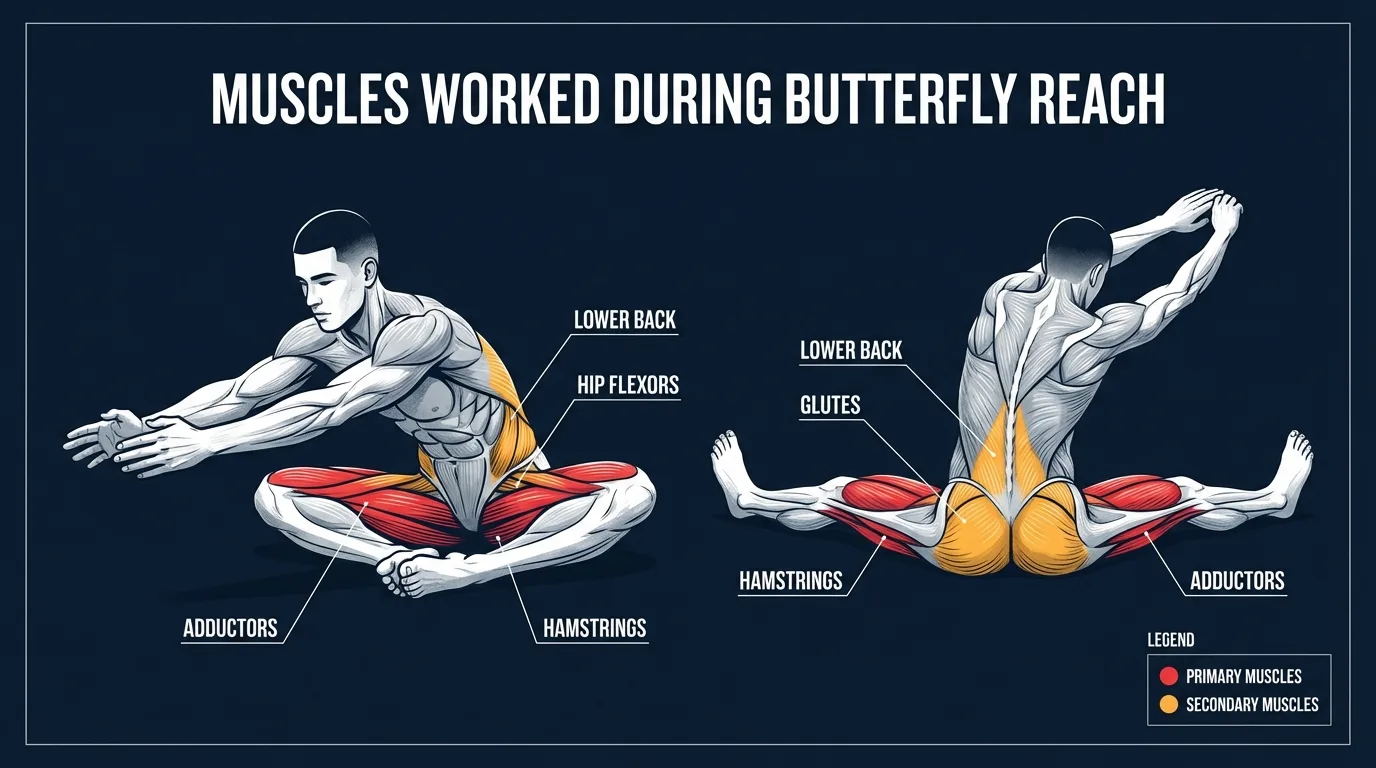
Areas Stretched & Mobilized
Primary stretch targets: the hip adductors (adductor longus, adductor brevis, and gracilis) along the inner thigh, plus the surrounding groin tissue. These muscles cross the hip joint and resist hip abduction. When you let the knees fall open in the butterfly setup, gravity pulls them toward the floor and the adductors lengthen passively. The forward hinge adds a second loading angle by pulling the femur into deeper flexion against the same fixed insertion points, increasing the stretch intensity along the inner thigh.
Secondary stretch targets: the erector spinae and latissimus dorsi along the back, which lengthen during the forward fold as the spine flexes from the hip crease. The hip flexors (psoas and iliacus) also see a gentle stretch in the deepest position.
Active stabilizers: stretching exercises usually do not require heavy isometric stabilization, but the butterfly reach is a dynamic mobility drill, so the core works to control the descent and the return. The rectus abdominis, obliques, and transverse abdominis fire eccentrically during the forward hinge (decelerating gravity) and concentrically during the roll back to upright. That dynamic core engagement is what separates the butterfly reach from a purely passive butterfly pose.
Evidence: Medeiros and Martini (2018) compared two adductor stretching protocols in a randomized study published in the Journal of Strength and Conditioning Research. Both methods produced meaningful improvements in hip abduction range of motion, and neither reduced force output measured immediately after stretching. The practical takeaway: static adductor stretching like the butterfly reach can be used as a warm-up component without sacrificing strength performance in the session that follows.
How to Do the Butterfly Reach (Step-by-Step)
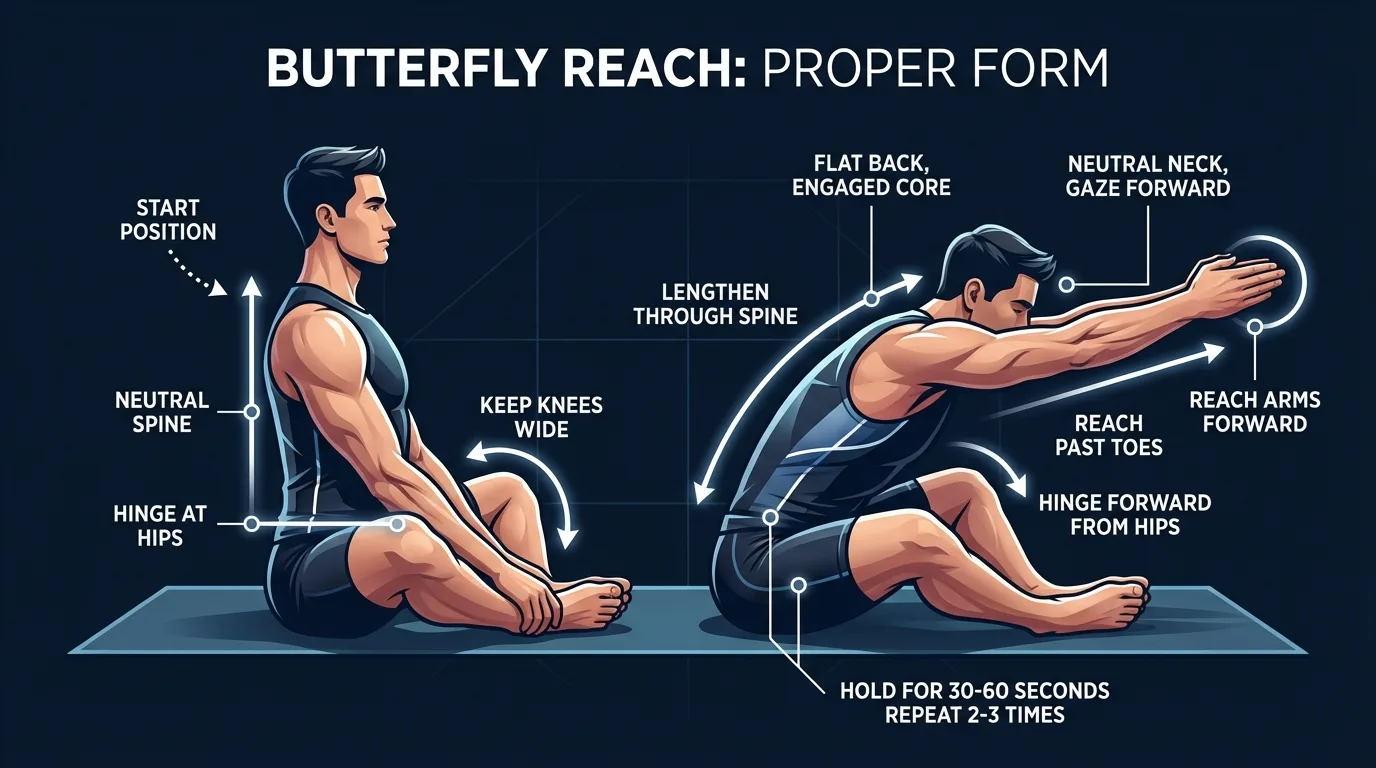
- Set up in butterfly position. Sit on the floor with your spine upright. Bend both knees and bring the soles of your feet together, pulling your heels roughly 12 to 18 inches from your pelvis. Let your knees fall open to the sides naturally. Hold your feet or ankles with both hands. If your lower back immediately rounds, sit on a folded towel or yoga block to elevate your hips. That small change tilts your pelvis forward and makes the whole exercise work better. This starting position is identical to the butterfly pose.
- Engage your core and lengthen your spine. Before you reach anywhere, brace your core at about 30% effort. Think about pulling your belly button gently toward your spine. Grow tall through the crown of your head. Roll your shoulders back and down. This alignment protects your lower back during the forward fold and creates the hinge point for the reach. Skip this step and the whole exercise becomes a sloppy forward slump.
- Hinge forward and reach. Release your feet. Hinge at your hips (not your waist) and extend both arms forward along the floor past your feet. Slide your hands out as far as you can while keeping your spine long. Your chest moves toward the floor, your arms reach straight ahead. You should feel a deep stretch through your inner thighs, groin, and lower back at the same time. Only fold as far as your spine stays neutral. The moment your upper back rounds into a C-shape, you've gone too far.
- Hold and breathe at end range. At your deepest point, hold for 3 to 5 slow breaths. Exhale completely each time and see if you can sink a fraction deeper. Your knees stay relaxed and open. Do not push them toward the floor with your elbows. The stretch should feel like a sustained, tolerable pull across your inner thighs and along your back. Sharp pain means back off.
- Return slowly to upright. Walk your hands back toward your body and use your core to roll up through your spine one vertebra at a time. This is the part most people rush, and it's where half the core work happens. Control the return. Don't jerk upright. Pause at the top, reset your posture, grab your feet again, and repeat.
Common Mistakes to Avoid
The butterfly reach looks gentle, and people treat it like it doesn't need attention. That's exactly when form breaks down. Here's what goes wrong most often.
- Rounding your back instead of hinging. This is the number one mistake. When you curve your entire spine into a C-shape to get lower, you're compressing your lumbar discs instead of stretching your adductors. The hinge has to come from your hip crease. Your back stays long. If you can't reach very far with a flat back, that's fine. Reach less. Your range will improve with consistent practice.
- Forcing your knees down. Pressing your knees toward the floor with your hands, elbows, or body weight during the forward fold is how you strain your groin. Your adductor muscles need time to lengthen. Let gravity and the sustained hold do the work. If your knees are high, they're high. That changes over weeks, not minutes.
- Reaching with your neck instead of your arms. Some people crane their neck forward and drop their head to create the illusion of reaching farther. Your neck should stay in line with your spine. Look at the floor about 12 inches past your fingertips. Reaching with your neck doesn't stretch your adductors or engage your core more. It just puts your cervical spine in a bad position.
- Holding your breath. Breathing is doing actual mechanical work here. Every exhale lets your nervous system relax, which allows your muscles to release into a deeper stretch. Holding your breath creates systemic tension that fights the stretch. Inhale as you set up, exhale as you fold and reach, breathe steadily at end range.
- Jerking back to upright. The return phase is where your core does its job. When you snap back to sitting instead of rolling up slowly, you skip the eccentric core work entirely and you risk jolting your lower back. Use your abdominals to peel yourself up one vertebra at a time. Make it slow. Make it deliberate.
Get this exercise in a personalized workout
FitCraft, our mobile fitness app, uses its AI coach Ty to program mobility work like this into your plan at the right volume and intensity, based on your level, goals, and equipment. Ty was designed and trained by Domenic Angelino, MPH (Brown University) and NSCA-CSCS, with research published in the Journal of Strength and Conditioning Research and Medicine & Science in Sports & Exercise.
Take the Free Assessment Free · 2 minutes · No credit cardVariations and Progressions
Supported Butterfly Reach (Regression)
Sit on a yoga block or folded blanket to elevate your hips, and place cushions under each knee for support. From here, do the same forward reach, but with less adductor demand. This variation is ideal if your knees sit more than 8 to 10 inches off the floor in the standard butterfly position, or if your lower back rounds before you can hinge forward at all. Reduce the props as your flexibility improves.
Static Hold Butterfly Reach (Regression)
Instead of repeating reps, reach forward once and hold the deepest position for 30 to 60 seconds. This is closer to the butterfly pose with a forward fold, but with the arms extended overhead rather than holding the feet. The sustained hold gives your connective tissue more time to release. Good option if the dynamic version feels too intense for your hips right now.
Alternating Single-Arm Butterfly Reach (Progression)
From the butterfly position, reach one arm forward and across your body toward the opposite knee while the other hand stays on the floor behind your hip for support. This adds a rotational component that targets the obliques and stretches the lateral chain on one side at a time. Alternate arms for 5 to 8 reps per side. The rotation also opens up the thoracic spine, which is a bonus if you sit at a desk all day.
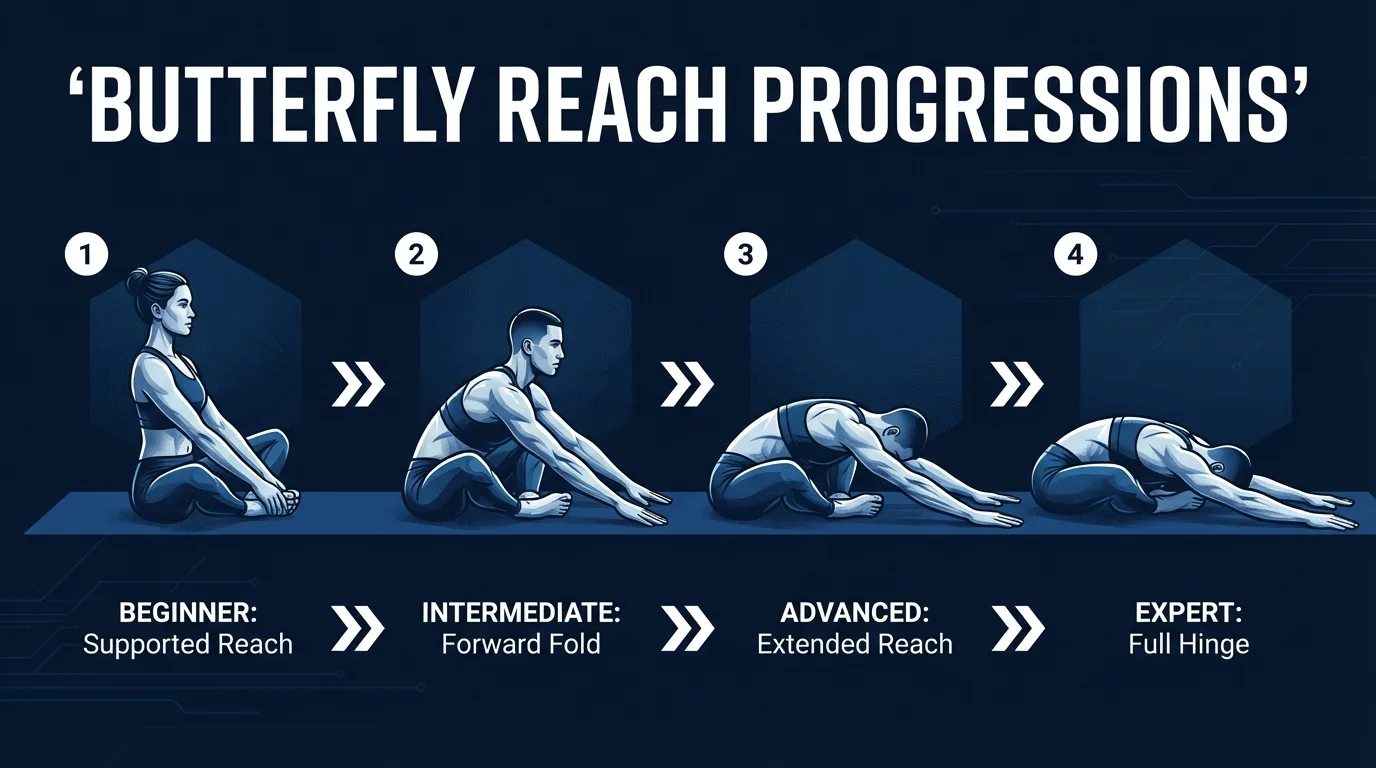
Butterfly Reach with Overhead Extension (Progression)
After reaching forward to your end range, sweep your arms overhead and extend them toward the ceiling as you roll back to upright. This adds shoulder mobility work and increases the core demand during the return phase. Think of it as a full-body mobility flow: reach forward, fold, pause, then sweep up and extend. The entire posterior chain gets loaded through a large range of motion.
Alternative Exercises
- Butterfly pose: The static version of this movement. Same starting position, but you hold the upright seated stretch without the forward reach. Better starting point if the forward hinge is too challenging right now.
- Cat-cow: Another mobility exercise that targets spinal flexion and extension. Pairs well with butterfly reach for a complete warm-up routine covering both the hips and spine.
- Downward dog: Stretches the posterior chain including hamstrings, calves, and lower back. Complements the butterfly reach by targeting the back of the legs while butterfly reach targets the inner thighs.
When to Avoid or Modify the Butterfly Reach
The butterfly reach is safe for most healthy adults and one of the gentler hip mobility drills available. A few situations call for modification or temporarily stepping back to easier variations. Always consult a qualified healthcare provider or physical therapist before starting or returning to any exercise program, especially if any of the following apply to you.
- Acute groin or adductor strain. Stretching a strained muscle can worsen the tear. Wait through the acute phase (typically 1 to 2 weeks for mild strains, longer for more severe ones), follow your physician's reintroduction protocol, and start with the supported variation (hips elevated on a yoga block, feet farther from your body) when you return. Pain that pinches or stabs is the signal to stop.
- Recent hip surgery or labral repair. Get clearance from your surgeon before any deep hip flexion or external rotation. Most post-surgical protocols restrict combined hip flexion plus external rotation in the early phases because the position loads the labrum and capsule.
- Hypermobility, Ehlers-Danlos, or other connective tissue disorders. If you can already reach your forehead to the floor without effort, the passive end-range stretch isn't doing anything productive and may stress your sacroiliac joints. Switch to active controlled mobility (hip CARs, glute bridges, cat-cow) and consult a PT with hypermobility expertise.
- Pregnancy (second and third trimesters). Relaxin loosens the pelvic ligaments, which increases the risk of overstretching the SI joint. Keep the reach gentle, stay within a comfortable range, and stop if you feel any pain or instability at the pubic symphysis or sacroiliac joints.
- Disc pathology, active sciatica, or recent back surgery. The forward hinge loads the lumbar spine in flexion. If forward folds aggravate disc symptoms or shoot pain down a leg, stop, and consult a spine specialist before continuing. Build core support first with bird-dogs and deadbugs, and reintroduce the butterfly reach only after a thorough clearance.
- Lower back rounds before you can hinge at all. This one is a setup problem you can fix in the moment. Sit on a folded blanket or yoga block 2 to 4 inches high. The elevation tilts your pelvis forward and gives you a real hinge to work with. Try the butterfly pose first if even the supported reach is too much.
Related Exercises
If the butterfly reach is part of your mobility routine, these movements complement or extend the same training pattern:
- Static version of the same position: Butterfly Pose holds the same setup without the forward hinge, useful as a foundation or when the dynamic reach feels too intense.
- Same area, different angle: Hip Abductor Stretch targets the outer hip and IT band rather than the inner thigh, giving you the other half of the hip mobility picture.
- Hip opener at a deeper angle: Royal Pigeon Pose and Mermaid Pose stretch the hip rotators and glutes through a different angle, complementing the adductor focus of the butterfly reach.
- Active spinal mobility pairing: Cat-Cow mobilizes the spine in flexion and extension, pairing well with the butterfly reach for a complete pre-training mobility sequence.
- Whole posterior chain stretch: Downward Dog lengthens the hamstrings, calves, and back, complementing the inner-thigh focus of the butterfly reach for a full lower-body mobility routine.
- Hip flexor and thoracic mobility: Half-Kneeling Triplanar Stretch addresses the hip flexors and thoracic rotation, the two other ranges most likely to be restricted in a desk-bound trainee.
How to Program the Butterfly Reach
Mobility programming works differently than strength training. Frequency matters more than load, and consistent practice over weeks is what produces lasting range-of-motion change. The general ACSM Position Stand on resistance training (Ratamess et al., 2009) sets the framework for accessory mobility work, and stretching research consistently shows that hold duration and weekly frequency drive flexibility gains.
| Level | Hold time | Sets | Frequency |
|---|---|---|---|
| Beginner (supported, gentle range) | 15 to 30 seconds per rep, 3 to 5 reps | 1 to 2 | 5 to 7 sessions per week |
| Intermediate (standard reach) | 30 to 60 seconds per rep, 3 to 5 reps | 2 to 3 | 5 to 7 sessions per week |
| Advanced (single-arm rotational or overhead extension) | 30 to 90 seconds, or active 5 to 10 reps per side | 2 to 4 | Daily |
Where in your workout: use the butterfly reach as a pre-training dynamic warm-up component before lower-body sessions (squats, deadlifts, lunges, sprints), as a post-training cool-down on the days you train hips, or as a standalone mobility block on a recovery day. For long static holds, place it post-workout when tissue is warm. Avoid holding deep static stretches for 60+ seconds immediately before max-effort strength or power work. The transient force-output reduction is small but real. The shorter dynamic version (2 to 3 seconds per reach for 8 to 10 reps) is the better pre-workout option.
Range over rep targets: the goal is improved range of motion and tissue quality over time, not hitting a number. If a rep starts to feel sharp, force the knees, or compress the lumbar spine, stop the set. Cleaner, shorter sets done daily beat heroic, painful sets done once a week.
How FitCraft Programs This Exercise
Knowing how to set up a butterfly reach is step one. Knowing how often to do it, how long to hold each rep, and when to add the rotational or overhead variation is where most people get stuck.
FitCraft's AI coach Ty handles that. During your personalized diagnostic, Ty maps your mobility level, training goals, and how much time you have for warm-ups and recovery. Then Ty builds a personalized program that slots the butterfly reach into the right spot at the right intensity.
As your hips open up, Ty adjusts the variation and volume to match your level. Supported regression becomes standard. Standard adds the rotational version. Hold times extend, or the dynamic version replaces it before lifting days. Every program is designed by an Ivy League-trained exercise scientist and NSCA-certified strength coach using evidence-based mobility principles, then adapted to you by the AI.
Frequently Asked Questions
What muscles does the butterfly reach stretch work?
The butterfly reach primarily stretches the hip adductors (inner thighs), including the adductor longus, adductor brevis, and gracilis. The forward reach adds an active stretch to the erector spinae and latissimus dorsi along the back. Your core (specifically the rectus abdominis, obliques, and transverse abdominis) works to control the forward hinge and the return to upright. It also opens the hip flexors and stretches the groin.
What is the difference between butterfly pose and butterfly reach?
The butterfly pose is a static seated stretch where you hold an upright position with the soles of your feet together. The butterfly reach adds a forward hinge and arm extension, turning it into a more dynamic mobility drill that actively engages the core and stretches the posterior chain along with the inner thighs. The butterfly reach is more demanding because it requires core control during the forward fold and return.
How long should I hold a butterfly reach stretch?
Hold each butterfly reach for 3 to 5 deep breaths at your end range, which works out to roughly 15 to 30 seconds per rep. Perform 3 to 5 reps per set. If using it as a dynamic warm-up, reduce the hold time to 2 to 3 seconds and increase reps to 8 to 10. A 2018 study in the Journal of Strength and Conditioning Research found that holding static stretches for at least 15 seconds produced meaningful improvements in range of motion.
Is the butterfly reach safe if I have tight hips?
Yes. The butterfly reach is safe for tight hips when performed correctly. Start with your feet farther from your body to reduce the adductor stretch intensity, and only reach forward as far as your spine stays long. Sit on a folded towel or yoga block to elevate your hips if your lower back rounds. Tight hips just mean you have a shorter range of motion to work with. The exercise itself is designed to progressively improve that range.
Can I do the butterfly reach every day?
Yes. The butterfly reach is a low-intensity mobility exercise that is safe to perform daily. Daily practice is especially effective for improving hip flexibility because connective tissue adapts best to frequent, gentle loading. Just avoid forcing your knees down or bouncing into the forward reach. If you experience soreness, reduce your range and hold time until it resolves.
Can I do the butterfly reach with a groin strain or adductor injury?
No. During an acute groin or adductor strain, stretching the injured muscle can worsen the tear and delay healing. Wait for the acute pain phase to resolve and follow your physician or physical therapist's reintroduction protocol. When you return, start with the supported variation (hips elevated on a block, feet farther from your body) and only reach as far as you stay completely pain-free. The mild pulling sensation of a stretch is fine. Sharp or pinching pain is the signal to back off.