Eagle pose is the standing balance posture that humbles experienced yoga practitioners. Not because the balance is the hardest part. Tree pose covers that. It humbles them because eagle demands everything at once. You need hip flexibility to wrap the legs. Shoulder mobility to bind the arms. Quad strength to hold a single-leg squat. Ankle stability to stay upright while your limbs are tangled. And enough core control to keep the whole structure from collapsing forward.
That combination is exactly what makes it valuable. Most exercises isolate one quality. Eagle pose forces your body to coordinate strength, flexibility, and balance simultaneously. That's closer to how movement works in the real world: catching yourself on ice, pivoting in a sport, or just getting up from a low chair with something in your hands.
The name comes from Garuda, the mythic eagle in Hindu tradition. The wrapped limbs are meant to resemble the eagle's intertwined form. But the real reason this pose matters isn't mythology. It's that the wrapping positions create a deep stretch across the upper back and shoulders that almost nothing else replicates, while simultaneously loading the standing leg in a way that builds functional strength. A 2014 systematic review of yoga and balance in the Journal of Alternative and Complementary Medicine found that yoga interventions consistently improved balance outcomes across all age groups studied, with the largest gains in standing postures requiring single-leg stability (Jeter et al., 2014).
Quick Facts: Eagle Pose
- Equipment needed: None (bodyweight)
- Difficulty: Advanced (arms-only variation is beginner-friendly)
- Modality: Yoga / isometric balance and mobility
- Body region: Full body (single-leg standing, upper-back stretch, hip wrap)
- FitCraft quest category: Yoga / Mobility / Balance
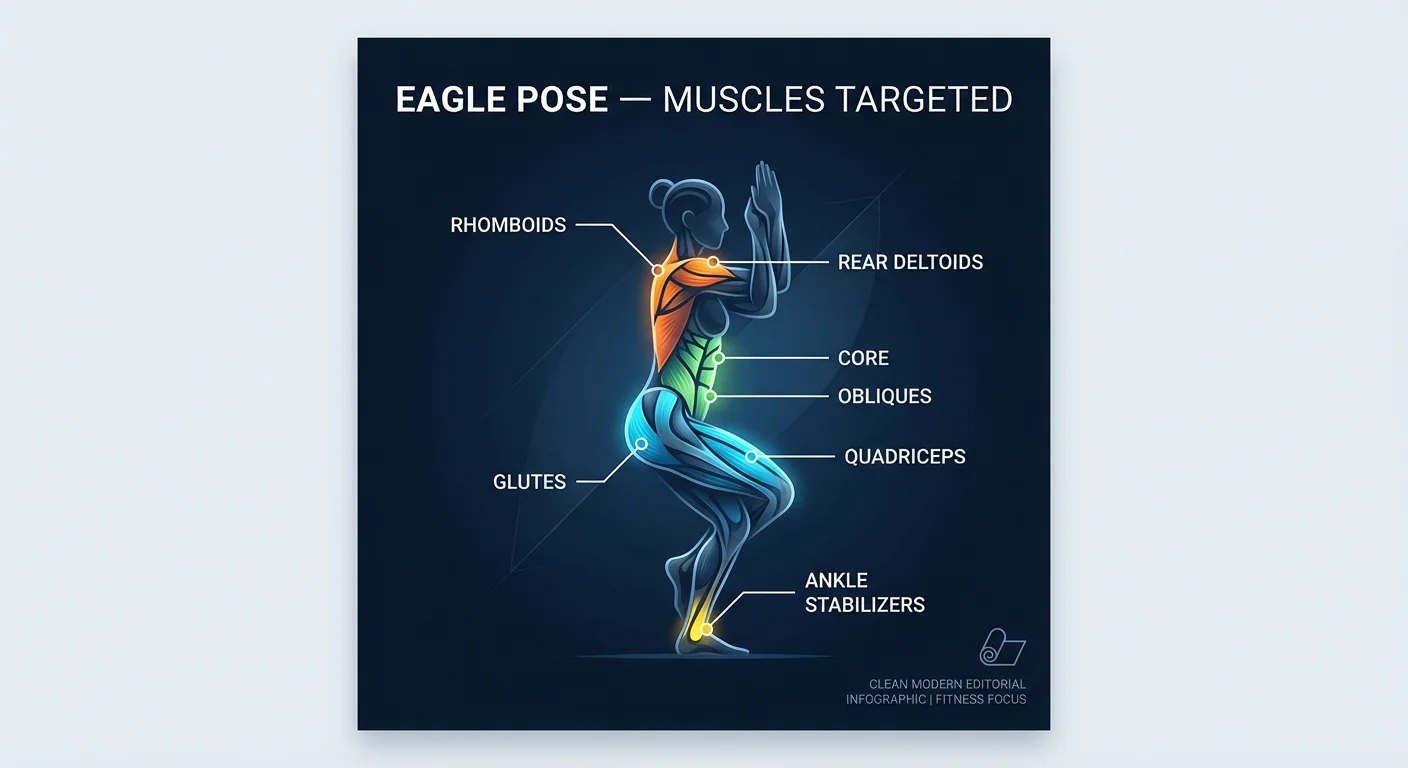
Muscles Engaged & Stretched
Primary movers (isometric work): the quadriceps, gluteus maximus, and gluteus medius of the standing leg. These hold the half-squat position throughout the entire hold. The deeper you sit, the harder they work. The ankle stabilizers (peroneals, tibialis posterior, and the small intrinsic foot muscles) also fire constantly to keep the standing foot rooted as the wrapped limbs threaten balance.
Secondary movers: the hip adductors (inner thighs) of both legs squeeze the wrapped leg against the standing leg, which is what keeps the wrap from loosening mid-hold. The serratus anterior and lower trapezius of the arm-under shoulder work to keep the elbows lifted to shoulder height.
Stabilizers: the entire anterior and lateral core (rectus abdominis, transverse abdominis, obliques, and erector spinae) holds the torso upright and resists the rotational pull of the wrapped hip. The deep hip stabilizers (gluteus medius, piriformis) of the standing leg keep the pelvis level. The breath is also a stabilizer here. Steady diaphragmatic breathing supports both the working muscles and the stretch, while held breath creates bracing that destabilizes the whole posture.
What the stretch is doing: on the arm side, the wrap creates a deep lengthening across the rhomboids, posterior deltoids, and upper trapezius. These are the exact muscles that shorten and tighten from desk posture and forward-rounded shoulders, which is why eagle pose feels so productive for people who sit all day. On the leg side, the wrap stretches the outer hip and gluteus medius of the lifted leg, an area most other yoga poses don't reach directly.
How to Do Eagle Pose (Step-by-Step)
- Sink into a half-squat on one leg. Stand with feet together, arms at your sides. Bend both knees and sink your hips down and back, as if sitting into chair pose. Shift your weight onto your left foot. Keep your standing knee tracking over your toes, not caving inward. The deeper you sit, the harder the balance but the more quad engagement you get. Start with a moderate bend.
Coach Ty's cue: "Sit your hips lower like you're dropping into a chair. Don't tip your torso forward to find balance. Deeper hips plus an upright chest equals more stability, not less."
- Wrap your right leg over your left. Lift your right leg and cross it over your left thigh, high up near the hip. Squeeze your inner thighs together. If your mobility allows, hook the top of your right foot behind your left calf. If you can't hook the foot, that's fine. Let your right toes rest on the floor next to the standing foot, or press them against the standing shin. The leg wrap is complete whether or not the foot hooks.
Coach Ty's cue: "Squeeze the thighs like you're cracking a walnut between your knees. Passive draping gives you none of the adductor work or hip stability."
- Wrap your arms, right under left. Extend both arms straight forward at shoulder height. Cross your right arm under your left at the elbows. Bend both elbows to 90 degrees. Bring the backs of your hands together, or if your shoulder mobility allows, rotate your forearms so your palms press together. Lift your elbows up to shoulder height. Draw your hands away from your face. You should feel a strong stretch across your upper back and the backs of your shoulders.
Coach Ty's cue: "Elbows up, hands out. If your elbows drop toward your belly, you lose the stretch entirely. If your hands collapse toward your face, the rhomboids barely engage."
- Hold, breathe, and repeat on the other side. Hold the position for 20 to 45 seconds, breathing steadily and slowly. Keep your hips square. They want to rotate open on the wrapped side, and resisting that rotation is part of the work. Keep your spine tall. Don't round forward to chase the arm position. When done, unwind slowly and with control. Repeat on the other side: left leg over right, left arm under right.
Coach Ty's cue: "Breathe into whatever feels tightest. The mental focus relaxes the tension around that area so you sink deeper into the stretch without forcing it. Forcing creates bracing. Breathing creates release."
Get this exercise in a personalized workout
FitCraft, our mobile fitness app, uses its AI coach Ty to program yoga poses like this into your plan at the right volume and intensity, based on your level, goals, and equipment. Ty was designed and trained by Domenic Angelino, MPH (Brown University) and NSCA-CSCS, with research published in the Journal of Strength and Conditioning Research and Medicine & Science in Sports & Exercise.
Take the Free Assessment Free · 2 minutes · No credit card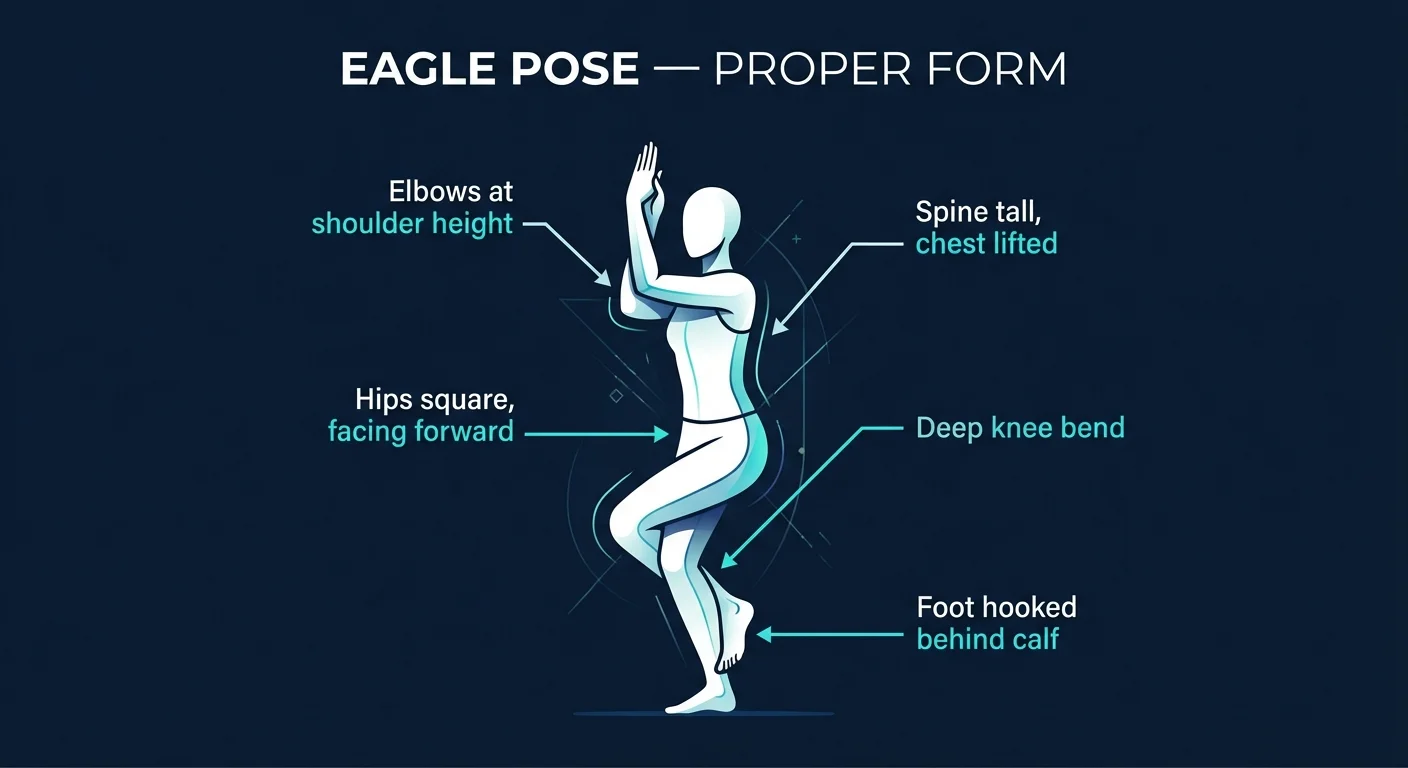
Common Mistakes to Avoid
- Rounding the spine forward. This is the most common compensation. When the arm wrap feels tight, people hunch their upper back to force the elbows higher. But rounding the spine collapses the chest and destabilizes the whole posture. Keep your chest lifted. If you can't get your palms together without rounding, press the backs of your hands together instead. The pose is still effective.
- Letting the hips rotate open. The wrapped leg pulls the hip open on that side. If you let it, your pelvis rotates and you lose the symmetry that makes the pose work. Think about keeping both hip points facing straight forward, like headlights. The muscles that resist this rotation, the obliques and deep core, are a major part of the exercise.
- Gripping the floor with your toes. When balance is threatened, your toes curl down and grip the ground. This engages the wrong muscles and actually creates more instability. Spread your toes wide and press down through the whole foot: big toe mound, little toe mound, heel. Stability comes from the full foot, not from white-knuckling the floor with your toes.
- Holding your breath. Eagle pose is uncomfortable. Uncomfortable positions trigger breath-holding. But holding your breath tightens the muscles you're trying to stretch, raises blood pressure, and makes balance worse. If you notice you've stopped breathing, the pose has become too challenging. Simplify the arm or leg position until you can breathe steadily through the hold.
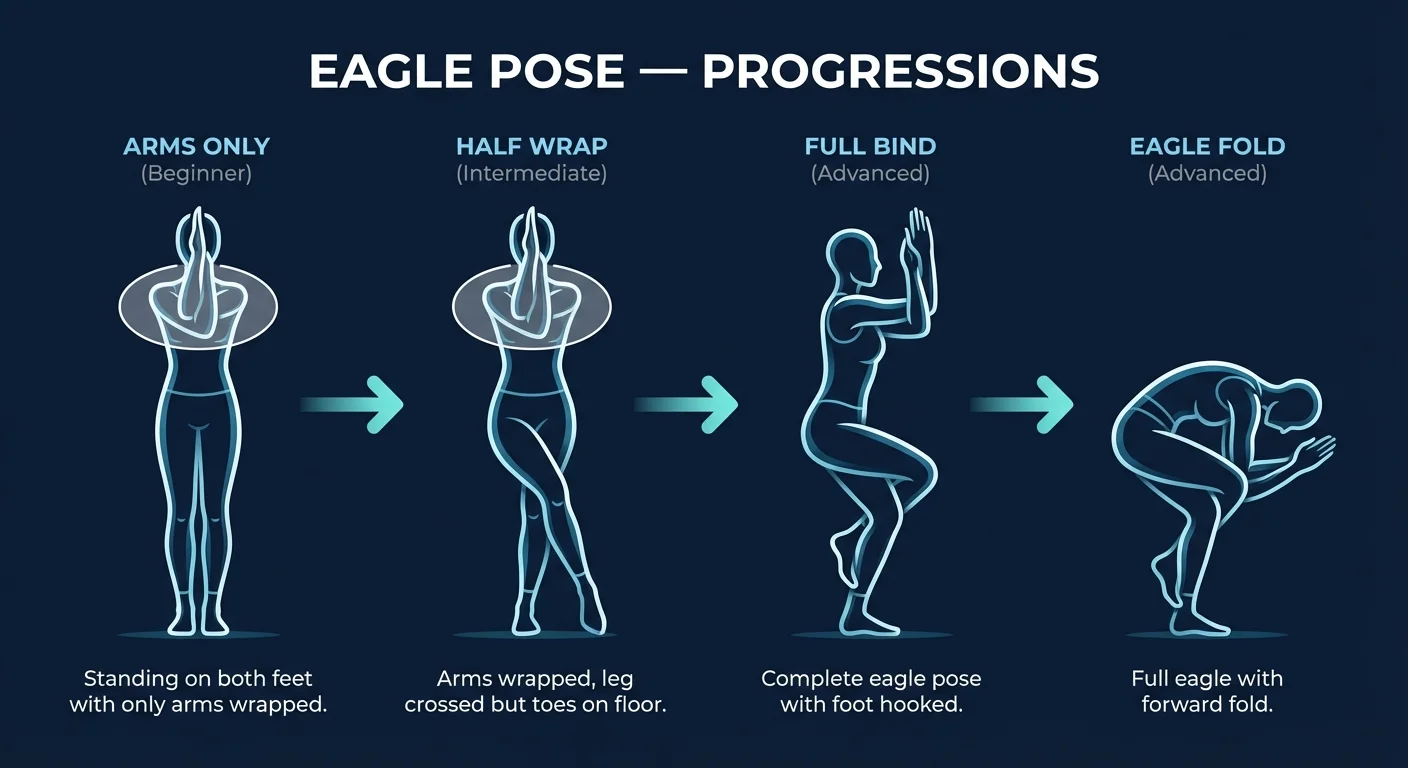
Eagle Pose Variations: From Arms-Only to Full Bind
Arms Only, Seated or Standing (Beginner)
Practice just the arm wrap without the leg balance challenge. Sit in a chair or stand on both feet. Cross one arm under the other at the elbows, bend to 90 degrees, and press the backs of the hands (or palms) together. Lift the elbows to shoulder height. Hold 30 seconds per side. This isolates the shoulder and upper back stretch, the component most people need most.
Half-Wrap, Toes on Floor (Intermediate)
Perform the full arm wrap with the leg crossed over the standing thigh, but instead of hooking the foot, let the toes of the lifted foot rest on the floor next to the standing foot. This gives you a touch point for balance while still loading the standing leg and engaging the adductors. It's a natural bridge between the seated version and the full expression.
Full Eagle, Foot Hooked (Advanced)
The full version described in the step-by-step above: deep single-leg squat, leg wrapped with foot hooked behind the calf, arms bound with palms pressed. This requires significant hip adductor flexibility, ankle mobility, and shoulder range of motion. Most people need months of consistent practice to achieve the full bind on both sides.
Eagle Fold (Advanced)
From the full eagle position, hinge forward at the hips and bring your wrapped elbows toward your wrapped knee. This deepens both the hip stretch and the upper back stretch while dramatically increasing the balance challenge. Hold for 10 to 20 seconds and come back up before unwinding.
When to Avoid or Modify Eagle Pose
Eagle pose is safe for most healthy adults, but several conditions call for modification or substitution. None of these are permanent restrictions. They're starting points. Always consult your physician or physical therapist for personalized guidance before starting a new yoga practice or returning after injury.
- Prior or current shoulder injury (rotator cuff, AC joint, impingement, post-surgical). The arm wrap deeply compresses the posterior shoulder and rotates the humerus internally under load. This can aggravate rotator cuff strain, AC joint pain, or shoulder impingement. Practice the arms-only version with only the back of the hands together (not the deeper palms-together bind), and stop short of any sharp or pinching sensation. Build prerequisite mobility with rotator cuff stretch and seated rear delt stretch first.
- Knee pain or meniscus issues. The deep single-leg squat at the bottom of eagle pose loads the standing knee under bodyweight and rotational forces from the wrapped leg. If you have a current meniscus injury, patellar tendinopathy, or recent knee surgery, skip the deep squat and either practice the arms-only version standing tall, or use a chair behind you for partial support. Build standing-knee strength with chair pose first.
- Active vertigo, balance disorders, or vestibular conditions. Single-leg balance poses risk falls when the vestibular system isn't reliable. Practice the full pose near a wall so you can touch out, or stay with the arms-only seated variation until symptoms resolve. Get clearance from your physician before practicing standalone.
- Late pregnancy (second and third trimesters). The deep single-leg squat, balance demands, and torso compression of the arm wrap can be unsafe as the belly grows and the center of gravity shifts. Substitute with the arms-only seated variation, and only with guidance from a prenatal yoga instructor.
- Ankle instability or recent ankle sprain. The standing ankle works hard to keep you upright while your limbs are tangled. A recent sprain or chronic instability raises re-injury risk. Practice near a wall, or substitute with tree pose against a wall until ankle strength rebuilds.
- Hypermobility or connective tissue disorders. The arm and leg wraps can encourage already-lax joints to overstretch. Focus on muscular engagement (squeezing thighs, lifting elbows) over depth, and stop at the first sign of "joint slip" rather than chasing range.
Related Exercises
If eagle pose is part of your yoga or mobility practice, these poses and drills complement or extend the same training pattern:
- Easier balance regression: Tree pose develops the single-leg balance foundation without the wrapping complexity. Master 30 to 60 second holds in tree pose before chasing the full eagle bind.
- Standing-leg strength foundation: Chair pose (Utkatasana) builds the quad and glute strength needed for eagle pose's deep single-leg squat, without the balance and mobility demands of the wraps. A strong chair pose makes eagle pose significantly more accessible.
- Shoulder opener pair: Seated rear delt stretch targets the same posterior shoulder muscles eagle pose stretches, but in a gentler position. Use as warm-up before eagle or as a regression if the full arm bind feels too intense.
- Mobility prep for the arm wrap: Shoulder rolls and rotator cuff stretch mobilize the gleno-humeral joint and posterior cuff before loading them in the bind.
- Hip opener pair: Royal pigeon pose opens the outer hip and gluteus medius that eagle pose also targets, but from a seated position that removes the balance demand.
- Single-leg balance progression: Warrior 3 deepens single-leg balance work in a hinged position, useful once eagle and tree pose feel comfortable.
How to Program Eagle Pose
Yoga programming follows different rules than resistance training. The stimulus is mobility and isometric endurance rather than progressive overload, so frequency can be daily and recovery time between sessions is minimal. That said, the broader principles of structured progression still apply, and the ACSM Position Stand on resistance training is a useful anchor for thinking about volume and rest in any hold-based exercise (Ratamess et al., 2009).
| Level | Hold time per side | Holds per session | Frequency |
|---|---|---|---|
| Beginner (arms-only or half-wrap) | 3 to 5 breaths (~15 to 30 seconds) | 1 to 2 per side | 3 to 5 sessions/week |
| Intermediate (half-wrap or full bind) | 5 to 10 breaths (~30 to 60 seconds) | 2 to 3 per side | 4 to 6 sessions/week |
| Advanced (full bind, eagle fold) | 10 to 15+ breaths (~60 to 90+ seconds) | 3 to 5 per side, deeper variations | 5 to 7 sessions/week |
Where in your workout: Eagle pose works in three contexts. As part of a standalone yoga sequence, it slots into the standing-pose block alongside tree pose, warrior 3, and chair pose. As a warm-up before upper-body strength training, one or two sides mobilizes the posterior shoulders and upper back for pressing and pulling. As a cool-down after a long workday at a desk, the arms-only variation undoes some of the postural shortening that hours of typing create.
Form floor over hold targets: if your spine starts rounding, your standing knee starts collapsing inward, or your breath becomes ragged, the hold has gone too long. End it. A short clean hold trains more than a long compromised one. Both sides will likely feel different. Practice both equally, and spend a few extra seconds on the tighter side.
How FitCraft Programs This Exercise
Knowing how to wrap the arms and legs is step one. Knowing which variation to start with, how often to practice, and when to progress to the full bind is where most people get stuck.
FitCraft's AI coach Ty handles that. During your personalized diagnostic assessment, Ty maps your fitness level, balance, mobility, and goals. Then Ty builds a personalized program that slots eagle pose into yoga and mobility-focused routines at the right variation for your level. The 3D model demonstrates the arm and leg wrapping from multiple angles, which matters here more than almost any other pose, because the wrapping sequence is hard to understand from written instructions alone.
As your shoulder and hip mobility improves, Ty adjusts the variation and hold time to match your level. Arms-only becomes half-wrap. Half-wrap becomes full bind. Every program is designed by an Ivy League-trained exercise scientist and NSCA-certified strength coach using evidence-based principles, then adapted to you by the AI.
Frequently Asked Questions
Can I do eagle pose if I have a prior shoulder injury?
The arm wrap compresses the posterior shoulder and stretches the rotator cuff and rhomboids under load. If you have a current rotator cuff strain, AC joint pain, or are within the first months of post-surgical recovery, the full arm bind is likely to aggravate it. Start with the arms-only variation using only the back of the hands together (not the deeper palms-together version), and stop short of any sharp or pinching sensation. Get clearance from a physical therapist before progressing if symptoms persist for more than a week.
What muscles does eagle pose work?
Eagle pose works the quadriceps, glutes, and ankle stabilizers of the standing leg for balance and isometric strength. The wrapped arm position stretches the rhomboids, posterior deltoids, and upper trapezius. The wrapped leg engages the inner-thigh adductors and stretches the outer hip and glute medius of the lifted leg. The core (obliques and transverse abdominis) holds the torso upright throughout the hold.
Is eagle pose good for tight shoulders?
Eagle pose is one of the most effective yoga poses for tight shoulders. The arm wrap creates a deep stretch across the posterior deltoids, rhomboids, and upper trapezius. Holding for 20 to 45 seconds per side with steady breathing can improve shoulder mobility over time, particularly for people who sit at a desk all day. If the full bind is too intense, practice the arms-only seated variation as a daily mobility drill.
Why can't I wrap my foot behind my calf in eagle pose?
The full foot hook requires significant hip adductor flexibility and ankle mobility. Many practitioners, including experienced ones, never achieve this variation. It is perfectly valid to rest your toes on the floor, press them against the standing shin, or simply cross the thigh without hooking. The balance and strengthening benefits are nearly identical regardless of foot position. Chasing the hook at the cost of upright posture is a worse pose.
How long should I hold eagle pose?
Beginners should hold eagle pose for 15 to 20 seconds per side. Intermediate practitioners can aim for 30 to 45 seconds. Advanced practitioners may hold for 45 to 60 seconds or add the eagle fold variation. Always practice both sides equally and prioritize steady nasal breathing over hold duration. If your breath becomes ragged, the hold has gone too long.