Step-N-Curl looks simple because it uses familiar pieces: a knee drive, a foot plant, and a standing hamstring curl. Put them together and you get a low-impact conditioning move that keeps the whole lower body cycling without hops, jumps, or floor transitions.
The exercise works best when each rep has two clear phases. First, drive one knee up with control. Then plant that foot and curl the opposite heel toward your glute. If you blur those phases, it turns into a loose march. If you keep them crisp, your quads, hip flexors, hamstrings, glutes, calves, and core all stay involved.
Quick Facts: Step-N-Curl
- Equipment needed: None
- Difficulty: Beginner to Intermediate
- Modality: Low-impact cardio
- Body region: Lower body and core
- FitCraft quest category: Cardio
Muscles & Systems Worked
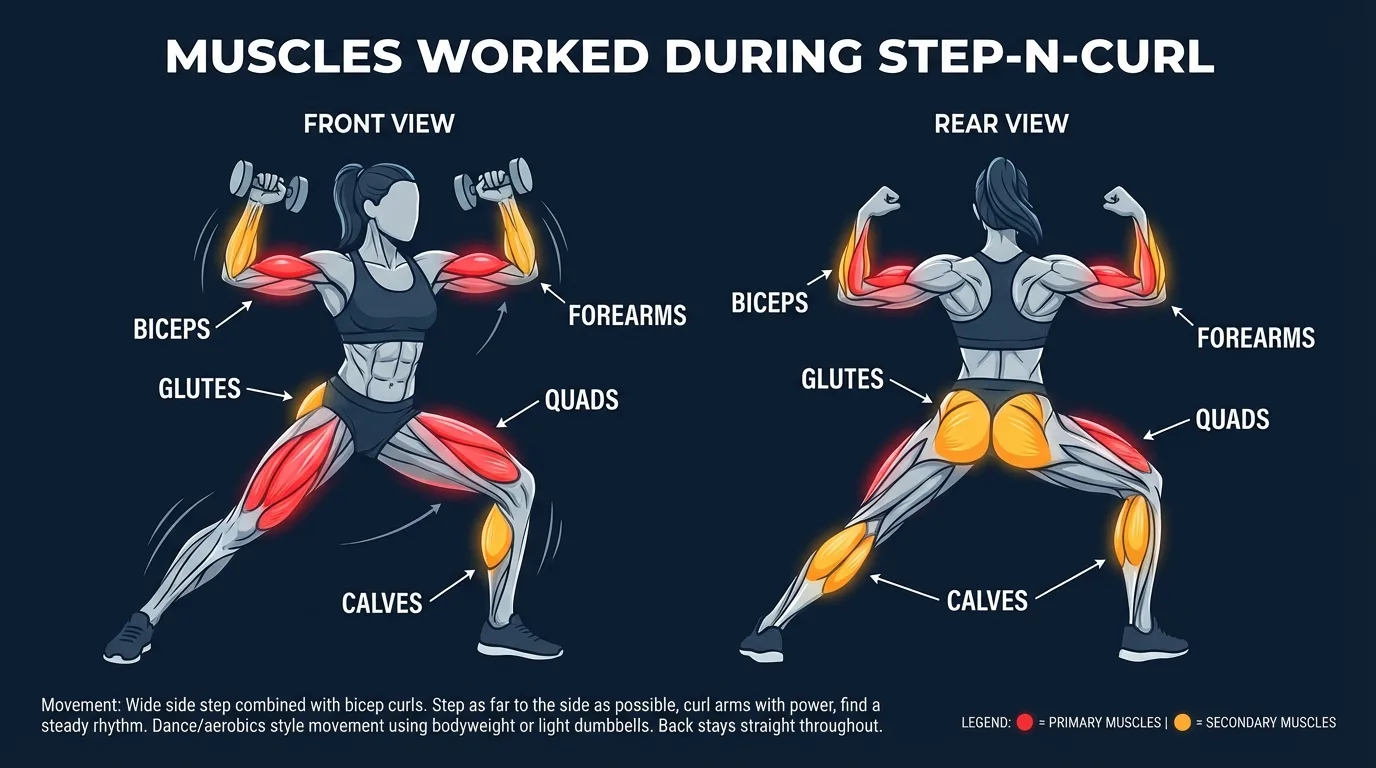
Primary movers: the quadriceps and hip flexors drive the knee up during the step phase. On the alternating side, the hamstrings flex the knee to pull the heel toward the glute. The gluteus maximus and gluteus medius help control the standing leg and keep the pelvis level as weight shifts from side to side.
Secondary movers: the calves help control each foot strike and assist the quick weight transfer between legs. The tibialis anterior helps lift the toes during the knee drive so the foot clears the floor cleanly. The arm swing adds rhythm, but it should support the leg pattern instead of throwing your balance around.
Stabilizers: the rectus abdominis, transverse abdominis, obliques, spinal erectors, ankle stabilizers, and deep hip stabilizers work isometrically to keep your torso tall. They matter most when the moving leg is in the air and your base of support is temporarily narrow.
Conditioning mechanism: Step-N-Curl keeps large lower-body muscles alternating for timed intervals, so the heart, lungs, and energy systems contribute alongside the muscles. Shorter intervals rely more on phosphocreatine and glycolytic energy. Longer steady sets bring more oxidative contribution as breathing rate climbs. No exercise-specific PubMed, PMC, or DOI citation is included in the verified FitCraft citation library for Step-N-Curl, so this section uses mechanism-based biomechanics instead of a proxy citation.
How to Do Step-N-Curl (Step-by-Step)
- Stand tall with feet hip-width apart. Let your arms rest at your sides, brace lightly, and keep your ribs stacked over your hips. Coach Ty's cue: "Start tall before every rep. Your posture sets the rhythm."
- Drive one knee up. Shift your weight onto your left foot and bring your right knee toward hip height. Keep the standing knee softly bent and your gaze forward.
- Plant and curl the opposite heel. Lower the right foot to the floor. Once it is stable, bend your left knee and curl the left heel toward your glute. Coach Ty's cue: "Make the curl a hamstring squeeze rather than a foot flick."
- Alternate sides. Lower the left foot, then drive the left knee up, plant it, and curl the right heel. Keep moving from side to side in a clean, repeatable pattern.
- Control the interval. Breathe steadily and choose a pace you can hold without leaning forward, skipping the curl, or stomping the foot down. End the set when the pattern gets sloppy.
Get this exercise in a personalized workout
FitCraft, our mobile fitness app, uses its AI coach Ty to program conditioning work like this into your plan at the right volume and intensity, based on your level, goals, and equipment. Ty was designed and trained by Domenic Angelino, MPH (Brown University) and NSCA-CSCS, with research published in the Journal of Strength and Conditioning Research and Medicine & Science in Sports & Exercise.
Take the Free Assessment Free · 2 minutes · No credit card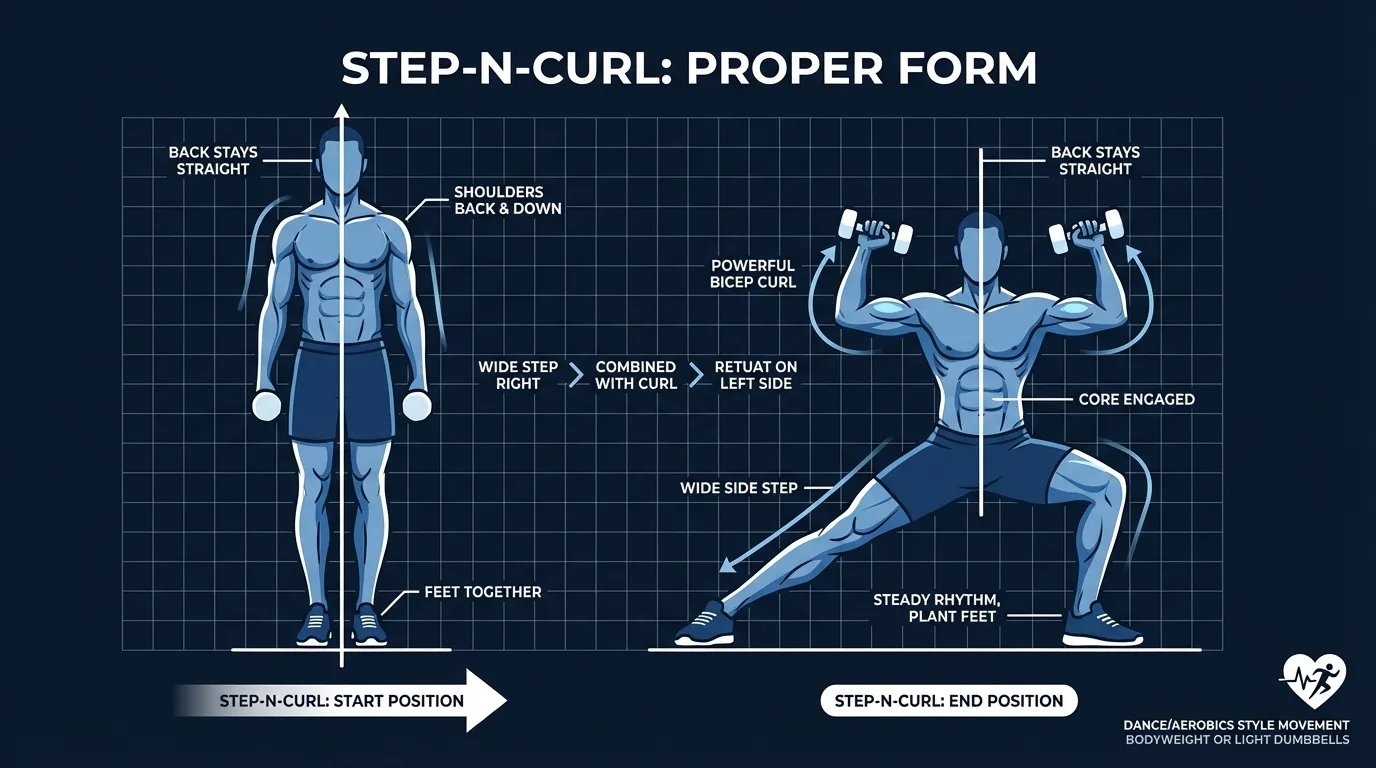
Common Mistakes (and How to Fix Them)
- Leaning forward on the knee drive. If your chest drops toward the rising knee, the drill shifts toward your lower back and loses hip-flexor range. Fix it by lowering the knee slightly and keeping your ribs stacked over your hips.
- Rushing through the curl. A fast heel flick skips the hamstring work. Fix it by squeezing the hamstring for a brief beat at the top of each curl before the next knee drive.
- Locking the standing knee. A locked support leg makes balance harder and can make the foot strike feel harsh. Keep a soft bend in the standing knee so you can absorb each plant quietly.
- Swinging the arms too wide. Big arm swings create momentum that pulls you off line. Keep the arms close to a controlled marching swing, with elbows bent and shoulders relaxed.
- Letting the pace choose your form. Speed should come after rhythm. If the curl shortens, the foot stomps, or your balance breaks, slow down until every phase looks the same.
Step-N-Curl Variations: Regressions and Progressions
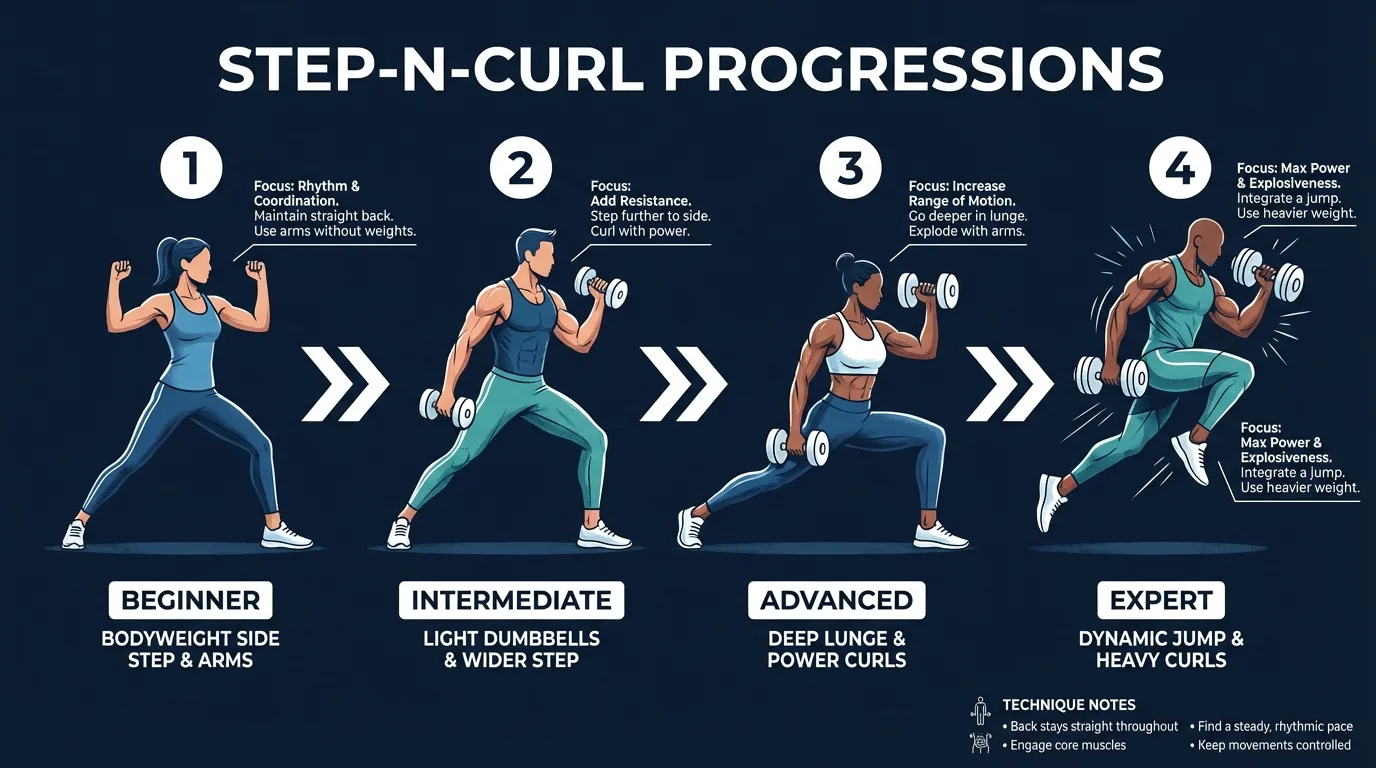
Wall-Supported Step-N-Curl
Place one hand lightly on a wall, counter, or chair. Keep the same step-and-curl pattern, but use the support to reduce balance demand. This is the best starting point if the alternating rhythm feels awkward.
Slow-Tempo Step-N-Curl
Pause briefly after the knee drive and again at the top of the heel curl. The pauses make the exercise less cardio-heavy and more skill-focused, which helps you learn the sequence without rushing.
Standard Step-N-Curl
Move continuously at a moderate pace for 20 to 45 seconds. Each rep still has a clear knee drive and heel curl, but the transitions become smoother and more aerobic.
Speed Step-N-Curl with Overhead Reach
Once your rhythm is clean, increase the tempo and add an overhead reach on the knee-drive phase. Pull the elbows down as the heel curls. This raises the conditioning demand while keeping the movement low impact.
When to Avoid or Modify Step-N-Curl
Step-N-Curl is low impact, but it still challenges heart rate, balance, hip flexion, knee control, and single-leg stability. Modify first if any of the situations below apply. Always consult your physician or physical therapist for personalized guidance.
- Known cardiovascular disease or uncontrolled hypertension. Conditioning intervals can raise heart rate and blood pressure quickly. Get medical clearance and stay within your prescribed heart-rate zone.
- Knee, ankle, hip, shin, or foot pain. Keep the knee drive lower, shorten the heel curl, and slow the tempo. If foot strikes become loud or painful, swap to walking in place until symptoms settle.
- Vertigo, balance disorders, or vestibular symptoms. Use wall support and a smaller range, or choose marching in place until balance feels steady.
- Pregnancy or early postpartum recovery. Use low-impact, clinician-cleared movement only. Avoid fast tempo changes if you have pelvic-floor symptoms, pelvic pain, or pressure. Progress with guidance from a qualified prenatal or pelvic-floor clinician.
- Stress incontinence or pelvic-floor symptoms. Step-N-Curl is less jarring than jumping drills, but faster intervals can still provoke symptoms. Use a slower pace, shorter sets, and supportive breathing before increasing intensity.
- Asthma or exercise-induced bronchoconstriction. Use a longer warm-up, keep medication accessible if prescribed, and stop if breathing symptoms escalate beyond normal exertion.
Related Exercises
If Step-N-Curl fits your training, these exercises build the same conditioning pattern or support the joints and muscles behind it:
- Simpler low-impact cardio: Marching in Place and Walking in Place reduce coordination demand while keeping the heart-rate stimulus accessible.
- Same pattern, higher intensity: High Knees and Butt Kicks split the two halves of Step-N-Curl into faster standalone drills.
- Step-based conditioning: Step-N-Clap and Step-N-Punch keep the low-impact footwork and add upper-body rhythm.
- Core stability foundation: Forearm Planks and Deadbugs build the trunk control that keeps the torso tall during alternating reps.
- Ankle and calf conditioning: Calf Raises and Calf Hops train the lower-leg control that makes foot strikes quieter.
How to Program Step-N-Curl
Step-N-Curl programming is usually interval-based. The broader ACSM progression model recommends matching training volume, rest, and frequency to the exerciser's level and recovery status (Ratamess et al., 2009).
| Level | Work interval | Rest between sets | Frequency |
|---|---|---|---|
| Beginner | 20-30 seconds | 60-90 seconds | 2-3 sessions/week |
| Intermediate | 30-45 seconds | 45-60 seconds | 3-4 sessions/week |
| Advanced | 45-60 seconds | 30-45 seconds | 3-5 sessions/week |
Where in your workout: use Step-N-Curl after a general warm-up, inside a low-impact cardio circuit, or as a short finisher after resistance training. Keep it short before heavy strength work because long conditioning blocks can reduce the energy you need for loaded sets.
Form floor over time targets: stop the interval when the heel curl disappears, knee height drops from fatigue, balance breaks, breathing gets too ragged to control the next rep, or foot strikes become loud.
How FitCraft Programs This Exercise
Step-N-Curl belongs in the low-impact conditioning bucket. That means it can warm up the hips and knees, raise heart rate in a joint-friendly way, or fill a short cardio slot on days when jumping does not fit.
FitCraft's AI coach Ty uses your personalized diagnostic, goals, available equipment, and progress to place conditioning work at the right dose. Ty can adjust the variation and volume to match your level, so a supported slow-tempo version can build toward longer, faster intervals when your rhythm is ready.
Frequently Asked Questions
What muscles does Step-N-Curl work?
Step-N-Curl primarily works the quadriceps and hip flexors during the knee-drive phase, then the hamstrings and glutes during the heel-curl phase. The calves, hip stabilizers, spinal erectors, and core help you stay balanced while the heart and lungs support the continuous conditioning effort.
Is Step-N-Curl good for low-impact cardio?
Yes. Step-N-Curl keeps the lower body moving continuously without jumping, so it can raise heart rate with less impact than high knees, butt kicks, or jump-based cardio drills. It works best when you keep the knee drive and heel curl distinct instead of rushing through them.
How long should I do Step-N-Curl?
Beginners can start with 20 to 30 second intervals, intermediate exercisers can use 30 to 45 seconds, and advanced exercisers can use 45 to 60 seconds. Rest long enough to recover clean form before the next set.
Can beginners do Step-N-Curl?
Yes, if the pace is slow and the range stays controlled. Beginners can use a wall for balance, keep the knee below hip height, or practice marching in place and butt kicks separately before combining both phases.
Can I do Step-N-Curl if I have knee or balance issues?
Modify first. Use wall support, lower the knee drive, shorten the heel curl, and move slowly enough that your foot placement stays quiet. If knee pain, vertigo, balance problems, or joint instability show up during the exercise, stop and get personalized guidance from a qualified clinician.