Most low-impact cardio feels like it isn't doing anything. You move your arms in a circle, tap your feet, and twenty seconds in you wonder if your heart rate has moved at all. Step-N-Push fixes that with the pushing-through-water tempo. Instead of swinging your arms fast and light, you move them slowly and deliberately, like something is actually resisting you. Your chest and shoulders have to fight to extend, your core has to fight to stay stacked, and the combination turns a simple step-and-push into a cardio move you can feel.
Quick Facts: Step-N-Push
- Equipment needed: None
- Difficulty: Beginner to Intermediate
- Modality: Low-impact cardio / conditioning
- Body region: Full body
- FitCraft quest category: Cardio
Muscles & Systems Worked
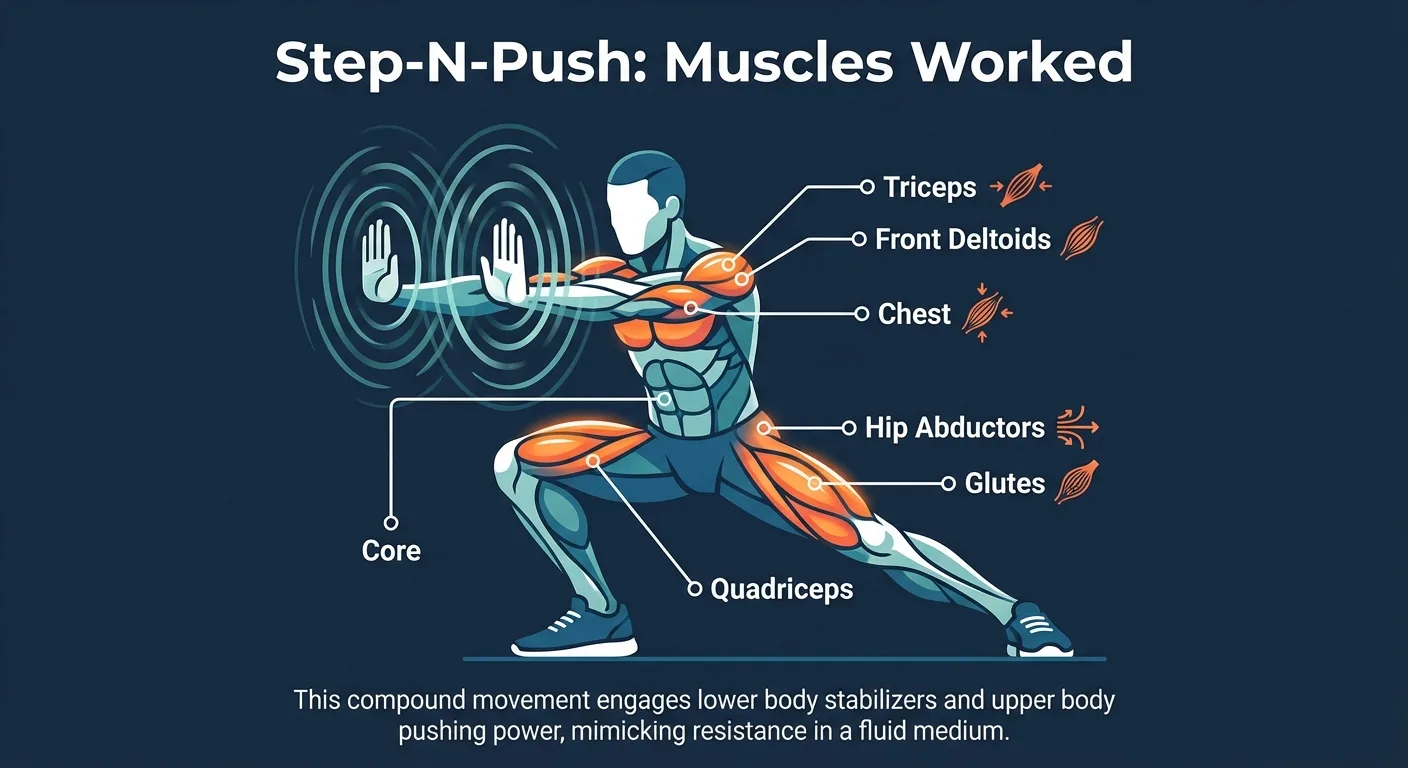
Primary movers: the quadriceps, glutes, hip abductors, pectoralis major, anterior deltoids, and triceps. The lower body drives each lateral step as the hip abductors move you side-to-side and the quads and glutes absorb the step. The chest, front shoulders, and triceps create the slow forward push, then control the return to the chest.
Secondary movers: the calves help each soft landing and push-off, while the serratus anterior helps the shoulder blades glide as the arms reach forward. The upper back helps pull the hands back to the chest with control, which keeps the movement from turning into a loose arm swing.
Stabilizers: the rectus abdominis, transverse abdominis, obliques, spinal erectors, ankle stabilizers, and foot intrinsics. They keep your trunk stacked, your ribs down, and your foot strike quiet while the arms and legs move in rhythm.
Conditioning mechanism: there is no exercise-specific PubMed, PMC, or DOI citation in the verified FitCraft citation library for Step-N-Push, so this section uses mechanism-based biomechanics instead of a proxy citation. Continuous stepping raises heart rate through repeated lower-body work, while the slow forward push adds local shoulder and chest endurance without impact or equipment.
Coach Ty programs Step-N-Push as conditioning work because that's the main stimulus. You'll feel a burn in the chest and shoulders as the set progresses, but the goal is rhythmic movement, steady breathing, and a climbing heart rate. If you want heavier chest work, do push-ups. If you want a low-impact cardio move that still wakes up your upper body, this is the right lane.
Step-by-Step: How to Do the Step-N-Push
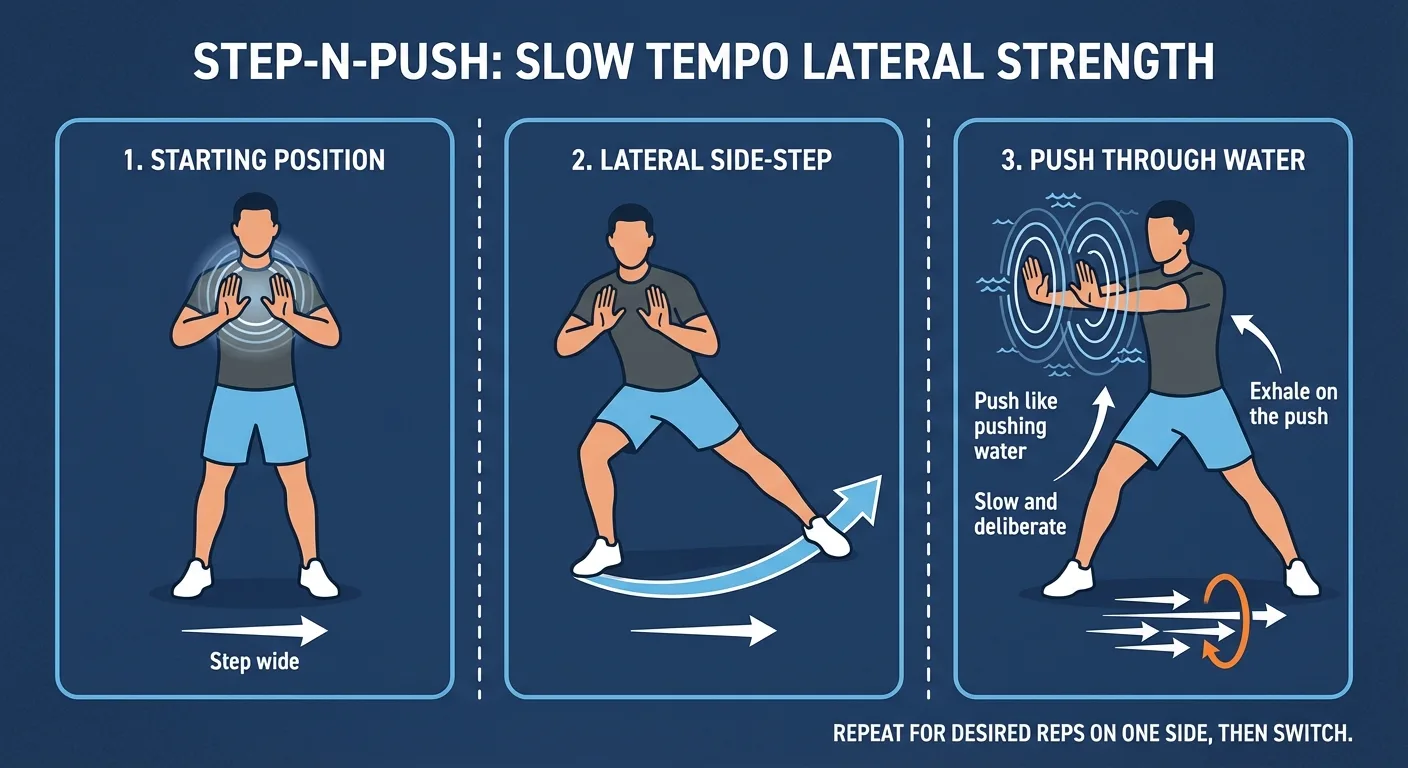
- Set your stance. Stand tall with your feet hip-width apart, chest up, core braced, shoulders relaxed and down. Bring both hands to chest height, palms facing forward, fingers pointing up, elbows tucked. This is your home position.
- Step wide to one side. Step your right foot out to the right, landing softly on the ball of the foot and rolling through the heel. Bring your left foot in to meet it. Stay tall and avoid leaning over the step.
- Push both palms forward. In the same beat the feet come together, push both palms straight forward from your chest until your arms are almost fully extended. Move slow and deliberate, like you're pushing through water. Feel the tension in your chest and shoulders. Pull the hands back to the chest with the same slow control.
- Step wide to the other side. Step your left foot out to the left, meet feet, push both palms forward again. Alternate directions each step. Keep the push continuous so the hands almost never stop moving.
- Breathe with the push. Exhale as the palms push forward. Inhale as they pull back to your chest. Keep the tempo musical. Holding your breath is how people gas out in 20 seconds on a move that should last a minute.
Common Mistakes (And How to Fix Them)
Fast, Light Arm Waves
What it looks like: Flappy, quick arm swings with no tension. The hands barely slow down.
Why it's a problem: The push tempo is the whole exercise. Fast and light creates no tension, no stimulus, no training effect. You're just moving air.
The fix: Slow the arms down. Imagine pushing through water. Or imagine pushing a heavy box across a table. Use whatever mental image creates the resistance.
Holding the Breath
What it looks like: Jaw clenched, face red, gasping after 15 seconds of what should be a 45-second set.
Why it's a problem: Continuous-tension movements without breath turn anaerobic fast. You lose the cardio benefit and end the set way too early.
The fix: Exhale on every push, inhale on every pull-back. Say the word "push" out loud on the forward phase if you have to. It forces the exhale.
Dropping the Hands
What it looks like: Starting with hands at chest level, drifting down to waist level as the set progresses.
Why it's a problem: A waist-level push uses your biceps and shoulders in a weird angle and loses the chest engagement.
The fix: Reset hand height every 10 seconds. Back to chest level, fingers pointing up. If you can't hold the height anymore, end the set. That's the cutoff signal.
Shuffling the Steps
What it looks like: Tiny foot movements, barely lateral at all.
Why it's a problem: Shuffling removes the leg work and kills the cardio component. You're left with just the arm push, which isn't enough by itself.
The fix: Step wide. Commit to at least hip-width lateral travel on every step. Quiet landings but wide steps.
Get this exercise in a personalized workout
FitCraft, our mobile fitness app, uses its AI coach Ty to program conditioning work like this into your plan at the right volume and intensity, based on your level, goals, and equipment. Ty was designed and trained by Domenic Angelino, MPH (Brown University) and NSCA-CSCS, with research published in the Journal of Strength and Conditioning Research and Medicine & Science in Sports & Exercise.
Take the Free Assessment Free • 2 minutes • No credit cardVariations
Easier (Regression)
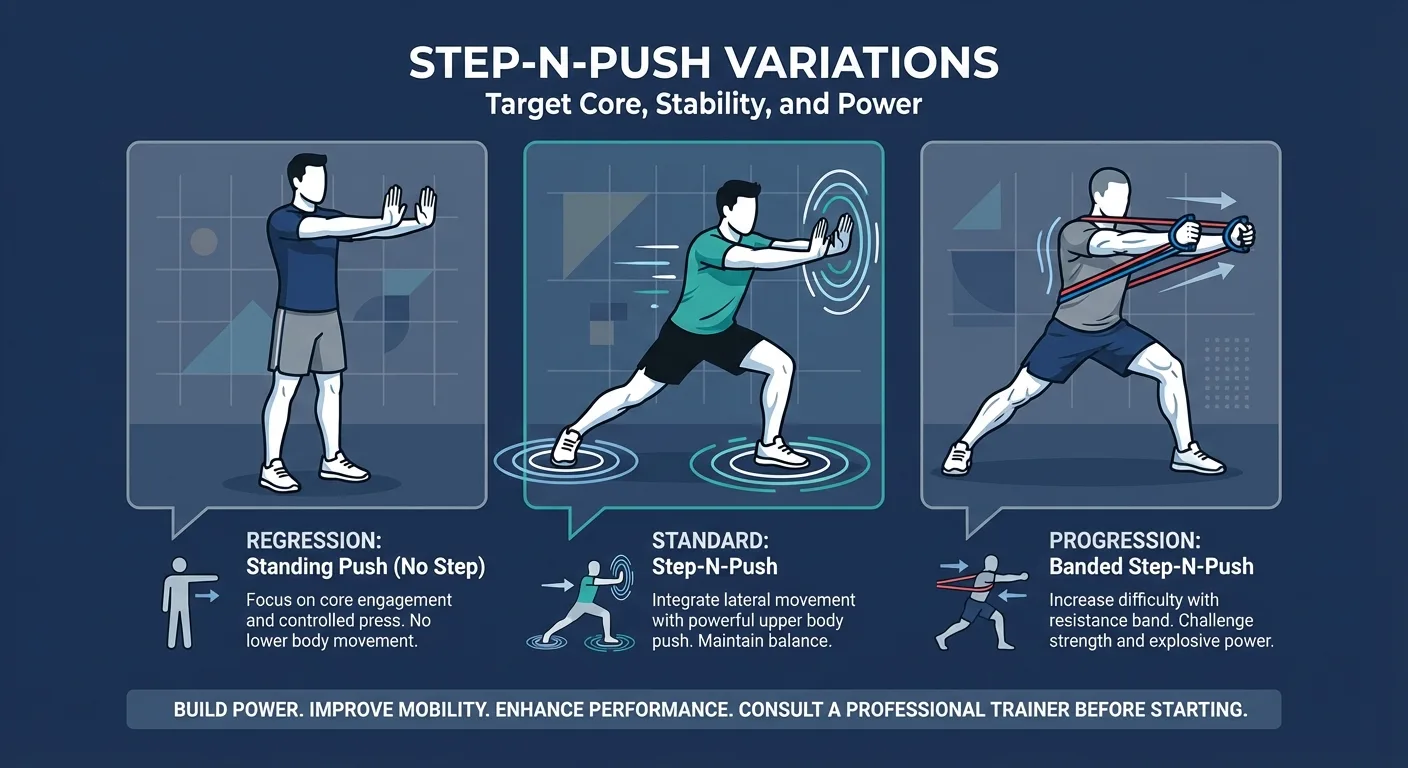
- Standing Push (No Step). Skip the lateral step and run the forward push in place. Lets you focus on the push tempo and breathing without the coordination piece.
- Step-N-Push (Narrow Step). Use a hip-width step instead of a wide one. Easier on the knees and hips while you build the pattern. Progress to wider steps as your hip mobility improves.
Harder (Progression)
- Step-N-Push (Double Push). Throw two deliberate pushes on every step instead of one. Doubles the chest and shoulder work for the same stepping volume.
- Step-N-Push with Resistance Bands. Loop a light resistance band around your back and hold the ends in each hand. Now the "pushing through water" image is literal because you're actually pushing against resistance. Turns a cardio drill into a chest-endurance drill fast.
Alternative Exercises
- Jumping Jacks. Higher-impact cardio alternative when you don't need the low-impact benefit.
- High Knees. Stationary cardio with higher intensity but no upper body component.
- Mountain Climbers. Ground-based cardio that recruits the chest and shoulders through a plank position.
When to Avoid or Modify Step-N-Push
Step-N-Push is safe for most healthy adults because one foot stays on the ground, but a few situations call for a slower tempo, smaller step, or a different conditioning option. Always consult your physician or physical therapist for personalized guidance.
- Known cardiovascular disease or uncontrolled hypertension. Step-N-Push can still raise heart rate quickly when you push the pace. Get your cardiologist's approval first and stay within any prescribed heart-rate zones. Start with walking in place or marching in place if you need a gentler entry point.
- Acute knee, ankle, hip, shin, or plantar fascia pain. The move is low impact, but the side step still asks the lower body to absorb repeated lateral loading. Use a narrower step, slow the cadence, or swap to marching in place until symptoms settle.
- Pregnancy or early postpartum recovery. Balance, joint laxity, and pelvic-floor tolerance can change quickly. Use a narrow stance, avoid fast direction changes, and get clearance from your OB, physician, or pelvic-floor PT before using longer conditioning intervals.
- Stress incontinence or pelvic-floor symptoms. The low-impact design is helpful, but fatigue can still trigger leakage if you hold your breath or rush the set. Shorten the interval, breathe on every push, and rebuild core control with deadbugs or forearm planks.
- Shoulder irritation. The forward push should feel smooth. If reaching forward pinches the front of the shoulder, lower the hands slightly, shorten the range, or use Step-N-Clap until the shoulder tolerates repeated arm work.
- Vertigo, balance disorders, or vestibular symptoms. Side-to-side stepping can feel disorienting. Hold a wall or counter, reduce step width, and stop if dizziness shows up.
Related Exercises
If Step-N-Push fits your training, these movements sit close to it in the same low-impact conditioning and full-body cardio family:
- Lower-impact alternatives in the same pattern: Step-N-Clap and Step-N-Punch use the same side-to-side rhythm with different upper-body actions.
- Simpler cardio foundations: Walking in Place and Marching in Place build cadence, posture, and breathing before adding a coordinated push.
- Higher-intensity cardio swaps: Jumping Jacks and High Knees raise the intensity when you do not need the low-impact benefit.
- Upper-body strength foundation: Push-Ups train the chest, shoulders, and triceps with real bodyweight resistance when Step-N-Push feels too light for strength work.
- Core and ankle support: Forearm Planks reinforce trunk stiffness, while Calf Raises build the lower-leg control that makes lateral steps quieter.
How to Program Step-N-Push
Step-N-Push programming is time-based, not rep-based. The American College of Sports Medicine resistance-training progression model supports matching volume, rest, and frequency to training status, then progressing gradually as tolerance improves (Ratamess et al., 2009).
| Level | Work interval | Rest between sets | Frequency |
|---|---|---|---|
| Beginner | 20-30 seconds | 60-90 seconds | 2-3 sessions/week |
| Intermediate | 30-45 seconds | 45-60 seconds | 3-4 sessions/week |
| Advanced | 45-60 seconds | 30-45 seconds | 3-5 sessions/week |
Where in your workout: use Step-N-Push as a warm-up block before upper-body strength work, a standalone low-impact cardio interval, or a short finisher after resistance training. It also pairs well with Step-N-Clap and Step-N-Punch in a low-impact circuit.
Form floor over time targets: stop the interval when the steps shrink into a shuffle, the hands drop below chest height, breathing gets choppy, or the push turns into a fast arm flap. A clean 30-second set beats a sloppy minute.
How FitCraft Programs This Exercise
FitCraft uses Step-N-Push as a low-impact conditioning option when a workout needs rhythmic movement without jumping. As your conditioning improves, Ty adjusts the variation and interval length to match your level. The narrow step can become the standard version, the standard version can become longer intervals, and advanced sets can add double pushes or light band resistance.
Frequently Asked Questions
What is Step-N-Push?
Step-N-Push is a FitCraft cardio combo. You take a wide lateral step side-to-side while pushing both palms straight forward from your chest as if you're moving through water. It's a low-impact, rhythmic, full-body conditioning movement that trains legs, chest, shoulders, core, and steady breathing.
What muscles does the Step-N-Push work?
Step-N-Push trains your quads, glutes, calves, and hip abductors through the lateral step, plus your chest, front deltoids, triceps, serratus anterior, and core through the forward push. It also trains the cardiovascular system because the movement is continuous.
What does "pushing through water" mean?
It's a tempo cue. Instead of a fast, light arm extension, imagine real resistance against your palms as you push forward, like you're wading through a pool. The intention creates tension in your chest, shoulders, and core even without actual resistance.
Is the Step-N-Push a cardio exercise or a strength exercise?
It's primarily cardio. You'll feel tension in your chest and shoulders from the deliberate push tempo, but the main stimulus is cardiovascular. FitCraft programs it as conditioning work or as a warm-up, rather than as a chest builder.
Can I do Step-N-Push if I have knee pain?
It depends on the cause. Step-N-Push is low impact, but the lateral step can still bother irritated knees if the step is too wide or fast. Start with a narrow step, slow the cadence, and keep the knee tracking over the toes. If pain persists or changes your gait, switch to walking in place and see a physical therapist.