The Zottman curl is a dumbbell curl that trains the biceps during the palms-up curl and the forearms during the palms-down descent. The key cue is simple: curl with the palms up, rotate only at the top, then lower slowly with the palms down. It fits best after compound pulling work or near the end of an arm session. Start lighter than a standard curl, because wrist rotation and forearm control set the true load limit.
The Zottman curl looks like a regular dumbbell curl until the top of the rep. That is where the exercise changes. You rotate from a palms-up grip to a palms-down grip, then lower the dumbbells slowly while your forearms keep the wrists from collapsing.
That grip change makes the exercise useful when you want arm work that covers more than elbow flexion. The biceps still drive the curl, but the brachioradialis, wrist extensors, wrist flexors, pronators, and supinators have to control the descent. The result is a strict arm exercise that feels humbling with lighter dumbbells.
Quick Facts: Zottman Curl
- Equipment needed: Pair of dumbbells
- Difficulty: Intermediate to advanced
- Modality: Strength
- Body region: Upper body
- FitCraft quest category: Strength
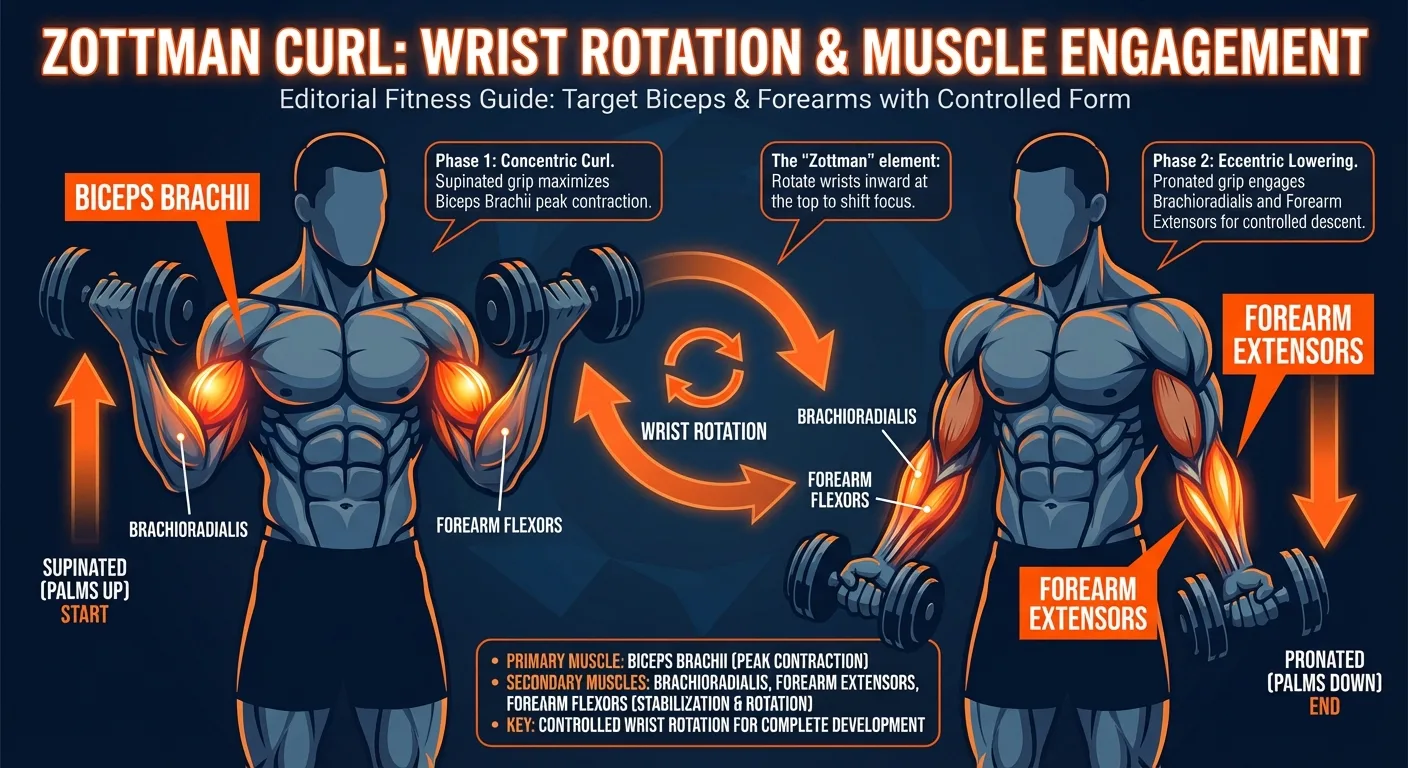
Muscles Worked
The primary movers are the biceps brachii and brachialis during the curl. They flex the elbow as the dumbbells rise, then work eccentrically as you control the transition at the top.
The secondary movers are the brachioradialis, wrist extensors, wrist flexors, pronator teres, pronator quadratus, and supinator. These muscles control the change from palms-up to palms-down and keep the wrists stacked while the dumbbells descend.
The stabilizers include the deltoids, rotator cuff, scapular retractors, and trunk muscles. They should not turn the curl into a shoulder swing, but they help keep the upper arm quiet and the torso still.
No exercise-specific PubMed, PMC, or DOI citation is included for Zottman curls in the verified FitCraft citation library. The muscles section uses mechanism-based biomechanics instead: supination favors the biceps during the curl, while pronated lowering shifts more demand to the brachioradialis and forearm extensor group because the wrists must resist flexion and rotation under load.
Step-by-Step: How to Do a Zottman Curl
- Set your stance. Stand with your feet about hip-width apart and hold a dumbbell in each hand. Keep your ribs down, chest tall, and palms facing forward.
- Curl up palms-up. Curl the dumbbells toward your shoulders without letting your elbows drift forward. Coach Ty's cue: "Show your palms to the ceiling on the way up."
- Rotate at the top. Pause briefly, then rotate your wrists until your palms face forward and down. Keep the dumbbells close instead of letting them drift away from your body.
- Lower palms-down. Lower the weights for three to four seconds. Coach Ty's cue: "The descent is the exercise. Own every inch."
- Reset cleanly. At the bottom, rotate your wrists back to palms-up before the next rep. If the wrists wobble or the elbows move, reduce the load.
Get this exercise in a personalized workout
FitCraft, our mobile fitness app, uses its AI coach Ty to program isolation exercises like this into your plan at the right volume and intensity, based on your level, goals, and equipment. Ty was designed and trained by Domenic Angelino, MPH (Brown University) and NSCA-CSCS, with research published in the Journal of Strength and Conditioning Research and Medicine & Science in Sports & Exercise.
Take the Free Assessment Free • 2 minutes • No credit card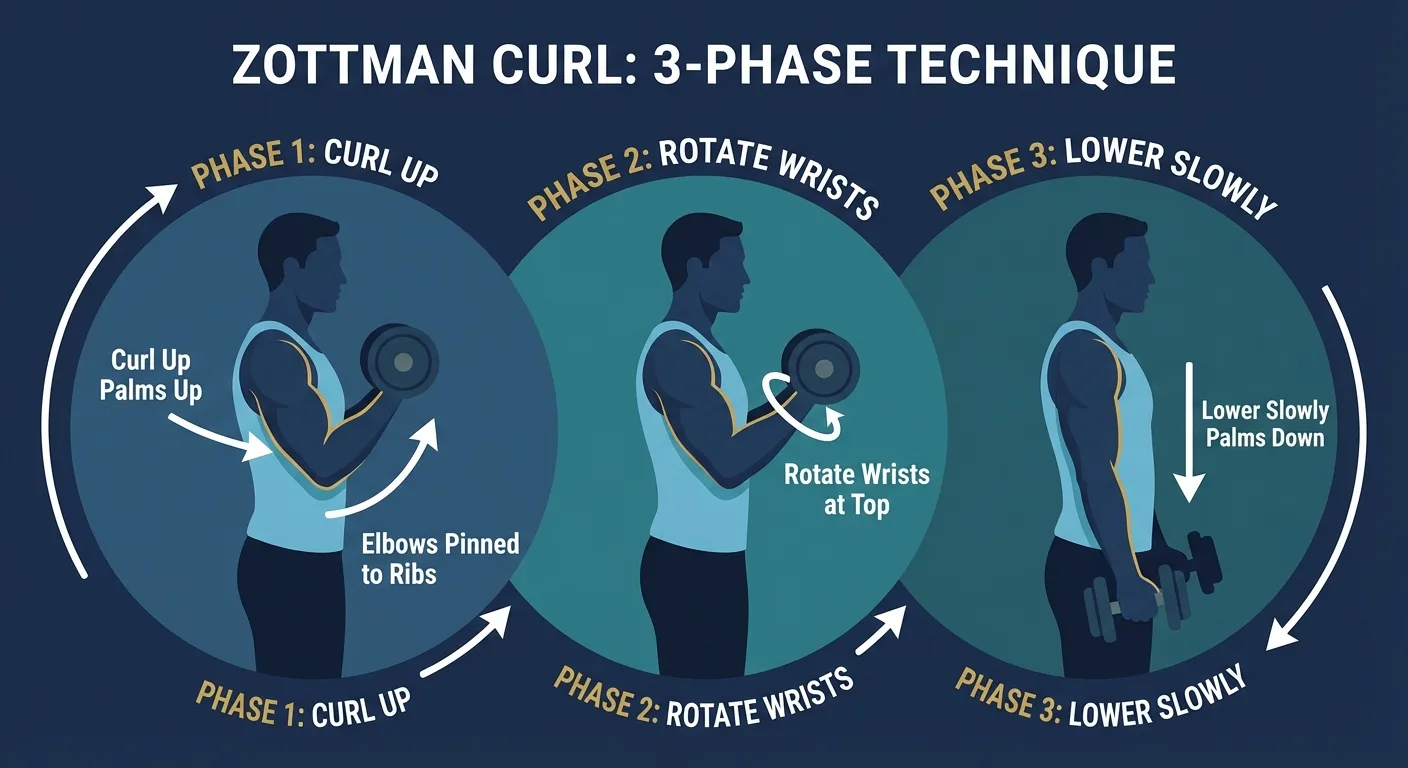
Common Mistakes
Using Too Much Weight
What it looks like: The curl goes up, but the palms-down lower turns into a fast drop.
Why it's a problem: The forearm-controlled descent is the point of the exercise. If you cannot lower slowly, the dumbbells are too heavy.
The fix: Choose a load you can lower for three to four seconds with straight wrists.
Rotating at the Bottom
What it looks like: You turn the palms down before the curl starts or wait until the dumbbells are almost back at your thighs.
Why it's a problem: The exercise loses the clean split between the biceps-focused lift and the forearm-focused lower.
The fix: Curl palms-up, rotate at the top, then lower palms-down.
Swinging the Torso
What it looks like: The hips drive forward or the shoulders rock back to start the rep.
Why it's a problem: Momentum steals work from the arms and makes the wrist rotation harder to control.
The fix: Brace before each rep and stop the set when you need body English to keep going.
Letting the Wrists Collapse
What it looks like: The knuckles fall toward the floor during the descent.
Why it's a problem: The wrist joint takes stress that should be managed by the forearm muscles.
The fix: Keep the wrist long and stacked over the dumbbell handle. If symptoms show up, switch to hammer curls.
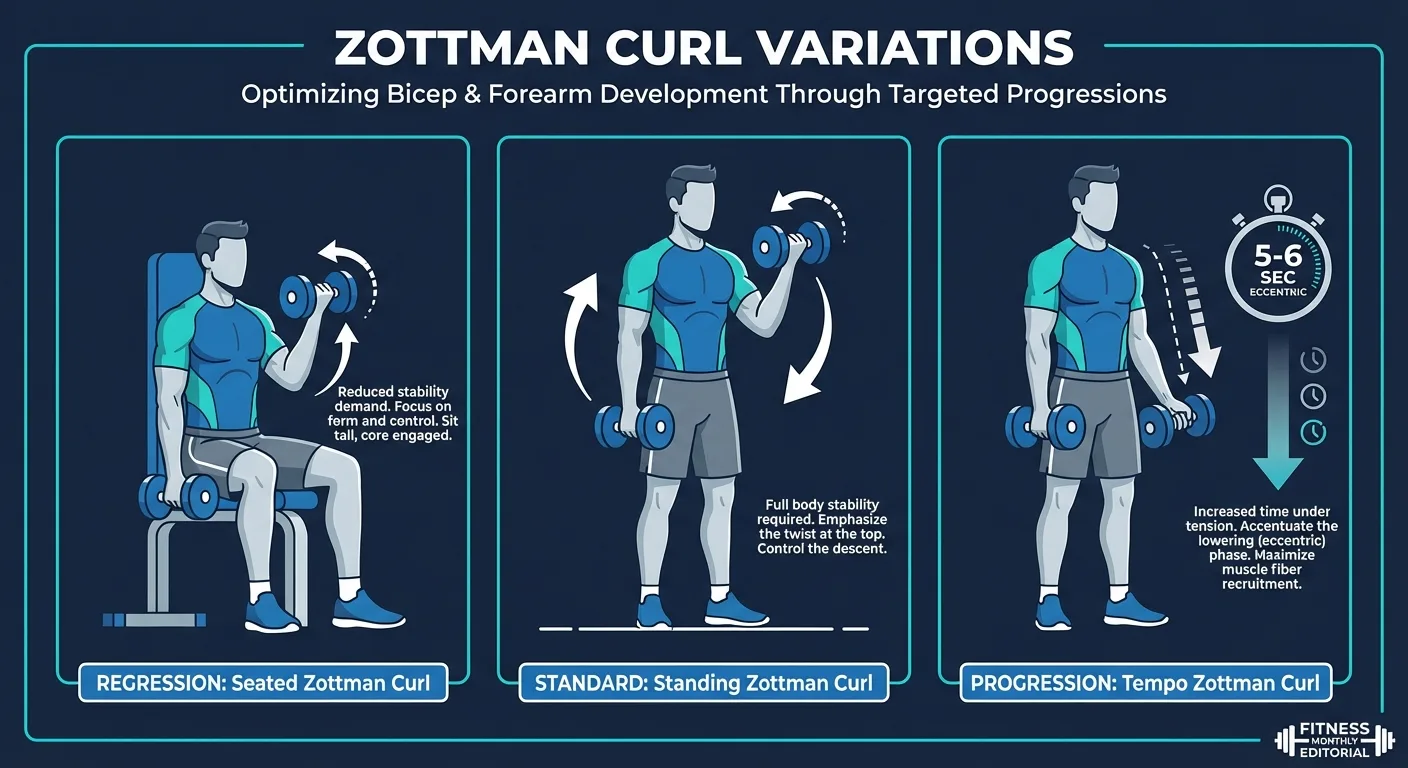
Zottman Curl Variations: Regressions and Progressions
Seated Zottman Curl
Sit tall on a bench and perform the same palms-up curl and palms-down lower. The seated setup reduces body swing and helps you focus on the wrist rotation.
Single-Arm Zottman Curl
Train one arm at a time. This version is useful when one wrist rotates more smoothly than the other or when you need to practice the timing before loading both sides.
Tempo Zottman Curl
Lower for five to six seconds after the top rotation. Use a lighter dumbbell and stop the set as soon as the wrist position breaks.
Incline Bench Zottman Curl
Lie back on a low incline bench and let the upper arm start slightly behind the torso. This increases the stretch at the bottom and makes cheating harder.
Adjacent Curl Options
Use bicep curls when you want simpler biceps loading, drag curls when you want elbows-back biceps emphasis, and twist curls when you want rotation without the harder palms-down descent.
When to Avoid or Modify Zottman Curls
Zottman curls are safe for most healthy adults, but wrist rotation under load makes a few situations worth modifying. Always consult your physician or a qualified physical therapist before training through pain, numbness, recent injury, or post-surgical restrictions.
- Wrist pain, carpal tunnel symptoms, or tingling. Reduce the load, use a smaller rotation range, or switch to hammer curls until symptoms settle.
- Elbow tendinopathy or bicipital tendon irritation. Use lighter dumbbells, higher reps, and a pain-free range. Stop the set when symptoms increase.
- Recent wrist, elbow, or shoulder surgery. Wait for clinician clearance before adding loaded rotation. Rehab often moves from isometrics to active range to light resistance.
- Poor shoulder control during curls. If the upper arm swings or the shoulder rolls forward, rebuild strict curling with bicep curls first.
- Grip fatigue after heavy pulling. Move Zottman curls later in the session or reduce sets so the forearms do not limit bigger back work.
Related Exercises
- Same target muscle: Bicep curls and drag curls keep the focus on elbow flexion.
- Forearm-biased curl: Hammer curls train the brachialis and brachioradialis with a simpler neutral grip.
- Rotation skill: Twist curls practice grip change with less palms-down eccentric demand.
- Antagonist isolation: Tricep extensions balance curl-heavy arm training with elbow-extension work.
- Shoulder and scapular health: W raises, Y raises, and pull-aparts help the shoulder girdle stay quiet during arm isolation.
How to Program Zottman Curls
Ratamess et al. (2009), the ACSM position stand on resistance training progression, supports matching sets, reps, rest, and frequency to training level. For Zottman curls, the practical limit is the palms-down descent, so start lighter than your regular curl.
| Level | Sets x Reps | Rest between sets | Frequency |
|---|---|---|---|
| Beginner | 2-3 x 10-15 | 45-60 seconds | 2-3 sessions/week |
| Intermediate | 3-4 x 8-15 | 60-90 seconds | 2-4 sessions/week |
| Advanced | 3-4 x 6-15 with tempo control | 60-120 seconds | 2-4 sessions/week |
Place Zottman curls late in an upper-body session, after rows, pull-ups, or other compound pulling work. Isolation work is accessory. If you do it first, the forearms can fatigue before the bigger lifts that need grip.
Use a form floor over rep targets. End the set when you cannot control the palms-down lower, when your wrists bend, or when your elbows drift away from your sides.
Frequently Asked Questions
What muscles do Zottman curls work?
Zottman curls train the biceps brachii and brachialis during the palms-up curl, then challenge the brachioradialis, wrist extensors, wrist flexors, pronators, and supinators during the rotation and palms-down lowering phase.
Can I do Zottman curls with wrist pain?
Avoid or modify Zottman curls if wrist rotation causes pain, tingling, or loss of grip. Use lighter dumbbells, reduce the range of rotation, switch to hammer curls, and ask a qualified clinician if symptoms persist.
Are Zottman curls better than hammer curls?
They solve different problems. Hammer curls keep a neutral grip and are simpler to load. Zottman curls add a pronated lowering phase, so they demand more forearm control and usually need lighter dumbbells.
How heavy should Zottman curls be?
Use less weight than your regular dumbbell curl. The palms-down descent is the limiting phase, so choose a load you can lower for three to four seconds without wrist collapse or elbow movement.
Why are Zottman curls so hard?
The curl combines a strong palms-up lift with a weaker palms-down lowering phase. Your forearms have to control rotation and wrist position under load, which makes the exercise feel harder than a standard curl.