Here is the most common complaint about bicep curls: "I feel it in my shoulders more than my arms." That happens in a standard curl because the front delts assist by letting your elbows drift forward and upward. The drag curl solves that problem by doing the exact opposite, pulling your elbows backward behind your torso so the weight has no choice but to drag straight up your body.
The drag curl was popularized by Vince Gironda, the "Iron Guru" who trained Arnold Schwarzenegger, Larry Scott, and a lot of other guys you've probably seen on magazine covers. Gironda was obsessed with isolation. His whole philosophy was that most people use too much body momentum and too many helper muscles during curls. The drag curl was his fix: eliminate the forward arc, eliminate the front delt, and force the biceps to do the work. The shoulder actually moves into slight extension during the rep, which stretches the long head of the biceps across both joints it crosses, and that is where the magic is.
Fair warning: it feels weird the first few times. Your brain is wired to curl weights forward. Telling it to drag the weight up instead takes a few sets to click. Start with a lighter load than you think you need. Once the movement pattern is locked in, you'll feel your biceps in a way standard curls rarely produce.
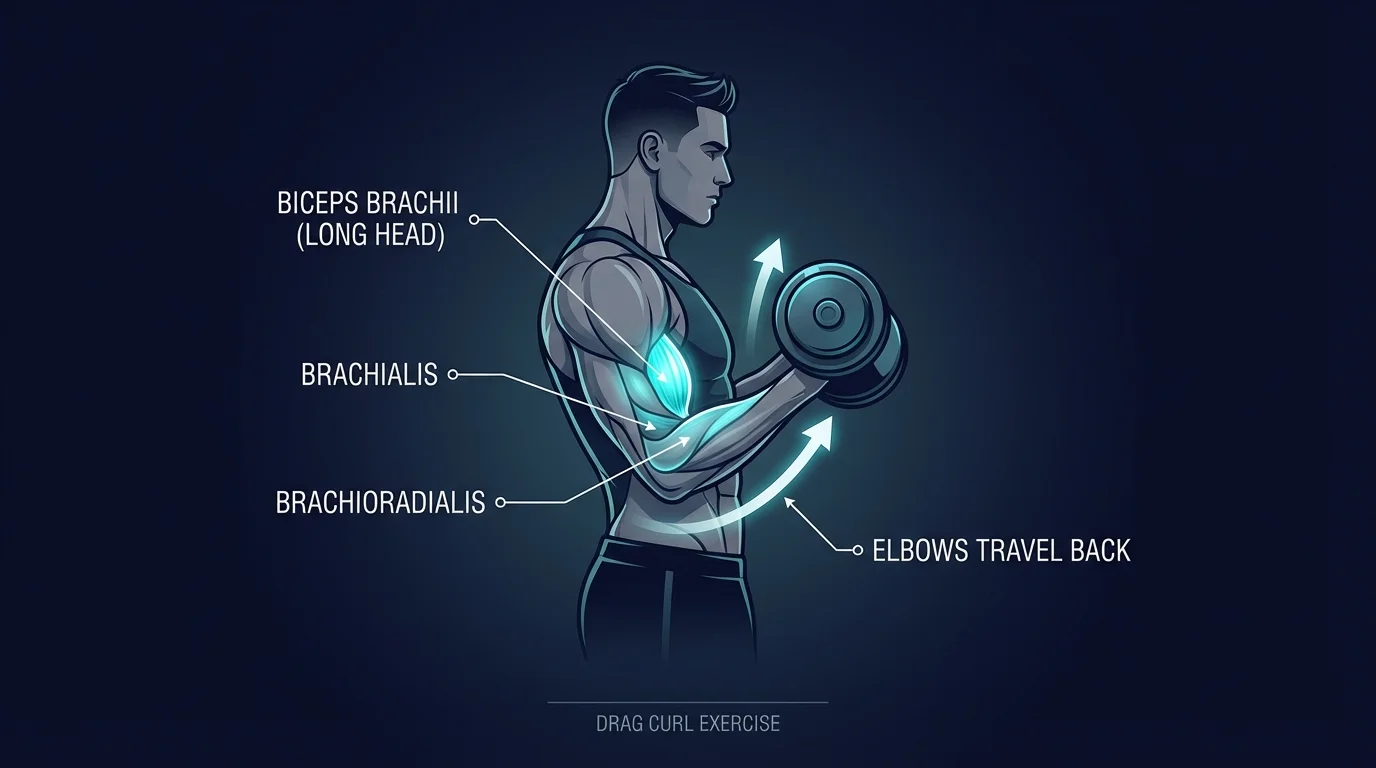
Muscles Worked
Primary movers: the biceps brachii, with particular emphasis on the long head. As the elbows drive backward into shoulder extension, the long head (which crosses both the shoulder and the elbow) is lengthened across both joints simultaneously, then has to shorten under load to finish the rep. This biases the long head over the short head and brings it into the high-tension portion of its length curve.
Secondary movers: the brachialis (the muscle that sits underneath the biceps and contributes to elbow flexion regardless of forearm position) and the brachioradialis (the forearm muscle that crosses the elbow). The posterior deltoid also fires concentrically to drive the elbows behind the torso, which is the defining mechanical feature of the lift.
Stabilizers: the scapular retractors (mid traps and rhomboids) hold the shoulder blades pinned together so the elbows can travel backward without the upper back collapsing forward. The forearm flexors grip the dumbbells or bar throughout the set. The core and erector spinae hold the torso upright and prevent the lean-back cheat that signals the load is too heavy.
Why the long head matters for arm shape: the long head of the biceps brachii is the muscle most responsible for the visible biceps peak. Because it originates above the shoulder joint (on the supraglenoid tubercle of the scapula), it is the only part of the biceps that gets stretched when the shoulder is extended. Exercises that combine elbow flexion with shoulder extension (drag curls, incline dumbbell curls, Bayesian cable curls) preferentially load the long head, which is why drag curls are a staple in peak-development programs even though they look unconventional next to a barbell curl.
Quick Facts
Quick Facts: Drag Curl
- Equipment needed: Dumbbells (also: straight barbell, EZ-bar, Smith machine)
- Difficulty: Intermediate
- Modality: Isolation, elbow flexion with shoulder extension
- Body region: Upper body, biceps (long head emphasis)
- FitCraft quest category: Strength accessory, arm specialization
How to Do a Drag Curl (Step-by-Step)
- Stand with dumbbells at your sides. Feet shoulder-width apart, a dumbbell in each hand. Arms fully extended, palms facing forward (supinated grip), dumbbells lightly touching the front of your thighs. Shoulders back and down, chest tall, core braced. Don't lean forward and don't hyperextend your lower back.
Coach Ty's cue: "Set your shoulders before you set the weight. If your shoulders roll forward at the start, the whole rep collapses."
- Drive your elbows backward. This is the critical cue and the part most people get wrong. Instead of curling the weights forward in an arc, drive your elbows straight back behind your torso. As your elbows travel back, the dumbbells will drag up the front of your body. They stay in contact with your ribs and chest the entire way up. If the dumbbells come away from your body even an inch, you're curling, not dragging.
Ty's cue: "Try to touch your elbows together behind your back. That image locks the pattern in faster than any verbal cue."
- Squeeze at the top. Pause when the dumbbells reach the lower chest or upper ribs. Your elbows should be pointing directly behind you, not flaring out to the sides. Squeeze the biceps hard for a one-count. Don't try to reach a full "top" position like you would with a standard curl, the range of motion is intentionally shorter.
Ty's cue: "Shorter ROM is by design. Stop where your elbows want to stop."
- Lower under control. Slowly lower the dumbbells back to the starting position over 2-3 seconds. Let the dumbbells slide back down the front of your body as your elbows return to your sides. Full extension at the bottom, no bouncing. The eccentric is where a lot of the biceps stimulus comes from, so don't rush it.
Ty's cue: "Two seconds down, every rep. Slow eccentric is non-negotiable."
- Reset and repeat. Check that your torso is upright, shoulders are back, and your palms are still facing forward. Breathe out as you drag up, in as you lower. Intermediate lifters: 3 sets of 8-12 reps with a weight that challenges the last 2-3 reps.
Ty's cue: "If the last two reps swing away from your body, you're done. Let form quality decide when the set ends."
Get this exercise in a personalized workout
FitCraft, our mobile fitness app, uses its AI coach Ty to program isolation exercises like this into your plan at the right volume and intensity, based on your level, goals, and equipment. Ty was designed and trained by Domenic Angelino, MPH (Brown University) and NSCA-CSCS, with research published in the Journal of Strength and Conditioning Research and Medicine & Science in Sports & Exercise.
Take the Free Assessment Free · 2 minutes · No credit card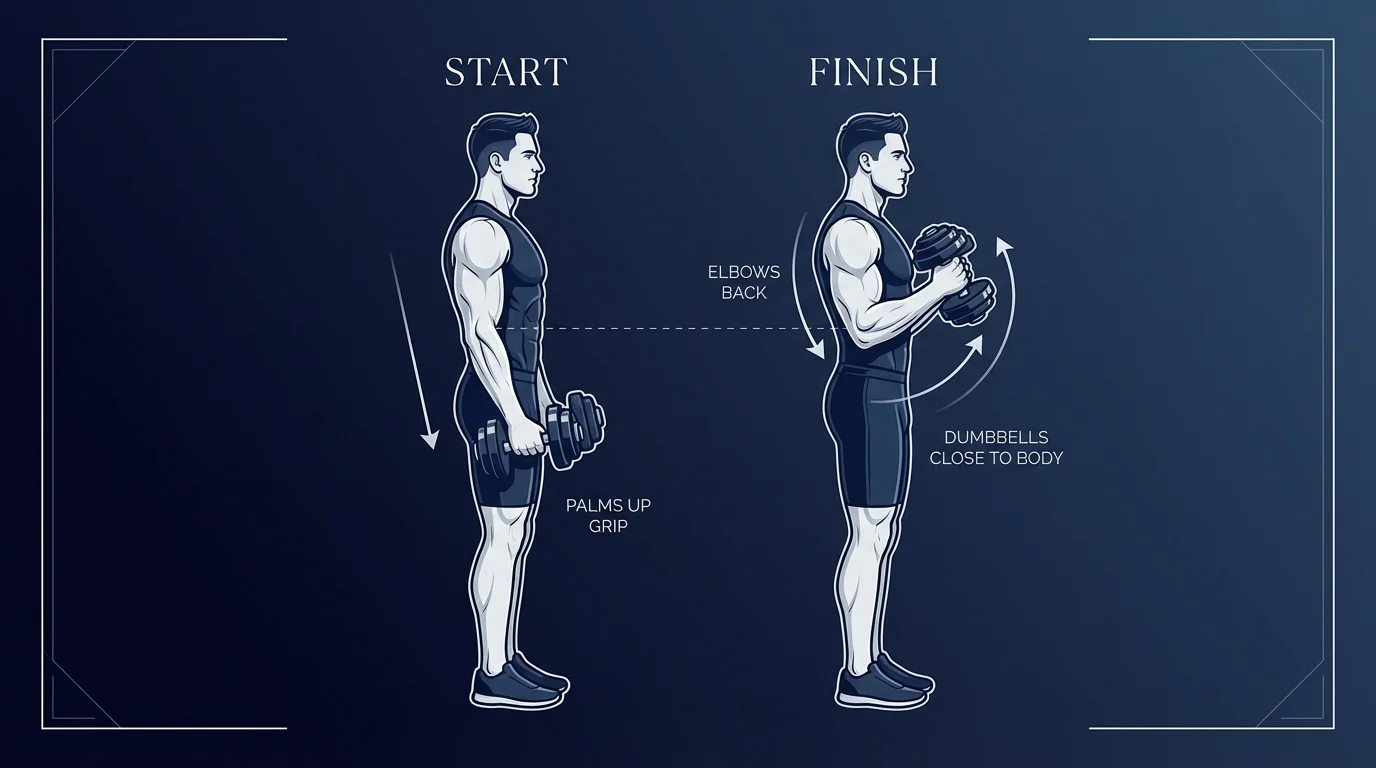
Common Mistakes to Avoid
The drag curl looks simple, but the movement pattern runs counter to instinct. These are the mistakes that show up in almost every first session:
- Curling the weight forward. The single most common error. Your body defaults to the standard curl motion, and the dumbbells end up traveling in a forward arc instead of dragging up your body. The fix: stand with your back against a wall. If the dumbbells cannot leave the front of your torso (because your back is pinned), you're forced into the correct path. Do a few reps that way until the pattern clicks.
- Elbows flaring out to the sides. When the elbows drift outward instead of straight back, the exercise turns into a hybrid curl/upright row and the biceps lose their isolation. The fix: think about pointing your elbows directly behind you, like you're trying to poke someone standing directly at your back.
- Using too much weight. Because drag curls feel unfamiliar, people reach for their usual curl weight and immediately start cheating to move it. The fix: drop 20-30% of your normal curl weight for your first 2-3 sessions. Once the pattern is locked in, you can slowly add weight. Strict drag curls with 15s beat sloppy drag curls with 30s every time.
- Leaning back to create leverage. Some people try to compensate for the awkward feel by leaning their upper body backward, which turns it into a pseudo-row. The fix: stand tall with your chest up and your weight evenly distributed. If you have to lean to complete the rep, drop weight.
- Incomplete extension at the bottom. Stopping short of full arm extension shortens the range and reduces the stretch on the biceps long head. The fix: every rep starts from dead arms hanging at your sides, dumbbells touching your thighs. Reset fully between reps if you have to.
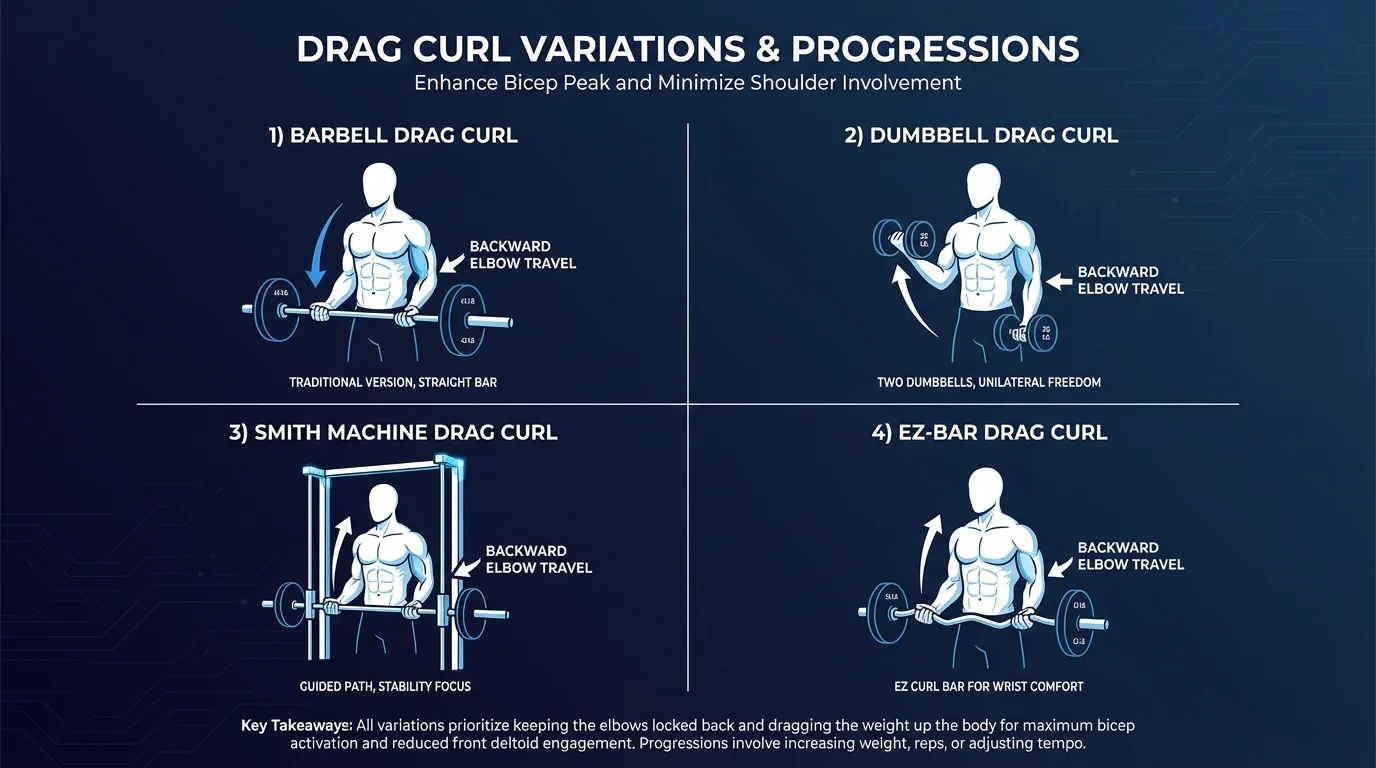
Variations: From Dumbbell to Barbell
Dumbbell Drag Curl (Standard)
The version described above. Dumbbells allow each arm to work independently, which is useful for spotting and fixing strength imbalances. They also let you rotate each wrist slightly to the most comfortable position. This is the best starting variation because dumbbells give you room to find your elbow path without locking you into a fixed bar.
Barbell Drag Curl (Intermediate)
Use a straight barbell and drag it up the front of your body from thighs to lower chest. The barbell forces both arms to work in sync and makes any elbow asymmetry obvious. If one side is dragging and the other is curling forward, the bar tilts. Many lifters find the barbell version easier to load progressively. Start with just the bar until you groove the path.
EZ-Bar Drag Curl (Wrist-Friendly)
An EZ curl bar's angled grips keep your wrists in a more neutral position, which can be a relief if straight-bar drag curls bother your wrists or elbows. The mechanics are identical to the barbell version. For most people with wrist sensitivity, this is the best drag curl variation for heavy work.
Smith Machine Drag Curl (Guided)
The Smith machine locks the bar path into a fixed vertical line, which eliminates the most common mistake (the bar drifting forward). This makes it an excellent teaching tool for new drag curlers. Stand slightly forward of the bar so it drags up your torso naturally as you drive your elbows back. The downside: you lose the stabilizer work of free weights.
Alternative Exercises
If you want similar biceps long head emphasis without drag curls, these work the same muscles through different mechanics:
- Incline dumbbell curls: Lie back on a 45-60 degree incline bench with arms hanging straight down. This also places the shoulder in extension and stretches the biceps long head. Arguably the closest alternative to the drag curl.
- Bayesian cable curls: Single-arm cable curl with the cable behind you, pulling the arm into extension. Same principle, extended shoulder position loads the long head.
- Hammer curls: Different muscles (brachialis emphasis) but useful as a complementary lift for complete arm development.
When to Avoid or Modify Drag Curls
Drag curls are safe for most healthy adults, but a few conditions call for modification or temporarily swapping to a different curl variation. None of these are permanent restrictions. They're starting points. Always consult your physician or physical therapist for personalized guidance.
- Bicipital tendinopathy or biceps tendon irritation. The drag curl loads the long head of the biceps in a stretched position, which is precisely the tissue that hurts in bicipital tendinopathy. During an active flare, swap to higher-rep band curls in a pain-free range or isometric biceps holds, and see a physical therapist. Reintroduce drag curls only after a clinician clears you for progressive loading, starting at roughly half your usual weight.
- Carpal tunnel syndrome or wrist pain. The supinated grip with a straight bar can aggravate carpal tunnel or wrist arthritis because it locks the wrist into a fixed pronation angle. Use dumbbells (you can rotate slightly) or an EZ-bar (angled grips ease the wrist into a more neutral position). If symptoms continue, drop drag curls until your wrist tolerance improves.
- Recent elbow, biceps, or shoulder surgery. Get clearance from your surgeon before any loaded biceps work. Post-surgical biceps protocols typically start with isometric holds, then active range without load, then light dumbbell work, before introducing exercises like the drag curl that combine elbow flexion with shoulder extension.
- Shoulder impingement or rotator cuff irritation. Driving the elbows behind the torso requires healthy scapular retraction. If retracting your shoulder blades reproduces shoulder pain, regress to hammer curls or standard curls (elbows pinned at sides, no shoulder extension component) until the impingement settles. Mobility work and scapular strengthening like rows often help.
- Lower-back pain that worsens with standing loaded work. Drag curls are performed standing with a braced torso. If standing biceps work consistently provokes back pain, switch to seated dumbbell curls or seated incline curls until the back tolerates the upright position. Rebuild trunk stability with deadbugs, bird-dogs, and forearm planks.
Related Exercises
If drag curls are part of your routine, these movements complement or extend the same training pattern:
- Same muscle group (biceps isolation): Hammer Curls bias the brachialis and brachioradialis with a neutral grip, useful for forearm and total arm thickness. Zottman Curls add a wrist rotation under load that trains both biceps and forearm pronators.
- Variation in elbow path: Twist Curls rotate the wrist mid-rep to bias different parts of the biceps fiber alignment, a useful contrast to the drag curl's straight-line path.
- Antagonist pairing (triceps): Tricep Kickbacks and Tricep Extensions work the opposite side of the arm, and supersetting them with drag curls is an efficient arm-day finisher.
- Compound that loads the biceps: Bent-Over Rows and Chin-Ups hit the biceps as part of larger pulling patterns, useful before drag curl accessory work since the heavier compounds should come first.
- Scapular and shoulder health: Bent-Arm Lateral Raises and shoulder external rotation drills build the scapular retraction and rotator cuff endurance the drag curl relies on for a healthy elbow path.
How to Program Drag Curls
Drag curl programming follows the same evidence-based ranges as any single-joint isolation exercise. The American College of Sports Medicine (ACSM) Position Stand on resistance training recommends roughly 8-15 reps per set for hypertrophy with isolation work, 60-90 seconds rest between sets, and training each muscle group 2-4 times per week with at least 48 hours between sessions for the same muscle (Ratamess et al., 2009).
| Level | Sets × Reps | Rest between sets | Frequency |
|---|---|---|---|
| Beginner | Skip; master standard curls first | n/a | n/a |
| Intermediate | 3 × 10-12 | 60-90 seconds | 1-2 sessions/week |
| Advanced | 3-4 × 8-12 | 60-90 seconds | 2 sessions/week |
Where in your workout: drag curls are an accessory lift. They belong at the end of an upper-body or pull session, after compound work like bent-over rows, chin-ups, and standard barbell or dumbbell curls. Doing them first will fatigue the biceps and underload your main pulls. A common pairing is to superset drag curls with a tricep finisher (kickbacks or pushdowns) for efficient arm training. Total weekly biceps volume across all curl variations should stay roughly between 10-20 sets per week for intermediate lifters.
Form floor over rep targets: if your last 2 reps of a set swing away from your body or your elbows drift forward, stop the set there. Hitting a target rep count with broken form is worse than hitting fewer reps cleanly, and on the drag curl, broken form means the biceps stop doing the work that the lift is designed to demand.
How FitCraft Programs This Exercise
Knowing how to do a drag curl is step one. Knowing when to do it, how many reps, and when to progress is where most people get stuck.
FitCraft's AI coach Ty handles that. During your personalized diagnostic assessment, Ty maps your fitness level, goals, and available equipment. Then Ty builds a personalized program that slots drag curls into a balanced training plan at the right variation for your level, only after your standard curl form is solid so the movement pattern doesn't reinforce bad habits.
As you get stronger, Ty adjusts the variation and volume to match your level. Dumbbells become EZ-bar or barbell. Volume adjusts based on your recovery and consistency. The 3D demonstrations show the elbow path from multiple angles, which matters for a movement where the cue "elbows back" has to click visually before it clicks in your body.
Frequently Asked Questions
Can I do drag curls if I have bicipital tendinopathy or elbow tendinitis?
Not while symptoms are flaring. Drag curls load the biceps long head in a stretched position, which is exactly the tissue that hurts in bicipital tendinopathy. During an active flare, swap to lower-intensity options like isometric biceps holds or band curls in a pain-free range and consult a physical therapist. Once symptoms settle and a clinician clears you for progressive loading, reintroduce drag curls with lighter weight (start at half your usual load), higher reps (12-15), and longer rest. Stop the set if symptoms increase. This is general guidance, not medical advice.
What muscles do drag curls work?
Drag curls primarily target the biceps brachii, with particular emphasis on the long head due to the shoulder extension that occurs as the elbows travel backward. Secondary muscles include the brachialis, brachioradialis, and the posterior deltoid (which helps drive the elbows behind the body). The shoulder movement into extension places the long head in a stretched position across both joints, which increases its activation compared to standard curls.
Are drag curls better than regular curls?
Drag curls are not universally better. They isolate the biceps more strictly than standard curls by removing front delt involvement and body english. Because the weights travel straight up along the body instead of forward in an arc, you cannot cheat the rep. This makes drag curls excellent for long head emphasis and as a finishing movement. Standard curls still allow heavier loading. Most intermediate programs include both.
Why are drag curls called drag curls?
The name comes from the movement pattern: the dumbbells or barbell drag straight up the front of the body, staying in contact with the torso the entire way. Unlike a standard curl where the weight travels in a forward arc, the drag curl keeps the resistance glued to the body by driving the elbows backward behind the torso. Vince Gironda, the bodybuilding coach who trained Arnold Schwarzenegger and Larry Scott, is credited with popularizing the movement in the 1960s.
How heavy should I go on drag curls?
Most people need to go 20-30% lighter on drag curls than on standard curls. The backward elbow travel removes momentum and front delt assistance, which makes the biceps work harder with less load. Intermediate lifters typically use 15-25 lb dumbbells or a 40-60 lb barbell. If the weights swing away from your body instead of dragging up it, the weight is too heavy.
Are drag curls a good exercise for the biceps peak?
Drag curls preferentially target the long head of the biceps brachii, which is the muscle responsible for the biceps peak. Exercises placing the shoulder in extension (drag curls, incline curls, Bayesian cable curls) increase long head activation because they lengthen the muscle across both joints it crosses. For peak development, drag curls are one of the most effective isolation tools available.