Twist curls are useful when regular curls feel too easy to cheat. The rotation gives you another quality check: if you have to swing the dumbbells to finish the twist, the load is too heavy.
The movement is still an isolation exercise. Your shoulders stay quiet, your ribs stay stacked, and your elbows act like hinges while the forearms rotate from neutral to palms-up.
Quick Facts: Twist Curls
- Equipment needed: Pair of dumbbells
- Difficulty: Intermediate
- Modality: Strength
- Body region: Upper body
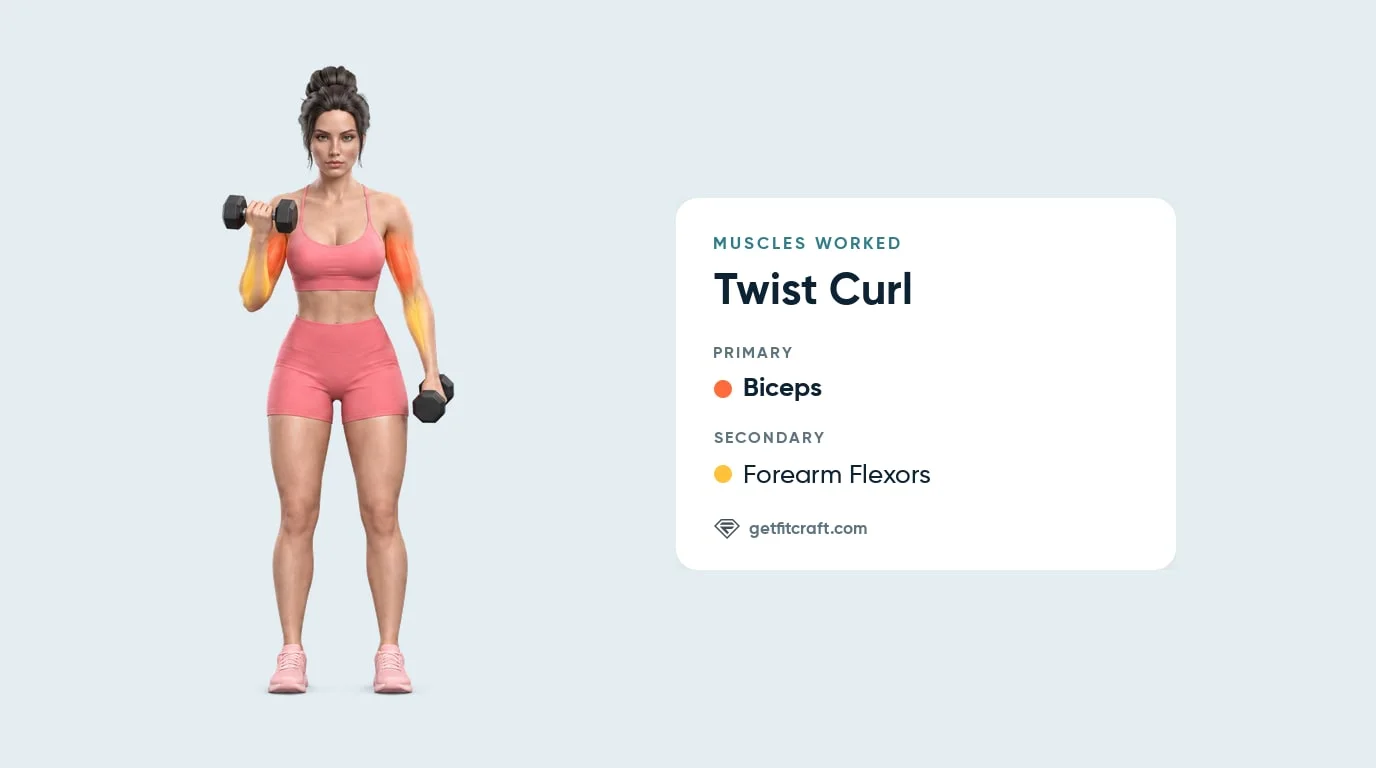
Muscles Worked
Primary mover: the biceps brachii drives the curl as the elbow bends. It shortens during the lift and lengthens under tension during the lower, which gives the exercise its main arm-strength and hypertrophy stimulus.
Secondary mover: the forearm flexors, on the palm side of the forearm, grip the dumbbell through every rep and keep your wrist straight as the palm turns up, so the weight does not bend the wrist back.
Why the twist matters: the biceps both bends the elbow and turns the palm up, so the palms-up finish lets it do both jobs. In an EMG study of 10 competitive bodybuilders doing curls with three grips, biceps activity while lifting was about 12 percent higher with the palms up than with a neutral grip and about 19 percent higher than with the palms down, and the brachioradialis was also most active with the palms up (Coratella et al., 2023). No study has tested the twisting curl itself.
Step-by-Step: How to Do a Twist Curl
Step 1: Set Your Starting Position
Stand tall with a dumbbell in each hand. Let your arms hang at your sides with palms facing your thighs, feet about hip-width apart, ribs stacked over your hips, and shoulders relaxed.
Form tip: stand tall and keep your shoulders from rolling forward before the first rep.
Step 2: Anchor Your Elbows
Keep your elbows close to your ribs before you move. Your upper arms should stay still so the curl comes from elbow flexion and forearm rotation.
Step 3: Curl and Rotate
Exhale as you curl one dumbbell up, turning your palm up gradually as you go, until your hand is near your shoulder and your palm faces it. Curl only as high as you can without your elbow moving forward. The other arm stays down with the palm facing your thigh.
Form tip: do not lean back or swing the dumbbell up. If you have to, the weight is too heavy.
Step 4: Squeeze at the Top
Finish with your palm facing your shoulder and your elbow still close to your side, so your forearm stops a little short of vertical. Pause briefly without letting the wrist bend back or the shoulder roll forward.
Step 5: Lower With Control
Lower the dumbbell slowly while turning your palm back to face your thigh, then curl the other arm. Keep each descent controlled so the biceps stay under tension.
Form tip: lower each dumbbell slowly instead of letting it drop.
Get this exercise in a personalized workout
FitCraft, our mobile fitness app, uses its AI coach Ty to program isolation exercises like this into your plan at the right volume and intensity, based on your level, goals, and equipment. Ty was designed and trained by Domenic Angelino, MPH (Brown University) and NSCA-CSCS, with research published in the Journal of Strength and Conditioning Research and Medicine & Science in Sports & Exercise.
Take the Free Assessment Free • 2 minutes • No credit card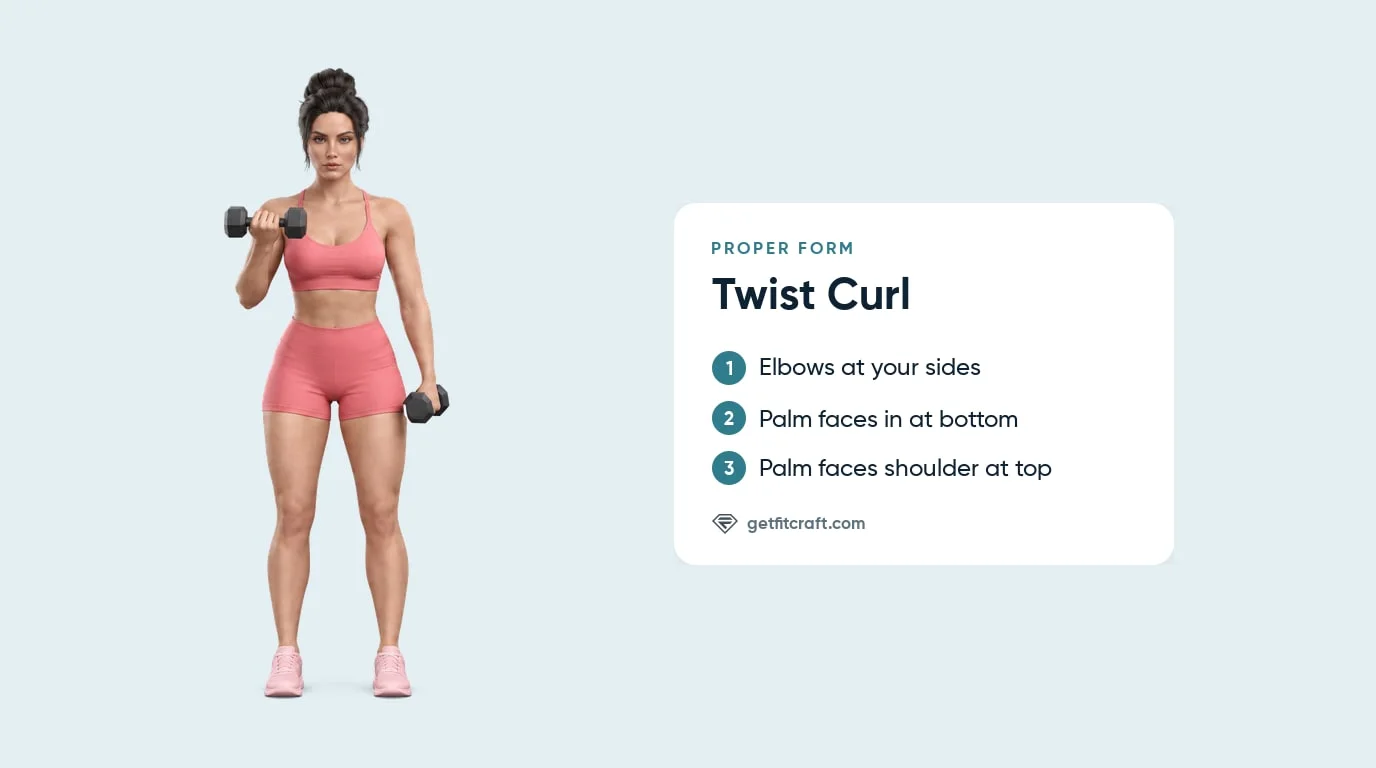
Common Mistakes (and How to Fix Them)
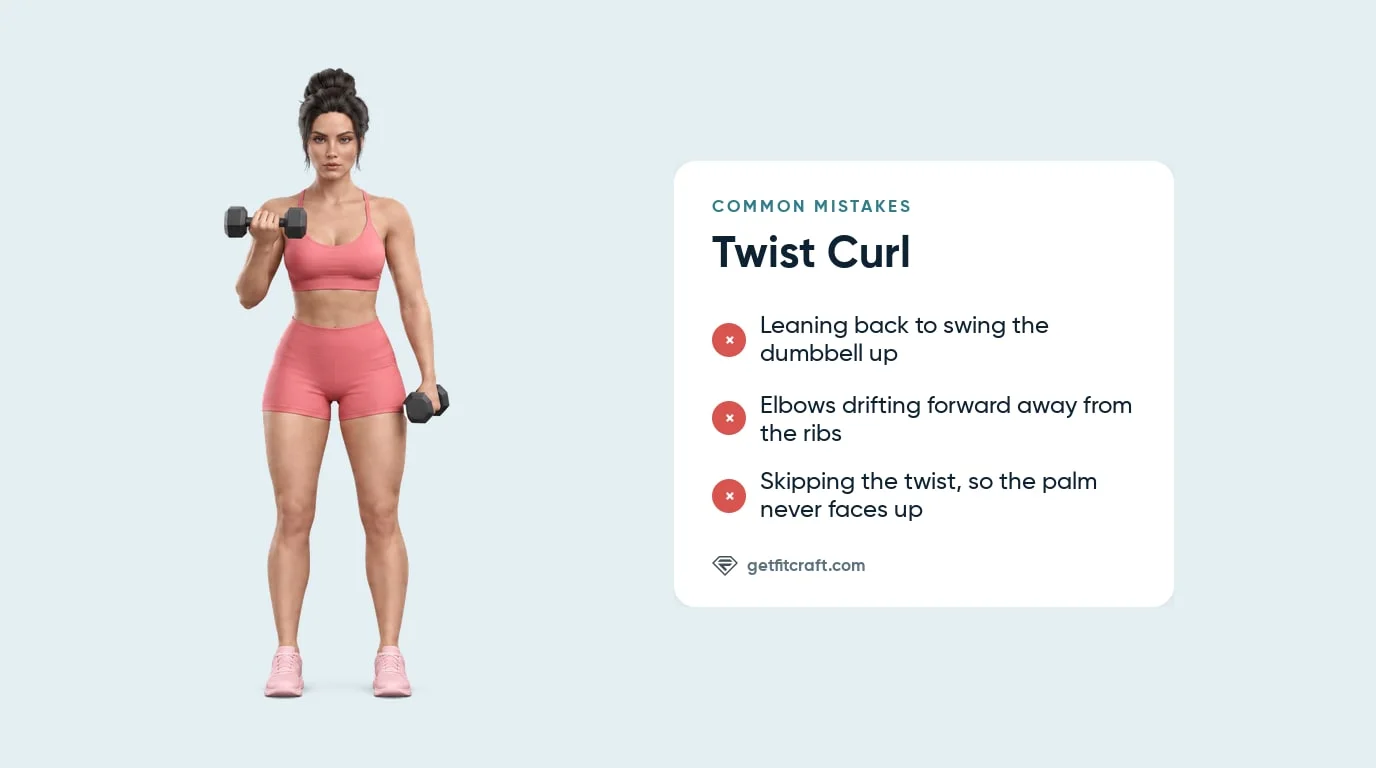
- Elbows drifting forward. The upper arms move away from your ribs and turn the curl into a partial front raise. Fix it by lowering the weight and keeping the elbows anchored for the whole rep.
- Skipping or snapping the twist. The palm never turns up, or it flips up suddenly at the end instead of turning smoothly. Fix it by turning the palm up gradually as you curl, so it faces your shoulder at the top.
- Swinging the torso. Leaning back gets the dumbbells moving but removes tension from the biceps. Fix it by bracing lightly and using a load you can lift without hip drive.
- Bending the wrists back. Letting the wrist bend back makes the top position sloppy. Fix it by keeping your knuckles in line with your forearm.
- Going too heavy too soon. Heavy twist curls often become loose hammer curls. Fix it by earning load only after every rep reaches a clean palms-up finish.
- Dropping the eccentric. Letting the dumbbell fall wastes half the rep. Fix it with a two-second lower, turning the palm back to face your thigh.
Twist Curl Variations: Regressions and Progressions
Hammer Curl (Beginner Regression)
Keep the palms facing each other for the whole rep. This removes the rotation demand and helps you train the elbow flexors with a neutral wrist.
Seated Twist Curl (Technique Regression)
Sit on a flat bench or chair and keep your torso still. The seated setup limits hip swing and makes the rotation easier to feel.
Standing Twist Curl (Standard)
This is the version the FitCraft app teaches: stand tall and alternate arms, curling and turning one dumbbell while the other arm hangs with the palm facing your thigh. You can also curl both arms together. Keep the rep strict and stop the set when the twist gets rushed.
Paused Twist Curl (Control Progression)
Pause for one to three seconds at the palms-up top position. The pause builds control and makes light dumbbells feel much harder.
Incline Twist Curl (Advanced Progression)
Lie back on an incline bench and start with the arms hanging slightly behind the torso. This increases the stretch at the bottom, so use lighter dumbbells and keep the shoulder quiet.
When to Avoid or Modify Twist Curls
Twist curls are safe for most healthy adults, but the loaded rotation can bother irritated elbows, wrists, or forearms. These are modification points, not permanent bans. Always consult your physician or physical therapist for personalized guidance.
- Active elbow pain or bicipital tendinopathy. Stop the set if your elbow hurts as you curl or rotate. Use lighter hammer curls, shorten the range, or train pain-free isometrics until symptoms calm down.
- Forearm tendon irritation. The rotation can aggravate the common flexor or extensor tendons near the elbow. Keep the wrist neutral, reduce load, and avoid forced end-range twisting.
- Carpal tunnel symptoms or wrist pain. Use a neutral grip and skip the full twist, and stop if tingling, numbness, or wrist pain appears. Hammer curls are usually the cleaner substitute.
- Recent elbow, wrist, or shoulder surgery. Get clearance from your surgeon or rehab clinician before loading curls. Most return-to-load plans progress from isometrics to active range before external resistance.
- Shoulder irritation from keeping the arm pinned. If holding the upper arm still hurts the front of the shoulder, stop the set; next time, use a lighter dumbbell, a seated setup, or temporarily switch to lower curls in a pain-free range.
Related Exercises
Use these exercises to build the same arm pattern, pair the opposite side of the elbow, or support the shoulder position twist curls require:
- Same target muscle: Bicep Curls, Hammer Curls, Drag Curl, and Lower Curl train nearby elbow-flexion patterns with different grip and range demands.
- Compound pulls that include the biceps: Chin-Ups and Bent-Over Rows train the biceps alongside the lats, upper back, and grip.
- Antagonist isolation: Tricep Extensions, Overhead Tricep Press, and Tricep Kickbacks balance curl work with elbow extension.
- Shoulder and scapular health: W-Raise, Y-Raise, T-Raise, Pull-Apart, and Scissor Raises build the upper-back control that keeps curls strict.
- Longer arm-day range: Full Back Curl adds upper-back involvement when you want biceps work that feels less isolated.
How to Program Twist Curls
Twist curls are accessory isolation work, so program them after your heavier pulls or upper-body compound lifts. The ACSM Position Stand on resistance training supports progressive sets, reps, rest, and frequency based on training level (Ratamess et al., 2009).
| Level | Sets × Reps | Rest between sets | Frequency |
|---|---|---|---|
| Beginner | 2-3 × 10-15 | 45-60 seconds | 2-3 sessions/week |
| Intermediate | 3-4 × 8-15 | 60-90 seconds | 2-3 sessions/week |
| Advanced | 3-4 × 6-15 with pauses or slower tempo | 60-120 seconds | 2-3 sessions/week |
Where in your workout: place twist curls late in an upper-body or pull session, after rows, pulldowns, or other compound work. Isolation work is accessory. Doing it first can fatigue your biceps before the lifts that need them more.
Form floor over rep targets: stop the set when your elbows drift, wrists bend, torso swings, or the palms no longer rotate smoothly. A lighter clean rep beats a heavier loose rep.
How FitCraft Programs This Exercise
FitCraft uses its mobile assessment to place isolation exercises at a volume and difficulty that fits your current level, goals, and equipment.
In the app, the twist curl is an Intermediate dumbbell exercise, done standing with alternating arms. The goal is enough direct arm work to build strength without letting elbow irritation or sloppy reps pile up.
Frequently Asked Questions
What muscles do twist curls work?
Twist curls train the biceps brachii, the muscle that both bends your elbow and turns your palm up, which is why each dumbbell turns from a palm-in start to a palms-up finish. The forearm flexors help by gripping the dumbbell and keeping your wrist straight as the palm turns up.
Are twist curls better than regular bicep curls?
Twist curls add a loaded rotation component that regular supinated curls do not emphasize as much. Use both if your elbows tolerate them well: standard curls for simple load progression and twist curls for controlled supination practice.
How many twist curls should I do?
Most lifters do well with 2-4 sets of 8-15 reps, two to four times per week. Start at the lower end if the rotation is new or if your elbows get irritated by curl work.
How heavy should twist curls be?
Use a load you can rotate smoothly without swinging, shrugging, or bending your wrists. That usually means going lighter than your regular dumbbell curl until the twist stays clean.
Can I do twist curls with elbow pain?
Stop loaded twist curls if your elbow hurts during the set, especially with bicipital tendinopathy or forearm tendon irritation. Switch to lighter hammer curls or pain-free range work, and get guidance from a qualified clinician if symptoms persist.