Quick Facts: Lower Curl
- Equipment needed: Pair of dumbbells (8-40 lb depending on level)
- Difficulty: Beginner-friendly, scales to advanced
- Modality: Strength · Isolation · Lengthened-partial range
- Body region: Upper body · Arms (biceps focus)
- FitCraft quest category: Arm hypertrophy & curl progression
Muscles Worked
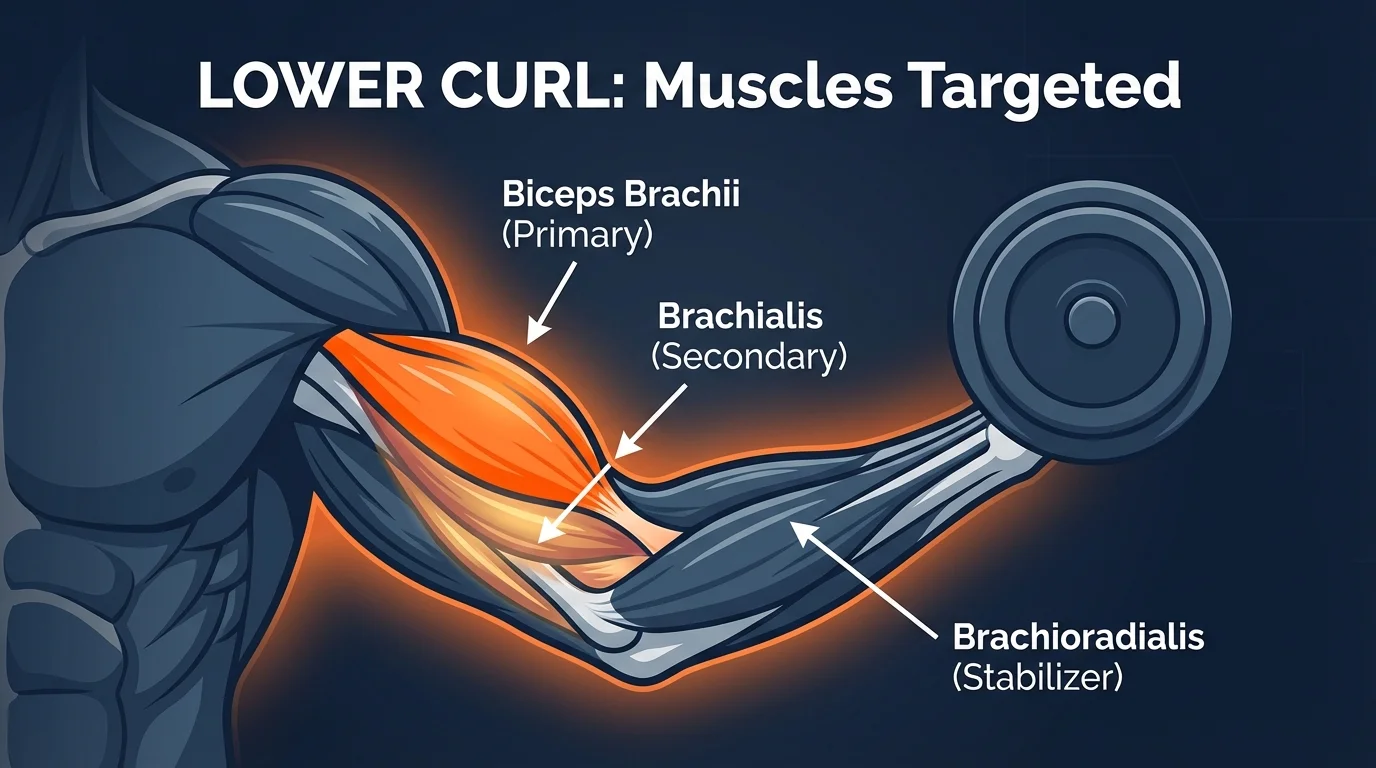
Primary movers: The biceps brachii drives the lift, with the long head loaded particularly hard because the lower-curl range keeps the upper arm extended (and the long head crosses the shoulder joint). The biceps work concentrically as you curl up to parallel and eccentrically as you lower back to full extension. Because you only train the bottom half of the range, the biceps stay under tension in their stretched position for the entire set, which is the part of the rep most likely to drive hypertrophy.
Secondary movers: The brachialis sits underneath the biceps brachii and assists every elbow flexion, regardless of grip. The brachioradialis (the prominent muscle that runs along the top of the forearm) also contributes, and its share of the work scales up as the dumbbell load increases.
Stabilizers: The forearm flexors fire isometrically to hold the supinated grip on the dumbbells. The shoulder girdle (deltoids, rotator cuff, scapular retractors) holds the elbow pinned to your side, and the core works to keep the torso upright and prevent the rocking that almost always creeps in when the set gets hard.
Mechanism: Lengthened-partial training works because muscles produce the largest growth signal when loaded near the end of their stretched range. At full elbow extension, the biceps is at its longest length and the force-length relationship requires the muscle to recruit more fibers to produce a given amount of torque. Restricting the rep to the bottom half (full extension to parallel) keeps the biceps in this high-recruitment zone for the entire set, instead of letting the upper half of the curl serve as a partial rest. The top half of a standard curl is mechanically easy because the moment arm shortens as the forearm approaches vertical; cutting that half out is the whole design intent of the lower curl.
How to Do a Lower Curl (Step-by-Step)
- Stand with dumbbells at your sides. Feet shoulder-width apart, a dumbbell in each hand. Arms fully extended at your sides, palms facing forward (supinated grip). Shoulders back and down. Elbows pinned to your ribs. Don't shrug, don't lean, and don't pre-curl the weights. You want a full stretch at the bottom before rep one even starts.
Coach Ty's cue: "Full stretch at the bottom. Every single rep starts with your arms completely straight."
- Curl up to the halfway point. Keeping your upper arms glued to your sides, curl both dumbbells up until your forearms are roughly parallel to the floor. That's the top of a lower curl. Stop there. Don't keep going to your shoulders. You're only training the bottom half of the range, and the second you pass parallel, you've left the exercise.
Coach Ty's cue: "Parallel is the ceiling, not a suggestion."
- Hold briefly at parallel. Pause for half a second. Your elbows should still be directly under your shoulders, torso still tall. No rocking, no swinging. Just a quick squeeze at the halfway point.
- Lower to full extension under control. Slowly lower the dumbbells back to the starting position over 2-3 seconds. Reach full extension at the bottom. This is the whole point. The stretched bottom is where the lower curl does its work, so don't cut it short by stopping with a slight bend in your elbow.
Coach Ty's cue: "Count two to three seconds on the way down. The eccentric is where the growth happens."
- Reset and repeat. Check that your elbows are still at your sides and your shoulders haven't crept forward. Breathe out on the curl, in on the descent. Beginners: 2-3 sets of 10-15 reps with a weight that's lighter than what you'd use for a full-range curl.
Get this exercise in a personalized workout
FitCraft, our mobile fitness app, uses its AI coach Ty to program isolation exercises like this into your plan at the right volume and intensity, based on your level, goals, and equipment. Ty was designed and trained by Domenic Angelino, MPH (Brown University) and NSCA-CSCS, with research published in the Journal of Strength and Conditioning Research and Medicine & Science in Sports & Exercise.
Take the Free Assessment Free · 2 minutes · No credit card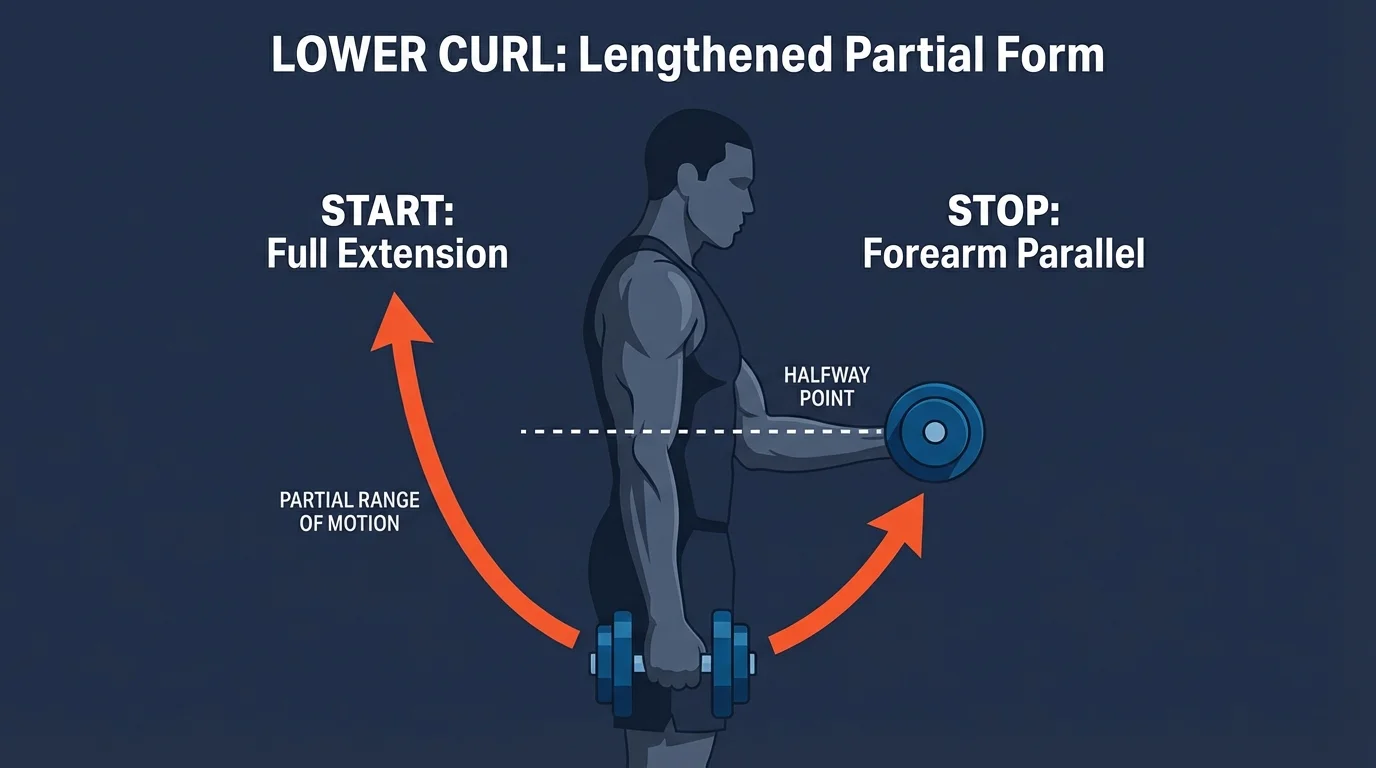
Common Mistakes to Avoid
Lower curls are simple on paper but surprisingly easy to mess up. These are the mistakes that turn a great exercise into a mediocre one.
- Going past parallel at the top. If you finish the rep at your shoulders, congratulations, you just did a normal curl. The lower curl stops at parallel. That's the entire point. The fix: set a visual marker. Stand next to a wall or a mirror, pick a spot that's roughly parallel, and stop the rep there. Your brain will try to sneak past it. Don't let it.
- Not reaching full extension at the bottom. Stopping with a slight bend in your elbows cuts the stretched portion off the rep, which is the part that makes the lower curl work in the first place. The fix: every rep starts with your arms straight and the dumbbells resting near your thighs. If you're maintaining tension by avoiding lockout, you're doing a different exercise.
- Using too much weight. The bottom half of the curl is mechanically weak. Trying to use your normal curl weight leads to body english, elbow drift, and sloppy form. The fix: start 20-30 percent lighter than your full-range curl weight and earn the right to add load by staying strict.
- Letting the elbows drift forward. When your elbows slide in front of your torso during the curl, the front delts start helping and the biceps do less work. The fix: elbows stay directly below your shoulders for the entire set. If you can't keep them still, drop the weight.
- Rushing the eccentric. Dropping the weight quickly on the way down leaves most of the benefit on the table. The lowering phase under control is where the biceps get loaded in the stretched position. The fix: count 2-3 seconds down on every single rep, including the last one of the last set.
Variations: From Seated to Incline
Seated Lower Curl (Beginner)
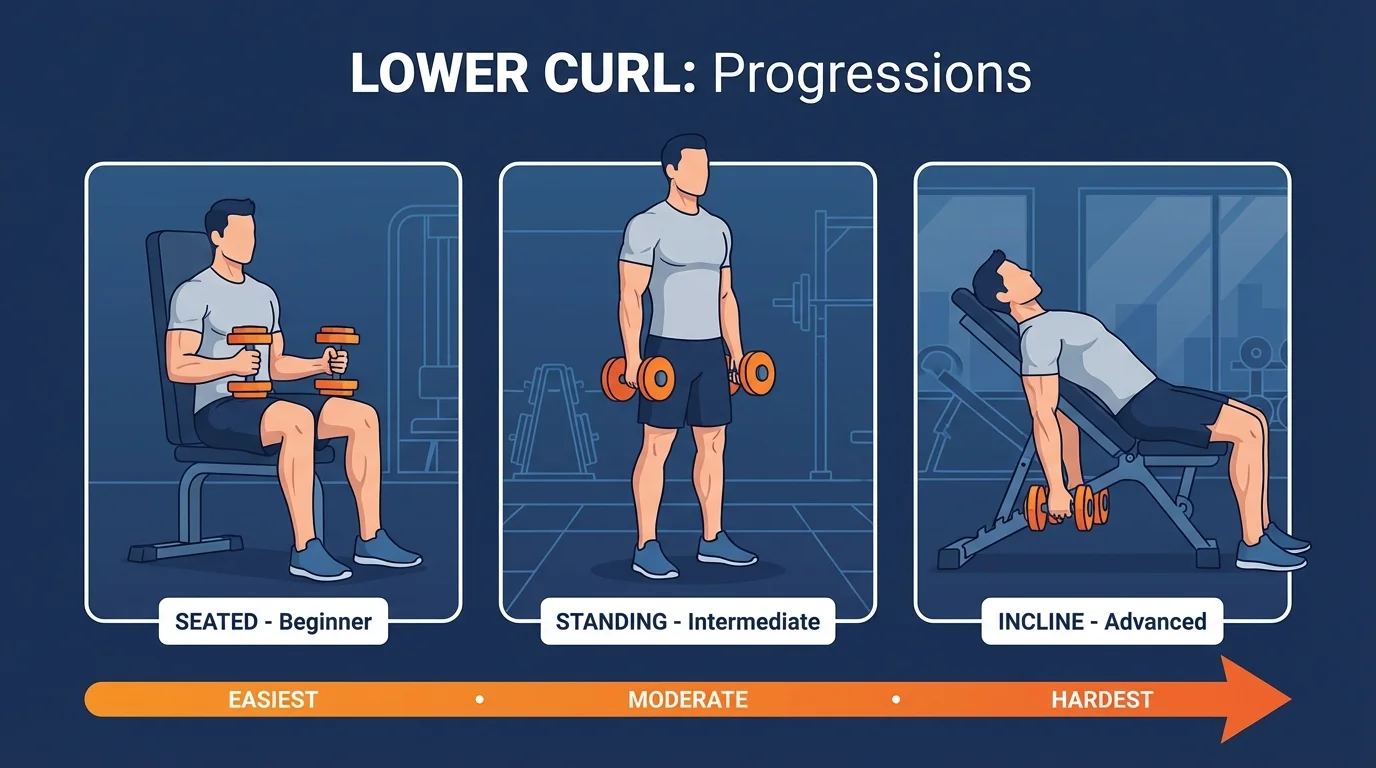
Sit on a bench with back support and perform the same bottom-half movement. Sitting eliminates any temptation to swing with your hips, which matters because lower curls are a strict-form exercise by design. If you're brand new to the movement or you catch yourself rocking during standing lower curls, start here. Use 10-15 percent less weight than you would standing.
Alternating Lower Curl (Beginner-Intermediate)
Curl one arm at a time while the other holds the dumbbell at full extension. This lets you focus entirely on the working arm, which helps with mind-muscle connection and also doubles the time each arm spends under tension per set. Just don't lean toward the curling arm. Keep your shoulders square.
Incline Lower Curl (Intermediate-Advanced)
Set an incline bench to 45-60 degrees, sit back, and let your arms hang straight down behind the line of your torso. Perform the same bottom-half curl from this deeper stretched position. The incline pre-stretches the long head of the biceps even further, which makes the lengthened-partial effect more pronounced. Drop the weight 20-30 percent compared to standing. This one is harder than it looks.
Lower Hammer Curl (Intermediate)
Same bottom-half range of motion, but with a neutral grip (palms facing each other). This shifts more of the work to the brachialis and brachioradialis while keeping the lengthened-partial benefits. Good variation if you're trying to build arm thickness and forearm size alongside bicep peak. See the dedicated hammer curls guide for the full neutral-grip pattern.
Alternative Exercises
If dumbbells are not available, these target similar muscles in a similar stretched position:
- Incline cable curl: Lie back on an incline bench set in front of a low cable pulley. The cable keeps constant tension through the stretched portion, which gives a similar feel to lower curls.
- Resistance band lower curls: Step on a resistance band and perform the bottom-half curl. Ascending resistance means the top of the partial feels slightly harder than the bottom, which is different from dumbbells but still effective.
When to Avoid or Modify Lower Curls
Lower curls are safe for most healthy adults who already curl, but a few conditions warrant modification or skipping the exercise entirely. Always consult a qualified healthcare provider or physical therapist before starting or returning to any exercise program, especially if you have the conditions below.
- Bicipital tendinopathy or long-head biceps tendon pain. Lower curls deliberately load the biceps in the deeply stretched position, which is where the long-head tendon experiences the most strain. If you have a flaring bicep tendon, skip lower curls until a PT clears you. A safer interim is short-range curls done only through the middle of the range, or isometric holds at the midpoint.
- Active elbow joint pain, golfer's elbow, or recent elbow strain. The full-extension start position puts the elbow joint under load. Drop to bodyweight rehab work and consult a PT before reintroducing loaded curls. When you return, start with a partial range that avoids both end ranges.
- Carpal tunnel syndrome or aggravated wrist pain. The supinated grip on dumbbells can flare wrist symptoms. Switch to the neutral-grip lower hammer curl variation, which loads the wrist in a less provocative position.
- Recent shoulder surgery or rotator cuff repair. Even though the elbow is the working joint, the shoulder girdle stabilizes the elbow position and the dumbbells hang from your arms. Get surgeon and PT clearance before loading the biceps.
- You can't yet maintain strict form on full-range curls. If your standard bicep curls still drift into swing or kipping, build that base first. Lower curls demand stricter form than full-range curls because the bottom half is the hardest part of the range. Spend 4-6 weeks on clean full-range work before adding the partial variation.
- You have no foundational pulling strength. Lower curls are an accessory exercise, meant to follow your main pulls and full-range curls. If you're brand new to strength training, prioritize compound pulls like chin-ups (or assisted chin-ups) and rows for several months before adding isolation curl work.
Related Exercises
- Same muscle, different ranges: Bicep curls (full range) and upper curls (the top-half partial). Pair lower curls with one or both for complete bicep training across the entire range of motion.
- Other curl variations: Hammer curls for brachialis and brachioradialis bias, drag curl for long-head emphasis, and Zottman curl for combined biceps and forearm-pronator work.
- Antagonist isolation (pair with curls): Tricep extensions and tricep kickbacks balance the biceps work and keep the elbow joint development symmetrical.
- Compound that recruits biceps: Chin-ups are the heavy compound biceps builder; pair lower curls as a finisher on chin-up days for targeted bicep volume.
- Twist variation: Twist curls add forearm rotation during the curl and bias different bicep fiber regions.
How to Program Lower Curls
Lower curls fit the standard accessory-lift programming model. The ACSM Position Stand on Resistance Training (Ratamess et al., 2009) gives the volume and intensity ranges that work for isolation exercises like this one.
| Level | Sets × Reps | Rest between sets | Frequency |
|---|---|---|---|
| Beginner | 2-3 × 10-15 | 45-60 sec | 1-2 sessions/week |
| Intermediate | 3-4 × 8-15 | 60-90 sec | 1-2 sessions/week |
| Advanced | 3-4 × 6-12 | 60-120 sec | 1-2 sessions/week |
Where in your workout: Lower curls belong late in the session, after your main compound pulls (rows, chin-ups) and after full-range curl work. Running them first will fatigue the biceps and underload your bigger lifts. Pair them with a tricep movement for efficient arm-day training, or slot them as the closer on a pull day.
Form floor over rep targets: If your elbows drift forward, your torso starts rocking, or your forearm sneaks past parallel, the set is over, even if you have reps left in the tank. Lower curls are a strict-form exercise by design. The whole reason they work is that they remove the rest break at the top of a normal curl, and the moment you cheat the position you've given that rest break back. Pick a weight you can hold strict for the full set, not the heaviest you can move.
FitCraft's AI coach Ty selects the lower curl variation (standing, seated, alternating, or incline), sets your weights and reps, and demonstrates the parallel stopping point with interactive 3D models so you can see the top of the partial from multiple angles. Getting the parallel cue right is the hardest part to learn from a written description, and seeing it in 3D makes it click.
Frequently Asked Questions
Can I do lower curls if I have bicep tendinopathy or elbow pain?
Probably not without modification. Lower curls deliberately load the biceps in the deeply stretched bottom position, which is where the long-head tendon and the elbow joint are under the most strain. If you have bicipital tendinopathy, golfer's elbow, or any elbow joint pain that flares with curling, skip lower curls until a physical therapist clears you. A safer alternative while you heal is short-range curls done only in the middle of the range (avoiding both full extension and full flexion), or isometric holds at the midpoint. Always work in a pain-free range and stop the set if symptoms increase.
What is a lower curl?
A lower curl is a dumbbell bicep curl performed through only the bottom half of the range of motion, from full arm extension up to roughly the point where your forearms are parallel to the floor. It is a type of lengthened partial, which means the muscle is loaded while it is in its longest, most stretched position. Research on partial-range training suggests the stretched portion of a curl drives most of the growth stimulus.
What muscles does the lower curl work?
The lower curl primarily targets the biceps brachii (both long and short heads) with the brachialis as a strong secondary mover and the brachioradialis assisting through the forearm. Because the movement emphasizes the stretched portion of the range, the long head of the biceps gets particularly loaded. Forearm flexors stabilize the grip, and the shoulder girdle and core engage isometrically to keep the elbows pinned at your sides and the torso upright.
Are lower curls better than full-range curls?
Lower curls are not strictly better, but the lengthened-partial approach can match or slightly outperform full-range curls for muscle growth on a set-for-set basis. The mechanism is straightforward: muscles grow most when they are loaded under stretch, and the bottom half of the curl is the stretched half. Most lifters get the best results by combining full-range curls with lower curls as a finisher rather than replacing one with the other.
How heavy should I go on lower curls?
Go lighter than your normal dumbbell curl weight, at least at first. The stretched position at the bottom is mechanically disadvantaged, so a weight that feels easy on full curls often feels brutal on lower curls. Beginners typically start with 8-12 lb dumbbells, intermediate lifters use 15-25 lb, and advanced lifters use 25-40 lb. If your elbows drift forward or your torso rocks, drop the weight.
How many lower curls should I do per workout?
For most people, 2-3 sets of 10-15 reps works well. Lower curls are usually programmed as a finisher after your main bicep work, not as the first exercise of the session. Total weekly biceps volume should generally stay between 10-20 sets across all curl variations, with lower curls making up 2-6 of those sets.