Upper curls are useful when you already know how to curl well and want more work in the top half of the rep. The range is short, but the standard is strict. Your elbows stay close, your wrists stay straight, and your shoulders stay out of the lift.
Think of the upper curl as accessory work. Full-range curls still do the heavy lifting for general arm strength. The upper curl adds focused volume where the biceps are already shortened, which makes it a practical finisher for arm days.
Quick Facts: Upper Curl
- Equipment needed: Pair of dumbbells
- Difficulty: Beginner to Intermediate
- Modality: Strength
- Body region: Upper body
- FitCraft quest category: Strength
Muscles Worked
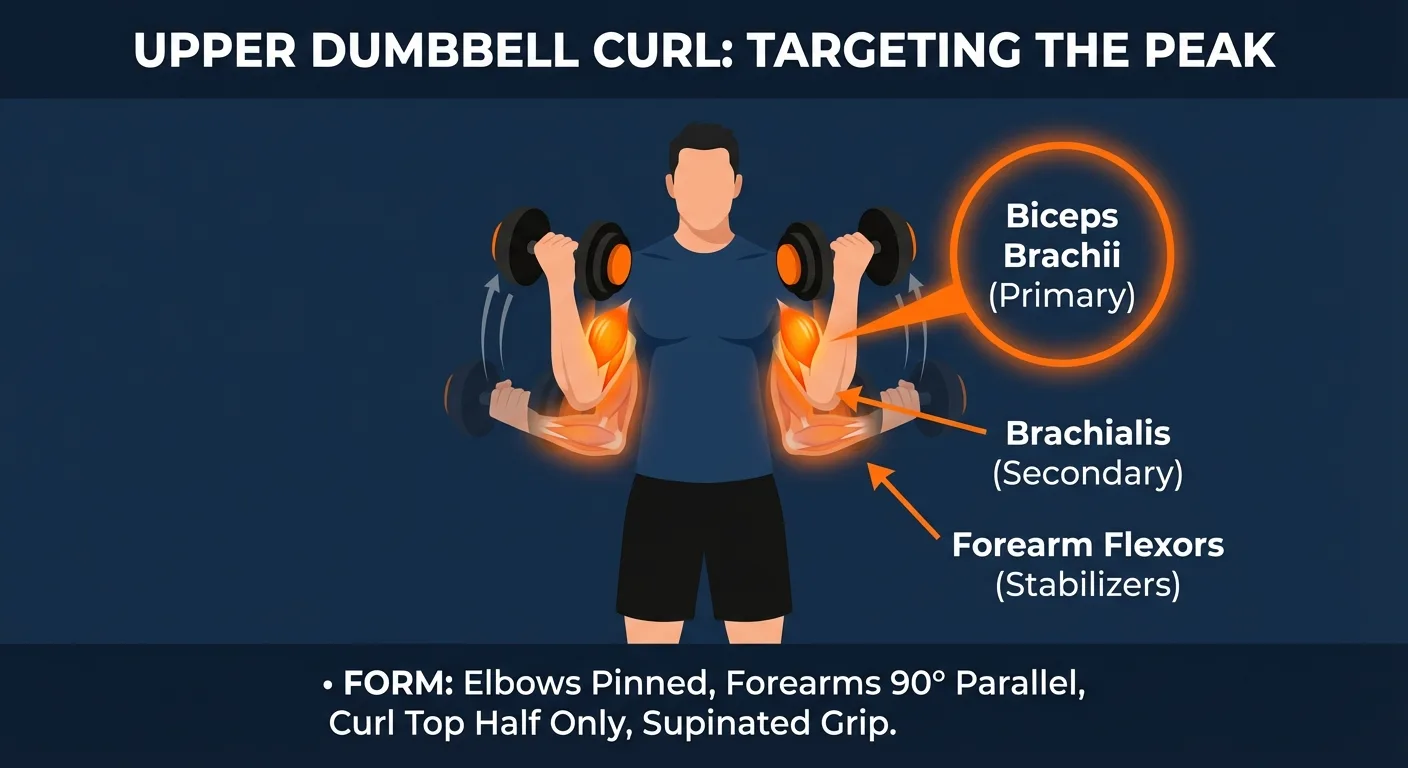
Primary movers: the biceps brachii drives elbow flexion through the top half of the curl. It shortens as you curl the dumbbells toward the shoulders and lengthens under control as you return to the halfway point.
Secondary movers: the brachialis and brachioradialis assist elbow flexion, especially as fatigue builds. The wrist and finger flexors keep the dumbbells from rolling in your hands, which helps the upper arm stay focused on the curl.
Stabilizers: the anterior deltoids, rotator cuff, scapular retractors, and trunk brace lightly to keep the upper arm and torso still. If your shoulder rolls forward or your lower back arches, the stabilizers have stopped doing their job.
Why the top half feels different: upper curls keep the elbow bent and the biceps shortened for the whole set. That increases local fatigue in the contracted position. It doesn't replace full-range curling, but it gives you a clean way to add peak-contraction volume after the main work is done.
Step-by-Step: How to Do an Upper Curl
- Set your stance. Stand with your feet about hip-width apart, a dumbbell in each hand. Keep your chest tall, ribs down, and palms facing forward.
- Start at halfway. Bend your elbows until your forearms are roughly parallel to the floor. This is the bottom of the upper curl. Coach Ty's cue: "Start where the regular curl gets hard. Hold that line."
- Pin your elbows. Keep your elbows close to your ribs before you begin the rep. If they drift forward, the front shoulders start helping too much.
- Curl to the top. Curl the dumbbells toward your shoulders and squeeze your biceps at the peak. Coach Ty's cue: "Small range, hard squeeze."
- Lower under control. Return only to the halfway position. Don't drop into a full stretch until the set is over.
- Breathe with the rep. Exhale as you curl up and inhale as you lower. Keep your wrists straight, your core braced, and your body quiet.
Get this exercise in a personalized workout
FitCraft, our mobile fitness app, uses its AI coach Ty to program isolation exercises like this into your plan at the right volume and intensity, based on your level, goals, and equipment. Ty was designed and trained by Domenic Angelino, MPH (Brown University) and NSCA-CSCS, with research published in the Journal of Strength and Conditioning Research and Medicine & Science in Sports & Exercise.
Take the Free Assessment Free • 2 minutes • No credit card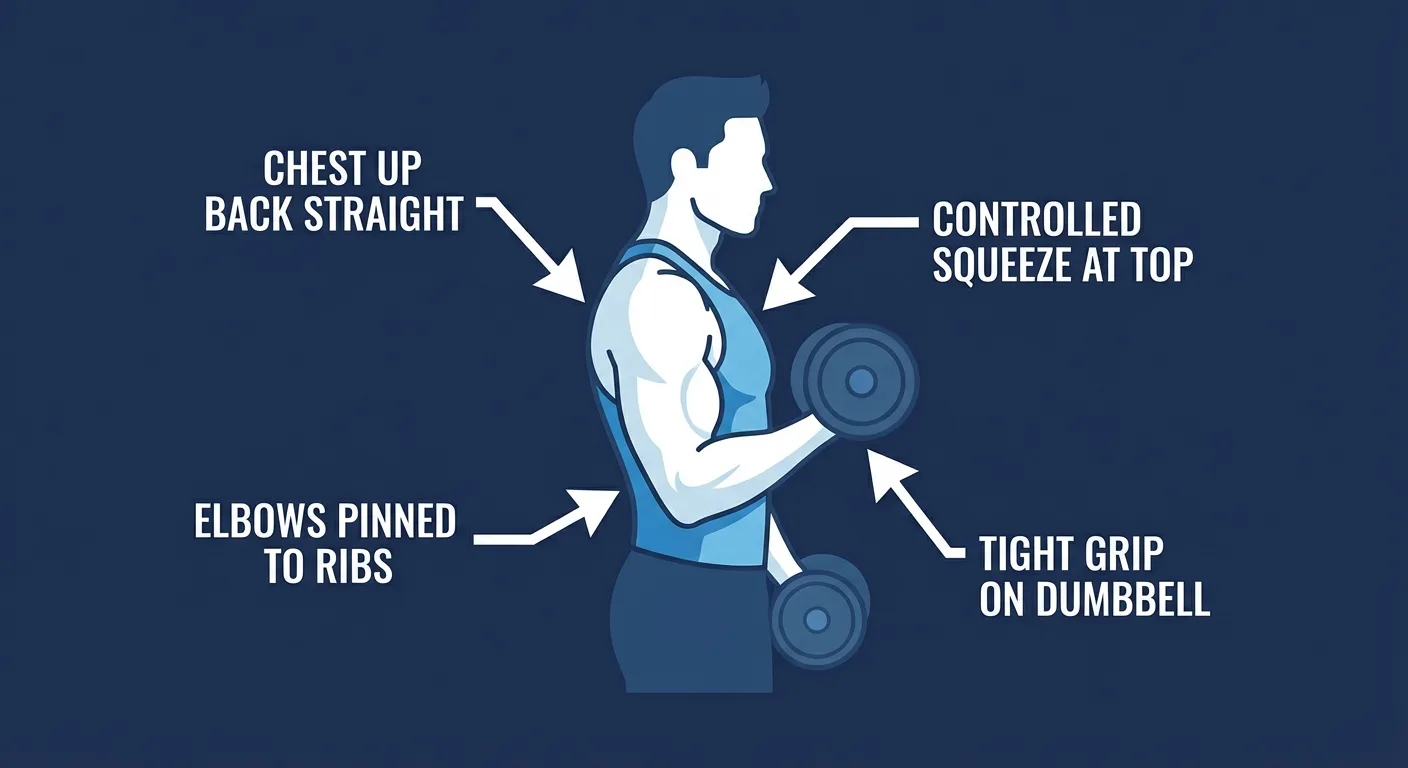
Common Mistakes (and How to Fix Them)
- Dropping below halfway. Letting the arms straighten turns the set back into a standard curl. Fix: stop each descent when the forearms are parallel to the floor.
- Swinging the torso. Leaning back turns the rep into a momentum lift. Fix: brace your abs and use a load you can move without shifting your ribs or hips.
- Letting the elbows drift forward. The shoulders take over when the elbows slide toward the mirror. Fix: keep the upper arms close to your sides and think about curling around the elbow joint.
- Bending the wrists. Flexed or extended wrists can irritate the forearm and reduce control. Fix: keep the knuckles stacked over the forearm and grip the dumbbells firmly.
- Skipping the squeeze. Rushing through the top removes the main reason to do the exercise. Fix: pause briefly at peak contraction before lowering.
- Using upper curls as your whole biceps plan. Partials are accessory work. Fix: keep full-range curls, rows, or chin-up variations in the program first.
Upper Curl Variations: Regressions and Progressions
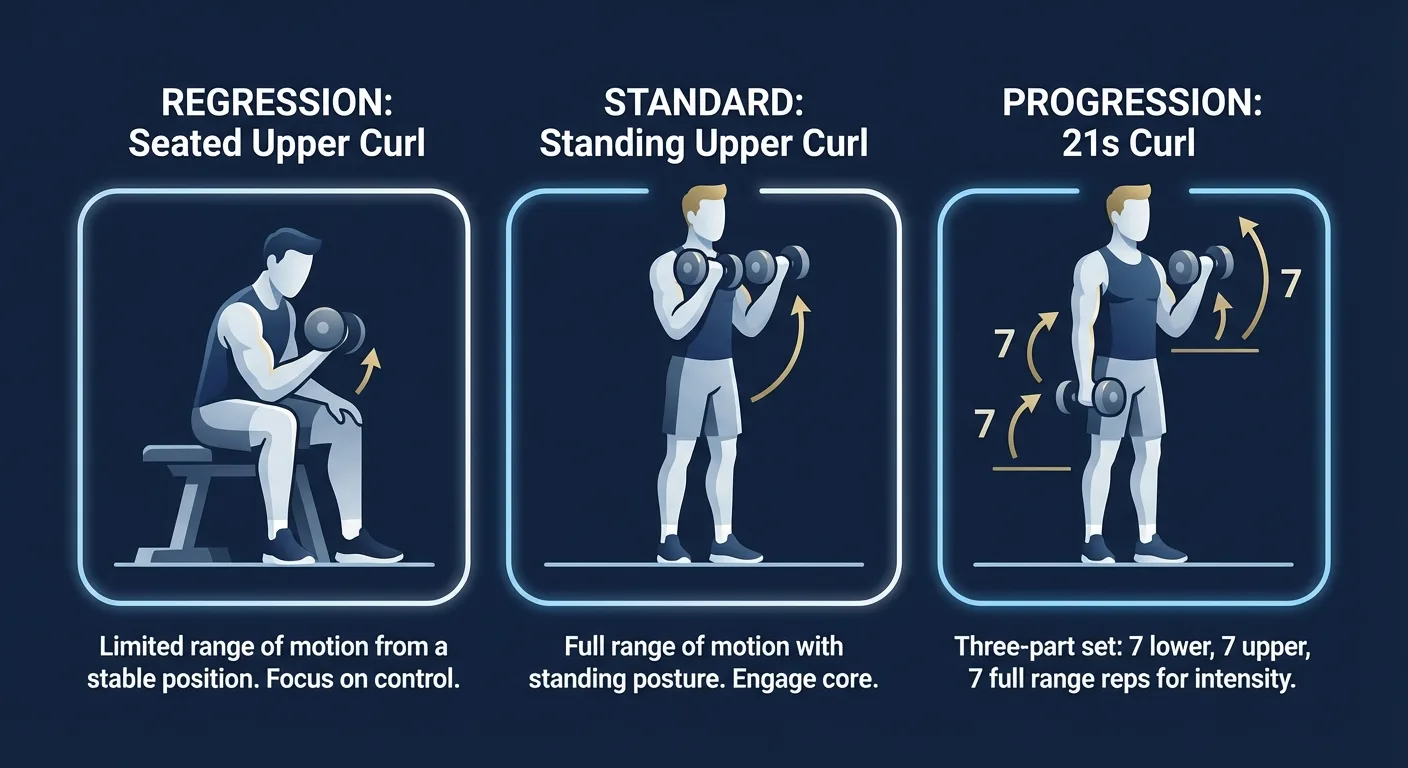
Seated Upper Curl
Sit tall on a bench and perform the same top-half range. The seated setup limits body swing and makes it easier to feel whether the elbows are staying still.
Single-Arm Upper Curl
Train one arm at a time with a lighter dumbbell. This gives you more attention on the working side and helps clean up uneven elbow position.
Hammer Curl
Use a neutral grip and train the full curl range. Hammer curls bias the brachialis and brachioradialis more than standard palms-up curls, which makes them a strong complement to upper curls.
21s
Combine seven lower curls, seven upper curls, and seven full-range curls in one extended set. Keep the load modest. The point is clean tension across the full range.
Drag Curl
Drag curls keep the elbows behind the torso and change the shoulder position of the curl. Use them when you want another strict biceps isolation option without repeating the same partial range.
When to Avoid or Modify Upper Curls
Upper curls are safe for most healthy adults, but elbow and wrist symptoms deserve attention because the exercise keeps the joint under constant tension. Always consult your physician or physical therapist for personalized guidance.
- Active elbow tendon pain or bicipital tendinopathy. Top-half curls can aggravate irritated biceps or forearm tendons. Reduce the load, use a slower tempo, and stop the set if symptoms increase.
- Carpal tunnel symptoms or wrist pain. A palms-up grip can bother the wrist or forearm. Use lighter dumbbells, keep the wrist neutral, or swap to hammer curls if that grip feels better.
- Recent elbow, wrist, or shoulder surgery. Get clearance from your surgeon or physical therapist before loaded isolation work. Rehab usually moves from isometrics to active range of motion before external load.
- Shoulder irritation from holding the elbows pinned. If keeping the upper arm still causes anterior shoulder pain, try drag curls with very light weight or pause loaded curls until the shoulder is assessed.
- Loss of strict form under fatigue. If your back arches, elbows drift, or wrists bend, the set is done. Use lower curls or full-range curls with lighter weight to rebuild control.
Related Exercises
Use these movements to build a complete arm and upper-body accessory block:
- Same target muscle: Lower Curl, Drag Curl, and Hammer Curls train the biceps and elbow flexors from different grips and ranges.
- Compound biceps builder: Chin-Ups add heavy pulling work that trains the biceps alongside the lats and upper back.
- Antagonist isolation: Tricep Extensions, Overhead Tricep Press, and Tricep Kickbacks balance curl volume with elbow extension work.
- Shoulder and scapular health: W Raise, Y Raise, T Raise, Pull-Apart, and Scissor Raises support the shoulder position that strict curls depend on.
How to Program Upper Curls
Upper curl programming follows the same evidence-based resistance-training principles as other isolation lifts. The American College of Sports Medicine Position Stand recommends progressive loading, appropriate rest, and training frequency scaled to experience level (Ratamess et al., 2009).
| Level | Sets x Reps | Rest between sets | Frequency |
|---|---|---|---|
| Beginner | 2-3 x 10-15 | 45-60 seconds | 2-3 sessions/week |
| Intermediate | 3-4 x 8-15 | 60-90 seconds | 2-4 sessions/week |
| Advanced | 3-4 x 6-15 with pauses or slower tempo | 60-120 seconds | 2-4 sessions/week |
Where in your workout: place upper curls late in an upper-body, pull, or arm session after rows, chin-ups, and full-range curls. They work best as accessory volume after the main lift has already trained the full range.
Form floor over rep targets: stop the set when your elbows drift, wrists bend, torso swings, or the dumbbells drop below the halfway point. Fewer strict reps beat more loose reps.
How FitCraft Programs This Exercise
FitCraft uses the free assessment to understand your level, goals, and equipment. Ty can then place isolation exercises in a balanced plan, usually after larger compound pulls and presses so accessory work doesn't steal energy from the main training.
For upper curls, that usually means a modest load, controlled reps, and a clear stop point when form breaks. Ty adjusts the variation and volume to match your level, then keeps the exercise in context with full-range curls and antagonist triceps work.
Frequently Asked Questions
What is an upper curl?
An upper curl is a partial biceps curl that trains the top half of the movement. You start with the forearms roughly parallel to the floor, curl up to full contraction, and lower back to the halfway point without fully extending the elbows.
What muscles do upper curls work?
Upper curls primarily target the biceps brachii in its shortened position. The brachialis, brachioradialis, forearm flexors, shoulder girdle, and trunk help keep the dumbbells and torso stable.
Are upper curls better than full-range curls?
Use upper curls as an accessory, not your only curl. Full-range curls should cover the main strength and hypertrophy work. Upper curls add targeted volume to the top half and work well as a finisher.
How heavy should upper curls be?
Use a weight you can control without swinging, leaning back, or bending the wrists. Most lifters should use the same load as full-range curls or slightly less because the set keeps constant tension in a small range.
Can I do upper curls with elbow or wrist pain?
Modify or skip upper curls if elbow tendons, wrists, or carpal tunnel symptoms flare during curls. Use lighter loads, a neutral grip like hammer curls, shorter pain-free ranges, or get guidance from a physical therapist if pain persists.