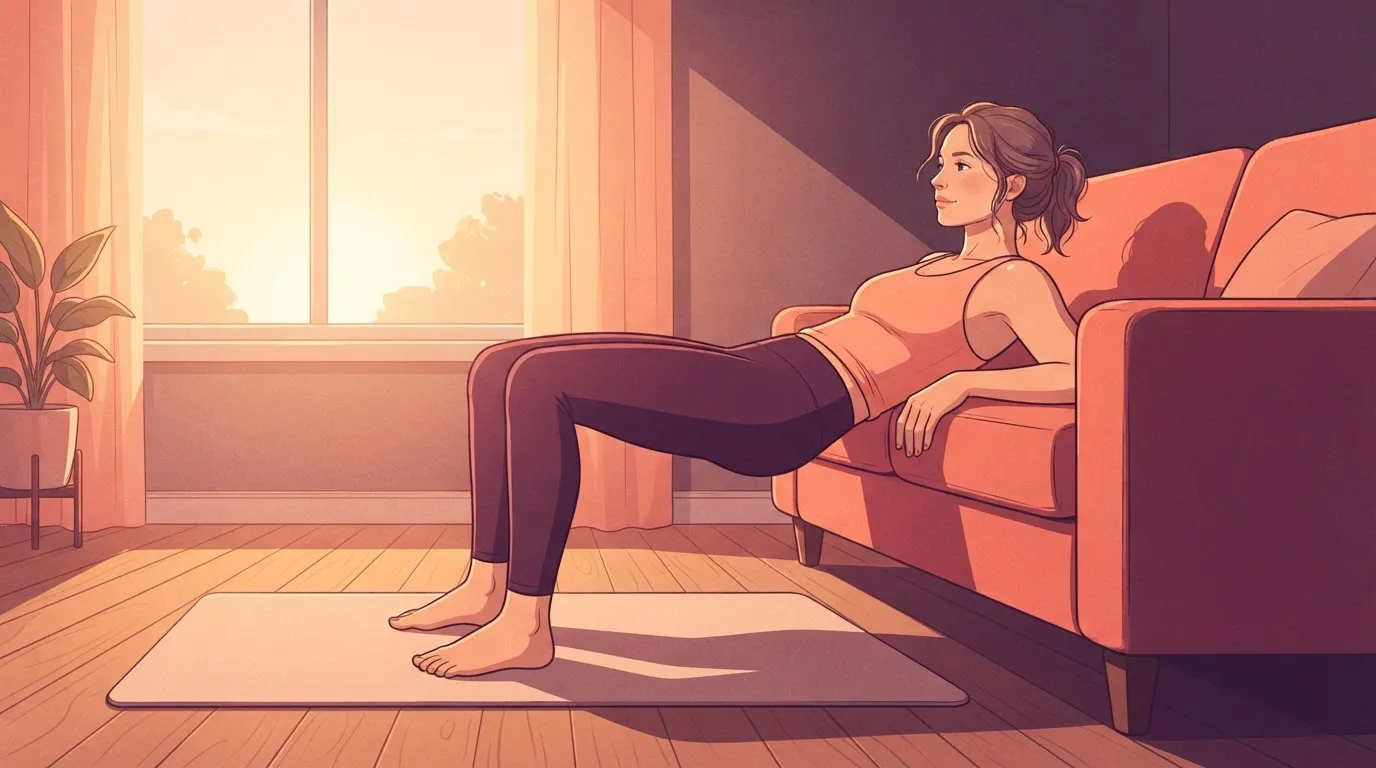
You've done glute bridges until they feel like lying down. The next step every video shows is a gym setup with a heavy load across the hips, and you train in your living room.
It's easy to think home glute work tops out at bridges, but it doesn't. A hip thrust gets harder in four ways that need little or no equipment. You can take a leg away, add range, add a band or a dumbbell, or slow the rep down. Each one loads your glutes a little differently, and knowing which does what tells you what to try next.
This guide covers 9 home hip thrust variations, what each one loads, what the EMG and training studies show, and how to choose and progress. If you're still deciding between a hip thrust and a floor bridge, our hip thrust vs glute bridge guide compares the two head to head. This page picks up once you've moved to the thrust.
Hip Thrust Variations at Home: Pick by Goal and Kit
Each variation below changes one thing. Find the row that matches what you want and what you own, then read that section.
| If you want | Try | What changes | Kit |
|---|---|---|---|
| To learn the movement | 1. Bodyweight hip thrust | Nothing yet: this is the baseline | A couch or bench |
| More load with no weights | 2. B-stance hip thrust | One leg does most of the work | A couch or bench |
| The hardest no-equipment version | 3. Single-leg hip thrust | One leg does all of it | A couch or bench |
| More range at the bottom | 4. Feet-elevated hip thrust | Your hips start lower and travel farther | Plus a step or low box |
| More side-glute work | 5. Banded hip thrust | You press your knees out against a band | A loop band |
| More resistance at the top | 6. Band-across-the-hips thrust | The band pulls hardest where you finish | A long band and two anchors |
| Steady extra load | 7. Dumbbell hip thrust | Weight rests across your hips | One dumbbell and a towel |
| Harder reps without more weight | 8. Paused hip thrust | A hold at the top of every rep | Nothing extra |
| Harder reps without more weight | 9. Slow-lowering hip thrust | A 3 to 4 second way down | Nothing extra |
Hip Thrust Form for Glutes: The Home Setup
Good hip thrust form for glutes comes down to where your back sits, where your feet go and how you finish. Get these right on the bodyweight version, variation 1, before you change anything else.
- Pick a stable edge about knee height. A couch seat, a bench or a sturdy low table works. If it shifts when you lean on it, back it against a wall.
- Set the contact point. Rest the strip of your back just below your shoulder blades on the edge, with your elbows out along it.
- Place your feet for vertical shins. At the top of the rep your shins should point straight up. Test it with one rep, then shuffle your feet in or out.
- Keep your chin tucked. Look forward at your knees rather than up at the ceiling, so your ribs stay down and your trunk moves as one piece.
- Finish with your glutes, not your back. Stop when your body is level from shoulders to knees, and tuck your pelvis under slightly at the top instead of arching.
Some people prefer setting the edge lower, around the middle of the back, and tucking the pelvis under as you lift. That style is called the American hip thrust. Try both and keep the one you feel most in your glutes. For the bodyweight version, 3 sets of 15 to 25 reps is a good start, and the glute bridge exercise guide covers the floor version if the couch setup feels awkward at first.
Change the Stance: B-Stance and Single-Leg Hip Thrusts
Taking support away from one leg is the cheapest way to make a hip thrust harder. The same body weight now goes mostly or entirely through one hip, with no equipment added.
2. B-stance hip thrust
Set up as usual, then slide one foot forward so only its heel touches the floor, with the toes up, a little ahead of your other foot. The planted leg does most of the lifting while the front heel helps you balance. People also call it the kickstand hip thrust. We found no study that measured how the load splits, so use it as a bridge between two legs and one, and do the same reps on each side. Aim for 3 sets of 10 to 15 per side.
3. Single-leg hip thrust
Lift one foot and pull that knee toward your chest, then drive up through the planted foot until your hips are level. Holding the free knee in keeps your pelvis from tipping and your lower back from arching. Your working glute now lifts what both legs shared, and the hip also has to stop your pelvis dropping toward the free side. If your hamstring cramps, move the planted foot an inch closer to the couch. Start with 3 sets of 8 to 12 per side, and lead with your weaker side.
Change the Range and Foot Position
Where your feet sit decides which muscles share the work and how far your hips travel.
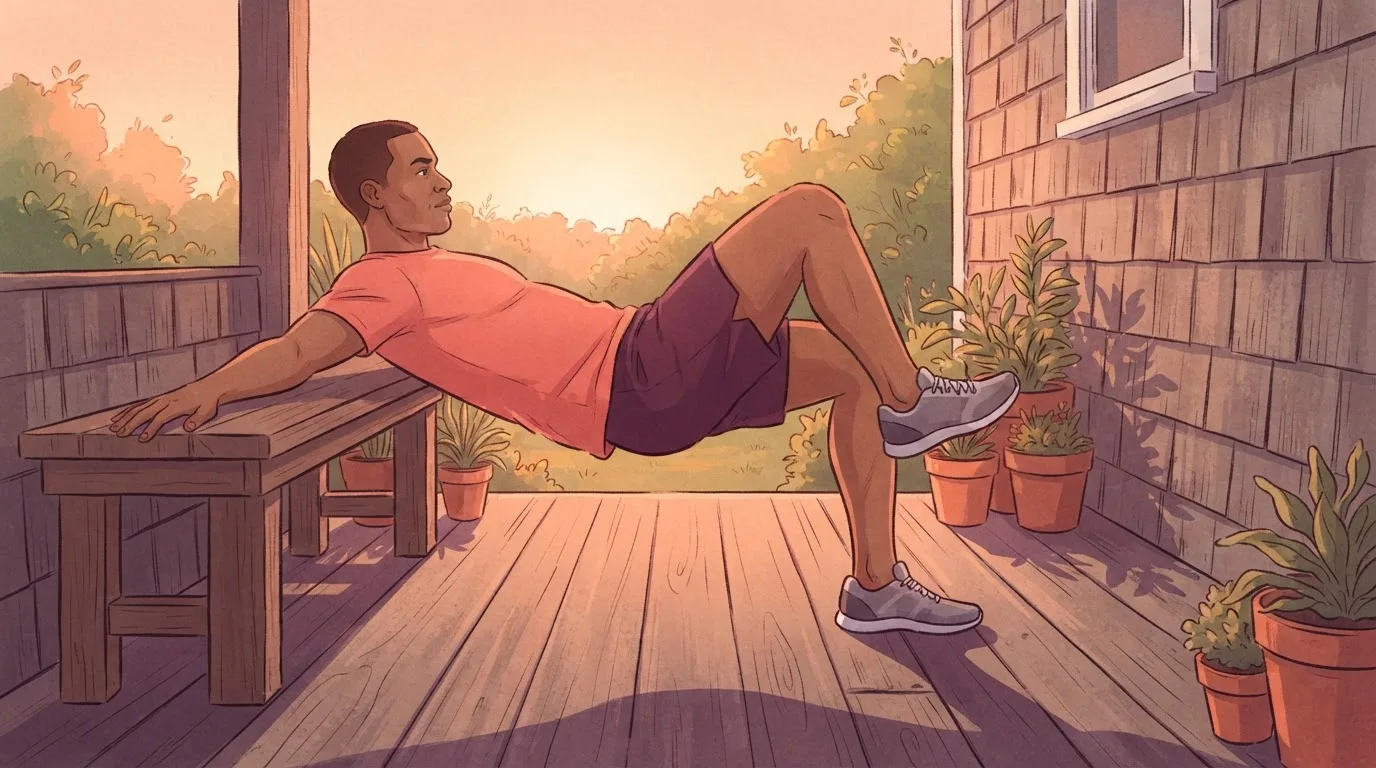
4. Feet-elevated hip thrust
Keep your back on the couch and put your feet on a step, a low box or a second sturdy chair. Your hips start lower, so each rep travels farther from the bottom. That deeper start matters, because the bottom is where the work is hardest. Brazil and colleagues (2021) analysed 19 trained men lifting 70 percent of their one-rep max and found the demand on the hip extensors was highest early in the lift and fell as the hips rose, rather than staying constant. We found no EMG study of the feet-elevated version itself, so treat it as more range rather than proven extra glute work. Start with 3 sets of 10 to 15.
Foot distance: glutes, hamstrings or quads
Foot placement is a variation of its own. Collazo Garcia and colleagues (2020) recorded seven experienced personal trainers doing 8 reps of four hip thrust versions at 40 percent of their max, changing how far the feet sat from the body and the direction they pushed. Every muscle measured changed its activity between versions except the gluteus medius. A 2019 systematic review by Neto and colleagues sums up the direction: with the feet farther forward, hamstring activity rose and quadriceps activity fell. In practice:
- Feet under your knees at the top (shins vertical) is the standard setup and the place to start.
- Feet farther out gives the hamstrings a bigger share and the quads a smaller one.
Seven trainers is a small sample, so use these as starting points and adjust to where you feel the work.
Find out what's really holding you back
FitCraft, our mobile fitness app, pairs you with an AI coach who builds you a personalized plan around your goals, schedule, and fitness level. Every FitCraft program is designed by Domenic Angelino, MPH (Brown University) and NSCA-CSCS, with research published in the Journal of Strength and Conditioning Research and Medicine & Science in Sports & Exercise.
Take the Free Assessment Free • 2 minutes • No credit cardChange the Resistance: Bands and Dumbbells
Most hip thrust research uses a barbell, the gym version, so read the studies here as a guide to the movement rather than to your exact setup. The useful finding is that the kind of resistance changes where in the rep the work lands.
5. Banded hip thrust (loop band above the knees)
Put a fabric or rubber loop band around your thighs just above your knees, and press your knees out against it for the whole set. That small outward push changes the exercise. Kang and colleagues (2016) tested 20 adults bridging with their knees together and with each thigh angled out 15 and 30 degrees. The 30-degree position produced the most gluteus maximus activity and the least lower-back muscle activity, with less forward tilt of the pelvis. In a study of 11 active adults by Bishop and colleagues (2018), a bridge with elastic resistance was among the best of 13 exercises for working the glutes relative to the TFL, a small hip muscle that tends to take over. Adding the band did not significantly change glute or TFL activity compared with the same bridge without one, though the bands in that study were light. If you're choosing a band, our resistance band workouts guide covers which strength to start with.
6. Band across the hips
Loop a long, heavy resistance band over your hips and anchor each end under a heavy dumbbell or kettlebell on either side of you. A band stretches more as your hips rise, so it pulls hardest at the top, the part of the rep where a weight resting on your hips gets easier. Contreras and colleagues (2016) compared three loaded versions in 13 trained women. The band version worked the gluteus maximus somewhat less than the gym version on average and about as much as the American hip thrust, and the authors suggested choosing by preference and goal. Set it up so the band is already taut at the bottom.
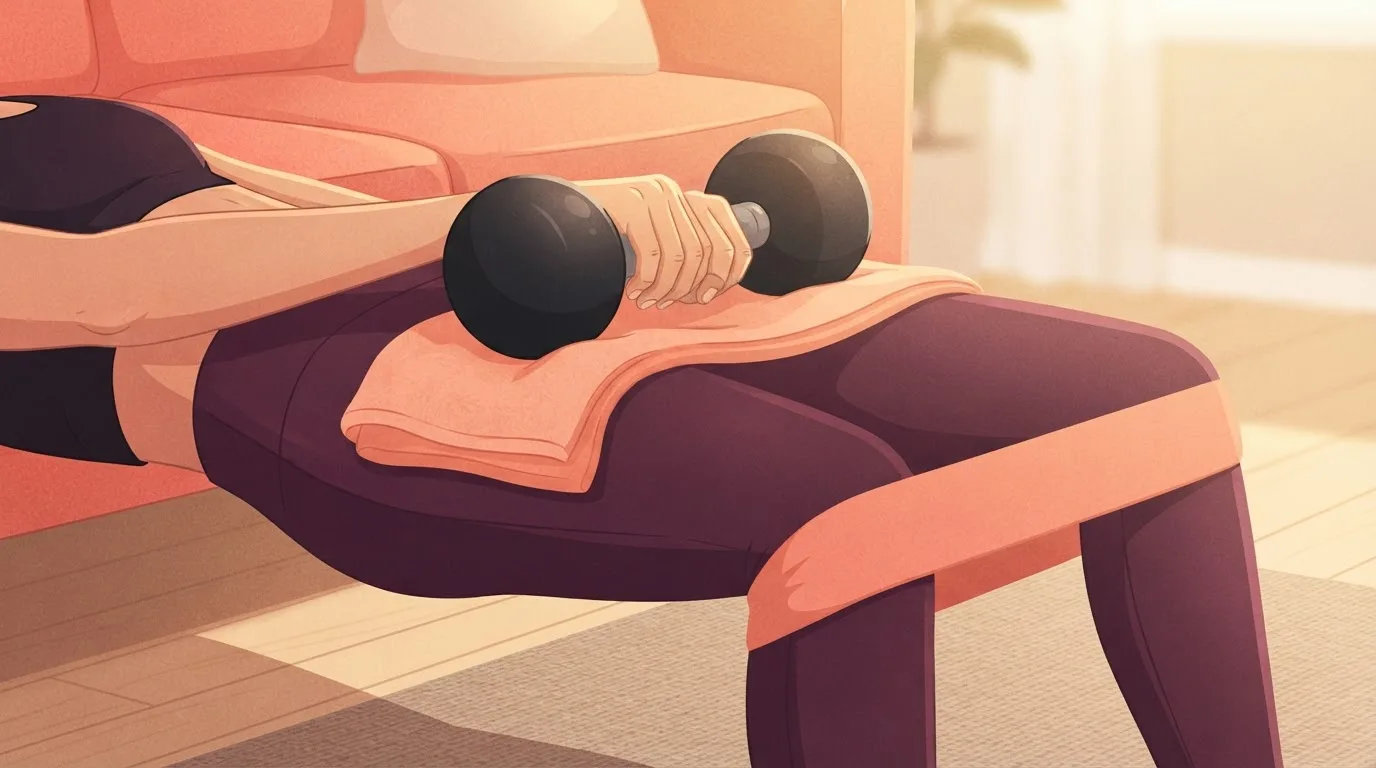
7. Dumbbell hip thrust
Lay a folded towel across the crease of your hips and rest one dumbbell on it, holding each end so it can't roll. The dumbbell adds steady load through the whole rep. Most home dumbbells top out long before your glutes do, and that's less of a problem than it sounds. Lopez and colleagues (2021) pooled 28 studies of 747 adults who trained to failure, and light, moderate and heavy loads built similar muscle, while heavier loads built more strength. So a lighter dumbbell works for muscle as long as your sets end close to failure. When yours gets easy, combine it with a single leg, a band above the knees or a slower tempo.
Change the Time: Pauses, Slow Lowering and the 8-8-8 Finisher
When you run out of weight, time is the next dial. Slowing a rep down makes the same load harder, and the research says you don't lose growth by doing it within reason. Schoenfeld and colleagues (2015) reviewed 8 training studies that took sets to failure and found that reps lasting anywhere from half a second to 8 seconds built similar muscle. Very slow reps, beyond about 10 seconds, looked worse.
8. Paused hip thrust
Hold the top position for 2 to 3 seconds on every rep, squeezing your glutes with your pelvis tucked. The pause teaches you to finish the rep with your glutes rather than your lower back, and it makes a light set much harder. No study has tested pauses for glute growth, so count them as a tool for control and for light loads.
9. Slow-lowering hip thrust
Lift in about a second and take 3 to 4 seconds to lower, stopping just before your hips touch the floor. That keeps each rep at about 5 seconds, inside the range the Schoenfeld review supports. It suits the single-leg and dumbbell versions, where a fast drop is where people lose control.
The 8-8-8 finisher
The 8-8-8 rule on social media means 8 full reps, 8 short pulses at the top and an 8-second hold, back to back. No study has tested it. It works like any hard set by taking a light load close to failure, so use it once at the end of a session rather than in place of your main sets.
How to Choose and Progress Your Hip Thrust Variation
Choose your next variation by what's holding you back, then change one thing at a time. These are the most common problems and the variation that fixes each one:
- Your lower back takes over. Add a loop band above your knees, tuck your pelvis at the top, and try the American setup with the edge lower on your back.
- You can't feel your glutes. Add a 2-second pause, check your shins are vertical, and do a few moves from our glute activation guide before your first set.
- Your hamstrings cramp. Bring your feet closer to the couch.
- Bodyweight is too easy and you have no weights. Go to the B-stance, then a single leg, then slow the lowering.
- The single-leg version is too easy. Raise the planted foot on a step, or rest a dumbbell on your hips.
Keep each set close to failure, ending with one to three good reps left. Move to the next variation when you can do 20 reps on every set with that much in reserve. Here's a 9-week outline for two glute sessions a week:
| Weeks | Main variation | Sets x reps | When it gets easy, add |
|---|---|---|---|
| 1 to 3 | Bodyweight or banded hip thrust | 3 x 15 to 20 | A 2-second pause at the top |
| 4 to 6 | B-stance hip thrust, or dumbbell hip thrust if you own one | 3 x 10 to 15 (per side for B-stance) | A 3-second lowering |
| 7 to 9 | Single-leg hip thrust, or feet-elevated dumbbell hip thrust | 3 x 8 to 12 (per side for single-leg) | A band above the knees or a dumbbell |
Hip thrusts shouldn't be your only glute exercise. In a 9-week MRI trial by Plotkin and colleagues (2023), hip thrusts and back squats grew the glutes by similar amounts in 34 untrained adults, and the squat group also gained more muscle in the front and inner thighs. Pair your hip thrust with a squat or lunge and a hinge. Our guide on how to grow glutes lays out a full two-day dumbbell plan around them.
If you'd like an app to plan the glute days for you, our roundup of the best fitness apps for women compares the options for home strength training. In FitCraft, the glute bridge and single-leg glute bridge come with interactive 3D demos that highlight the working muscles, along with tips such as squeezing your glutes at the top. The AI coach Domenic designed says your name while you train, and your workouts adjust as you progress.
What the Studies Don't Tell You Yet
The evidence on hip thrust variations is thin in places, and it helps to know where. The B-stance, the dumbbell on the hips, the feet-elevated version, pauses and the 8-8-8 finisher have no direct studies behind them. Most EMG work used trained adults with gym equipment and small samples. And higher EMG doesn't guarantee more growth: in the Plotkin trial, glute activity measured in the first session didn't reliably predict who grew most. Choose the variation you can load, progress and do well twice a week.
The Bottom Line
Hip thrust variations at home change one thing each: your stance, your range, the resistance or the timing. Start with the bodyweight version on a couch, go to a B-stance and a single leg when it gets easy, and add a band, a dumbbell or a slower tempo when your reps climb past 20. Keep your shins vertical and finish each rep with your glutes, not your lower back.
Working out consistently is hard, but it doesn't have to be. As Sarah put it, it was the "first app that made exercise feel like something I chose, not forced." Set up on your couch and do your first set today.
Frequently Asked Questions
What is the 8-8-8 rule for hip thrusts?
The 8-8-8 rule is a social media finisher: 8 full hip thrusts, then 8 short pulses at the top, then an 8-second hold, done back to back. No study has tested it. It works the way any hard set works, by taking a light load close to failure, so use it as the last set of a session rather than as your main work.
What workout is equal to hip thrust?
No exercise is identical, but the back squat matched the hip thrust for glute growth in a 9-week MRI trial of 34 adults. At home with no equipment, a hard single-leg glute bridge is the closest substitute, and a dumbbell Romanian deadlift or a reverse lunge trains the glutes through a different range.
Are hip thrusts better than squats?
Not for glute size. In a 9-week trial of 34 untrained adults, hip thrusts and squats grew the glutes by similar amounts, while squats also built more muscle in the front and inner thighs (Plotkin 2023). Each group got strongest at the exercise it practised, so many people do both.
Do hip thrusts work hamstrings?
Yes, as helpers. The hamstrings assist the glutes in straightening your hip, and setting your feet farther from the couch gives them a bigger share. For hamstring size, add a hinge such as the dumbbell Romanian deadlift, because hip thrusts grew the hamstrings very little in a 9-week MRI trial.
How do you feel hip thrusts in your glutes?
Set your feet so your shins are vertical at the top, tuck your chin, and finish each rep by tucking your pelvis under instead of arching your lower back. A loop band above your knees and a two-second squeeze at the top both make the glutes easier to feel. If your hamstrings cramp, bring your feet a little closer.