The ache sits on one side, just above your belt line. It shows up after a long day at a desk, or after you carry a bag or a toddler on the same hip for an hour. You stretch it, it eases for ten minutes, and the next morning it's back.
That kind of ache can make your back feel fragile, as if one wrong move will set it off. A lot of the advice online makes it worse by calling the quadratus lumborum, or QL, a "tight muscle" you need to release. A QL that aches may be tired from holding you upright all day rather than short, and stretching alone doesn't build strength.
This guide explains what the QL does, then gives you 7 strengthening exercises in the order to learn them, 4 stretches for afterwards, the sets and reps for each, and a 15-minute routine you can run two or three times a week. It's written for adults in their 30s and 40s who sit a lot and want a stronger, steadier lower back.
What Does the QL Muscle Do?
The quadratus lumborum is the deepest muscle of your lower back. You have one on each side. It runs from the top of your pelvis up to your lowest rib, with fibers that attach to the side of your lumbar vertebrae on the way. When Phillips and colleagues (2008) dissected it in six cadavers, they found that about half its fibers pull on the 12th rib and the rest pull on the spine, and that the layout varied a lot from person to person.
Its function comes down to three jobs.
1. Side-bending your trunk
When one QL shortens, it bends your trunk toward that side, which anatomists call lateral flexion. Andersson and colleagues (1996) placed fine-wire electrodes in the QL of seven healthy adults, guided by ultrasound, and found its highest activity when people lay on their side and lifted their trunk sideways off the floor. They also found that the QL kept working at the end of a full forward bend, after the superficial back muscles had switched off.
2. Hiking your hip
If your ribs stay still, the same muscle pulls the other way and lifts one side of your pelvis toward your ribs. That's a hip hike. You use it to step over a low obstacle, to swing a stiff leg through when you walk, or to shift your weight when you stand on one leg for a long time.
3. Holding your spine steady under a one-sided load
This is the job that matters most in daily life. A shopping bag in your right hand tries to bend your trunk to the right, and the QL on your left side, along with your obliques, holds you upright. McGill and colleagues (1996) recorded the QL with fine-wire electrodes in four young adults across a wide variety of tasks. During a side plank it worked at 54 percent of its maximum, harder than any other trunk muscle they measured. In upright standing, it also switched on more as the load pressing down through the spine increased. They concluded that the side plank is a good way to train it.
Keep its size in perspective, though. In the Phillips model, the QL's compression on the spine, its extension force and its side-bending force were each no more than 10 percent of what the larger erector spinae and multifidus muscles produce. It's a stabilizer that works with many other muscles, so the exercises below train it as part of your whole trunk.
The 7 Best QL Strengthening Exercises
Strengthen first and stretch second. These seven moves cover the QL's three jobs, and they need nothing more than a mat, a step and one dumbbell. Learn them roughly in this order, because each one asks a little more of your trunk than the one before.
| # | Exercise | QL job it trains | Starting dose |
|---|---|---|---|
| 1 | Side plank (knees or feet) | Holding steady against a sideways pull | 3 holds of 10 sec per side |
| 2 | Suitcase hold | Staying upright with a weight on one side | 2 holds of 20 sec per side |
| 3 | Suitcase carry | Staying upright while you walk | 3 walks of 20 steps per side |
| 4 | Bird dog | Holding steady while a leg lifts | 2 x 6 per side, 5-sec holds |
| 5 | Side-lying hip hike | Hip hiking, without body weight | 2 x 10 per side |
| 6 | Standing hip hike | Hip hiking, with body weight | 2 x 10 per side |
| 7 | Dead bug | Keeping your trunk still while limbs move | 2 x 6 per side |
1. Side plank
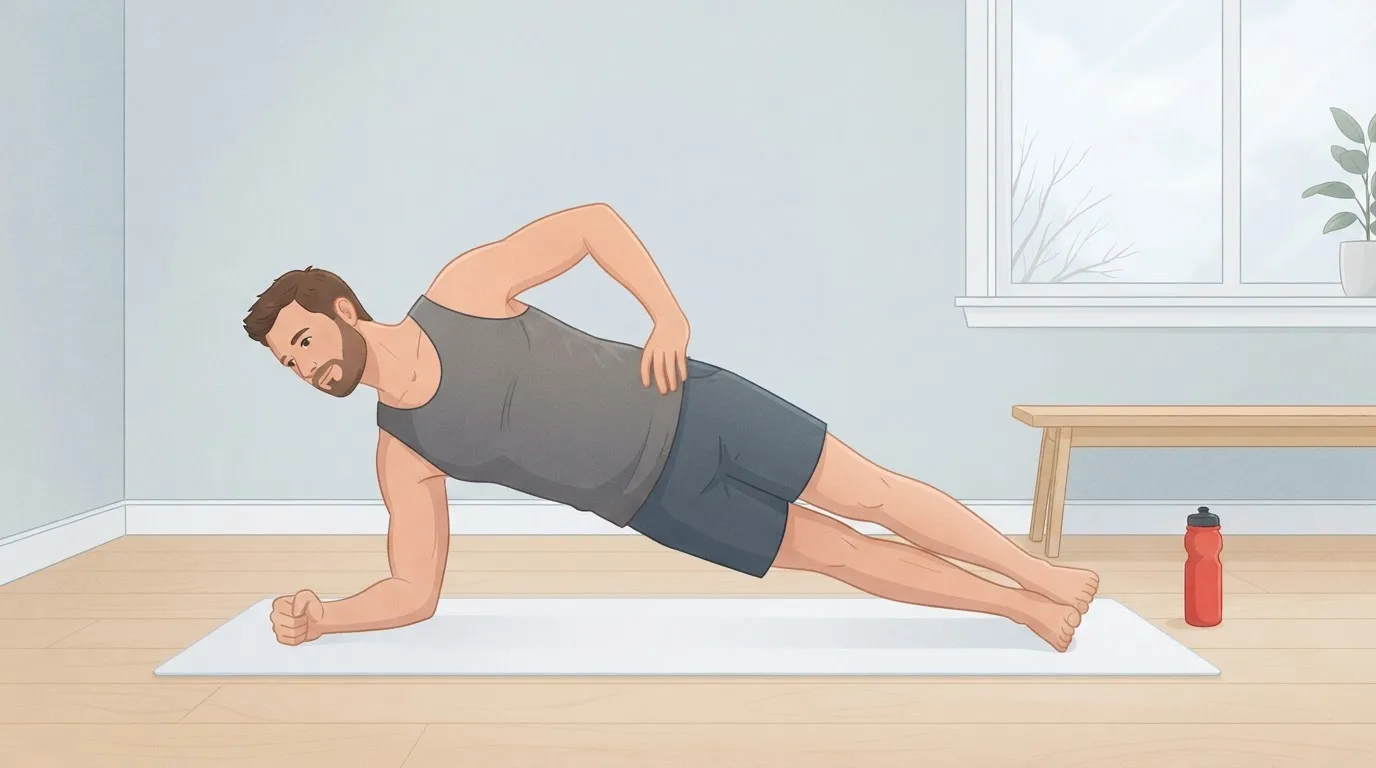
Lie on your side with your elbow under your shoulder and your knees bent behind you. Lift your hips until your body makes a straight line from head to knees, and hold. When that feels easy, straighten your legs and stack your feet. Our side plank guide walks through the form step by step.
The side plank has the strongest QL evidence of any exercise. Beyond the McGill recordings, Oshikawa and colleagues (2020) used fine-wire electrodes in 13 healthy men to compare 14 plank and bridge exercises. A side plank with the top leg raised gave the highest activity in both the front and back layers of the QL, at about 47 and 43 percent of maximum. So lifting your top leg a few inches is the natural next step once a 30-second hold feels steady.
If your shoulder or elbow complains, lie on your side and lift both straight legs together a few inches off the floor instead. In a surface EMG study of 20 healthy men, Choi and colleagues (2020) found that this side-lying double leg lift worked the QL about as hard as a full side plank, while a standing side lean against a wall worked it less.
2. Suitcase hold
Stand tall with one dumbbell hanging at your side, arm straight and shoulders level. Brace your stomach as if someone were about to poke it, and don't let the weight tip you toward it. Hold for 20 seconds, then switch hands. The QL and obliques on the side away from the weight do the work here, so you'll usually feel it on the empty-hand side.
The hold teaches the position before you add walking. Use a dumbbell you could curl easily. If you can't keep your shoulders level for 20 seconds, the weight is too heavy for now.
3. Suitcase carry
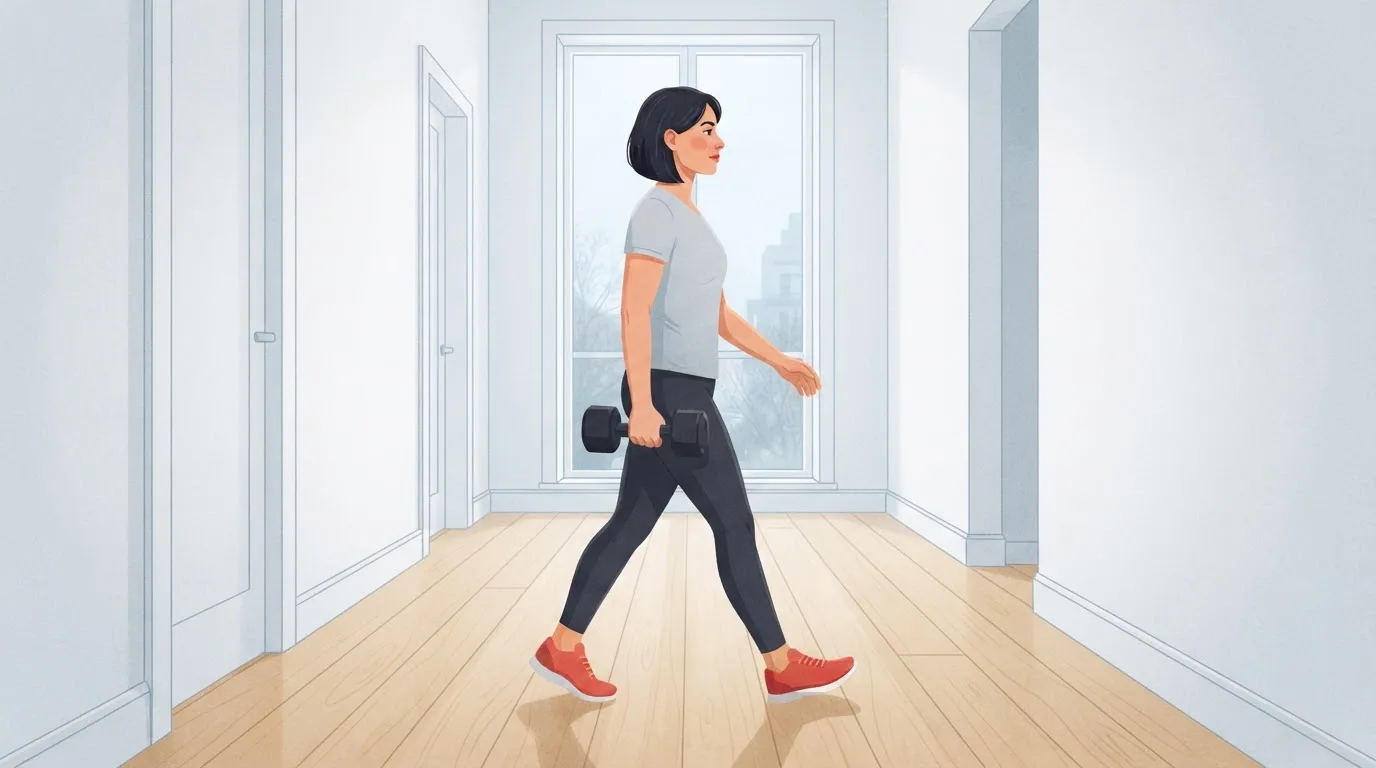
Pick up the same dumbbell and walk 20 steps, turn and walk back, then switch hands. Walk slowly, keep your head over your hips and let your free arm swing. If you catch yourself leaning toward the weight, or away from it to balance, set it down and go lighter.
A one-hand carry is a bigger challenge for your trunk than it looks. McGill, Marshall and Andersen (2013) had six people walk while carrying buckets and modelled the load on their low backs. With 30 kg in one hand, compression on the low back passed 2,800 newtons. Split across both hands, the same 30 kg produced 1,570 newtons, about 44 percent less, and even 30 kg in each hand loaded the spine less than 30 kg in one. That's why a modest dumbbell is enough to start, and why the weight should go up only a little at a time.
Carries also train something lifting doesn't. In a study of strongman events, McGill, McDermott and Fenwick (2009) found that the carrying events, including the suitcase carry, challenged the trunk differently from the lifting events, and suggested adding loaded carries to lifting-based programs. Our farmer's carry research review compares the two-hand and one-hand versions.
4. Bird dog
Start on your hands and knees with your hands under your shoulders and your knees under your hips. Reach one arm forward and the opposite leg back until both are level with your body, hold for 5 seconds, and return without letting your hips rock. Our bird dog guide has the levels from leg-only to the full version.
The bird dog reaches the back layer of the QL. In the Oshikawa study, the posterior QL worked harder on the side of the lifted leg when people were on their hands and knees with one arm and one leg raised than it did in a plain plank. Your hip on that side wants to drop or twist, and the QL helps stop it.
5. Side-lying hip hike
Lie on your side with both legs straight and your head resting on your bottom arm. Keep your knees straight and draw your top hip up toward your top ribs, so your top leg slides an inch or two toward your head. Hold for 2 seconds and lower it slowly. You should feel a small squeeze in your side between the ribs and the pelvis.
This is the gentlest move on the list, and no study has measured QL activity in it. It's the side-bend from the Andersson study done from the pelvis end, with almost no load, so it works well as a first step for finding the muscle when side planks still hurt.
6. Standing hip hike
Stand side-on at the edge of a step on your right foot, with your left foot hanging off the edge, and hold a wall or rail for balance. Keep both knees straight. Let your left hip drop below the level of the step, then lift it back up and a little above level using your waist, not your knee. Do 10, then switch sides.
This move trains two muscles at once. The QL on the hanging side lifts that hip, and the gluteus medius of your standing leg holds the pelvis steady. In an EMG study of 16 healthy adults, Bolgla and Uhl (2005) found that this pelvic drop exercise worked the standing leg's gluteus medius harder than standing leg raises did. They measured the glute, not the QL, so the QL half rests on anatomy.
7. Dead bug
Lie on your back with your arms pointing at the ceiling and your knees bent over your hips. Breathe out, flatten your lower back gently toward the floor, then slowly lower one arm behind you and straighten the opposite leg toward the floor. Return and switch sides. Our dead bug guide shows the easier versions.
The dead bug is mostly a front-of-the-trunk exercise, and there's no QL measurement for it. It's on this list because it teaches the skill the other six depend on: keeping your trunk still while your arms and legs move. That steadiness comes from many muscles working together. When Kavcic, Grenier and McGill (2004) modelled seven stabilization exercises, no single muscle dominated spine stability, and each muscle's role changed from task to task.
Find out what's really holding you back
FitCraft, our mobile fitness app, pairs you with an AI coach who builds you a personalized plan around your goals, schedule, and fitness level. Every FitCraft program is designed by Domenic Angelino, MPH (Brown University) and NSCA-CSCS, with research published in the Journal of Strength and Conditioning Research and Medicine & Science in Sports & Exercise.
Take the Free Assessment Free • 2 minutes • No credit cardHow Many Sets and Reps Build QL Strength?
Two or three sessions a week is enough. That matches the 2 to 3 days a week the American College of Sports Medicine position stand (2009) recommends for people new to strength training. Leave a day between sessions, and do them after a short warm-up or at the end of another workout.
- Holds (side plank, suitcase hold): 2 to 4 holds per side. Stop each hold while your position is still clean, even if that's 10 seconds. Add 5 seconds a week until you reach 30 seconds, then make the move harder.
- Carries: 2 to 4 walks of 20 to 30 steps per side. Add distance first, then a slightly heavier dumbbell.
- Reps (bird dog, hip hikes, dead bug): 2 sets of 6 to 12 per side, slow, with a short pause at the hardest point.
- Rest: 30 to 60 seconds between sets is plenty, since none of these moves are heavy.
Work both sides even when only one aches. If one side clearly tires sooner, give it one extra set until the two feel about even.
Make each move harder in small steps. For the side plank, go from bent knees to straight legs, then to a top-leg lift. For carries, add a few steps before you add weight. For the standing hip hike, slow the lowering down to three seconds. Expect hold times and carry distances to climb over four to six weeks, which is how strength usually shows up.
4 QL Stretches to Do After Your Strength Work
Stretches ease the tight, pulling feeling along your side, and they feel good at the end of a session. Very little research has tested QL stretches, so use them for comfort and range of motion. Hold each one for about 30 seconds per side. In a six-week hamstring stretching trial of 93 adults, Bandy, Irion and Briggler (1997) found that 30-second holds improved flexibility as much as 60-second holds, and stretching three times a day added nothing over once a day.
1. Standing overhead side reach
Stand with your feet hip-width apart. Raise your right arm overhead and reach up and over to the left, keeping your hips centered and both feet flat. You'll feel the stretch from your right hip to your right armpit. For a bigger stretch, cross your right foot behind your left.
2. Child's pose with a side reach
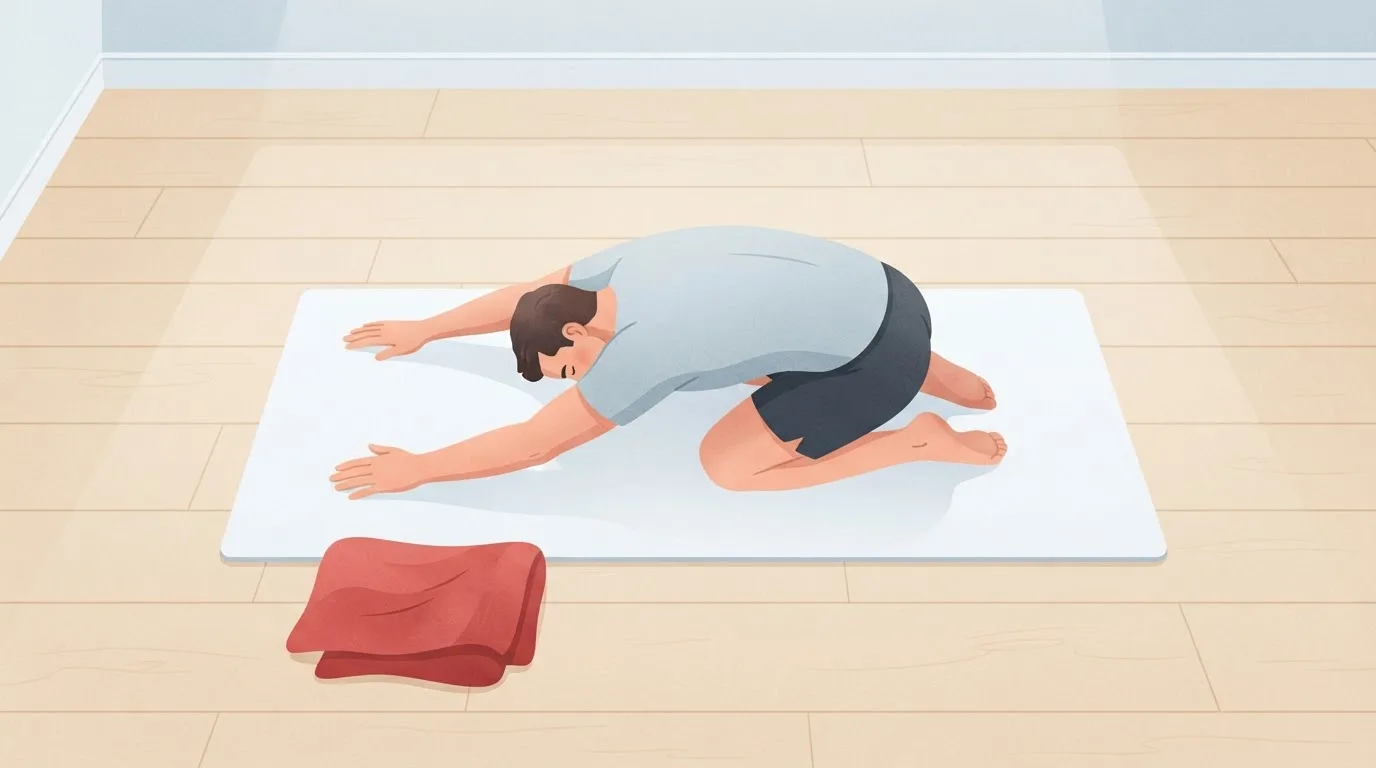
Kneel and sit your hips back toward your heels, with your arms stretched forward on the floor. Then walk both hands over to the left until you feel a stretch along the right side of your lower back. Breathe slowly into that side, then walk your hands to the right.
3. Seated side bend
Sit tall on a chair with both feet flat. Hold the seat with your left hand, raise your right arm overhead and lean to the left, keeping both hips on the chair. This one works at a desk between meetings. Our seated side bend guide shows the setup.
4. Lying banana stretch
Lie on your back on the floor or a bed. Walk your feet over to the left and reach both arms overhead and to the left too, so your body makes a curve like a banana. Keep your back flat and hold. The stretch runs along your right side. It's an easy one to do before bed.
A 15-Minute QL Routine You Can Do at Home
Run this two or three times a week. All you need is a mat, a step and one dumbbell. If you're short on time, the five starred moves take about 10 minutes.
| Order | Exercise | Dose | Time |
|---|---|---|---|
| 1 | Easy warm-up: cat-cow and slow side bends | 1 minute | 1 min |
| 2 | Bird dog * | 2 x 6 per side, 5-sec holds | 2.5 min |
| 3 | Side-lying hip hike | 2 x 10 per side | 1.5 min |
| 4 | Side plank * | 3 x 10 to 20 sec per side | 2.5 min |
| 5 | Suitcase hold | 2 x 20 sec per side | 1.5 min |
| 6 | Suitcase carry * | 3 x 20 steps per side | 2 min |
| 7 | Standing hip hike * | 2 x 10 per side | 1.5 min |
| 8 | Dead bug | 2 x 6 per side | 1 min |
| 9 | Two stretches of your choice * | 30 sec per side each | 1.5 min |
The order matters a little. The bird dog and hip hikes wake your trunk up, the side plank and carries do the heaviest work while you're fresh, and the stretches come last, when your muscles are warm.
What Weak Muscles Cause a Tight QL?
The usual answer is a weak gluteus medius, the muscle on the side of your hip that keeps your pelvis level when you stand on one leg. The theory goes like this: when that hip muscle can't hold your pelvis level, the QL on the other side hikes the hip to make up for it, works overtime all day, and ends up feeling tight and sore.
It's a reasonable idea with only indirect support. In a study of strongman events, McGill's team found that when the hip muscles that move the leg out to the side couldn't produce enough force during a very heavy yoke walk, muscles such as the QL made up the difference by holding the pelvis and torso from the side. In the clinic, Cooper and colleagues (2016) compared 150 people with chronic low back pain against 75 matched people without it. The gluteus medius tested weaker in the back pain group, and a Trendelenburg sign, the hip dropping on one side when you stand on one leg, was more common. That study didn't measure the QL, and it can't show which came first.
The practical answer is to train both. The standing hip hike above works your glutes and your QL in one move, and a side-lying leg raise or a clamshell adds more hip work. If one QL always feels tight, check whether you also stand on that leg with your hip pushed out, or always carry bags and children on the same side.
Do QL Exercises Help Lower Back Pain?
They can be part of the answer, but keep your expectations modest. Exercise therapy as a whole helps chronic low back pain by a small to moderate amount, and the evidence on which type works best is weak and mixed. Our review of the research on exercise for lower back pain goes through the trials. No trial has tested QL strengthening by itself for back pain, and the QL is a small contributor next to your larger back muscles. "QL syndrome" is a label some clinics use for one-sided low back pain, but it isn't a well-studied diagnosis.
The good news is that most new back pain settles. In a meta-analysis of 33 groups of patients with 11,166 people, Menezes Costa and colleagues (2012) found that average pain in people with acute low back pain fell from 52 out of 100 to 23 by six weeks, and to 6 by one year. Staying active and adding the moves above as they feel comfortable fits that pattern.
If your back already hurts, our guide to the best exercises for lower back pain has a 4-week plan and covers what to do in a flare, and our guide to core stability exercises explains how the side plank and bird dog fit into McGill's big three. See a doctor promptly for back pain with leg weakness, numbness in the groin or saddle area, trouble with your bladder or bowels, fever, unexplained weight loss, or pain after a fall.
The Bottom Line
The QL bends your trunk sideways, hikes your hip and holds your spine upright when a weight pulls on one side. Side planks have the best evidence, suitcase holds and carries train its everyday job, and hip hikes, bird dogs and dead bugs fill in the rest. Train them two or three times a week, stretch afterwards, and judge progress by longer holds and steadier carries.
The hard part is doing it for six weeks straight. If finding the time is what stops you, our roundup of the best workout apps for busy professionals compares the options. FitCraft's strength workouts use bodyweight and dumbbells, and an AI coach demonstrates each exercise on an interactive 3D model, names the muscles to focus on and says your name as you train. Your workouts adjust as you progress, and streaks make the rest of the week easier to keep. Barry, 42, fit his workouts in at breakfast while his kids ate, and it worked around his life. Do the 10-minute version of the routine tonight.
Frequently Asked Questions
What is the best exercise for the QL muscle?
The side plank is the best-studied QL exercise. In fine-wire recordings the quadratus lumborum worked at 54 percent of its maximum during a side plank, more than the other trunk muscles measured (McGill 1996). In a later study, a side plank with the top leg lifted gave the highest QL activity of 14 plank and bridge exercises (Oshikawa 2020). Start on your knees with 10-second holds if the full version is too hard.
Does walking loosen a tight back?
Walking keeps your back moving gently, and it can help keep back pain from coming back. In the WalkBack trial of 701 adults who had just recovered from low back pain, a walking and education program pushed the median time to the next episode of activity-limiting pain from 112 days to 208 days (Pocovi 2024). Start with short, easy walks and build up.
What are the big 3 exercises for lower back pain?
The big 3 are Stuart McGill's curl-up, side plank and bird dog, chosen to train the trunk muscles while keeping spine load low. Two of the three, the side plank and the bird dog, also work the quadratus lumborum. They're a sensible base, but they haven't been shown to beat other kinds of exercise for back pain.
Should you stretch or strengthen a tight QL?
Do both, with strengthening first. A QL that feels tight may be working hard to hold your trunk upright, and stretching eases that feeling for a while without making the muscle stronger. Train side planks, carries and hip hikes 2 to 3 days a week, then finish with two or three 30-second stretches.
How long does a QL strain take to heal?
No study has tracked QL strains on their own, but most new episodes of low back pain improve a lot within six weeks. In a meta-analysis of 33 cohorts, average pain in people with acute low back pain fell from 52 to 23 out of 100 by week six (Menezes Costa 2012). See a clinician if it isn't clearly easing after two or three weeks.
What's the worst thing to do for back pain?
For ordinary back pain, the worst move is usually to stop moving altogether and stay in bed. Gentle activity, walking and light exercise within comfort are the standard advice. Sudden leg weakness, numbness in the groin, trouble controlling your bladder or bowels, fever or pain after a fall needs a doctor straight away.