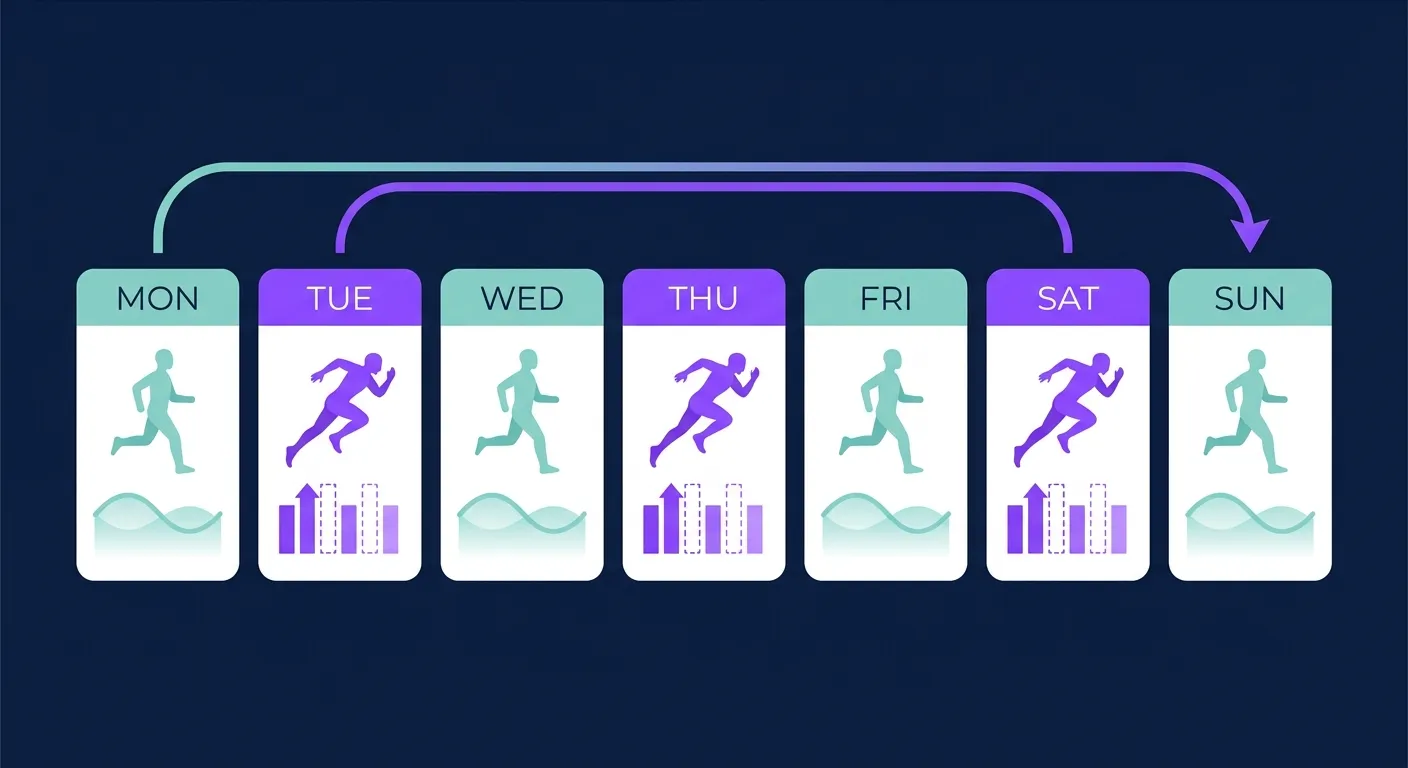
The Norwegian Singles Method is one of the most talked-about training frameworks in amateur endurance running right now. It emerged from online running communities in 2022 to 2023 as a distillation of what the Norwegian professional runners (Marius Bakken, the Ingebrigtsen brothers, Kristian Blummenfelt, Gustav Iden) actually do, scaled down to something a person with a job and a family can actually run. It has produced a stream of amateur PRs at every distance from the 5K to the marathon, and it has picked up enough enthusiasts on r/AdvancedRunning, LetsRun, and running podcasts that most coaches now field questions about it weekly.
What makes it interesting from a research standpoint is that the underlying principles are well-supported. The elite Norwegian training model has been characterized in the peer-reviewed literature for two decades. The polarized and pyramidal training-intensity-distribution research pools cleanly with what the Norwegian pros do in practice. And the specific mechanism the amateur singles method borrows, sub-threshold intensity control, sits in a well-defined physiological zone where researchers have documented substantial aerobic adaptations at manageable recovery cost.
This article walks through the actual research that supports the method, the ways elite and amateur versions differ, what a real session looks like, and where the framework runs into limits. If you are trying to decide whether to try it, this is the evidence you should be weighing.
The Research: What Studies Show
Seiler and Kjerland 2006: The Polarized Distribution
The foundational paper for modern endurance-training-distribution research is Seiler and Kjerland (2006), published in the Scandinavian Journal of Medicine and Science in Sports. The team tracked training in a cohort of well-trained junior cross-country skiers and quantified the daily distribution of intensity using three methods (session goal, heart-rate zones, and blood-lactate zones).
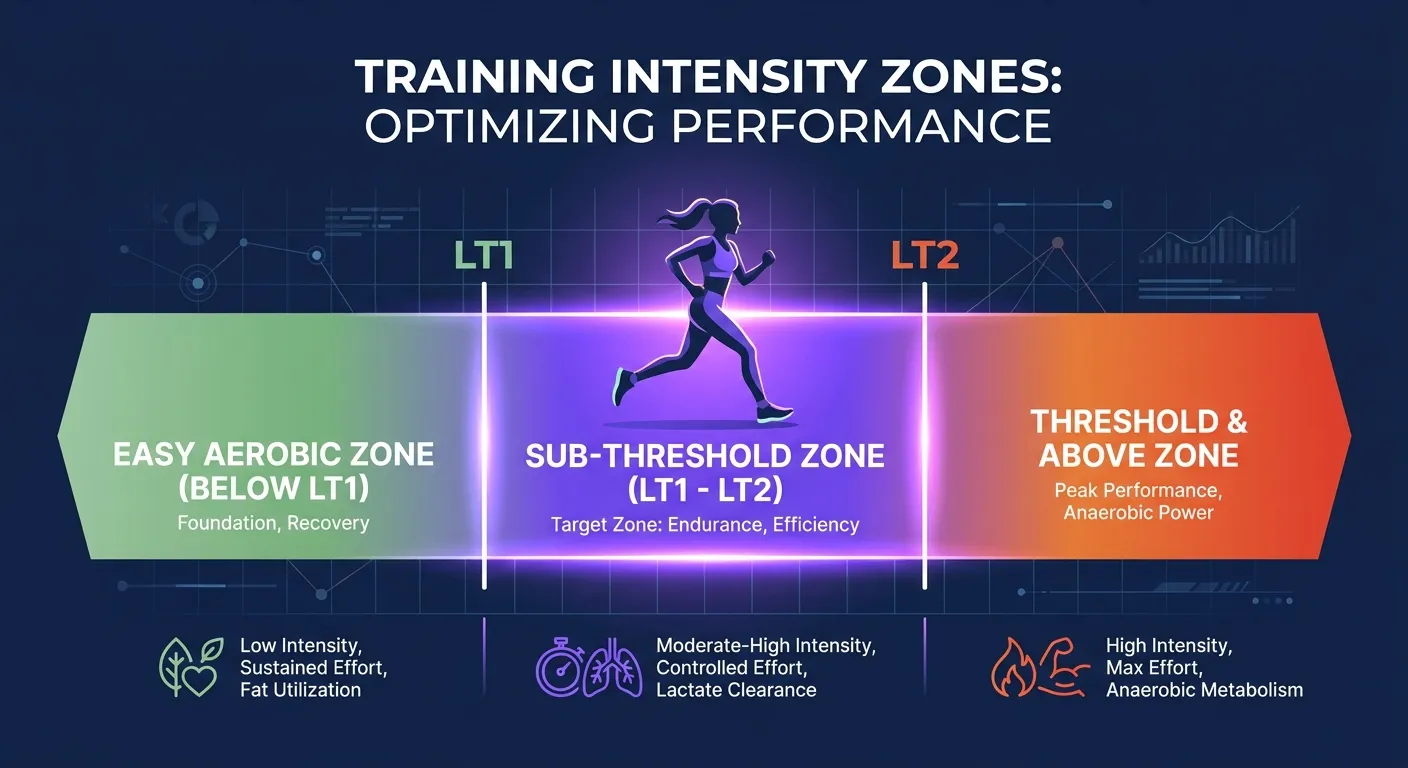
Two findings became durable reference points. First, roughly 75 to 80 percent of training time was spent at low intensity (below the first lactate threshold, LT1, around 2 mmol/L blood lactate). Second, the remaining ~20 percent was concentrated near or above the second lactate threshold (LT2, around 4 mmol/L), with very little time spent in the "moderate" zone between the two. That bimodal shape, heavy easy plus a targeted quality block, became known as the polarized training distribution, or the 80/20 rule in popular writing.
The paper did not claim polarized was optimal in a causal sense. It described what elite endurance athletes were already doing. But the description held up across dozens of follow-up cohort studies in rowing, running, cycling, and skiing, and it seeded the intervention trials that followed.
Tonnessen 2014: One Year of Training in Olympic Endurance Athletes
The most detailed longitudinal picture of what elite training actually looks like is Tonnessen, Sylta, Haugen, Hem, Svendsen, and Seiler (2014), published in PLOS ONE under the memorable title "The Road to Gold." The team reconstructed one full year of day-to-day training for 11 Norwegian cross-country skiers and biathletes leading into a gold-medal Olympic or World Championship performance.
Total volume averaged about 800 hours across 500 sessions per year, with roughly 500 hours specifically in the sport. 94 percent of training was aerobic endurance work. The rest was strength, speed, and race-specific work. The intensity distribution followed the pattern Seiler documented in 2006: heavy low-intensity base, targeted threshold and above-threshold quality, minimal time in the moderate middle zone. Peaking involved a taper in volume with the intensity distribution largely preserved.
Two points are worth pulling out. The volume itself is not the mechanism. What matters is the balance: enough easy work to sustain daily training without accumulating fatigue, plus enough hard work to drive adaptation, distributed so recovery is possible. Norwegian Singles borrows that balance principle even though the total hours are a fraction of the elite version. For a version of that balance scaled down to one short goal instead of a season, our 8-week mile plan applies the same easy-plus-hard split across a single training block.
Stoggl and Sperlich 2014: The Head-to-Head RCT
The most cited intervention trial in the distribution literature is Stoggl and Sperlich (2014), published in Frontiers in Physiology. 48 well-trained endurance athletes (runners, cyclists, triathletes, cross-country skiers, baseline VO2peak 62.6 ml/kg/min) were randomized to four different 9-week training programs, matched for total training time.
The four groups: high-volume training (HVT, heavy low-intensity), threshold training (THR, heavy moderate zone), high-intensity interval training (HIIT, heavy above-threshold), and polarized training (POL, heavy low plus targeted high, minimal moderate). Outcomes were VO2peak, time-to-exhaustion in an incremental test, peak power, and velocity at 4 mmol/L blood lactate.
POL improved VO2peak significantly more than the other three groups (+11.7 percent versus +4.8 percent for HIIT; the THR and HVT groups did not show significant VO2peak changes). Time-to-exhaustion also improved most in POL. HVT and THR were the worst-performing conditions across most variables, which contradicts both the "pure easy volume is enough" and the "grind threshold every session" positions. The paper's authors concluded that a polarized distribution produces greater adaptations than distributions dominated by any single intensity zone.
Rosenblat 2019: The Meta-Analysis
The head-to-head polarized-versus-threshold trials were pooled in Rosenblat, Perrotta, and Vicenzino (2019), published in the Journal of Strength and Conditioning Research. The team screened randomized controlled trials comparing polarized (POL) with threshold (THR) distribution in trained athletes (VO2max above 50 ml/kg/min). Four studies met inclusion criteria; three provided data suitable for meta-analysis.
The pooled effect on time-trial performance favored POL over THR with a moderate effect size (ES -0.66, 95 percent CI -1.17 to -0.15). That is the strongest quantitative evidence in the amateur-training literature that pushing more of your work into a single moderate intensity zone underperforms compared with sitting mostly easy and running mostly hard when you go hard.
Norwegian Singles is not pure polarized. It sits closer to a pyramidal distribution because the "quality" bucket is sub-threshold rather than above-threshold. The meta-analysis result still matters because it establishes that threshold-heavy training is not a superior alternative, and it validates the general principle that intensity distribution shape matters more than intensity alone.
Casado 2022: What Elite Runners Actually Do
The most important nuance in the current literature is Casado, Gonzalez-Mohino, Gonzalez-Rave, and Foster (2022), published in the International Journal of Sports Physiology and Performance. The team systematically reviewed 10 studies of training in highly trained and elite distance runners across 1500-meter through marathon events.
The finding that surprised people: elite runners actually run a pyramidal distribution more often than a strict polarized one. Pyramidal means the largest bucket is low intensity, the middle bucket (near LT1 and up to LT2) is meaningful, and the smallest bucket is above LT2. Polarized is the same shape except the middle bucket is nearly empty. Elite runners spend more time in the sub-threshold and threshold zones than the pure polarized model predicts. That is exactly what Norwegian Singles does: it plants a lot of work in the sub-threshold bucket rather than pushing every "quality" session above LT2.
Casado's authors were careful. They noted that distributions shift across the season (more polarized close to competition, more pyramidal in the base phase) and that middle-distance runners tend more polarized while marathon-focused runners tend more pyramidal. But the takeaway for amateur programming is clean: heavy sub-threshold work is what many of the fastest runners in the world actually do most of the year.
Kelemen 2023: The Elite Norwegian Double-Threshold Method
The direct parent of the Norwegian Singles Method is characterized in Kelemen, Benczenleitner, and Toth (2023), a systematic literature review of the Norwegian double-threshold method published in the Scientific Journal of Sport and Performance. The team synthesized 7 studies covering 13 elite Norwegian long-distance runners.
Weekly volume in the elite pool was 120 to 180 kilometers (roughly 75 to 112 miles). 75 to 80 percent of training was at low intensity (62 to 82 percent HRmax). Two to four sessions per week were at anaerobic threshold pace (82 to 90 percent HRmax), and these were often executed twice on the same day (the "double threshold" that gives the method its name). Once or twice a week the runners added a higher-intensity session above 97 percent HRmax.
Two features are load-bearing. Sub-threshold intervals were held below the second lactate threshold by lactate-meter feedback (targets in the 2.0 to 3.5 mmol/L range). And the doubles allowed cumulative threshold volume to climb without any single session becoming ruinously hard. Norwegian Singles preserves the first feature (sub-threshold intensity control) but drops the second (doubles). What amateurs give up in weekly threshold volume, they get back in reduced recovery load, and the daily schedule fits around ordinary life.
Why This Matters for Your Running
If you have been running for a year or more and you have hit a plateau on volume-only training (or on volume-plus-one-hard-workout-a-week), Norwegian Singles is worth serious consideration. The mechanism it targets is the biggest lever in aerobic development for a runner past the beginner phase: high cumulative work at intensities the body can actually adapt to, without dropping into the injury and recovery hole that pure threshold or VO2max training creates.
The reason the framework travels well from elite to amateur contexts is that sub-threshold intervals are inherently self-limiting. When you accumulate 25 to 40 minutes of work at effort just below the lactate turn-point, the fatigue signature is closer to a hard long run than to a track workout. You can do them 3 to 4 times a week without accumulating the neuromuscular damage that VO2max sessions produce, and you get most of the aerobic adaptation. That is the physiological argument. The behavioral argument is that runs held in the "controlled hard" zone are less scary to start, more sustainable across a season, and less likely to make you skip the workout because you dreaded the pain.
The trade-off is real. Norwegian Singles under-develops peak oxygen uptake and running economy at higher velocities. If you race 5K and shorter, you need dedicated VO2max blocks (2 to 4 weeks, 3x/week, sessions above 90 percent VO2max) mixed into your year to sharpen. The framework works best for events at half-marathon distance and up, where the lactate-buffering capacity that sub-threshold training builds directly determines race performance. It also assumes you have the aerobic base and pacing skill to hold an even effort across 5 to 8 intervals. Complete beginners without that base and control should start with our start-from-zero guide and our writeup on the run-walk method first.
This sits inside a broader picture on aerobic training that is worth reading alongside. Zone 2 training research covers the low-intensity end (Norwegian Singles builds on a foundation of Zone 2 work). Polarized training research covers the distribution shape and the trial evidence more broadly. Norwegian 4x4 protocol covers a different Norwegian export (an above-threshold interval protocol widely used in cardiac rehab and general fitness).
Get an evidence-based plan built for you
FitCraft, our mobile fitness app, pairs you with an AI coach who builds you a personalized plan around your goals, schedule, and fitness level. Every FitCraft program is designed by Domenic Angelino, MPH (Brown University) and NSCA-CSCS, with research published in the Journal of Strength and Conditioning Research and Medicine & Science in Sports & Exercise.
Take the Free Assessment Free • 2 minutes • No credit cardHow Norwegian Singles Works in Practice
The core weekly template, distilled from the community consensus and the elite research:
- Alternate quality and easy days. Sub-threshold interval workout on day 1, easy aerobic run on day 2, sub-threshold again on day 3, easy on day 4, and so on. One full rest or cross-training day per week is optional but common.
- Sub-threshold sessions target 2.0 to 3.0 mmol/L blood lactate. That is the zone between LT1 and LT2, well below the sharp inflection where lactate starts to accumulate rapidly. Without a lactate meter, the practical marker is "controlled discomfort," described as effort you could hold for about an hour but not race at.
- Interval structures are moderate reps and moderate distances. Common sessions: 5 to 8 repeats of 1000 meters with 60 to 90 seconds jog recovery, or 4 to 6 repeats of 1600 to 2000 meters with 90 to 120 seconds jog. Total quality volume per session lands between 4 and 10 kilometers.
- The last rep is not harder than the first. If effort creeps up mid-session, slow down. If your third or fourth interval feels like a race, you started too hard. Community shorthand: "if in doubt, easier."
- Easy days are genuinely easy. Conversational pace, around 65 to 75 percent max heart rate. If the easy days start slipping into moderate effort, the whole system breaks because you cannot recover for the next quality day. This is the single biggest execution failure.
- Weekly quality volume climbs gradually. Start with 4 to 5 km at sub-threshold across the two or three weekly quality days. Build over 6 to 12 weeks toward 10 to 15 km per week. Never add distance and pace in the same week.
- Long run once a week. One easy long run per week (60 to 120 minutes for most amateur builds) at conversational pace. Some plans put a short sub-threshold segment mid-long-run once every 2 to 3 weeks. Most keep the long run pure easy.
- Strides or short hills twice a week. Add 4 to 6 x 20-second strides at the end of two easy runs to preserve neuromuscular quality without adding fatigue. This is the practical replacement for VO2max work outside of dedicated peaking blocks.
- Pre-race VO2max block. If you race a 5K or shorter, insert a 3 to 4 week block of true VO2max intervals (5 to 6 x 3 minutes at 3K to 5K pace, or 6 to 8 x 800m at similar effort) in the month before the race. Norwegian Singles builds the aerobic engine; VO2max sharpens the top end.
Individual Variation: Who Sees the Biggest Difference
Runners Coming Off Traditional Threshold Plans
The runners who see the fastest gains on Norwegian Singles are often the ones who spent years on Jack Daniels-style plans that put one hard threshold workout and one hard interval workout per week. The typical progression: 6 to 8 weeks of Norwegian Singles produces a PR at 10K and half-marathon distances, partly because cumulative sub-threshold volume climbs and partly because the runner stops accumulating the mid-week fatigue that a "hard workout Tuesday, hard workout Saturday" template produces. The mechanism is dose-response: more quality volume at a tolerable intensity beats less quality volume at a punishing intensity.
Time-Crunched Runners
The Ingebrigtsens run 120 to 180 km per week. A working amateur cannot. What makes Norwegian Singles adaptable is that the intensity control (sub-threshold) transfers cleanly to lower weekly mileage. A 40 mile per week runner alternating sub-threshold days with easy days is running the same physiological program the elites are, just at a fraction of the volume. Results scale with mileage, but the framework does not fall apart at 30 to 40 miles per week the way high-volume-only training does.
Master Runners and Recovering Runners
Runners over 40 tend to recover better from sub-threshold intervals than from above-threshold work, and that recovery advantage compounds over a season. Norwegian Singles is one of the better master-runner frameworks for that reason. Similarly, runners coming back from an injury layoff find that sub-threshold intervals let them re-introduce quality work without risking the tendon and joint irritation that above-threshold intervals can produce.
Middle-Distance Racers
The one population that should be more cautious is racers focused on 5K and shorter. The pure Norwegian Singles template under-develops running economy at faster paces and neuromuscular recruitment at near-max efforts. Casado and colleagues (2022) noted that middle-distance runners tend more polarized (with a bigger above-threshold bucket) than marathoners in the elite data. Amateur 5K racers should either use Norwegian Singles as a base-building phase then add a VO2max block, or blend the singles framework with a weekly true VO2max session year-round.
Common Misconceptions
Misconception 1: "Norwegian Singles is just polarized training."
Not exactly. Polarized training as defined in the Seiler literature keeps the "quality" bucket above the second lactate threshold, so a polarized week is heavy easy plus above-threshold intervals with almost no time in the middle zone. Norwegian Singles puts its quality bucket in the middle zone, just below LT2. That makes it closer to the pyramidal distribution Casado documented in elite runners than to strict polarized. The Rosenblat and Stoggl trial evidence supports the general principle that a well-shaped distribution beats a threshold-heavy one, but the specific placement of quality in Norwegian Singles is a pyramidal-ish variant, not textbook polarized.
Misconception 2: "You need a lactate meter to do it right."
A lactate meter helps a lot in the first few weeks because it removes the guesswork. It is not required. The talk test and RPE are usable substitutes for most amateurs. You are in the right zone if you can speak in short sentences but not hold a conversation, effort feels like 5 to 7 out of 10, and you finish the session thinking you could have done another rep or two. If you end sessions crushed, you were above sub-threshold.
Misconception 3: "Because the elites do doubles, I need to eventually do doubles too."
No. Doubles in the elite Norwegian system exist to raise cumulative weekly threshold volume above what one session can deliver, and to distribute that volume across two shorter recovery windows in the same day. That only pays off at 15 to 25 hours of weekly training. For anyone running under 90 minutes per day, a single well-run sub-threshold session per quality day fully saturates the adaptation you can absorb before the next one. Adding doubles to a 5-hour-per-week schedule increases risk without adding stimulus.
Misconception 4: "Skipping VO2max sessions means you sacrifice speed forever."
Not permanently. Sub-threshold training does under-develop pure VO2max compared with above-threshold interval work in the short term. But VO2max responds quickly to a targeted block (Stoggl 2014 measured meaningful gains in 9 weeks). Amateurs on Norwegian Singles year-round will lose some 5K peak, but 3 to 4 weeks of true VO2max intervals in the month before a race recovers most of it. The base you built by staying healthy on sub-threshold is what makes the VO2max block productive.
Misconception 5: "It only works because the Norwegians are genetically talented."
The genetics argument gets less credible the longer you look at it. The Kelemen 2023 review characterized 13 elite Norwegian runners but the training model has been adopted by non-Norwegian elites (Bashir Abdi, several European marathon medalists) and by thousands of amateurs producing PRs across every training group. The mechanism is not Norwegian genetics; it is the intensity-control discipline that the Norwegian coaching culture built infrastructure around. Any runner can copy the intensity discipline. That is what makes the amateur adaptation portable.
What the Research Suggests Going Forward
The Norwegian training research is in a solid place. The distribution literature (Seiler 2006, Tonnessen 2014, Stoggl 2014, Rosenblat 2019, Casado 2022) converges on the finding that elite endurance athletes distribute training heavily toward low intensity and cluster their quality work either at or just below the second lactate threshold. The specific Norwegian double-threshold implementation is now characterized in the Kelemen 2023 systematic review. And the amateur singles adaptation has an accumulating body of user experience showing it produces PRs at half-marathon and marathon distances with reasonable weekly volume.
What is still open:
- No randomized controlled trial has directly tested Norwegian Singles in amateur runners against a matched-volume traditional plan (e.g., Daniels or Pfitzinger). All the amateur evidence is anecdotal or case-series. A well-designed RCT of 12 to 16 weeks would settle whether the effect size in amateurs is as favorable as the elite pattern suggests.
- The optimal ratio of sub-threshold to above-threshold work in a mixed year is not resolved. Elite Norwegian runners still include some above-threshold work, especially in-season. How much amateurs need is under-studied.
- Whether the sub-threshold zone target should be tighter (2.0 to 2.5 mmol/L) or looser (2.0 to 3.5 mmol/L) for amateurs is debated. Lactate response to a given pace varies with training status, diet, and prior-day fatigue, so a fixed lactate target may be less useful than an RPE-plus-pace band for many recreational runners.
- Long-term durability of Norwegian Singles across a full year (or multiple years) has not been tracked in a rigorous cohort. The elite version peaks and periodizes; amateurs sometimes run the same singles pattern year-round without formal blocks. Whether that produces stagnation or continued gains is unclear.
- Sex differences in response are almost completely unstudied. The bulk of the Norwegian training characterization work was done in male athletes. Whether female runners respond identically, faster, or slower to the same distribution is an open question worth answering.
The bottom line for a runner deciding whether to try it: if you have a year or more of consistent aerobic training under your belt, race at half-marathon or marathon distances, and want a framework that stays productive without asking you to grind punishing threshold workouts week after week, Norwegian Singles is one of the best-supported amateur templates in the literature right now. The mechanism is real, the distribution research is mature, and the practical execution rules are not complicated. The hardest part is the discipline to keep sub-threshold sessions sub-threshold. Almost everyone runs the first three intervals a little too hard.
This is a good example of why consistency beats intensity in almost every serious training study that runs long enough to detect the effect. Norwegian Singles works partly because it delivers meaningful stimulus at a cost you can pay every week for a year, not because any single session is optimized.

References
- Seiler KS, Kjerland GO. "Quantifying training intensity distribution in elite endurance athletes: is there evidence for an 'optimal' distribution?" Scand J Med Sci Sports. 2006;16(1):49-56. doi:10.1111/j.1600-0838.2004.00418.x
- Tonnessen E, Sylta O, Haugen TA, Hem E, Svendsen IS, Seiler S. "The road to gold: training and peaking characteristics in the year prior to a gold medal endurance performance." PLoS One. 2014;9(7):e101796. doi:10.1371/journal.pone.0101796
- Stoggl T, Sperlich B. "Polarized training has greater impact on key endurance variables than threshold, high intensity, or high volume training." Front Physiol. 2014;5:33. doi:10.3389/fphys.2014.00033
- Rosenblat MA, Perrotta AS, Vicenzino B. "Polarized vs. threshold training intensity distribution on endurance sport performance: a systematic review and meta-analysis of randomized controlled trials." J Strength Cond Res. 2019;33(12):3491-3500. doi:10.1519/JSC.0000000000002618
- Casado A, Gonzalez-Mohino F, Gonzalez-Rave JM, Foster C. "Training periodization, methods, intensity distribution, and volume in highly trained and elite distance runners: a systematic review." Int J Sports Physiol Perform. 2022;17(6):820-833. doi:10.1123/ijspp.2021-0435
- Kelemen B, Benczenleitner O, Toth L. "The Norwegian double-threshold method in distance running: systematic literature review." Sci J Sport Perform. 2023;3(1):38-46. doi:10.55860/NBXV4075
Frequently Asked Questions
What is the Norwegian Singles Method?
The Norwegian Singles Method is an amateur adaptation of the Norwegian threshold training approach. Runners do a sub-threshold interval session (below the second lactate threshold, around 2 to 3 mmol/L blood lactate) every other day, and easy aerobic running on the alternate days. There are no traditional VO2max workouts, no doubles, and no all-out efforts most weeks. It borrows the sub-threshold intensity control that Marius Bakken and the Ingebrigtsen brothers use, but keeps the total volume and session count realistic for people who train once a day.
How is Norwegian Singles different from the Norwegian double-threshold method?
The elite Norwegian double-threshold method uses two sub-threshold sessions on the same day, typically twice a week, alongside 120 to 180 kilometers of weekly running (per Kelemen and colleagues 2023). That workload only makes sense for full-time elites with clinic-grade recovery support. Norwegian Singles keeps the same sub-threshold intensity control but caps it at one session per day, every other day, running once daily. Same physiological target, realistic workload.
Does the polarized training research actually support Norwegian Singles?
Directly and indirectly, yes. Seiler and Kjerland (2006) showed elite endurance athletes distribute training with about 80 percent easy work and about 20 percent high-intensity work (the 80/20 polarized pattern). Stoggl and Sperlich (2014, Frontiers in Physiology) randomized 48 well-trained athletes to 4 different distributions for 9 weeks; the polarized group improved VO2max and time-to-exhaustion more than the threshold, high-intensity-interval, or high-volume groups. Rosenblat and colleagues (2019) pooled 3 RCTs and found a moderate effect favoring polarized over threshold (ES -0.66). Norwegian Singles sits closer to the pyramidal end of the spectrum that Casado and colleagues (2022) documented in elite distance runners, but the low-intensity majority and sub-threshold quality bucket are the same load-bearing features.
What does a Norwegian Singles workout actually look like?
A typical session is 5 to 8 repeats of 800 to 2000 meters with short rest, run at an effort that stays just below the second lactate threshold (roughly marathon-to-half-marathon race pace for most amateurs). If you have a lactate meter, target 2.0 to 3.0 mmol/L. If you do not, use the talk test: you can speak in short sentences but not hold a conversation. RPE sits at 5 to 7 out of 10, described in the community as "controlled discomfort." The critical rule is that the last interval feels no harder than the first. If the effort creeps into all-out threshold or VO2max territory, the plan breaks.
Who should not use the Norwegian Singles Method?
Complete beginners should not start here. Sub-threshold interval work assumes you have an aerobic base of at least 25 to 30 miles a week for 3 to 6 months and the pacing awareness to hold a controlled effort. Runners peaking for a 5K or shorter event may under-develop top-end speed without a dedicated VO2max block. Anyone with uncontrolled cardiovascular disease, a history of chest symptoms with exertion, or recent injury should get medical clearance before starting any interval program.