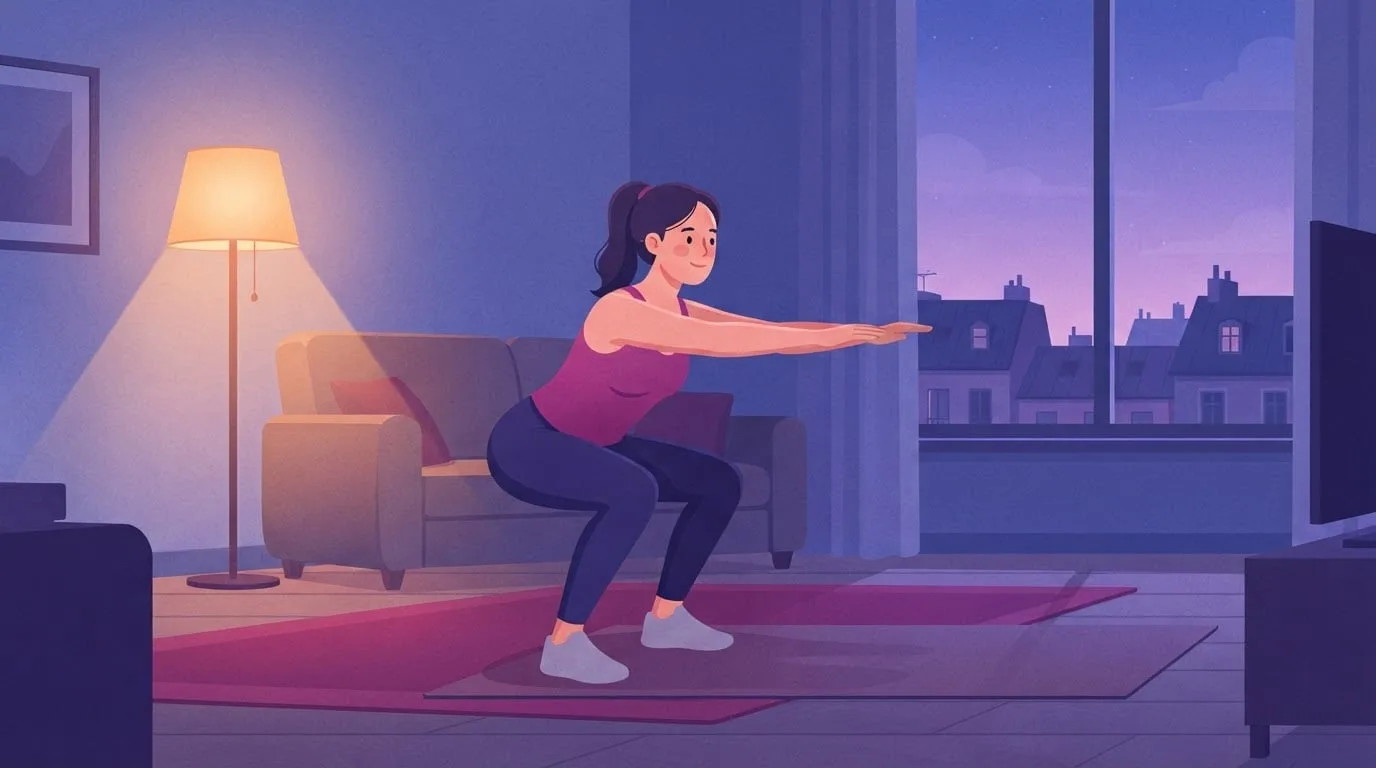
You did 100 squats before breakfast, checked a calorie calculator, and it said 22. If that felt like a letdown, the number is about right. Squats are one of the best things you can do for your legs and one of the slowest ways to burn calories, and knowing the size of each helps you use them well.
This page is the squat-specific part of our calorie series. The ranking of the highest-burning exercises lives on our page about what exercise burns the most calories. Here you'll find what one squat costs, what lab studies measured, per-minute tables by body weight, 100 squats, goblet and jump squats, tempo, and what squats help with beyond calories.
How Many Calories Does One Squat Burn?
A bodyweight squat burns about 0.2 calories at a steady pace for a 150 lb person and about 0.35 when you take it slowly. The 2024 Adult Compendium of Physical Activities by Herrmann and colleagues has two entries that match a plain squat closely, because they cover sit-to-stand exercise: standing up from a chair and sitting back down. At 6 to 12 reps a minute it rates 2.8 METs, and at 18 to 24 a minute it rates 4.0. At 150 lb that's about 3.2 and 4.5 calories a minute, using the Compendium's approximation of 1 calorie per kilogram of body weight per hour for each MET.
A slow squat costs more per rep because each rep takes longer, and part of every minute is energy you'd spend standing still anyway. A quicker pace wins per minute. Here's the cost of one squat at five body weights:
| Body weight | Per squat at 18 to 24 a minute (4.0 METs) | Per squat at 6 to 12 a minute (2.8 METs) |
|---|---|---|
| 120 lb (54 kg) | 0.17 | 0.28 |
| 150 lb (68 kg) | 0.22 | 0.35 |
| 180 lb (82 kg) | 0.26 | 0.42 |
| 210 lb (95 kg) | 0.30 | 0.49 |
| 240 lb (109 kg) | 0.35 | 0.56 |
These are gross figures, so they include your resting burn. Take it out and a steady squat costs about 0.16 calories at 150 lb. The cost climbs with body weight because every rep lifts most of your body against gravity, and a heavier body takes more energy to lift.
Calories Burned Doing Squats Per Minute, by Body Weight
Bodyweight squats burn about 3.5 to 7.5 calories a minute at 150 lb, and more with a dumbbell or a jump. The Compendium rates general bodyweight exercises such as squats and lunges at 3.0 METs and hard bodyweight sets at 6.5. Loaded squats rate 5.0, and squat jumps inside a HIIT circuit rate 11.0. Here are the calories per minute of work:
| Body weight | Easy bodyweight sets (3.0) | Steady, 18 to 24 a minute (4.0) | Hard bodyweight sets (6.5) | Goblet squats (5.0) | Jump squats in HIIT (11.0) |
|---|---|---|---|---|---|
| 120 lb | 2.7 | 3.6 | 5.9 | 4.5 | 10.0 |
| 150 lb | 3.4 | 4.5 | 7.4 | 5.7 | 12.5 |
| 180 lb | 4.1 | 5.4 | 8.8 | 6.8 | 15.0 |
| 210 lb | 4.8 | 6.4 | 10.3 | 7.9 | 17.5 |
| 240 lb | 5.4 | 7.3 | 11.8 | 9.1 | 20.0 |
These figures cover minutes of work. Rest between sets burns close to your resting rate, about 1.1 calories a minute at 150 lb, so a 20-minute squat session with rests burns less than 20 times the figure in the table.
What Lab Studies Measured for Squats
Three lab studies put real numbers on loaded squats. Mazzetti and colleagues (2007) measured nine young men doing four sets of eight squats on a plate-loaded squat machine at 60 percent of their one-rep max, with 90 seconds between sets. Across the workout they burned 6.4 to 7.3 calories a minute, and about 2.4 to 2.5 a minute during the hour afterward.
Del-Cuerpo and colleagues (2023) measured 29 sports science students, 13 men and 16 women who averaged 68 kg, doing half squats on a computer-controlled resistance machine. Three sets of 30 reps at half their maximum burned about 109 to 124 calories across the measured protocol, which included five-minute rests, while three sets of 12 at 75 percent burned about 92. Men burned about 40 percent more than women in every session, and both sex and body mass index predicted the total.
Robergs and colleagues (2007) measured 20 trained men squatting continuously for five minutes at several loads. Oxygen use rose with both the load and the distance it traveled, and their calorie estimates came out higher than earlier studies had suggested. Two practical points follow: deeper squats cost more than shallow ones because the load travels farther, and a heavier load costs more per rep.
How Many Calories Do 100 Squats Burn?
100 bodyweight squats burn about 22 calories at 150 lb at a steady pace of about 20 a minute, and about 35 if you spread them over 11 minutes. Jump squats raise it to about 50. Here's the range by body weight, counting the calories you'd burn anyway:
| Body weight | Steady, about 5 minutes | Slow, about 11 minutes | Jump squats, about 4 minutes of jumping |
|---|---|---|---|
| 120 lb | 17 | 28 | 40 |
| 150 lb | 22 | 35 | 50 |
| 180 lb | 26 | 42 | 60 |
| 210 lb | 30 | 49 | 70 |
| 240 lb | 35 | 56 | 80 |
Halve the table for 50 squats: about 11 to 18 calories at 150 lb. Run the math the other way and the numbers get big fast. Burning 300 calories takes about 1,400 steady squats at 150 lb, more than an hour of nonstop squatting, and 1,000 calories takes about 4,600. Whether 100 a day is a good habit is a separate question, and our guide to how many squats a day answers it by goal.
Knowing what to do is the easy part.
FitCraft, our mobile fitness app, pairs you with an AI coach who builds you a personalized plan around your goals, schedule, and fitness level. Every FitCraft program is designed by Domenic Angelino, MPH (Brown University) and NSCA-CSCS, with research published in the Journal of Strength and Conditioning Research and Medicine & Science in Sports & Exercise.
Take the Free Assessment Free • 2 minutes • No credit cardBodyweight Squats vs Dumbbell Goblet Squats
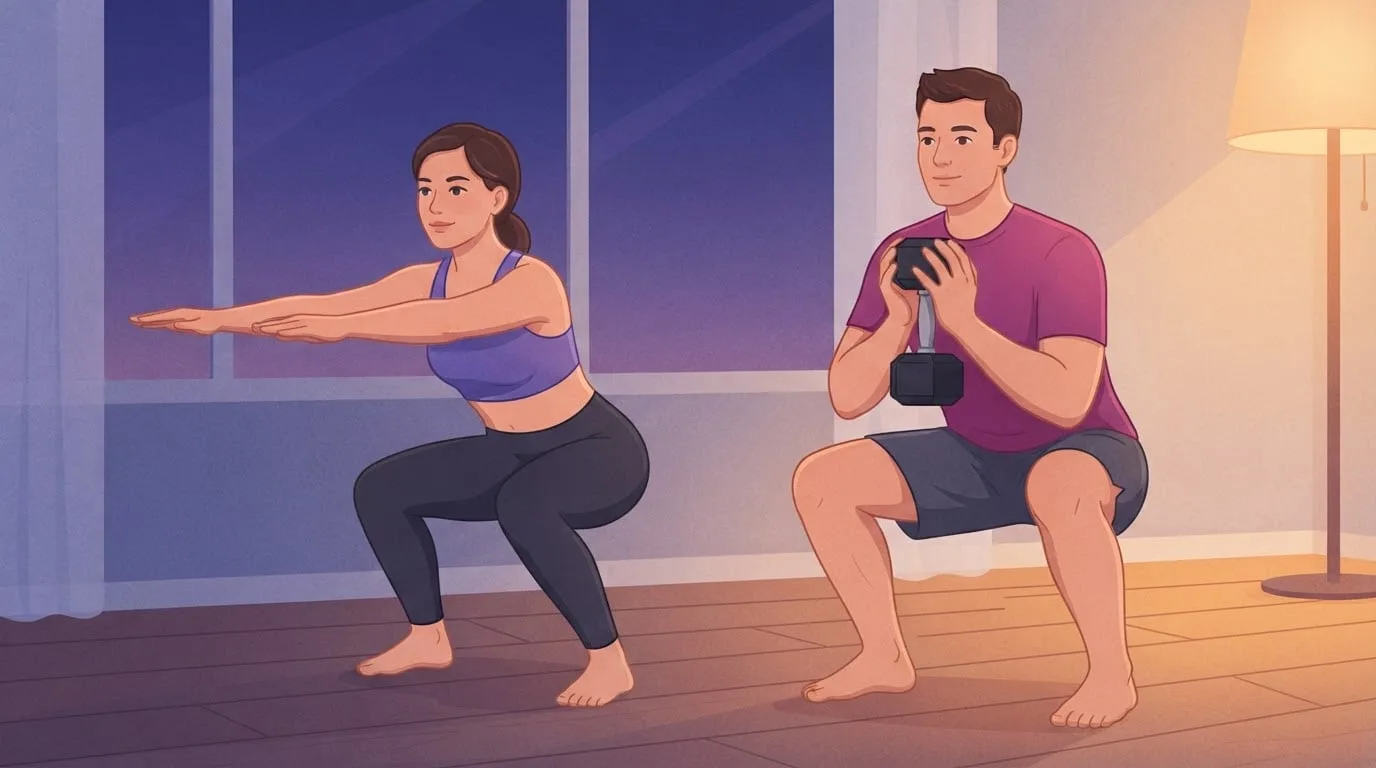
Holding a dumbbell at your chest makes every rep cost more, because you lift more weight through the same distance. The Compendium reflects that: general bodyweight exercise rates 3.0 METs and loaded squats 5.0, so goblet squats burn about two thirds more per minute than easy bodyweight sets. At 150 lb that's roughly 5.7 calories a minute of work against 3.4. Our goblet squat guide covers the setup and form.
The bigger difference is what each set does for your legs. With a dumbbell, a set gets hard within about 8 to 15 reps rather than after dozens, and hard sets are what build muscle. How you load the squat also changes the burn. In the Del-Cuerpo study, three sets of 30 at half of maximum burned more in total than three sets of 12 at 75 percent. In the Mazzetti study, a moderate load lifted explosively burned more per minute (7.27 calories) than a heavier load lifted the same way (6.25). For calories, a moderate weight and more reps come out ahead, and for strength, heavier sets do.
How Many Calories Do Jump Squats Burn?
Jump squats burn about 12.5 calories a minute of work at 150 lb, nearly three times a steady bodyweight squat. The Compendium has no separate jump squat entry. Its closest match is high-intensity interval exercise with burpees, mountain climbers and squat jumps at 11.0 METs, so treat that as the rate for hard sets of jump squats. At 20 to 30 jumps a minute, that works out to about 0.4 to 0.6 calories per jump at 150 lb.
Measured sessions land in the same place. A 20-minute bodyweight Tabata that included squats, split squats and box jumps averaged 14.5 calories a minute in fit adults (Emberts and colleagues, 2013), a study our ranking of the exercises that burn the most calories describes in more detail. Jumps add impact, though. Each landing loads your knees, hips and ankles more than a plain squat, so land softly with your knees bent, keep the sets short and build up over a few weeks. Our jump squat guide walks through the landing.

Does Squat Tempo Change the Calories?
Yes. Faster, explosive reps burn more per minute, while slow reps burn more per rep and less per minute. Mazzetti's study compared the same work done two ways: four sets of eight at 60 percent of max, lifted explosively or over two seconds. The explosive reps burned 7.27 calories a minute against 6.43 for the slow ones, about 13 percent more, and blood lactate rose higher after the slow sets.
Much slower reps cost less again. In a study by Hunter and colleagues (2003), seven trained young men burned about 155 calories above resting in a normal-tempo weight workout against 107 when they did the same workout as Super Slow training, 45 percent more at the normal tempo. The Compendium's sit-to-stand entries show the same pattern for bodyweight squats, 2.8 METs at 6 to 12 reps a minute and 4.0 at 18 to 24.
Slow squats still have a job. A three-second lowering or a pause at the bottom makes each rep harder and builds control, which our page on tempo training explains, and our 30 day squat challenge builds tempo and pause squats into a month of training. For calories, a brisk, steady pace comes out ahead.
Do Squats Help You Lose Weight?
Squats help weight loss mostly by building and keeping leg muscle. Even 500 squats a week add up to only about 110 calories at 150 lb, and fat loss follows your total energy balance from all your activity and your eating. Squats protect the muscle in your legs while you eat a little less, and stronger legs make walking, stairs and every other calorie-burning activity easier to keep up. The exercises that burn the most calories, and why the minutes you can sustain matter more than intensity, are covered on our page about what exercise burns the most calories.
What Do Squats Help With?
Squats train the movement you use every time you sit down and stand up. If you're wondering what squats work, it's mainly your quadriceps and glutes, with the muscles around your hips, your calves and your trunk helping you balance, as our squat exercise guide shows. That everyday link is why the 30-second chair stand, which counts how many times you can stand up from a chair, is a standard strength test for adults over 60. Jones, Rikli and Beam (1999) validated it in 76 older adults: scores tracked leg press strength, with correlations of 0.78 in men and 0.71 in women, and fell with each decade of age.
Squats also deliver the things people usually want from them. Hard sets build stronger, firmer legs and glutes, which our look at whether squats make your butt bigger covers. Squat breaks also help during long stretches of sitting: in a trial of 18 young men with overweight or obesity, Gao and colleagues (2024) found that short squatting breaks every 45 minutes lowered blood sugar after meals more than one 30-minute walk did.
What This Means for You
Count squats for your legs and let the rest of your day handle the calories. A few hard sets most weeks keep the muscle that makes every other kind of movement easier, and that muscle is what you'll notice on the stairs, on a hike or getting up off the floor. Picture your squats a couple of months from now: deeper, steadier and holding a heavier dumbbell than you thought you'd manage.
If you'd like those sets planned and led for you, a home workout app with no equipment needed can do it. In FitCraft, a 3D AI coach demonstrates each exercise and says your name as you work, the workouts adjust as you progress, and streaks keep a running count of the days you show up. Stacy, 41, lost 22 pounds in four months, and her reason was simple: "After my second kid, I needed something stupidly simple."
Frequently Asked Questions
How many calories do 50 squats burn?
About 11 to 18 calories for a 150 lb person and 14 to 24 at 200 lb, depending on whether you do them at a steady pace of about 20 a minute or slowly over five minutes. Fifty jump squats raise it to about 25 at 150 lb. Fifty squats are worth doing for your legs, but they're a small part of a day's calorie burn.
How many squats does it take to burn 1,000 calories?
About 4,600 steady bodyweight squats at 150 lb, or about 3,500 at 200 lb. That's almost four hours of nonstop squatting at 150 lb and nearly three at 200 lb. Burning 300 calories takes about 1,400 squats at 150 lb. For comparison, an ordinary 10,000-step day burns about 400 calories at 150 lb, the same as roughly 1,850 squats.
How many calories do squats burn with weights?
Goblet and other loaded squats rate 5.0 METs in the 2024 Compendium, about 5.7 calories a minute of work at 150 lb and 7.6 at 200 lb. In the lab, young men doing four sets of eight loaded squats burned 6.4 to 7.3 calories a minute across the workout, rests included. Moderate weights for more reps burned more in total than heavy weights for fewer reps.
Do squats burn belly fat?
Not directly, because you can't burn fat from one spot. In a 12-week study by Ramírez-Campillo and colleagues (2013), 11 young adults trained one leg with up to 1,200 leg-press reps per session. Their total fat mass fell 5.1 percent, but the fat came off the arms and trunk, not the trained leg. Squats help with belly fat the same way, by adding to the activity and muscle that shrink your total body fat.
How many calories do lunges burn?
About the same as squats. The 2024 Compendium rates general bodyweight exercises such as squats and lunges at 3.0 METs and moderate calisthenics that include lunges at 3.8, about 3.4 to 4.3 calories a minute at 150 lb. Holding a dumbbell in each hand raises the cost with the load, as it does for squats.
Do deadlifts burn a lot of calories?
About as many as loaded squats. The 2024 Compendium puts squats and deadlifts in one entry at 5.0 METs, about 340 calories an hour of lifting at 150 lb and 455 at 200 lb. A real session burns less than that, because much of it is rest between sets.
What is the laziest way to burn calories?
Small bouts of movement spread through the day take the least effort. Standing instead of sitting adds only about 9 calories an hour, as our look at whether standing burns calories shows, so getting up and moving does more. Ten chair squats every hour of an eight-hour workday add about 15 to 30 calories at 150 lb, and short walks add more.