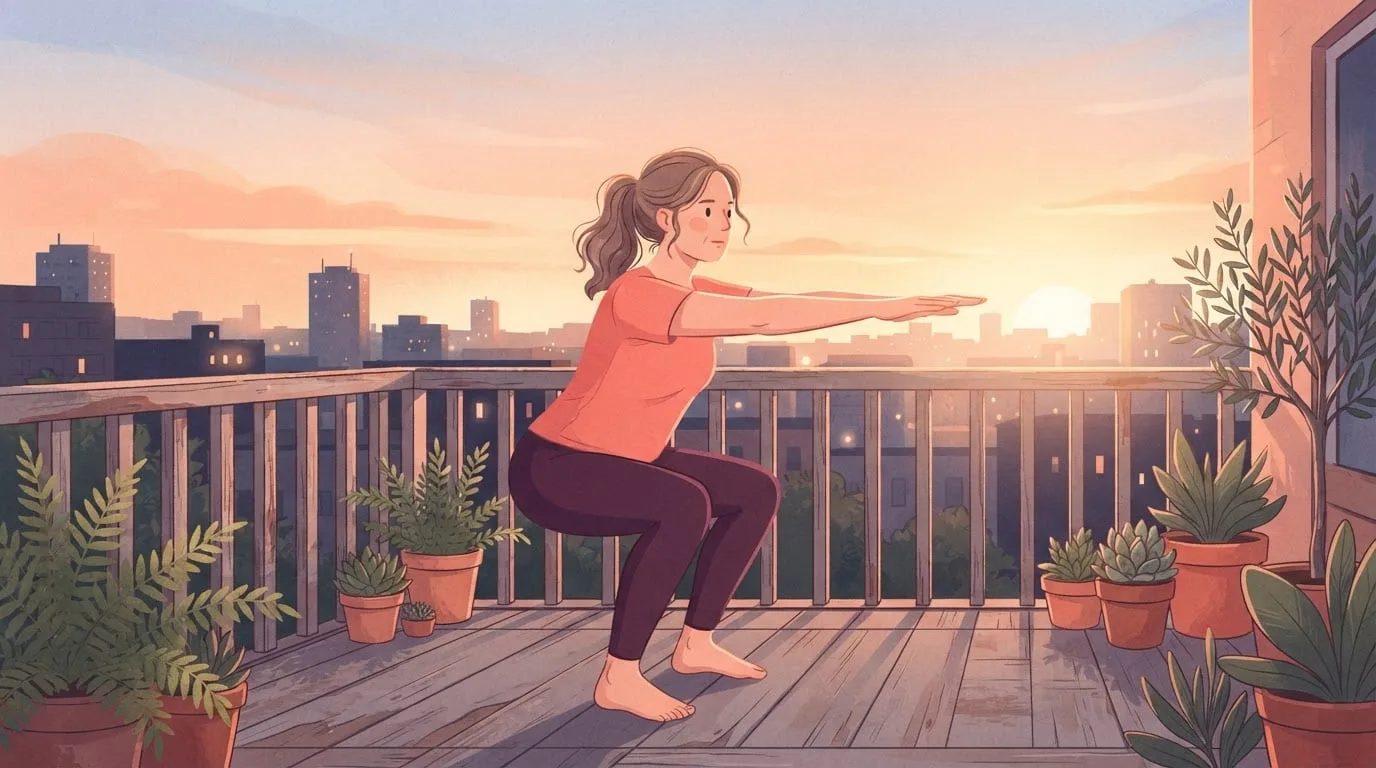
Most 30-day squat challenges are a number that climbs. Fifty squats today, a few more tomorrow, two hundred by the end. The first week feels great. By week 3 the sets take twenty minutes, your knees ache and the challenge quietly stops somewhere around day 19.
That's not a willpower problem. A plan that only adds reps gets longer and more boring at the same time, and it turns into endurance work long before day 30. When you drop it, it's easy to decide you're just not someone who finishes these things.
You are. You just need a challenge built the way a coach would build it. This 30 day squat challenge for beginners and up keeps the sessions short and makes the squats harder each week instead. Hard days and easy days alternate, and a one-set test on day 1 and day 30 turns your before and after into a number you can trust.
The 30 Day Squat Challenge Calendar
Each week has three hard days, three easy days and a rest day. Hard days take about 15 to 20 minutes and use the week's harder squat. Easy days take about 5 minutes and keep the habit going without tiring your legs for the next hard day. Warm up before every session with a minute of marching in place and 10 slow half squats.
- Sets and rest: rest 60 to 90 seconds between sets on hard days and 30 to 60 seconds on easy days.
- Effort: finish each hard set with 2 or 3 good reps left in you. If you can't finish a set with good form, stop the set there.
- Per leg: split squats and Bulgarian split squats are per leg, so do all the reps on one side, then switch.
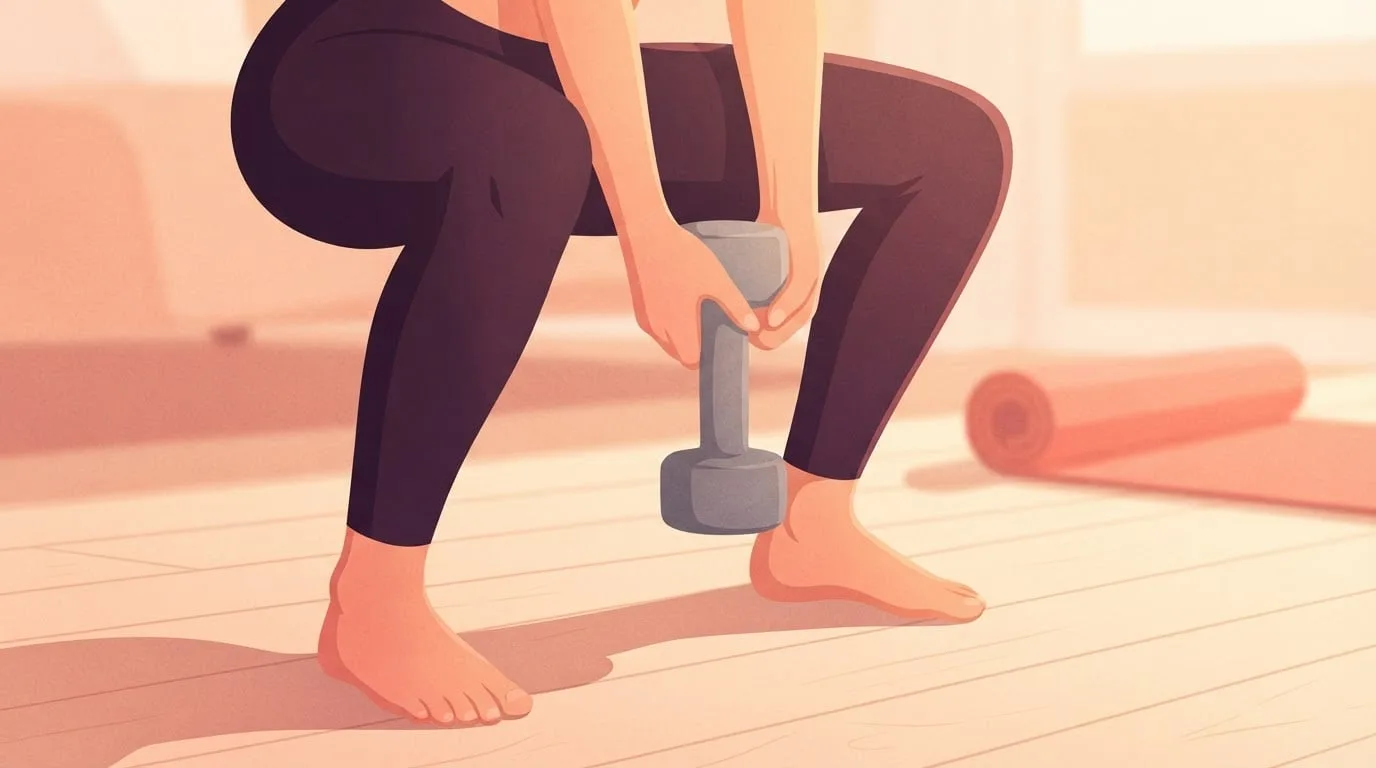
- Optional dumbbell: on hard days, hold one dumbbell at your chest for the pause, tempo and 1.5-rep squats, or one in each hand for split squats.
Week 1, days 1 to 7: learn the squat
| Day | Type | What to do |
|---|---|---|
| 1 | Test | One set of as many good bodyweight squats as you can. Write the number down. Then 2 x 10 glute bridges. |
| 2 | Easy | 2 x 10 bodyweight squats, 3 seconds down. 30-second wall sit. |
| 3 | Hard | 3 x 12 bodyweight squats. 2 x 10 glute bridges. |
| 4 | Easy | 2 x 12 bodyweight squats. 30-second wall sit. |
| 5 | Hard | 3 x 15 bodyweight squats, 3 seconds down. 2 x 8 reverse lunges per leg. |
| 6 | Easy | 2 x 12 sumo squats. |
| 7 | Rest | Walk if you like. |
Week 2, days 8 to 14: slow it down
| Day | Type | What to do |
|---|---|---|
| 8 | Hard | 3 x 10 pause squats (2-second hold at the bottom). 2 x 12 sumo squats. |
| 9 | Easy | 2 x 15 bodyweight squats. 40-second wall sit. |
| 10 | Hard | 3 x 8 tempo squats (4 seconds down, 2-second pause). 2 x 8 split squats per leg. |
| 11 | Easy | 2 x 15 sumo squats. |
| 12 | Hard | 3 x 12 pause squats. 3 x 8 split squats per leg. |
| 13 | Easy | 2 x 15 bodyweight squats. 45-second wall sit. |
| 14 | Rest | Walk if you like. |
Week 3, days 15 to 21: one leg at a time
| Day | Type | What to do |
|---|---|---|
| 15 | Hard | Halfway retest: one set of as many good bodyweight squats as you can. Then 3 x 10 split squats per leg. |
| 16 | Easy | 2 x 15 sumo squats. 45-second wall sit. |
| 17 | Hard | 3 x 8 Bulgarian split squats per leg. 2 x 12 pause squats. |
| 18 | Easy | 2 x 20 bodyweight squats. |
| 19 | Hard | 3 x 10 Bulgarian split squats per leg. 3 x 8 1.5-rep squats. |
| 20 | Easy | 2 x 15 sumo squats. 60-second wall sit. |
| 21 | Rest | Walk if you like. |
Week 4 and the finish, days 22 to 30: the hardest week
| Day | Type | What to do |
|---|---|---|
| 22 | Hard | 3 x 10 1.5-rep squats. 3 x 10 Bulgarian split squats per leg. |
| 23 | Easy | 2 x 20 bodyweight squats. |
| 24 | Hard | 4 x 8 tempo squats. 3 x 12 Bulgarian split squats per leg. |
| 25 | Easy | 2 x 15 sumo squats. 60-second wall sit. |
| 26 | Hard | 3 x 8 jump squats, or 3 x 12 pause squats for knee-friendly days. 3 x 12 Bulgarian split squats per leg. 2 x 10 1.5-rep squats. |
| 27 | Easy | 2 x 15 bodyweight squats, 3 seconds down. |
| 28 | Rest | Walk if you like. |
| 29 | Easy | 1 x 15 bodyweight squats and 5 minutes of easy stretching. Keep your legs fresh for the test. |
| 30 | Test | One set of as many good bodyweight squats as you can. Compare it with day 1 and day 15. |
That's 13 hard days, 13 easy days and 4 rest days. The three test days use the same rule. Count a rep only if your thighs reach at least parallel, or your usual depth, with your heels down. End the set when your form changes or you need to stop for more than 2 seconds.
How to Do Each Squat in the Challenge
Every variation starts from the same bodyweight squat. Stand with your feet about shoulder-width apart and your toes turned out a little. Sit your hips back and down as if onto a low chair, keeping your knees in line with your toes and your heels on the floor. Go as deep as you can with your chest up, then stand by pushing the floor away.
- Sumo squat: feet wider than your shoulders, toes turned out about 30 to 45 degrees. The wide stance puts more work on your inner thighs. See our sumo squat page.
- Pause squat: hold the bottom position for 2 seconds without bouncing, then stand. The pause removes the spring at the bottom, so your legs do all the work.
- Tempo squat: take 4 seconds to lower, pause for 2, and stand up at normal speed. Slow lowering makes a light load hard.
- 1.5-rep squat: squat to the bottom, come halfway up, go back to the bottom, then stand all the way up. That's one rep.
- Wall sit: slide down a wall until your thighs are about parallel and hold. The wall sit trains the thighs without any movement.
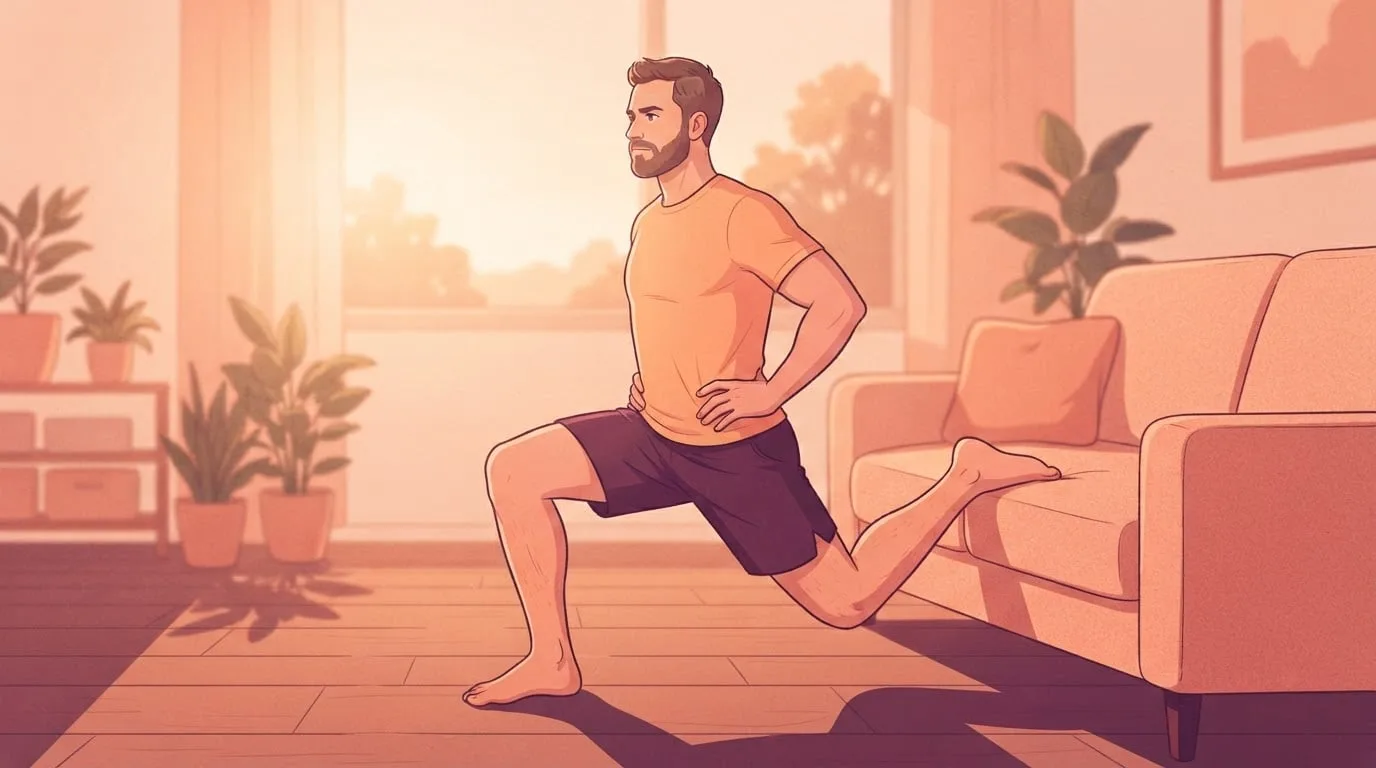
- Split squat: take a long step forward and lower your back knee toward the floor, then stand without moving your feet. Our split squat page covers the stance.
- Bulgarian split squat: the same movement with your back foot on a couch, chair or step behind you. It loads one leg with close to your full body weight. Our Bulgarian split squat page shows the setup.
- Jump squat: squat to about half depth and jump, land softly and sink straight into the next rep. It's optional, and it's the one move to swap out if your knees complain. See our jump squat page for the landing.
Why This Challenge Adds Difficulty Instead of More Squats
The classic squat challenge adds reps every day. Our 30 day workout challenge tracker runs that version, growing from 30 to 120 squats a day, with a daily tracker and a rest day every fourth day. It's a good choice if you want one simple number to beat. This page is the other approach: shorter sessions where the exercise itself gets harder.
The reason is that a bodyweight squat is a light load, and light loads only build muscle when the set gets close to failure. A 2017 meta-analysis by Schoenfeld and colleagues found that light and heavy loads built similar muscle when sets were taken to failure, while heavy loads built more maximal strength. Once you can do 50 squats in a row, reaching that point takes so many reps that the session becomes endurance training. Our guide to how many squats a day covers the rep ranges by goal.
Two school trials show how mixed the results of pure rep volume can be. Takai and colleagues (2013) had 36 boys aged about 14 do 100 bodyweight squats a day for 45 sessions over 8 weeks. Compared with 58 boys who didn't train, their knee extension strength rose 16 percent and their thigh muscle thickness 3.2 percent. Yoshimoto and colleagues (2016) tested the same 100-a-day program in a trial of 52 girls. The squat group's body fat dropped, but their muscle thickness and strength changed no more than the untrained group's. Both studies were in teenagers, not adults, so they show the range of what squats alone can do rather than what you'll get.
Moving to pause squats, tempo squats and Bulgarian split squats keeps each set hard within 8 to 15 reps, which is the logic of the calendar. It also keeps sessions under 20 minutes, and short sessions are the ones people finish.
Find out what's really holding you back
FitCraft, our mobile fitness app, pairs you with an AI coach who builds you a personalized plan around your goals, schedule, and fitness level. Every FitCraft program is designed by Domenic Angelino, MPH (Brown University) and NSCA-CSCS, with research published in the Journal of Strength and Conditioning Research and Medicine & Science in Sports & Exercise.
Take the Free Assessment Free • 2 minutes • No credit card30 Day Squat Challenge for Beginners
If a full squat to parallel is hard right now, or you haven't trained in a while, keep the same calendar and make five swaps:
- Chair squats for bodyweight squats. Stand in front of a sturdy chair, sit back until you lightly touch it, and stand straight back up without rocking. Lower the seat with a cushion removed as you get stronger.
- 2 sets wherever the calendar says 3. Keep the reps the same.
- Hold a counter for split squats. A light hand on a kitchen counter fixes the balance problem so your legs can do the work.
- Stay on split squats in weeks 3 and 4. Replace every Bulgarian split squat with a split squat until those feel steady.
- Pause squats instead of jump squats on day 26.
If you already train and the calendar looks easy, go the other way. Hold one dumbbell at your chest for every pause, tempo and 1.5-rep squat, which turns them into goblet squats, and hold a dumbbell in each hand for the split squats.
30 Day Squat Challenge Results: What Changes, Week by Week
The honest before and after of a 30-day squat challenge, the transformation people hope for, is mostly about strength, endurance and how your legs feel. Visible change is smaller. Here's what the research says to expect, and when.
Week 1: soreness, then much less of it
Expect delayed onset muscle soreness in your thighs and glutes a day or two after your first sessions, especially from the slow lowering. It fades fast. The repeated bout effect means one bout of a new exercise protects the muscle against damage from the next ones, according to a review by McHugh (2003). That's why week 1 starts light: the soreness from a too-hard first day is what ends most challenges by day 3.
Weeks 2 and 3: your nervous system does most of the work
Your test number usually climbs fastest in the first two or three weeks, and most of that is skill. Moritani and deVries (1979) tracked 15 young adults through 8 weeks of strength training. Neural factors, meaning better recruitment and coordination of the muscle you already have, explained most of the early strength gain. Muscle growth became the bigger factor only after the first 3 to 5 weeks.
Days 20 to 30: the start of measurable muscle
Muscle growth begins sooner than most people think. Seynnes, de Boer and Narici (2007) had 7 young adults do heavy leg extensions on a flywheel machine 3 times a week. The cross-sectional area of the quadriceps was measurably larger after 20 days, up 3.5 to 5.2 percent, and 6.5 to 7.4 percent larger by day 35. That was heavy training, so bodyweight squats will grow less. It still shows that a month is long enough for real change to begin.
What about a bigger butt?
Depth matters most for the glutes. Kubo, Ikebukuro and Yata (2019) found that 10 weeks of full-depth squats grew the gluteus maximus by about 6.7 percent, against 2.2 percent for half squats. So squat as deep as you can with good form, and expect a 30-day squat challenge for a bigger bum to be the start of the change rather than the whole of it. The Bulgarian split squats in weeks 3 and 4 help, because they stretch the glute of the front leg under load.
How to measure your before and after
- The test number. Your day 1, day 15 and day 30 squat tests are the most reliable result you'll have.
- Depth and control. Film one squat from the side on day 1 and day 30. Most people squat deeper and more steadily by the end.
- Daily life. Notice stairs, getting up from the floor and carrying shopping.
- Photos. Take them in the same spot, light, clothes and time of day, or they'll mislead you either way.
Fat loss is a separate question. Squats burn relatively few calories, and fat comes off the whole body through your overall diet and activity, not from the muscles you train. A challenge can still help indirectly by making you someone who trains most days.
The 30 Day Ab and Squat Challenge
The 30 day ab and squat challenge is a popular pairing, and it fits this calendar easily. On the three hard days each week, add a forearm plank and a set of dead bugs at the end, about five minutes in all. Start with 2 planks of 20 seconds and 2 x 8 dead bugs per side in week 1, and build to 2 planks of 45 seconds and 2 x 12 dead bugs per side by week 4.
Keep the goal honest. Vispute and colleagues (2011) had 24 sedentary adults do 7 ab exercises, 2 sets of 10 each, 5 days a week for 6 weeks. Abdominal fat, waist size and body fat didn't change compared with the control group. Their curl-up endurance did improve, to 47 reps against 32. Ab work builds a stronger core, and a visible stomach depends on overall body fat. Our guide on how to get abs in 30 days covers the full plan for that goal.
What to Do After Day 30
Don't restart the same month. Your legs have adapted to it, and the next step is load and a steady schedule. Train your legs 2 or 3 times a week with a goblet squat, a Bulgarian split squat and a hinge such as a Romanian deadlift, and add weight or reps whenever every set hits the top of its range. The goblet squat plan in our guide to how many squats a day is a good next step.
Thirty days is a strong start on a habit, but usually not the finish. In a study by Lally and colleagues (2010), a new daily behavior took a median of 66 days to feel automatic, with a range from 18 to 254 days. The challenge gets you a third of the way there. The next month is when it starts to run on its own.
If you'd rather have the next month planned for you, FitCraft's strength workouts use dumbbells and bodyweight, and an AI coach demonstrates each move on an interactive 3D model you can rotate and zoom. Workouts adjust as you progress through multi-week programs, and streaks, calendar rewards and leaderboards give you a reason to come back tomorrow. Our page on the bodyweight workout app for home shows how it works with no equipment at all.
The Bottom Line
A 30 day squat challenge works when the squats get harder, not just more numerous. Spend week 1 on plain squats, week 2 on pause and tempo squats, and weeks 3 and 4 on split squats and Bulgarian split squats, with easy days between hard ones and a rest day every week. Test on day 1 and day 30, and judge the result by that number first.
Finishing a challenge you designed to finish says more about you than any rep count. Thirty days from now you'll have a stronger squat and proof that you can stick with something.
Frequently Asked Questions
Does the 30 day squat challenge work?
Yes, for strength and squat endurance, especially if you're new to training. Most of the strength you gain in the first few weeks comes from your nervous system learning the movement, and measurable muscle growth starts around the third week in studies of heavier training. A challenge that makes the squats harder each week, not just more numerous, keeps the legs working hard enough to keep improving.
What are realistic 30 day squat challenge before and after results?
Expect a clearly higher score on a one-set squat test, a deeper and steadier squat, and easier stairs and getting up from the floor. Visible changes in leg or glute size after 30 days are small, and fat loss depends on your overall diet and activity, not on squats alone. Retest on day 30 with the same test you did on day 1, and take photos in the same light and clothes.
Is the 30 day squat challenge good for beginners?
Yes, with a few swaps. Replace every bodyweight squat for a chair squat, sitting lightly onto a chair and standing back up, and do 2 sets wherever the calendar says 3. Hold a counter for balance on split squats, stay on split squats instead of moving to Bulgarian split squats, and swap jump squats for pause squats.
Will a 30 day squat challenge make my butt bigger?
A little, if the squats are deep and hard. In a 10-week study, full-depth squats grew the gluteus maximus by about 6.7 percent against 2.2 percent for half squats. Thirty days is short for visible glute growth, so treat the challenge as the start and keep training the glutes two or three times a week afterward.
Can you do a 30 day ab and squat challenge together?
Yes. Add a forearm plank and a set of dead bugs to the three hard days each week, which adds about five minutes. Ab exercises strengthen your core but don't burn belly fat on their own: in a 6-week trial, ab training 5 days a week improved curl-up endurance without changing abdominal fat.
Should you squat every day for 30 days?
You can squat on most days if the hard sessions are spread out. This calendar puts a hard session every other day, an easy practice session on the days between and a full rest day every seventh day. That gives your legs about 48 hours between hard sessions while you keep a daily habit.
What should I do after a 30 day squat challenge?
Keep training your legs two or three times a week rather than starting another month of the same plan. Add load with a dumbbell held at your chest, keep Bulgarian split squats in the plan, and add a hinge such as a Romanian deadlift. That turns a 30-day challenge into a habit that keeps building strength.