
Search for a HIIT workout and you'll find everything from a 4-minute Tabata to an hour-long bootcamp class carrying the same four letters. Most of them leave you sweaty and wrecked. Some of them aren't high-intensity interval training at all, and the label tells you nothing about the numbers that make intervals work.
If you've tried a HIIT class, felt sore for two days and quietly stopped going, the design of the workout is the likely culprit. A session built to exhaust you is hard to repeat, and HIIT only pays off when you repeat it. The research points to something simpler: hard bursts of a set length, rest long enough to do each one well, and only a few sessions a week.
This page covers what HIIT stands for and how hard high intensity really is, what goes into a HIIT workout, the four protocols with the most research behind them, the benefits of interval training, how HIIT compares with steady cardio, whether it burns belly fat, its downsides and how often to do it.
What Does HIIT Stand For?
HIIT stands for high-intensity interval training. Instead of holding one steady pace, you repeat short bouts of hard work, each followed by a recovery period of rest or easy movement. In their review of interval training in the Journal of Physiology, MacInnis and Gibala (2017) describe HIIT efforts as near maximal, at an intensity that brings your heart rate to at least 80 percent of its maximum and often to 85 to 95 percent.
Three numbers define any HIIT workout:
- How hard each work bout is. Hard enough that you're glad when it ends, at 80 percent of your maximum heart rate or above.
- How long each work bout lasts. From about 10 seconds to 4 minutes. The shorter the bout, the harder it can be.
- How long you recover. Long enough that the next bout can be just as hard. All-out bursts need long rests, while longer and slightly easier bouts can get by with equal or shorter ones.
Change any of the three and you change the workout. Twenty seconds all out with 10 seconds of rest, and 4 minutes at 90 percent of maximum heart rate with 3 minutes of easy jogging, both count as HIIT, and they feel nothing alike.
How hard is high intensity?
Heart rate is the most common yardstick. To estimate your maximum, a meta-analysis of 351 studies by Tanaka, Monahan and Seals (2001) found that 208 minus 0.7 times your age predicts it better than the familiar 220 minus age, which underestimates the maximum in older adults. For a 40-year-old that's 208 minus 28, or 180 beats a minute, which puts the HIIT range at roughly 145 to 170 beats a minute.
Effort and breathing work just as well, and they respond faster than heart rate during short bursts. The CDC's guide to measuring intensity puts moderate activity at 5 or 6 on a 0-to-10 effort scale and vigorous activity at 7 or 8. It adds a talk test: during vigorous activity you can't say more than a few words without pausing for a breath. A HIIT work bout sits at the top of that range or just above it.
| Moderate cardio | HIIT work bout | All-out sprint | |
|---|---|---|---|
| Effort, 0 to 10 | 5 to 6 | 8 to 9 | 10 |
| Talk test | You can talk but not sing | A few words at most | No words at all |
| Heart rate | Below 80% of maximum | 80 to 95% of maximum | Still climbing when the sprint ends |
| Typical bout length | 20 to 60 minutes, continuous | 15 seconds to 4 minutes | 10 to 30 seconds |
| Typical recovery | None | 15 seconds to 3 minutes | Usually longer than the sprint, often 2 to 4 minutes |
What is interval exercise?
Interval exercise is the broader family that HIIT belongs to: any workout that alternates work and recovery on purpose. A walk-jog session where you jog for a minute and walk for two is interval training. It becomes high-intensity interval training only when the work bouts reach the hard range above. All HIIT is interval training, but plenty of interval training is gentle enough for someone starting from scratch, which makes it a useful first step toward HIIT.
HIIT vs sprint interval training
MacInnis and Gibala separate HIIT from sprint interval training, or SIT, which uses all-out or supramaximal efforts: bursts at or above the pace that would draw out your VO2 max. In the 20- and 30-second sprint trials below, the rests between sprints run 2 to 4.5 minutes of easy pedaling. An all-out sprint leans heavily on the energy systems that work without oxygen, which our explainer on what anaerobic exercise is walks through, and those systems need a long rest to recharge. SIT asks for less total hard work than HIIT and far more from each second of it. Our sprint interval training research review covers how little of it you need and who responds best.
What's Included in a HIIT Workout?
A HIIT workout has four parts: a warm-up, a series of hard work bouts, the recovery periods between them and a cool-down. Most sessions take about 10 to 40 minutes from start to finish, and only a few of those minutes are hard. In the trials on this page, the hard work in a session ranged from 1 minute to 16 minutes.
- Warm-up, 5 to 10 minutes. Easy movement that builds to one or two short practice bursts at a moderately hard effort.
- Work bouts. Usually 3 to 12 of them, each 10 seconds to 4 minutes long, at 80 percent of maximum heart rate or harder.
- Recovery periods. Rest or easy movement, from 10 seconds in Tabata to 4.5 minutes between all-out sprints.
- Cool-down, 3 to 5 minutes. Keep walking or pedaling easily until your breathing settles instead of stopping dead.
Which exercises work for HIIT?
Any movement you can speed up and slow down quickly will work, as long as your form holds up when you're tired. The research mostly used stationary bikes and running because the effort is easy to measure. At home, these work well:
- Cardio moves: running intervals, hill or stair sprints, fast step-ups, jumping rope, high knees and mountain climbers.
- Bodyweight moves: jump squats, skater hops, burpees and squat thrusts.
- Dumbbell moves: thrusters (a squat that flows into an overhead press), dumbbell swings and alternating snatches.
- Joint-friendly swaps: if jumping bothers your knees or ankles, fast step-ups and marching keep the effort high without the landings.
Save heavy or technical lifts for your strength days, because form slips when you're tired and moving fast.
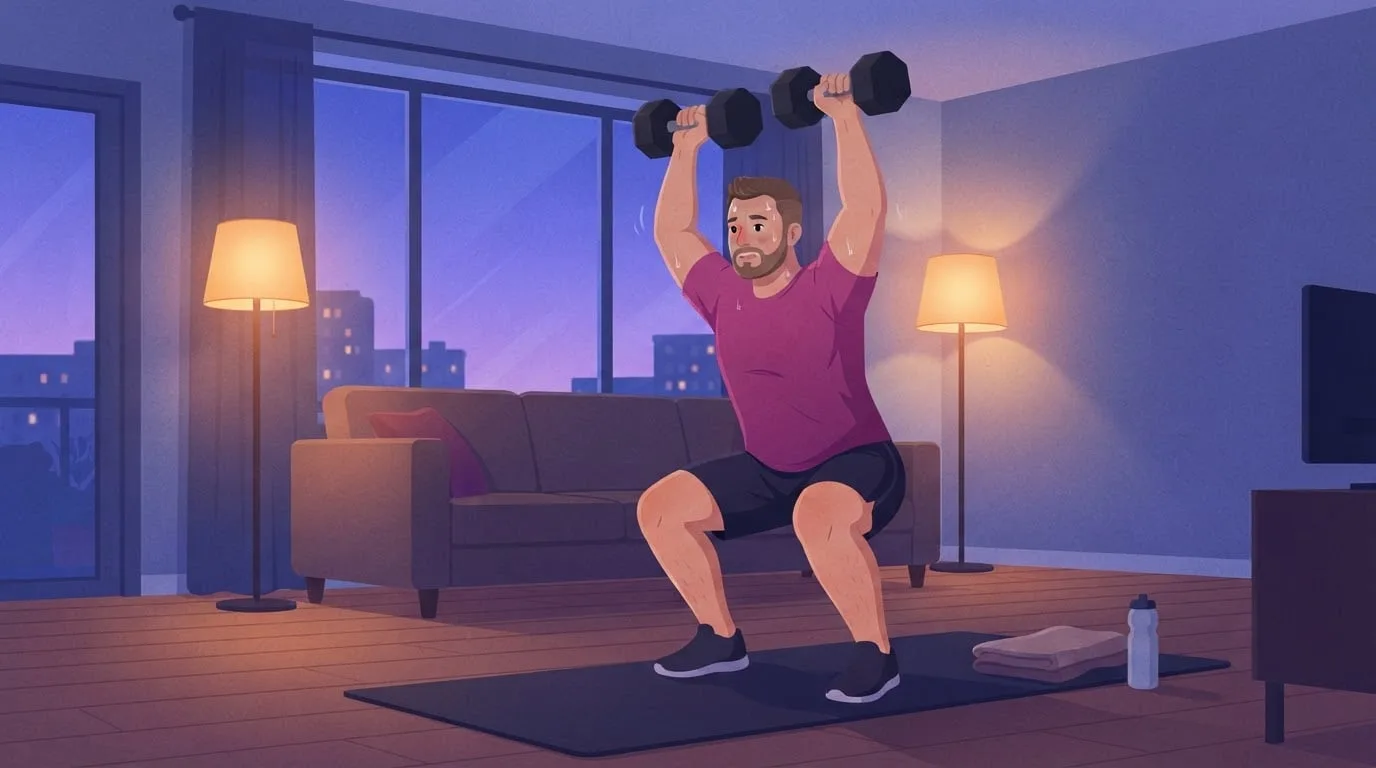
A sample 10 x 1-minute session at home
Here's what a complete session looks like, modeled on the 10 x 1-minute protocol described below. It takes about 30 minutes and needs a staircase or a sturdy step and a pair of light dumbbells.
- Warm up for 5 minutes. March in place, step up and down at an easy pace, then do two 15-second practice bursts.
- Do 10 rounds of 60 seconds hard. Alternate fast step-ups with dumbbell thrusters, one move per round, at about 8 out of 10 effort.
- Recover for 60 seconds between rounds. March in place or walk slowly. If you still can't speak a full sentence when the minute is up, take 30 seconds more.
- Cool down for 3 to 5 minutes. Walk easily until your breathing settles.
Start with 6 rounds if 10 feels like too many, and add one or two rounds a week. For three complete routines from 15 to 25 minutes and a six-week progression, see our HIIT workout at home guide.
4 HIIT Protocols and the Trials Behind Them
There are hundreds of HIIT formats, but four have most of the research behind them. Each was tested in small trials, mostly on stationary bikes or treadmills, and each produced measurable gains within 2 to 12 weeks.
| Protocol | Work and recovery | Hard work per session | What the key trial found |
|---|---|---|---|
| Tabata | 7 or 8 rounds of 20 s at about 170% of VO2 max, 10 s rest | Under 3 minutes | VO2 max up 7 mL/kg/min and anaerobic capacity up 28% in 6 weeks |
| 10 x 1 minute | 8 to 12 rounds of 60 s hard, 60 to 75 s easy | 8 to 12 minutes | Time trials 9 to 11% faster after 6 sessions in 2 weeks |
| Norwegian 4x4 | 4 rounds of 4 min at 90 to 95% of max heart rate, 3 min easy | 16 minutes | VO2 max up 7.2% in 8 weeks, more than steady running |
| 30-second sprints | 4 to 7 rounds of 30 s all out, 4 to 4.5 min easy | 2 to 3.5 minutes | Cycling endurance doubled after 6 sessions in 2 weeks |
Most of these trials had fewer than 20 people per group, often young men, so treat the numbers as what each format can do rather than what it will do for you.
Tabata: 20 seconds on, 10 seconds off
In the 1996 study that named the format, Tabata and colleagues had seven men do seven or eight 20-second cycling bouts at about 170 percent of their VO2 max, with 10 seconds of rest between them, five days a week for six weeks. VO2 max rose by 7 mL/kg/min and anaerobic capacity by 28 percent. A comparison group that cycled steadily for an hour at 70 percent of VO2 max gained 5 mL/kg/min and no anaerobic capacity. By MacInnis and Gibala's definition, an effort at 170 percent of VO2 max is supramaximal, so the original Tabata is really sprint interval training, and few bodyweight classes that borrow the name get close to it. Our Tabata protocol research review covers the follow-up studies.
10 x 1 minute: the practical middle ground
The 10 x 1-minute format came out of Martin Gibala's lab at McMaster University as a more practical alternative to all-out sprints, with longer bouts at a lower intensity. In the first trial, Little and colleagues (2010) had seven recreationally active young men ride 8 to 12 one-minute bouts at about the peak power they reached in a ramp test, with 75 seconds of easy pedaling between bouts, six times over two weeks. Their times in two cycling time trials improved by 9 and 11 percent, and two markers of mitochondrial capacity in the thigh muscle, citrate synthase and cytochrome c oxidase, rose by about 16 and 29 percent.
The format also scales down for people who weren't fit to begin with. Hood and colleagues (2011) put seven sedentary adults with an average age of 45 through ten 1-minute bouts at about 60 percent of peak power, with 1 minute of rest between them, six times in two weeks. That effort raised their heart rate to 80 to 95 percent of its reserve, the range between resting and maximum. Muscle oxidative capacity rose by about 35 percent, and so did an index of insulin sensitivity. In eight adults with type 2 diabetes, Little and colleagues (2011) used ten 1-minute bouts at about 90 percent of maximum heart rate with 1 minute of rest. After six sessions, average 24-hour blood glucose fell from 7.6 to 6.6 mmol/L. These were small, short studies without control groups, but they show the format works well below all-out effort.
The Norwegian 4x4
The 4x4 is four 4-minute intervals at 90 to 95 percent of maximum heart rate, each followed by 3 minutes of active recovery at about 70 percent. In the trial that made it famous, Helgerud and colleagues (2007) split 40 moderately trained men into four groups that ran three days a week for eight weeks, with every program matched for total oxygen use. VO2 max rose 7.2 percent in the 4x4 group and 5.5 percent in a group doing 15-second intervals, both significantly more than in the groups running steadily at 70 or 85 percent of maximum heart rate. Our Norwegian 4x4 protocol review follows it into heart patients and older adults.
Sprint intervals: 30 seconds all out
Sprint interval training usually means the 30-second all-out cycling sprint that labs call the Wingate test. In a 2005 study by Burgomaster and colleagues, eight recreationally active people did four to seven of those sprints with 4 minutes of recovery, six times in two weeks. The time they could ride at about 80 percent of VO2 peak doubled, from 26 to 51 minutes, even though VO2 peak itself didn't change. Citrate synthase in their muscles rose by 38 percent.
Then the lab set sprints against long steady rides. In Gibala and colleagues (2006), 16 active young men did either four to six 30-second sprints or 90 to 120 minutes of steady cycling at about 65 percent of VO2 peak, six times in two weeks. The sprint group trained for about 2.5 hours in total and the steady group for about 10.5 hours, and both improved their time trials and muscle oxidative capacity by similar amounts. Over six weeks, Burgomaster and colleagues (2008) found matching muscle adaptations from about 1.5 hours a week of sprints and 4.5 hours a week of steady cycling. The shortest version so far came from Gillen and colleagues (2016). In their 12-week trial with 25 sedentary men, those doing three 20-second sprints inside a 10-minute session, three times a week, raised VO2 peak by 19 percent, the same gain as those cycling steadily for 45 minutes.
Knowing what to do is the easy part.
FitCraft, our mobile fitness app, pairs you with an AI coach who builds you a personalized plan around your goals, schedule, and fitness level. Every FitCraft program is designed by Domenic Angelino, MPH (Brown University) and NSCA-CSCS, with research published in the Journal of Strength and Conditioning Research and Medicine & Science in Sports & Exercise.
Take the Free Assessment Free • 2 minutes • No credit cardWhat Are the Benefits of Interval Training?
The main benefits of interval training are better aerobic fitness and endurance, more capable muscle mitochondria and better blood sugar control, often in a fraction of the time steady cardio takes. Here's what the trials above show:
- More aerobic fitness per minute. MacInnis and Gibala conclude that HIIT generally raises VO2 max more than steady training of the same volume, and that sprint intervals match steady training despite a much smaller volume. VO2 max is the ceiling of your aerobic capacity.
- Better endurance, quickly. Six sprint sessions doubled how long people could ride at a hard steady pace in Burgomaster's 2005 study.
- Stronger muscle mitochondria. Markers of mitochondrial capacity rose by roughly 16 to 35 percent within two weeks in the 10 x 1-minute studies. Mitochondria are the parts of your muscle cells that use oxygen to make energy.
- Better blood sugar control. Insulin sensitivity improved in sedentary adults after two weeks of 10 x 1 minute and in sedentary men after 12 weeks of sprints, and 24-hour blood glucose fell in people with type 2 diabetes.
- Time saved. In the head-to-head trials, interval groups matched steady groups on a third to a fifth of the training time.
- More enjoyment, for many people. In a 12-month trial of overweight adults by Roy and colleagues (2018), people who chose HIIT reported enjoying physical activity more than people who followed the standard advice of 30 minutes of moderate exercise a day.
HIIT vs Steady Cardio: Which Is Better?
Neither is better for everything. HIIT wins on time and usually on VO2 max gains per minute, while steady cardio is easier to start, easier to recover from and about as effective for fat loss. Our HIIT vs steady-state cardio research review covers the head-to-head fat loss meta-analyses in detail.
| HIIT | Steady cardio | |
|---|---|---|
| Time per session | 10 to 40 minutes, only a few of them hard | 30 to 60 minutes or more |
| VO2 max | Larger gains for the same training volume | Solid gains, especially with more total time |
| Fat loss | About the same as steady cardio | About the same as HIIT |
| How it feels | Very hard during each bout | Comfortable to moderately hard |
| Recovery | Needs an easier day after each session | Can be done most days |
| Joint load | Higher with sprints and jumps | Lower, especially walking, cycling and swimming |
| Best for | Busy weeks, raising VO2 max, variety | Building a base, easy days, new exercisers |
Most people do best with both. The CDC's adult activity guidelines ask for 150 minutes of moderate activity or 75 minutes of vigorous activity a week, or a mix of the two, so a vigorous minute counts about double. A couple of HIIT sessions, some walking or steady cardio and two strength days can cover the whole recommendation.
Does HIIT Burn Belly Fat?
HIIT does reduce belly fat over time, including the deeper visceral fat around your organs, but it can't target your belly over any other area, and what you eat still decides most of the result. A meta-analysis of 39 studies with 617 adults by Maillard, Pereira and Boisseau (2018) found that HIIT significantly reduced total, abdominal and visceral fat mass. Running intervals reduced total and visceral fat more than cycling intervals did. Efforts above 90 percent of peak heart rate worked best for whole-body fat, while intervals below that level had the larger effect on abdominal and visceral fat, so you don't have to go all out to shrink your waist.
Real life is less tidy than a supervised trial. In Roy's 12-month study, people who chose unsupervised HIIT ended up with the same weight and visceral fat as people who followed the 30-minutes-a-day advice. Within the HIIT group, though, the ones who kept doing their intervals lost more visceral fat than the ones who drifted away. For belly fat, sticking with the routine mattered more than which routine it was.
Is HIIT Cardio or Strength?
HIIT is mainly cardio. Even when it's built from squats, push-ups or dumbbell moves, each bout is timed and the loads are light, so your breathing gives out long before your muscles do. It can add a little muscle in people who are new to exercise, mostly in the legs, but much less than lifting does. Our article on whether HIIT builds muscle goes through the lean-mass trials.
The CDC's guidelines also ask for muscle-strengthening activity that works all the major muscle groups on at least 2 days a week, on top of aerobic exercise. So the most useful week pairs one to three HIIT sessions with two strength sessions. If lifting is new to you, our guide to what resistance training is explains the types and how to start at home.
What Are the Downsides of HIIT Training?
The main downsides of HIIT are that it's hard to keep doing on your own, fast moves done while tired can lead to sprains and strains, it carries a small extra cardiac risk for people with heart disease, and it stops paying off when you do too much of it.
It's hard to stick with on your own
In Roy's trial, 250 overweight adults chose between HIIT and the standard advice of 30 minutes of moderate exercise a day, and 42 percent picked HIIT. After a single coached session, they were told to do HIIT three times a week on their own. Heart-rate records showed that the share doing at least two sessions a week fell from 60.8 percent at the start to 19.6 percent by 12 months. Hard sessions are easy to skip when nobody is expecting you, which is why a plan and a reason to show up matter as much as the protocol.
Injuries rose as HIIT got popular
Using a sample of US emergency department records from 2007 to 2016, Rynecki and colleagues (2019) estimated nearly 4 million injuries linked to exercises and equipment typical of HIIT, such as burpees, push-ups, lunges, boxes and kettlebells. Injuries rose 144 percent from the first five years to the second, alongside a 274 percent rise in interest in HIIT. The lower body accounted for the largest share, 35 percent, and knee and ankle sprains and muscle strains all more than doubled. The data can't prove the injuries happened during HIIT sessions, but the pattern fits what coaches see when jumps and fast reps meet tired legs. Start with low-impact moves and build up the jumping gradually.
A small cardiac risk, mostly for people with heart disease
Hard exercise briefly raises the strain on your heart, and the best data on how often that goes wrong comes from cardiac rehab. Rognmo and colleagues (2012) counted events among 4,846 people with coronary heart disease at three Norwegian rehab centers over 175,820 hours of supervised exercise. There was one fatal cardiac arrest in 129,456 hours of moderate exercise and two nonfatal arrests in 46,364 hours of high-intensity intervals, or one per 23,182 hours. A review of 23 trials by Wewege and colleagues (2018) found one major cardiovascular event per 17,083 HIIT sessions in heart patients. Both teams judged the risk low, but their patients were screened and supervised. If you have heart disease, chest pain, dizziness when you exercise or high blood pressure, get medical clearance before you start HIIT.
More HIIT isn't always better
In a study in Cell Metabolism, Flockhart and colleagues (2021) raised healthy volunteers' training load week by week for four weeks. After the heaviest week, the volunteers' mitochondria worked markedly worse and their glucose tolerance dropped, the reverse of what HIIT normally does. That load was far above a normal routine, but the lesson applies at any level. Past a certain point, extra hard sessions add fatigue instead of fitness.
Can HIIT workouts cause high cortisol?
HIIT raises cortisol for a short time, as any hard exercise does, and that temporary rise is a normal part of the body's response to effort. In a study by Hill and colleagues (2008), 12 moderately trained men exercised for 30 minutes at 40, 60 and 80 percent of VO2 max on separate days. Cortisol barely moved at 40 percent, rose about 40 percent at 60 percent and rose about 83 percent at 80 percent. Short HIIT sessions with easier days between them fit within that normal response. Our article on cortisol and exercise covers what regular training, overtraining and poor sleep do to cortisol over months.
How Often Should You Do HIIT?
Most adults do well with one to three HIIT sessions a week, with at least one easier day between them. That's close to the dose in the trials above: three sessions a week in the 10 x 1-minute, 4x4 and sprint interval studies, for two to twelve weeks. The original Tabata study used five days a week, but that was seven men in a supervised lab study doing about 4 minutes of intervals a day.
Fill the other days with walking, easy cardio and two strength sessions. That mix meets the CDC's weekly guidelines and gives your legs and nervous system time to recover, so each HIIT session can be genuinely hard.
HIIT for beginners
If you're new to exercise, spend a few weeks walking or doing easy cardio first, then add one interval session a week. Use bouts of 30 to 60 seconds at a hard but controlled effort, about 7 or 8 out of 10, with at least as much easy recovery, and finish the session while your form is still good. After two or three weeks, add a second session, then make the bouts longer or harder, one change at a time. The 10 x 1-minute studies in sedentary adults and people with type 2 diabetes show that this gentler end of HIIT still works.
What This Means for You
HIIT is a way of arranging exercise: short, genuinely hard efforts with enough rest to repeat them, a few times a week. Get those three numbers right and a 20-minute session can do as much for your fitness as an hour of steady cardio. Get them wrong and you end up with a workout that leaves you wrecked and dreading the next one.
Picture yourself eight weeks from now: two short interval sessions and two strength days a week, stairs that no longer leave you gasping, and intervals that feel hard but doable. The hardest part is turning up for the next session, and that's where a plan built around your week helps more than motivation does. If you'd rather follow a plan than build one, an AI personal trainer app can build it around your goals and schedule. In FitCraft, a 3D AI coach demonstrates every exercise on an interactive model you can zoom in on, calls you by name during the workout and adapts your plan as you progress, while streaks and leaderboards give you a reason to come back. As one FitCraft user, Katie, put it: "I've tried everything. This is the first time I've stuck with something past two weeks."

Frequently Asked Questions
What is a HIIT class?
A HIIT class is a group workout, usually 30 to 60 minutes long, built from timed rounds of hard exercise with short rests, using bodyweight moves, bikes, rowers or light weights. Some classes keep the rests so short that later rounds slide down to moderate effort, which makes them closer to circuit training. That's still good exercise, but the results seen in HIIT studies come from rounds that are genuinely hard and rests long enough to repeat them.
What should I eat after HIIT?
Eat a normal meal or snack with protein and carbohydrate within a couple of hours, such as yogurt with fruit, eggs on toast or chicken with rice. The International Society of Sports Nutrition's position stand on nutrient timing suggests 20 to 40 grams of protein every 3 to 4 hours, and says fast carbohydrate refueling matters mainly when you'll train hard again within about 4 hours. A short HIIT session doesn't call for a special recovery drink.
What is HIIT cardio?
HIIT cardio is high-intensity interval training done with a cardio activity such as running, cycling, rowing or stair climbing instead of bodyweight or dumbbell moves. Most HIIT research used it this way, mainly on stationary bikes and treadmills, because the effort is easy to measure. A typical session is 3 to 12 hard bouts of 20 seconds to 4 minutes with easy pedaling, jogging or walking in between.
Is HIIT good for weight loss?
HIIT helps with weight loss because it raises fitness and burns calories in a short session, and a meta-analysis of 39 studies found it reduced total, abdominal and visceral fat. Compared head to head, it produces about the same fat loss as steady cardio. Your diet and how consistently you train decide most of the result.
Can you do HIIT every day?
Doing HIIT every day isn't a good idea for most people. Most of the trials that showed benefits used three sessions a week, and when researchers raised volunteers' training load every week for four weeks, their mitochondrial function and glucose tolerance got worse after the heaviest week. Keep HIIT to one to three sessions a week with an easier day between them, and fill the other days with walking, easy cardio or strength training.
Can beginners do HIIT?
Yes, beginners can do HIIT if they start below all-out effort. In the 10 x 1-minute studies, sedentary middle-aged adults and people with type 2 diabetes did ten 1-minute bouts at a hard but controlled effort and improved within two weeks. Start with one or two sessions a week of 30- to 60-second bouts with at least as much easy recovery, and get medical clearance first if you have heart disease, high blood pressure or another chronic condition.