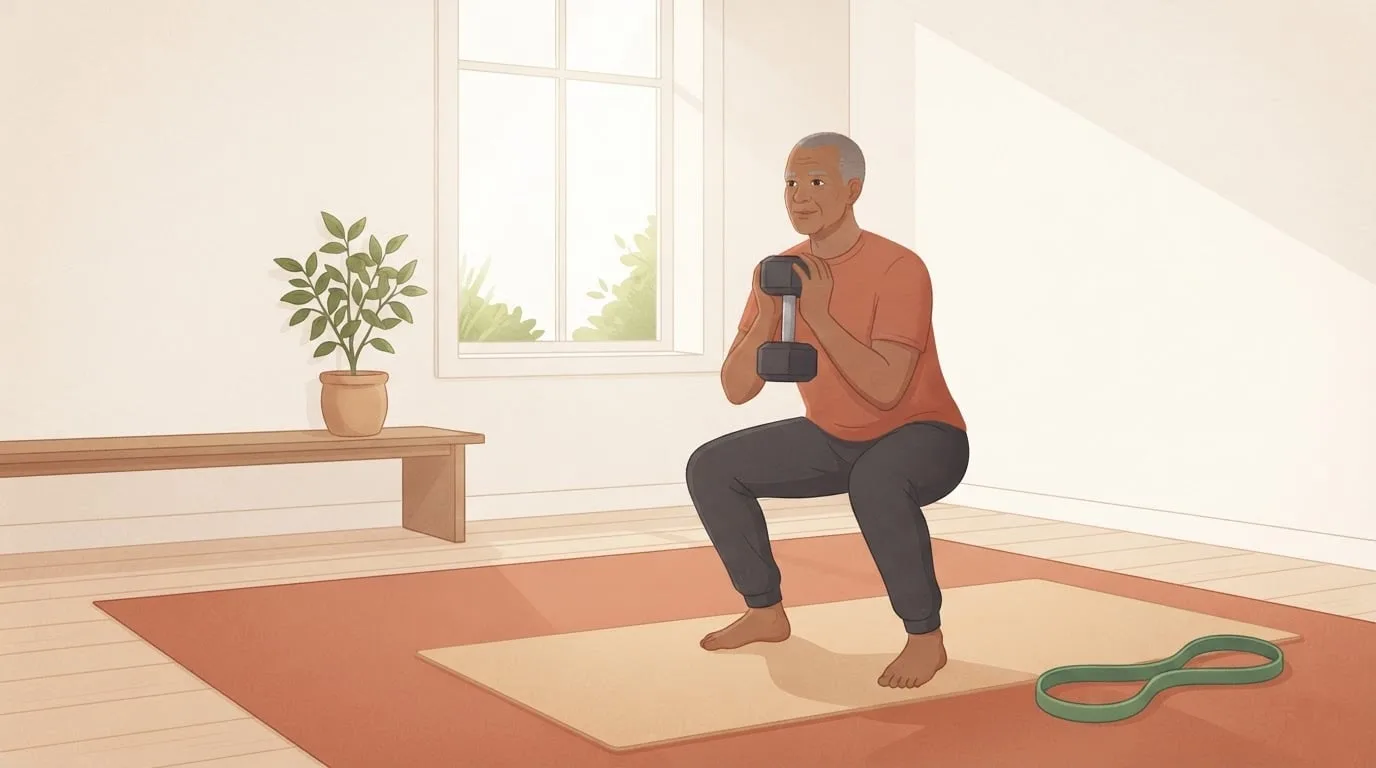
Picture resistance training and you probably see a gym: racks of weights, rows of machines and people who seem to know exactly what they're doing. That picture keeps a lot of people away. In 2020, only 24.2 percent of US adults met the guidelines for both aerobic and muscle-strengthening activity, according to the CDC's National Center for Health Statistics.
If you've avoided strength training because the gym felt like someone else's world, or started a program and drifted away after a few weeks, you're far from alone, and a simpler plan usually fixes it. Your muscles respond to effort against a load, and a pair of dumbbells, a band or your own body weight on a living room floor can supply that load.
This page explains what resistance training is and how it differs from strength training, the four main types, which exercises count, what it does for strength, muscle, bones and metabolic health, how much you need and a beginner workout you can do at home.
Resistance Training, Defined
Resistance training means making a muscle contract against a force that resists it. The force can be your own body weight, as in a push-up or a squat, or an external load such as a dumbbell, a kettlebell, a resistance band, a cable or a machine. Activity guidelines call it muscle-strengthening activity. The CDC's guidelines for adults ask for it on at least 2 days a week, working all the major muscle groups: legs, hips, back, abdomen, chest, shoulders and arms.
Two things turn an exercise into effective resistance training. The load has to be heavy enough that each set gets genuinely hard, and it has to grow as you get stronger. That second rule is called progressive overload, and it's why the same 10 squats that challenge you in week one do much less by week eight.
Is resistance training the same as strength training?
Yes, in everyday use. Resistance training, strength training and weight training all describe muscles working against a load, and the guidelines group them as muscle-strengthening activity. Coaches sometimes use strength training more narrowly, for heavy, low-rep work aimed at lifting the most weight, and weight training only when the load is weights. Bodyweight and band workouts are resistance training too.
How resistance training makes you stronger
Your strength rises before your muscles visibly grow. In a study by Seynnes, de Boer and Narici (2007), seven young adults trained their thighs on a leg extension device three times a week. Their strength rose 39 percent in 35 days, while quadriceps size grew by 6.5 to 7.4 percent. Much of the early gain comes from your nervous system learning to use more of the muscle you already have. Muscle growth, called hypertrophy, starts sooner than most people think: in that study it was already measurable after 20 days.
Types of Resistance Training
Resistance training comes in four main types, sorted by what supplies the load. They differ in cost, space and how easy they are to make harder, and all of them build strength when the sets are hard enough.
| Type | Examples | Good for | Trade-offs |
|---|---|---|---|
| Bodyweight | Push-ups, squats, lunges, glute bridges, planks | Starting anywhere, with no equipment | Leg moves get easy; you progress with harder variations, slower reps or more reps |
| Dumbbells and other free weights | Goblet squats, rows, presses; kettlebells and barbells are free weights too | Small, steady load increases for every muscle group, at home or in a gym | You need a few weights, and form takes some practice |
| Resistance bands | Band rows, pull-aparts, presses, lateral walks | Pulling exercises at home, travel, warm-ups | Tension changes through the movement, and the load is hard to measure |
| Machines and cables | Leg press, chest press, cable rows | A guided path that's quick to learn, with easy load changes | Needs a gym, and the machine sets the path for you |
The type matters less than the effort. Kikuchi and Nakazato (2017) had 18 young men train twice a week for 8 weeks with either bench presses at 40 percent of their one-rep max or push-ups adjusted to the same load. Chest muscle thickness grew from 17.0 to 20.8 mm in both groups, and bench press strength rose by similar amounts. Our resistance band training research review covers the trials that found bands build strength about as well as weights.
Training for strength, muscle size or endurance
You can point resistance training at different goals by changing the load and the number of reps. Heavy loads for few reps build the most maximal strength. For muscle size, the load matters less than how close each set gets to failure: in a meta-analysis of 21 studies with every set taken to failure, Schoenfeld and colleagues (2017) found that loads at or below 60 percent of the one-rep max grew muscle about as much as heavier ones, though the heavier loads won for strength. Light loads for many reps build muscular endurance. Our explainer of the ACSM 2026 resistance training guidelines turns these goals into sets, loads and weekly volumes.
What Exercises Count as Resistance Training?
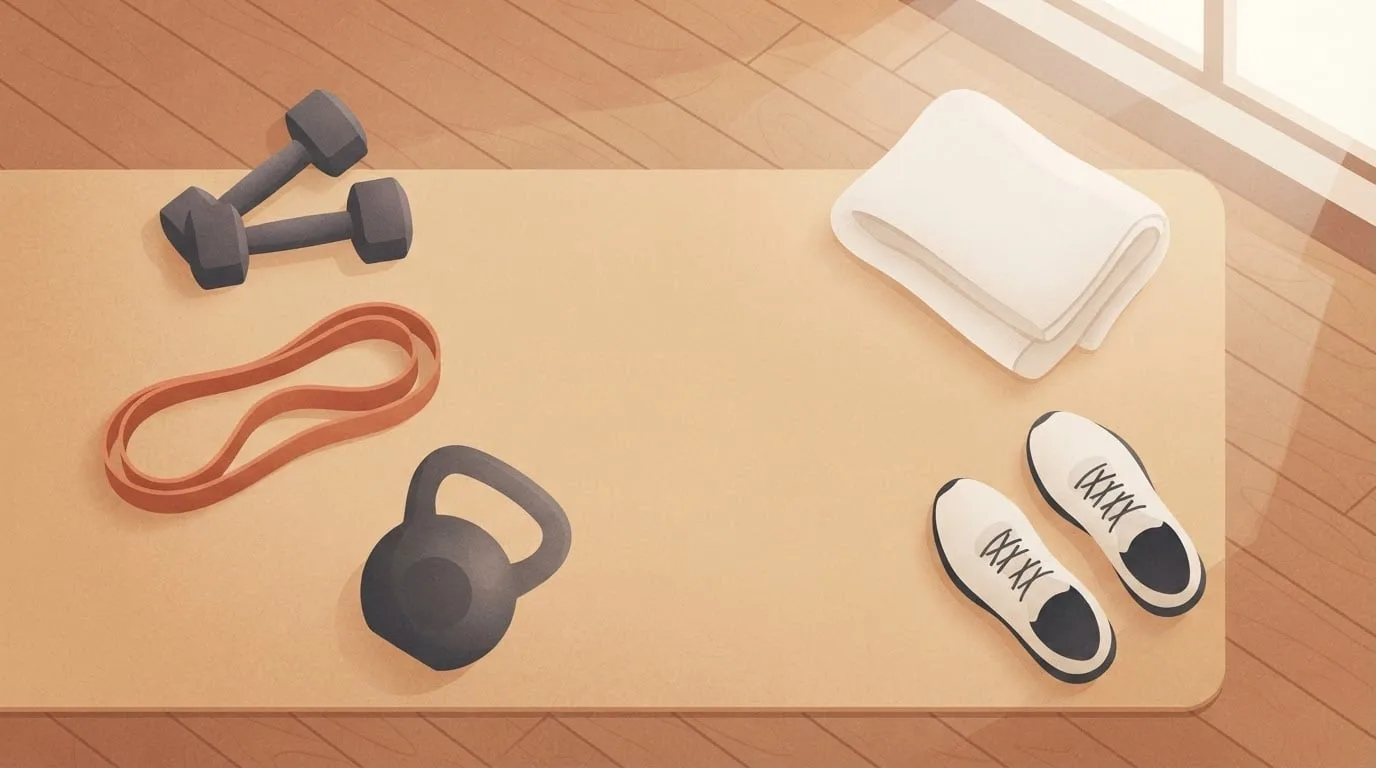
Any exercise that makes a muscle work against a load counts as resistance training, including bodyweight moves like push-ups and squats, dumbbell and kettlebell lifts, resistance band exercises and gym machines. A balanced routine covers six movement patterns. Here are examples of resistance training for each, with versions you can do at home:
- Squat. Bodyweight squats, or goblet squats holding one dumbbell at your chest.
- Lunge. Reverse lunges, split squats and step-ups onto a sturdy step.
- Hip hinge. Glute bridges, or Romanian deadlifts with a pair of dumbbells.
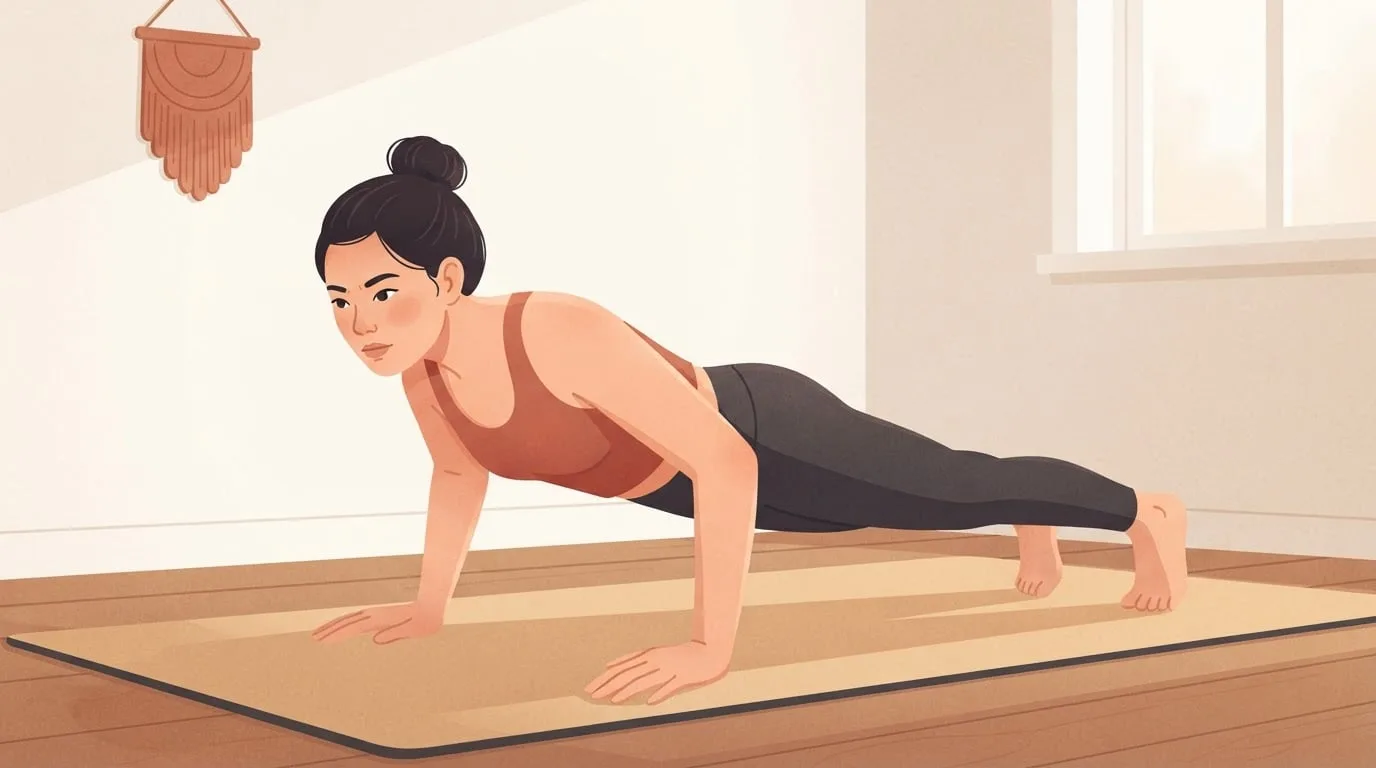
- Push. Push-ups, with your hands on a bench to make them easier, plus dumbbell floor presses and shoulder presses.
- Pull. One-arm dumbbell rows, band pull-aparts and band rows with the band anchored in a door.
- Carry and core. Farmer's carries with two dumbbells, planks, side planks and dead bugs.
Five exercises that cover the whole body between them are the goblet squat, the dumbbell row, the push-up, the dumbbell Romanian deadlift and the plank. Yoga and Pilates can count as well when the holds are demanding, and our article on whether Pilates is strength training covers where it fits.
Knowing what to do is the easy part.
FitCraft, our mobile fitness app, pairs you with an AI coach who builds you a personalized plan around your goals, schedule, and fitness level. Every FitCraft program is designed by Domenic Angelino, MPH (Brown University) and NSCA-CSCS, with research published in the Journal of Strength and Conditioning Research and Medicine & Science in Sports & Exercise.
Take the Free Assessment Free • 2 minutes • No credit cardResistance Training Benefits: What It Does for Your Body
Resistance training makes you stronger, adds or protects muscle, helps keep bones dense, improves blood sugar control and body composition, and is linked to a longer life. Here's what the research shows for each.
Strength, at any age
Strength responds to training at every age, even when it has been lost. In a classic study by Fiatarone and colleagues (1990), ten frail, institutionalized adults with an average age of 90 did 8 weeks of high-intensity strength training. The nine who finished gained an average of 174 percent in strength, their mid-thigh muscle area grew 9 percent, and their speed walking heel to toe improved by 48 percent.
More muscle and a slightly faster metabolism
Muscle doesn't take care of itself. In a review of the health effects of strength training, Westcott (2012) puts the loss at 3 to 8 percent of muscle mass per decade in inactive adults, and reports that 10 weeks of resistance training may add about 1.4 kg of lean weight, raise resting metabolic rate by about 7 percent and cut about 1.8 kg of fat. Those figures are averages from a review, and your own results will depend on your starting point, your effort and how much you eat.
Can resistance training improve bone density?
Yes, when the load is high enough. In the LIFTMOR trial, Watson and colleagues (2018) randomized 101 postmenopausal women with low bone mass, average age 65, to supervised high-intensity resistance and impact training or a low-intensity home program for 8 months. The lifting group did 5 sets of 5 reps at above 85 percent of their one-rep max in two 30-minute sessions a week. Lumbar spine bone density rose 2.9 percent in that group and fell 1.2 percent in the home group, and at the femoral neck it held steady (up 0.3 percent) while the home group lost 1.9 percent. The only reported adverse event was one minor back spasm.
That program used heavy, supervised lifts, which most people can't copy at home. Our guide to bone density exercises at home covers the jumping and progressive dumbbell and band work that loads bone without a gym.
Better blood sugar control and body composition
Resistance training also helps your blood sugar control. In a meta-analysis of trials in people with type 2 diabetes, Umpierre and colleagues (2011) found that structured resistance training lowered HbA1c, the 3-month average of blood sugar, by 0.57 percentage points, close to the 0.73 from aerobic training. In healthy adults, a meta-analysis of 54 trials by Wewege and colleagues (2022) found that full-body resistance training cut body fat by 1.46 percentage points and fat mass by 0.55 kg compared with no exercise, and reduced visceral fat, the fat stored around the organs.
A longer life
In a meta-analysis of 16 cohort studies, Momma and colleagues (2022) linked muscle-strengthening activity to a 10 to 17 percent lower risk of early death, cardiovascular disease, total cancer, diabetes and lung cancer. Doing both strength and aerobic exercise went with lower risk than doing neither. These are observational data, so they show an association rather than proof, and our review of resistance training and mortality covers the dose-response curve in detail.
How Much Resistance Training Do You Need?
Adults need resistance training on at least 2 days a week, working all the major muscle groups, according to the CDC's guidelines, alongside 150 minutes of moderate aerobic activity or 75 minutes of vigorous activity. In Momma's meta-analysis, the lowest risk of early death, heart disease and cancer came at about 30 to 60 minutes of muscle-strengthening activity a week, and the lower diabetes risk kept growing up to 60 minutes. That works out to two or three sessions of 20 to 30 minutes.
For the aerobic half, short interval sessions are one time-efficient option, and our page on what HIIT is explains how they work and how often to do them.
How to Start Resistance Training at Home
Start with two full-body sessions a week on days that aren't back to back, and add a third once the first two feel routine. A full-body session trains every major muscle group each time, which suits two or three sessions a week better than a split routine. Choose a load or variation you can lift for the target reps with good form, and finish most sets with two or three good reps still in you.
A beginner full-body workout with dumbbells, a band and body weight
This session takes about 30 minutes with a short warm-up. Do the exercises in order and rest about a minute or two between sets.
| Exercise | Sets and reps | Make it easier | Make it harder |
|---|---|---|---|
| Goblet squat | 2 x 10 to 15 | Squat to a chair with no weight | Heavier dumbbell, 2-second pause at the bottom |
| One-arm dumbbell row | 2 x 10 to 12 per side | Lighter dumbbell | Heavier dumbbell, 3-second lowering |
| Push-up | 2 sets, stopping 2 or 3 reps short of failure | Hands on a wall or bench | Feet raised on a step |
| Dumbbell Romanian deadlift | 2 x 10 to 15 | Glute bridge on the floor | Heavier dumbbells or one leg at a time |
| Reverse lunge | 2 x 8 to 10 per leg | Hold a chair for balance | Hold a dumbbell in each hand |
| Band pull-apart | 2 x 15 | Lighter band | Thicker band, 2-second squeeze |
| Plank | 2 x 20 to 40 seconds | Knees on the floor | Longer hold, or lift one foot |
Warm up for 5 minutes first: march in place, then do a light set of squats, rows and push-ups. Lower each rep under control and breathe out as you push or pull, rather than holding your breath. Stop any exercise that causes sharp pain, and swap it for the easier version.
How to progress
When you can do the top of the rep range on every set with good form, make that exercise a little harder the next time. At home you can add a rep or two, add a third set, pick up a heavier dumbbell or a thicker band, slow the lowering to 3 seconds or move to a harder variation. Change one thing at a time. If you'd like to train with heavier dumbbells or in a gym, our guide on how to start lifting weights covers choosing your first weights and your first two weeks, session by session.
What This Means for You
Resistance training is any exercise that makes your muscles work against a load, and it doesn't require a gym. A push-up on your living room floor counts. So does a goblet squat with one dumbbell or a row with a band looped around a door handle. Two sessions a week covers the guideline, and the research shows the benefits arrive at any age.
Picture two months from now: you carry the shopping up the stairs in one trip, you've added weight or reps to every exercise, and two 30-minute sessions are simply part of your week. The hard part is showing up long enough for the changes to add up. A personalized training program can take the planning off your hands. In FitCraft, a 3D AI coach demonstrates each exercise, from dumbbell rows to band pull-aparts, on an interactive model you can zoom in on, says your name during the workout and adapts your workouts as you progress, while streaks and calendar rewards keep you coming back. As one FitCraft user, Stacy, put it: "After my second kid, I needed something stupidly simple."
Frequently Asked Questions
At what age is your body strongest?
Most people are strongest between their late 20s and early 40s. In grip strength data from nearly 50,000 people in Britain, men peaked between 29 and 39 and women between 26 and 42, and strength declined from midlife onward. Resistance training slows that decline at any age: frail adults around 90 more than doubled their strength in 8 weeks of training.
What should I eat when strength training?
Eat enough total food to recover and get enough protein, spread across your meals. In a meta-analysis of 49 trials, extra protein added to resistance training gains in muscle and strength, but intakes above about 1.6 grams per kilogram of body weight a day added no further muscle. Carbohydrate-rich foods such as fruit, potatoes, rice and oats fuel your sessions.
Is Pilates resistance training?
Yes. Pilates works your muscles against your body weight or a reformer's springs, so it counts as resistance training, usually at light loads. It's a good start, and most people need heavier loads, such as dumbbells or harder bodyweight moves, once the exercises stop challenging them.
Is resistance training good for weight loss?
Resistance training helps with weight loss, though mostly by changing body composition rather than the number on the scale. Compared with no exercise, it cut body fat by about 1.5 percentage points, fat mass by about half a kilogram and visceral fat in a meta-analysis of 54 trials. Pair it with an eating plan you can keep for the biggest change in body fat.
Is resistance training good for women?
Yes, women gain muscle and strength from resistance training at the same relative rate as men. A meta-analysis found no difference between the sexes in relative muscle growth or lower-body strength gains, and women gained more relative upper-body strength. Lifting won't make you bulky by accident; building large muscles takes years of deliberate training and eating.
How long does it take to see results from resistance training?
Strength usually starts rising within the first few weeks, and muscle growth you can see takes longer, often a couple of months or more. In one study, leg strength rose 39 percent in five weeks of training, and the increase in thigh muscle size was already measurable after 20 days. Training two or three times a week and adding load as you get stronger keeps the results coming.