- Three meals a day is a social pattern, not a biological law. For most of recorded history, most people ate two meals. The three-meal structure spread during the Industrial Revolution to fit factory schedules.
- Meal frequency doesn’t meaningfully change body composition. Two large meta-analyses (Schoenfeld et al., 2015; Blazey et al., 2023) found no robust advantage for higher-frequency eating in randomized trials.
- The 3-meal norm has real-world benefits, though. It matches work schedules, coordinates with family, and simplifies planning. That’s a fine reason to keep it.
- What actually matters: total daily calories and protein for body composition, meal timing around workouts if you train hard, and picking a pattern you can stick with.

Someone on r/nutrition asked a good question recently: why did “3 meals a day” become the default? Every guide, every calorie tracker, every fitness app assumes it. But there’s no obvious biological reason humans should eat three specific times per day. So why do we?
The short answer is that we largely didn’t, until pretty recently. And when researchers actually test whether three meals beats four or two for weight loss and body composition, the answer is: it doesn’t.
Here’s the history of how the pattern spread, what the modern research says about whether meal frequency matters for your body, and how to think about picking a pattern that actually works for you.
Where the Three-Meal Day Came From
For most of recorded history in Europe, two meals a day was standard. A JSTOR Daily piece by Livia Gershon (2018) notes that up until about 1800, most English people ate two meals a day, not three. During the reign of Henry VII (1485-1509), the big daily meal happened around 11 a.m., not the evening.
Roman agricultural writers described a similar pattern. A light early meal (bread, cheese, olives), a larger midday meal, and often nothing after that. Medieval European monks and farmers followed the same rough shape. The word “dinner” itself originally referred to the biggest meal of the day, whenever that fell, not to the evening meal specifically.
The shift to three meals came with the Industrial Revolution. When workers moved from farms into factories in the late 1700s and 1800s, three constraints converged. First, factory shifts were long and standardized. Workers couldn’t come home for a midday meal, so a lunch developed that could be eaten quickly at or near work. Second, the workday extended past sunset thanks to cheap artificial lighting (candles, then gaslight, then electricity), which pushed the main meal into the evening as “dinner.” Third, breakfast expanded from a small pre-work bite into a proper meal because workers needed enough calories to make it to lunch.
A recent Conversation piece by culinary historians Rob Richardson and Dianne Ma (2025) at Auckland University of Technology adds a nautical origin story. The British Royal Navy adopted three standardized meals a day to structure life on long voyages, which spread the pattern through the empire well before the factory system reinforced it. Either way, the takeaway is the same. Three meals a day was engineered by schedules, not by physiology.
What Modern Research Says About Meal Frequency
The idea that a specific meal frequency changes what your body does with food has been tested directly, more than once, and the answer keeps coming back the same.
Schoenfeld, Aragon & Krieger 2015: 15 Studies, No Robust Effect
The most-cited meta-analysis is Schoenfeld, Aragon and Krieger (Nutrition Reviews, 2015), which pooled 15 studies comparing higher versus lower meal frequencies for body composition. Initial pooled results showed a small positive association between higher meal frequency and better body composition (more fat loss, more lean mass). But the authors ran a sensitivity analysis and found that the entire effect came from a single outlier study. Remove that study and the effect vanished. The honest conclusion: the evidence base does not support the “eat more small meals” recommendation for body composition.
Blazey et al. 2023: 16 RCTs, No Difference in Weight Change
A more recent and larger meta-analysis by Blazey and colleagues (International Journal of Behavioral Nutrition and Physical Activity, 2023) pooled 16 randomized trials comparing restricted eating (3 or fewer meals per day) with unrestricted eating (4 or more meals per day). The result: no meaningful difference in weight change between the two patterns (mean difference -0.62 kg, 95% CI -2.76 to 1.52, p = 0.57). Cardiometabolic markers (blood pressure, blood glucose, cholesterol) also showed no advantage in either direction. The authors noted the evidence base is thin and biased, so certainty is low, but the point estimate is essentially zero.
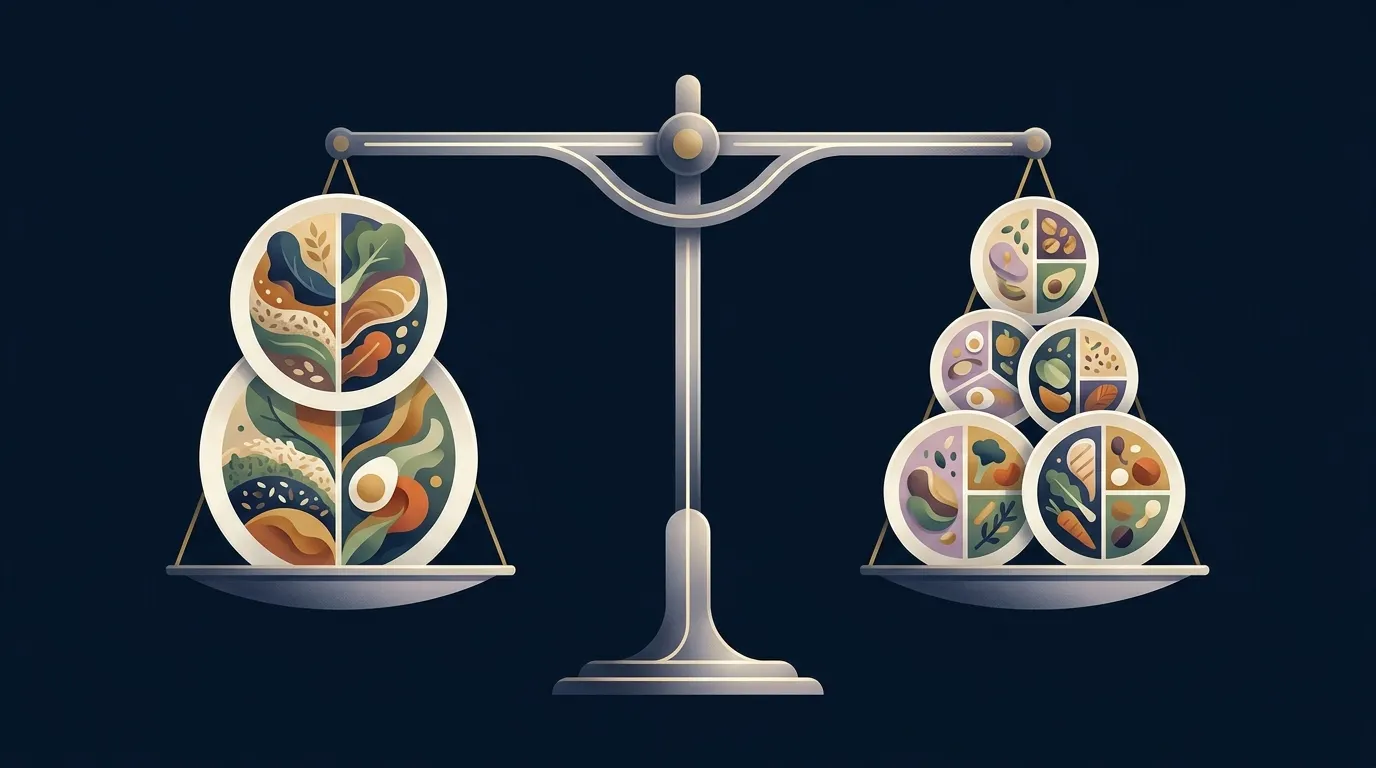
Why the “Small Meals Boost Metabolism” Idea Doesn’t Survive
The persistent version of this myth says eating more often keeps your metabolic fire burning through the thermic effect of food (the calorie cost of digesting a meal). The problem: that cost scales to total calories eaten, not to how those calories are split across the day. Six 300-calorie meals and three 600-calorie meals produce roughly the same total thermic effect. There’s no free calorie lunch here.
What can matter is appetite control and adherence. If small frequent meals keep you from getting so hungry you binge at dinner, that’s a real behavioral win. If large infrequent meals leave you satisfied and less snacky, that’s also a real win. The pattern that helps you eat in your target calorie range without willpower fatigue is the correct pattern for you.
Knowing what to do is the easy part.
FitCraft, our mobile fitness app, pairs you with an AI coach who builds you a personalized plan around your goals, schedule, and fitness level. Every FitCraft program is designed by Domenic Angelino, MPH (Brown University) and NSCA-CSCS, with research published in the Journal of Strength and Conditioning Research and Medicine & Science in Sports & Exercise.
Take the Free Assessment Free • 2 minutes • No credit cardWhen Meal Frequency Actually Matters
The right answer to “does meal frequency matter?” is: usually no, sometimes yes. Here are the situations where the split genuinely moves the needle.
If You’re Building Muscle, Per-Meal Protein Matters
Protein synthesis has a per-meal ceiling and a refractory period between meals. To maximize muscle-protein synthesis over the day, you want at least 3 to 5 meals that each contain roughly 0.4 g of protein per kilogram of body weight (about 25-40 g for most adults). This has nothing to do with metabolism or hunger. It’s a signaling constraint on the muscle side.
Two meals a day can hit total daily protein but usually stack too much in one sitting to fully use it for muscle building. If your goal is hypertrophy, spread protein across 3 to 5 meals. For the detailed research on why, see our science piece on protein distribution across meals.
If You’re Training Hard, Fuel Around Workouts
Meal timing matters most in the window around exercise. A carb-plus-protein meal 1 to 3 hours before training supports performance. A similar meal 0 to 2 hours after training supports recovery and muscle-protein synthesis. Whether those two meals are part of a 3-meal or 5-meal day is much less important than whether they anchor your workout.
If You Have Diabetes or Blood Sugar Issues
People with type 2 diabetes, prediabetes, or reactive hypoglycemia often benefit from a specific frequency pattern that keeps blood sugar swings smaller. This is medical territory, not a general recommendation. Work with a registered dietitian or physician who knows your labs.
If Your Appetite Regulation Is Off
Some people (especially after a period of chronic dieting, or during peri/menopause) have blunted satiety cues. Regular meals at set times can help re-anchor hunger. Others do better with fewer, larger meals that let hunger build naturally between them. Neither is universally right. The pattern that reduces late-night snacking, mindless grazing, or binge cycles is the one that’s working. If breakfast is the meal you're unsure about, our guide to the best breakfast for weight loss walks through the trials on eating it, skipping it and making it the biggest meal of the day.
How to Pick Your Meal Pattern
Since the research doesn’t hand you a specific number, use these three questions to find the shape that works.
- What matches your schedule? A commuting parent probably needs breakfast, a portable lunch, and a family dinner. A shift worker might do best with 2 large meals bracketing sleep. Pick the pattern that survives a normal week without you having to fight for it.
- Where does hunger actually land? Track appetite for a week. If you’re starving at 10 a.m., you need a real breakfast. If you’re fine until noon, breakfast is optional. Feed the hunger you have, not the hunger the schedule assumes.
- Can you hit your protein target? Multiply body weight in kilograms by 1.6 to get a daily protein target for muscle maintenance and body composition. Divide across your chosen number of meals. If you can’t comfortably hit 25 to 40 g of protein per meal in your pattern, add a meal (or a shake) until you can.
For more on the surrounding evidence, see our related reads on how much protein per day, pre-sleep protein research, and the consistency-not-intensity guide. All three focus on inputs that actually matter for progress instead of the meal-count decoration on top.
The Honest Answer to the Reddit Question
Someone asking “why did the 3 meals a day pattern become standard?” is asking a legitimate historical question, and the honest answer is: for social and industrial reasons, not health reasons. Once we understand that, the follow-up (“so does it matter?”) has a clean answer too. In most modern randomized trials, no. Total calories, total protein, and adherence to the pattern all matter more than the number of times per day you sit down.
That’s liberating if you’ve been forcing three meals on yourself and only one of them actually feels hungry. It’s also reassuring if the three-meal rhythm just works for your family and your job. There isn’t a hidden metabolic penalty for either choice. The version you can sustain wins.
Frequently Asked Questions
Why do we eat 3 meals a day?
The three-meal pattern is roughly 200 years old. For most of history, humans in agricultural societies ate two main meals a day (a light early meal and a larger later meal), not three. The three-meal structure emerged during the Industrial Revolution when factory workers needed a midday break to eat lunch away from home, then a formal dinner after work under artificial lighting. Before 1800 in England, most people ate two meals; the third slot got added to fit the workday. It’s a social schedule, not a biological requirement.
Is 3 meals a day scientifically the best pattern?
No. Two large meta-analyses have looked directly at this. Schoenfeld, Aragon and Krieger (Nutrition Reviews, 2015) pooled 15 studies on meal frequency and body composition and found no robust advantage for higher meal frequencies; the apparent benefit disappeared when a single outlier study was removed. Blazey et al. (Int J Behav Nutr Phys Act, 2023) pooled 16 randomized trials comparing 3 meals per day versus 4 or more and found no meaningful difference in weight change (MD -0.62 kg, 95% CI -2.76 to 1.52, p = 0.57). The pattern that produces the best results is the pattern you can stick with.
Should I eat more small meals to boost my metabolism?
Probably not. The metabolic-boost claim is based on the thermic effect of food (the calorie cost of digesting a meal), but that cost scales to total calories eaten, not to how many meals you split them across. Six 300-calorie meals and three 600-calorie meals produce roughly the same thermic effect over the day. Blazey et al. (2023) confirmed no cardiometabolic advantage for higher-frequency eating in randomized trials. Choose the meal pattern that matches your hunger, schedule, and appetite control.
Is eating 2 meals a day okay?
For most healthy adults, yes. Two meals a day was the historical norm in England before 1800 and is still common in many cultures today. The evidence base does not favor two meals over three or four in randomized trials. If you’re an active adult trying to build muscle, the constraint is total daily protein (roughly 1.6 g/kg) and per-meal protein (20 to 40 g), and two very high-protein meals can hit those targets. If you have diabetes, are pregnant, or take medications affected by food timing, talk to a healthcare provider before changing your pattern.
Did ancient humans really eat 1 meal a day?
Hunter-gatherer eating patterns varied by environment and food availability. Some populations likely ate one main meal a day and snacked opportunistically, others ate more often. Agricultural societies after roughly 12,000 years ago converged on two meals a day (a light morning meal and a larger later meal) as the dominant pattern until the Industrial Revolution. There is no single ancestral eating frequency that modern humans are “built for.” The species tolerated a wide range of patterns.