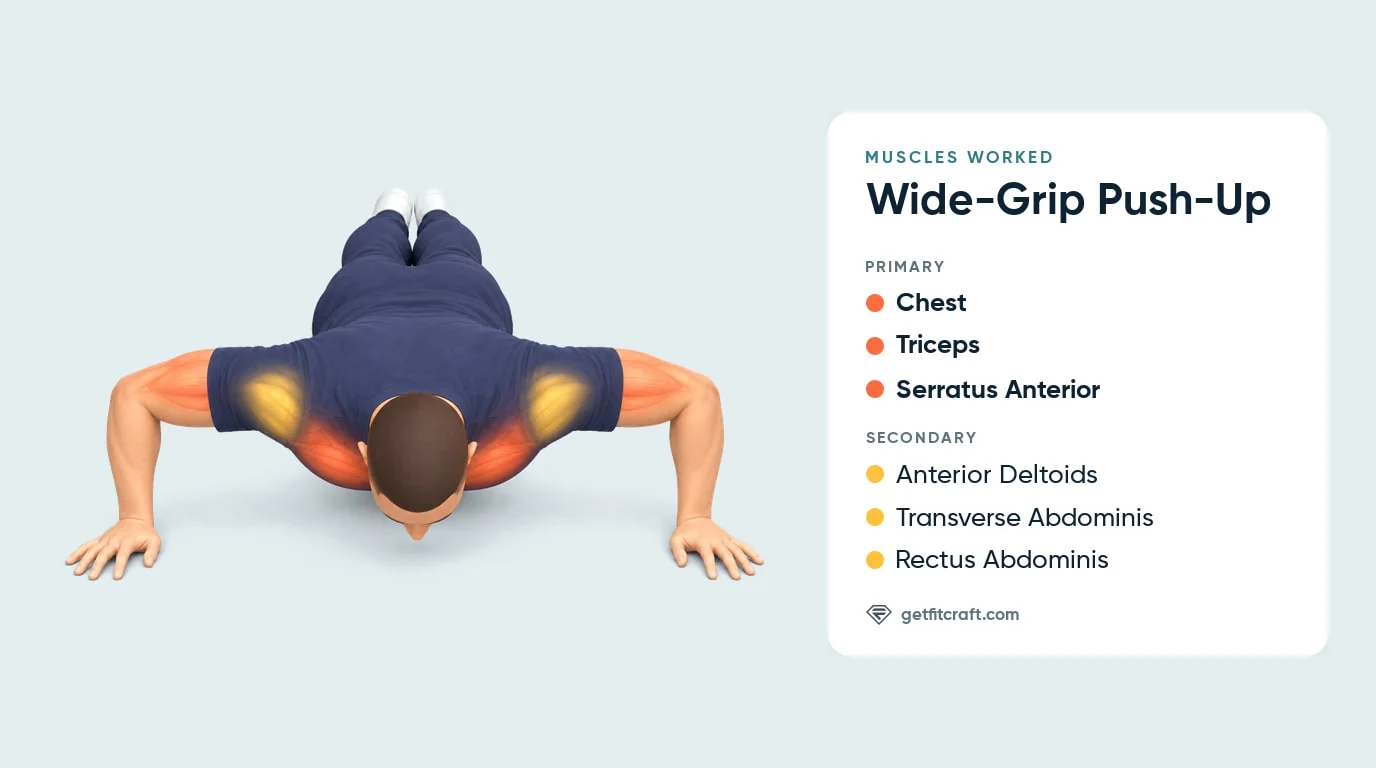
Muscles Worked
Primary movers. Wide-grip push-ups mainly work the chest (pectoralis major), the triceps and the serratus anterior. The chest brings your upper arms in to push your body away from the floor. The triceps straighten your elbows on the way up. The serratus anterior, the muscle along your ribs under your armpits, holds your shoulder blades flat against your ribs and pushes them forward as your arms straighten.
Secondary movers. The anterior deltoids (the fronts of your shoulders) help the chest press your body up. The transverse abdominis, your deepest abdominal muscle, braces your trunk like a belt, and the rectus abdominis, the six-pack muscle, keeps your hips from sagging. Together they hold your body in one straight line from head to heels.
Evidence. Cogley et al. (2005) measured pectoralis major and triceps EMG across wide, shoulder-width, and narrow push-up hand positions in 40 subjects and found greater activation in both muscles with the narrow base than the wide base. That finding contradicts the common belief that wider hands train the chest harder. Choose the wide grip for variety in your push-up training, not as a stronger chest exercise.
Ask around any gym and you'll hear the same rule of thumb: go wide to hit the chest, go narrow to hit the triceps. The research backs the narrow part, since narrow hand positions raise triceps activity. It does not back the wide part.
When researchers compared hand positions with EMG electrodes, the wide base produced lower activation in the chest and the triceps than the narrow base. So why does the wide-grip push-up still deserve a spot in your rotation? It trains the same push-up muscles with your elbows traveling out to the sides, which adds variety to your pushing work and builds strength in a different arm position.
The thing to watch is your shoulders. With your hands this wide, your elbows bend out to the sides, so angle them slightly back toward your hips, never straight out in a T, and keep your shoulders down, away from your ears. If your shoulders feel strained, bring your hands in a little, and stop if they hurt. This guide walks through all of it.
Quick Facts: Wide-Grip Push-Ups
- Equipment needed: None. Optional sturdy box or bench for the easier hands-up version and the harder feet-up version
- Difficulty: Beginner (hands on a box or bench) to Advanced (on the floor) in the app, with the feet-elevated decline version rated Expert
- Modality: Compound · Bilateral · Horizontal-push pattern · Closed-chain
- Body region: Upper body (chest, triceps and serratus anterior)
How to Do Wide-Grip Push-Ups (Step-by-Step)
- Set your hand width. Place your hands flat on the floor well outside your shoulders, about twice your regular push-up width, fingers pointing forward. A little narrower, such as one and a half times shoulder width, is fine, and so is a slight turn of the fingers if it feels better on your wrists. If your shoulders feel strained, bring your hands in a little.
Tip: if your wrists feel pressure, make fists or hold dumbbell handles so your wrists stay straight, and stop if they hurt.
- Build the plank. Walk your feet back until your body forms one straight line from head to heels, legs straight and close together, up on your toes. Squeeze your glutes, brace your abs, and keep your shoulders down, away from your ears. Set the plank before the first rep and keep it through the last one.
Tip: squeeze your glutes and brace your abs so your hips stay in line with your shoulders and heels, neither sagging nor piked up.
- Lower under control. Bend your elbows and lower your chest between your hands over about a second or slower, with no bouncing. Let your elbows travel out to the sides but angled slightly back toward your hips, never straight out in a T in line with your shoulders. Lower until your chest nearly or lightly touches the floor, or as low as you can control with your body straight. Your elbows bend to about a right angle.
Tip: lead with your chest and keep your head in line with your body. Your chin never reaches for the floor, and your face never takes weight.
- Press back up. Drive both palms into the floor and press back up until your arms are straight or nearly straight, without snapping your elbows. Breathe out as you press up and in as you lower.
Tip: keep your shoulders down, away from your ears, as you press.
- Reset and repeat. Re-check hand width, elbow path, and plank tension before the next rep. Beginners: 2-3 sets of 5-10 with your hands on a sturdy box or bench. Progress to floor reps when you can complete 3 sets of 10 with a stable plank and your elbows angled slightly back.
Tip: a clean 8 beats a grinding 15. End the set when your hips sag or your elbows flare straight out to the sides.
Get this exercise in a personalized workout
FitCraft, our mobile fitness app, uses an AI coach to program pressing exercises like this into your plan at the right volume and intensity, based on your level, goals, and equipment. Every FitCraft program is designed by Domenic Angelino, MPH (Brown University) and NSCA-CSCS, with research published in the Journal of Strength and Conditioning Research and Medicine & Science in Sports & Exercise.
Take the Free Assessment Free · 2 minutes · No credit card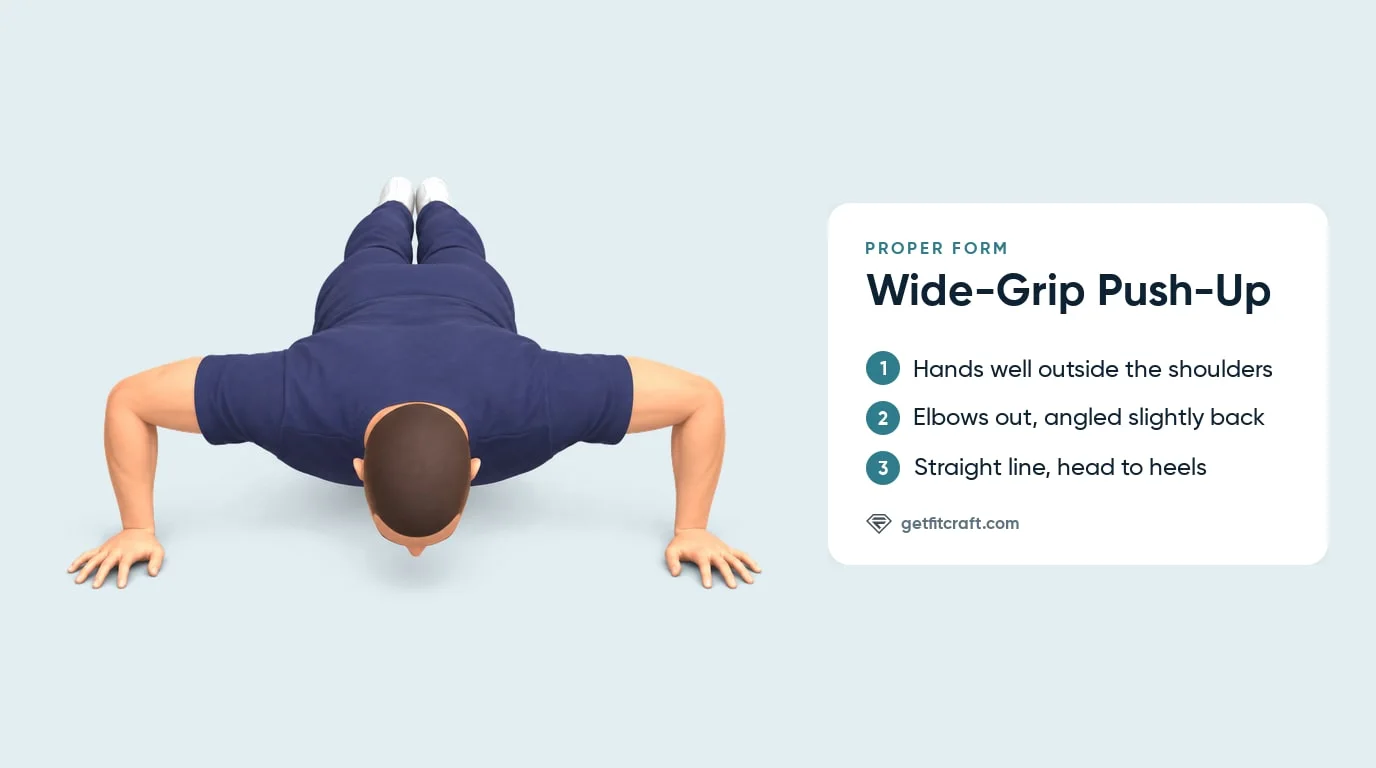
Common Mistakes to Avoid
These are the errors that cause most of the trouble on wide-grip push-ups.
- Flaring the elbows straight out. Your elbows point straight out to the sides in a T, in line with your shoulders. Fix: let your elbows travel out to the sides but angled slightly back toward your hips. Seen from above, your arms and body make an arrow shape, not a capital T.
- Shrugging the shoulders. Your shoulders creep up toward your ears as you lower or press. Fix: keep your shoulders down, away from your ears, through every rep. If your shoulders feel strained, bring your hands in a little.
- Sagging hips. Your hips drop below the line from your shoulders to your heels mid-set, arching your lower back. Fix: squeeze your glutes and brace your abs before the first rep, and end the set if your hips still sag.
- Piking the hips up. Your hips rise above that line. Fix: lower your hips until your body is one straight line from head to heels again.
- Cutting the depth. Stopping well above the floor on every rep. Fix: lower until your chest nearly or lightly touches the floor, or as low as you can control with your body straight. If you can't get close yet, put your hands on a sturdy box or bench instead of cutting the range on the floor.
- Leading with the chin. Your head drops and pokes forward, and your face reaches for the floor before your chest does. Fix: keep your head in line with your body and lead with your chest; your face never takes weight.
- Dropping or bouncing. Falling into the bottom and bouncing out of it. Fix: lower over about a second or slower, pause briefly, then press back up smoothly.
- Holding your breath. Fix: breathe in as you lower and out as you press back up.
Wide-Grip Push-Up Variations: Regressions and Progressions
Start where your shoulders and plank are solid, and progress when you own 3 sets of 10 at the current level.
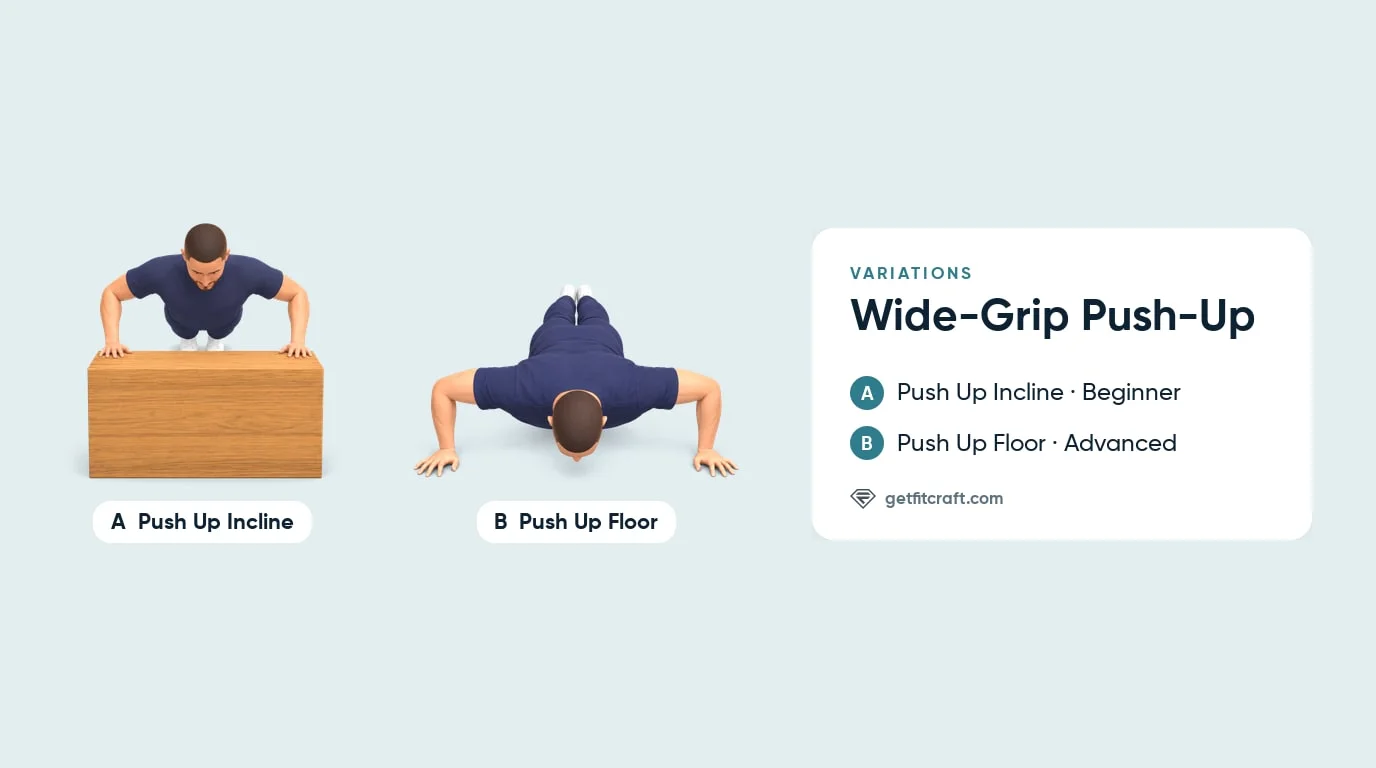
Incline Wide-Grip Push-Up (Beginner)
Hands wide on a sturdy box, bench or kitchen counter that can't slide, up on your toes with your body straight from head to heels. The higher the surface, the less of your body weight goes through your arms. The app rates its incline wide-grip push-up Beginner, with the hands on a box about thigh height. This is also a good place to learn the elbow path before the floor. See incline push-ups for the full incline progression logic.
Knee Wide-Grip Push-Up (Beginner)
Floor position with your knees down and your hands at the same wide width. Resting on your knees takes some of your body weight off your hands, and the app rates its wide-grip kneeling push-up Beginner. Keep one straight line from your knees to your head, with no bend at the hips.
Standard Wide-Grip Push-Up (Advanced)
Full plank on your toes, hands about twice your regular push-up width, elbows out to the sides and angled slightly back. The app rates its floor wide-grip push-up Advanced. This is the version this guide describes.
Feet-Elevated Decline Wide-Grip Push-Up (Expert)
Feet on a sturdy box or bench, hands wide on the floor. Raising your feet puts more of your body weight on your hands, so it's harder. The app's wide-grip decline push-up is rated Expert. Earn it after your floor sets feel controlled, and watch the elbow path closely: when you tire, the elbows tend to flare straight out.
Slow-Lowering Wide-Grip Push-Up (Harder)
Keep the floor version and slow your lowering to about three seconds, keeping your body straight and your elbows angled slightly back. Keep breathing the whole way. It makes each rep harder without any equipment.
Alternative Exercises
- Standard push-ups: The all-round default, with the hands slightly wider than the shoulders. Master these first; visit the wide grip for variety.
- Chest fly: A dumbbell isolation exercise for the chest that trains the arms-together motion without the pressing.
- Close-grip push-ups: The opposite end of the hand-width spectrum: hands under your chest and elbows tucked close to your sides, which puts more of the work on the triceps.
When to Avoid or Modify Wide-Grip Push-Ups
Wide-grip push-ups are safe for most healthy adults. If any of the situations below applies to you, check with a doctor or physical therapist before you do them, and stop any set that causes pain in a joint, your lower back or your neck. A burn in your chest, the backs of your arms or the fronts of your shoulders is normal.
- Shoulder impingement or rotator cuff irritation. If your shoulder is irritated or injured, see a doctor or physical therapist before you do wide-grip push-ups, and stop any set that causes shoulder pain.
- AC joint pain or prior shoulder dislocation. Get clearance from a doctor or physical therapist before you do wide-grip push-ups, and stop any set that causes shoulder pain.
- Wrist pain or carpal tunnel symptoms. Push-ups bend your wrists back under your body weight. If you have wrist pain or carpal tunnel symptoms, see a doctor or physical therapist before you do wide-grip push-ups. If your wrists only feel pressure, not pain, make fists or hold dumbbell handles so your wrists stay straight, and stop if they hurt.
- Recent shoulder, wrist, or elbow surgery. Get clearance from your surgeon before you do wide-grip push-ups.
- First 6-8 weeks postpartum or active diastasis recti. Holding a straight body line asks a lot of your abs. Get clearance from your doctor or a pelvic-floor physical therapist before you do wide-grip push-ups, and stop if you feel any pain.
- Lower-back pain. Any lower-back pain during a set means stop. If you have lower-back pain, see a doctor or physical therapist before you do wide-grip push-ups. If your hips sag and you can't hold your body straight, end the set there.
Related Exercises
- Same movement, different hand widths: push-ups, close-grip push-ups, diamond push-ups
- Chest-focused pressing and flys: chest press, chest fly, pec squeeze crossovers
- Shoulder-focused progression: pike push-ups
- Easier entry point: incline push-ups
- Core foundation (for the plank hold): forearm planks, hand planks, deadbugs, bird-dogs
- Pulling partner (for balanced programming): bent-over rows, inverted rows
How to Program Wide-Grip Push-Ups
The ranges below are a practical starting point that follows the general resistance-training principles of the ACSM Position Stand (Ratamess et al., 2009): match your sets, reps, rest and frequency to your level, and progress once your target reps feel easy. The position stand gives no ranges for wide-grip push-ups themselves. On wide-grip push-ups, you progress by moving to a harder version.
| Level | Sets × Reps | Rest between sets | Frequency |
|---|---|---|---|
| Beginner (incline or knee) | 2-3 × 5-10 | 60-90s | 2-3 sessions/week |
| Advanced (floor, on the toes) | 3-4 × 8-15 | 60-90s | 2-4 sessions/week |
| Expert (feet-elevated decline) | 3-5 × 6-12 | 90-120s | 3-4 sessions/week |
Where in your workout. Slot wide-grip push-ups as a second pressing movement after your primary press, or alternate them week to week with standard push-ups as your main horizontal push. In a circuit, pair them with a pull like inverted rows so the shoulders get balanced work.
Form floor over rep targets. The moment your elbows flare straight out to the sides, your shoulders shrug toward your ears or your hips sag, the set is over. Fewer clean reps beat more sloppy ones.
How FitCraft Programs This Exercise
Knowing how to do wide-grip push-ups is step one. Knowing when to rotate them in, how they fit next to your other pressing, and when your shoulders are ready for the decline version is where most people get stuck.
FitCraft handles that. During your personalized diagnostic assessment, the app maps your fitness level, goals, and available equipment, then builds a training plan for your level. The app has the wide-grip push-up with the hands on a box (Beginner), on the floor (Advanced) and with the feet up on a box (Expert), and its 3D demonstrations show the hand width and the elbows traveling out to the sides.
Every program is designed by an Ivy League-trained exercise scientist and NSCA-certified strength coach using evidence-based periodization, then adapted to you by the AI.
Frequently Asked Questions
Can I do wide-grip push-ups with shoulder pain?
Not while your shoulders hurt. Any shoulder pain during a set means stop, and if you have shoulder pain, impingement symptoms or rotator cuff irritation, see a doctor or physical therapist before you do wide-grip push-ups. If your shoulders only feel strained, not painful, bring your hands in a little and angle your elbows slightly back, and stop if they hurt.
Do wide-grip push-ups work the chest more than regular push-ups?
The EMG evidence says no. Cogley et al. (2005) measured pectoralis major and triceps activation across wide, shoulder-width, and narrow hand positions and found greater activation in both muscles with the narrow base than the wide base, and a small pilot study by Marcolin et al. (2015) found the highest chest and triceps activity with the hands together under the chest. The wide grip is a variation of the push-up pattern, not a stronger chest exercise. It still works your chest, triceps and serratus anterior as the main muscles, with your elbows traveling out to the sides.
How wide should my hands be for wide-grip push-ups?
Set your hands well outside your shoulders, about twice your regular push-up width, with your fingers pointing forward. A little narrower, such as one and a half times shoulder width, works too, and a slight turn of the fingers is fine if it feels better on your wrists. If your shoulders feel strained, bring your hands in a little, and stop if they hurt.
How many wide-grip push-ups should a beginner do?
Start with 2-3 sets of 5-10 reps with your hands wide on a sturdy box, bench or kitchen counter, resting 60-90 seconds between sets. Progress to knee wide-grip push-ups on the floor, then to full floor reps on your toes. The progression signal is 3 sets of 10 clean reps with a straight body and your elbows angled slightly back.
What is the difference between wide-grip and regular push-ups?
The difference is hand spacing and elbow travel. A regular push-up puts the hands slightly wider than the shoulders with the elbows angled back about 45 degrees. A wide-grip push-up sets the hands about twice that width, so the elbows travel out to the sides, angled slightly back toward the hips. Both work the chest, triceps and serratus anterior as the main muscles.