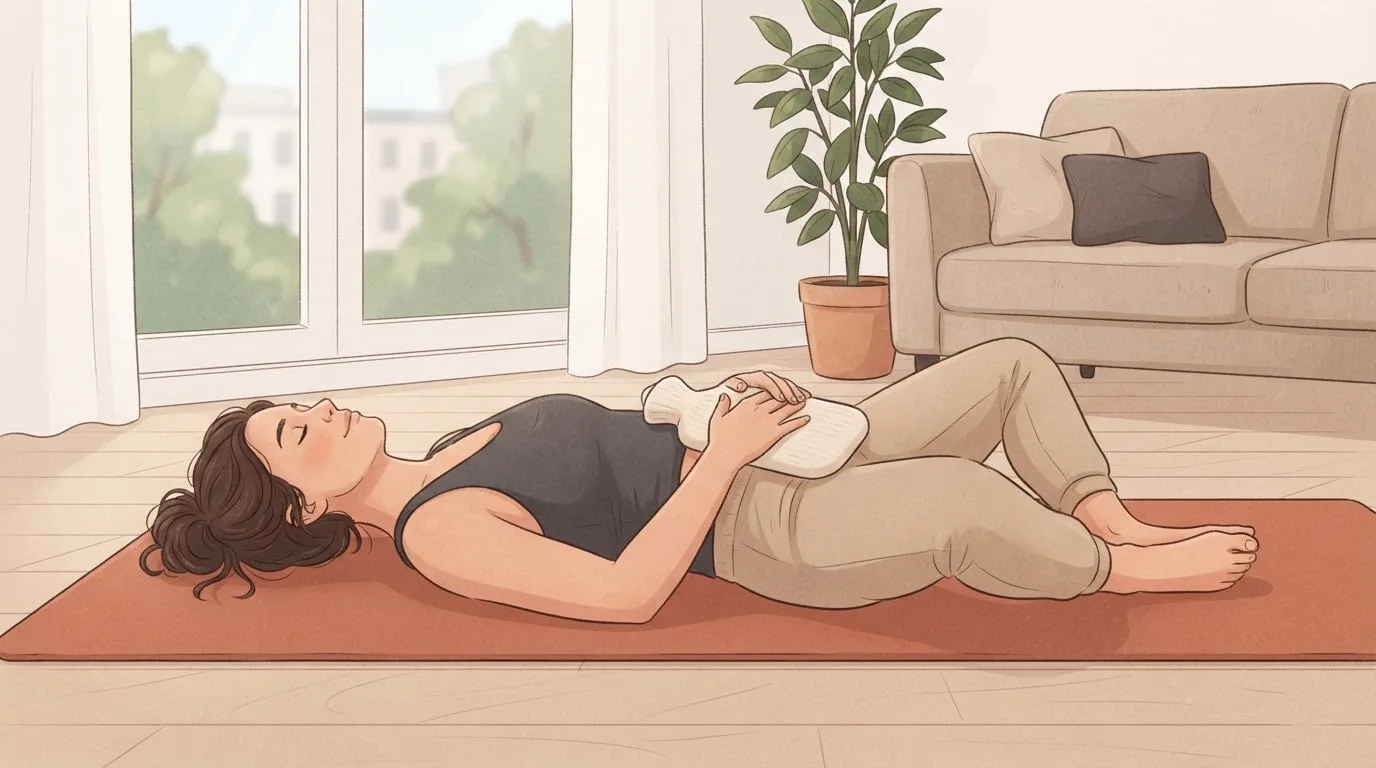
Day one arrives with a dull ache low in your belly, heavy legs and no interest in the workout you planned. Maybe you skip it and feel guilty. Maybe you force your usual session and feel worse halfway through.
Neither has to happen. The goal on period days is simpler: pick movement that eases the ache and keeps your routine going, so one rough day doesn't turn into a lost week.
Should you work out on your period at all? For most people, yes, if you feel up to it, and resting on your worst day is fine too. Research finds only trivial changes in strength and endurance during menstruation, and our review of training around your period covers that evidence. This guide picks up from there: which exercises feel best when working out on your period, a short session to follow, what to adjust, and when symptoms need a doctor.
Which Exercises Should Be Done During Periods?
These five kinds of exercise are the easiest to do on period days. If you feel fine, your normal workout is fine too.
1. Walking
The American College of Obstetricians and Gynecologists (ACOG) lists aerobic exercise such as walking, jogging, biking and swimming among the things you can do at home for period pain, because it helps your body produce chemicals that block pain. A 20 to 30 minute walk at a pace where you can still hold a conversation is the easiest version. It's low impact, needs no planning and you can turn around whenever you like.

2. Gentle yoga and stretching
Slow yoga relaxes the belly, hips and lower back, where period pain often spreads. In a randomized trial, Yang and Kim (2016) gave 40 university students with painful periods either a 60-minute yoga class once a week for 12 weeks or no program. The yoga group reported less cramping and less menstrual distress. A large 2024 review ranked stretching among the best exercise types for overall period symptoms. If you're new to it, our guide to yoga for beginners at home covers the basic poses.
3. Light strength training
You don't need to stop lifting. In Zheng and colleagues' (2024) network meta-analysis of 49 trials and 3,129 participants, resistance exercise and mixed programs ranked highest for reducing pain intensity, and resistance exercise worked best when programs ran longer than eight weeks. On period days, keep the exercises and lighten the dose: bodyweight or light dumbbells, two sets instead of three, and stop well short of failure. The long-term case for lifting is in our look at the benefits of strength training for women.
4. Mobility and core work
Slow spine and hip movements such as cat cow, pelvic tilts and knee rocks ease the stiff, achy feeling in the lower back. The same 2024 review found core-strengthening programs among the best at shortening how long period pain lasts. Keep core work gentle on crampy days. Bracing hard can make an aching belly feel worse.
5. Easy cycling or swimming
Both are low impact and both are on ACOG's list. A stationary bike lets you stop the moment you want to, and swimming is fine with a tampon or menstrual cup.
Best Exercises for Cramp Days
Cramps come from prostaglandins, natural chemicals made in the lining of the uterus that make its muscle contract. ACOG notes that levels are highest on the first day of a period and fall as bleeding continues, which is why the first day or two usually hurt most. Period pain is common: a review of 15 large studies found it in 16% to 91% of women of reproductive age, with severe pain in 2% to 29% (Ju and colleagues, 2014).
On a cramp day, try this order and stop wherever you like:
- Walk for 10 to 20 minutes at an easy pace.
- Child's pose for about a minute: knees wide, hips back toward your heels, arms long, belly resting between your thighs.
- Cat cow for 8 to 10 slow reps, breathing out as you round your back.
- Knees to chest on your back, rocking gently side to side for 30 to 60 seconds.
- Lying spinal twist for about 30 seconds a side.
- Heat on your lower belly for 15 to 20 minutes afterward.
The heat isn't an extra. In a 2025 meta-analysis of 57 trials with 5,359 participants, Yuan and colleagues found heat therapy reduced period pain compared with no treatment, gave relief comparable to anti-inflammatory pain relievers, and caused fewer side effects than those drugs. A heating pad or a hot water bottle in a cover both work.
Best Exercises for Heavy-Flow Days
Heavy days are often more about energy and logistics than pain, and they're more common in active women than most people think. In a survey by Bruinvels and colleagues (2016), heavy menstrual bleeding was reported by 54% of women who answered online and 36% of London Marathon runners. Across the exercising women surveyed, 32% reported a history of anemia and half had taken iron supplements, yet only 22% had sought medical advice.
On heavy days:
- Pick lower-impact options such as walking, cycling or strength work without jumps, if bouncing feels uncomfortable.
- Keep sessions shorter and close to a bathroom. A 20-minute home workout beats a long run far from one.
- Wear what makes you feel secure. Dark shorts, period underwear or a menstrual cup can take leak worry off the table.
- Notice your energy. If you're unusually tired or out of breath on heavy days month after month, ask a doctor to check your iron.
A 20-Minute Period Workout
This session follows the warm-up, circuit and cool-down shape of a coached workout. Do the circuit moves for 40 seconds each with 20 seconds of rest, and go through the circuit twice.
| Part | What to do | Time |
|---|---|---|
| Warm-up | March in place or walk around the house, then 8 slow cat cows | 5 minutes |
| Circuit, round 1 | Glute bridge, goblet squat with a light dumbbell, bird dog alternating sides, kneeling push-up | 4 minutes |
| Circuit, round 2 | The same four moves | 4 minutes |
| Cool-down | Child's pose for 1 minute, lying spinal twist for 30 seconds a side, knees to chest, then slow breathing on your back | 5 to 7 minutes |
Cramp-day swap: replace the circuit with 10 more minutes of easy walking, and add heat during the cool-down. Heavy-day swap: keep the circuit as written, skip anything with a jump, and keep water nearby. Good day: do your normal workout.
Find out what's really holding you back
FitCraft, our mobile fitness app, pairs you with an AI coach who builds you a personalized plan around your goals, schedule, and fitness level. Every FitCraft program is designed by Domenic Angelino, MPH (Brown University) and NSCA-CSCS, with research published in the Journal of Strength and Conditioning Research and Medicine & Science in Sports & Exercise.
Take the Free Assessment Free • 2 minutes • No credit cardDoes Exercise Help Period Cramps?
Yes, when it's regular. The strongest evidence is a Cochrane review by Armour and colleagues (2019), which included 12 randomized trials and 854 women with moderate to severe period pain. In the nine trials that compared exercise with no treatment, exercise reduced pain intensity by about 25 millimeters on a 100-millimeter pain scale, a change the authors called likely to be clinically meaningful. The programs that produced it ran about 45 to 60 minutes a session, three or more times a week, at low or high intensity.
Two details change how you should use that finding. First, the women trained throughout the month, and some trials even asked them not to exercise during their periods. So the benefit comes from steady training across your whole cycle, not from one workout on day one. Second, the evidence quality was rated low, partly because the trials were small, their results varied widely and they couldn't blind women to whether they were exercising.
Zheng's 2024 network meta-analysis adds the rest of the picture. Across 49 trials, every type of exercise reduced period pain, resistance training and mixed programs ranked highest for pain intensity, and meaningful relief showed up after 4 to 8 weeks of training. So if cramps keep costing you workouts, the most useful change may be the training you do in the other three weeks of the month.
Cramps do cost workouts. In a survey of 6,812 exercising women recruited through the Strava app, Bruinvels and colleagues (2021) found 84% reported stomach cramps at some point in their cycle, and women with more frequent symptoms were more likely to miss or change training.
What to Adjust When Working Out on Your Period
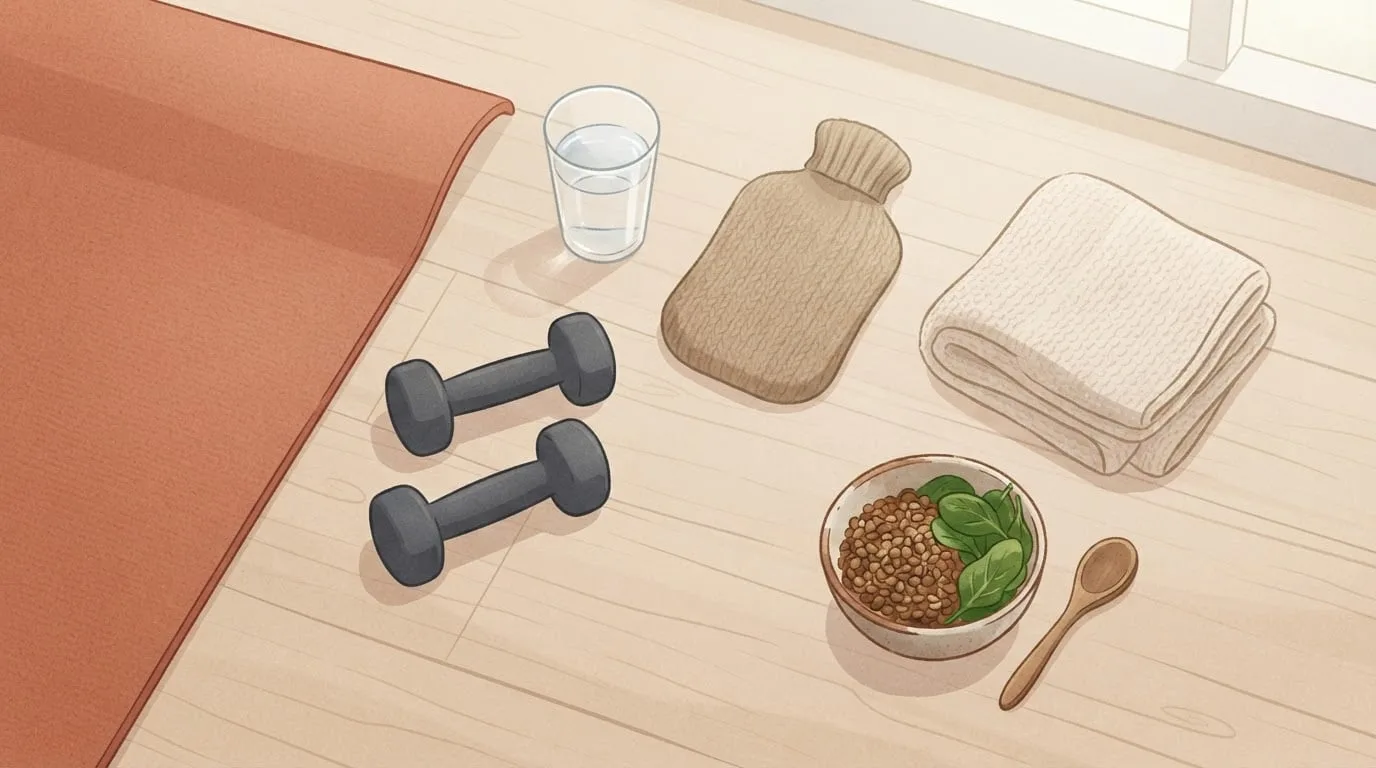
You don't need a separate program for period days. Four small adjustments cover most of it.
Intensity
Rate your effort on a 1 to 10 scale, which coaches call the rating of perceived exertion, and aim a point or two lower than usual on rough days. For cardio, use the talk test: you should be able to speak in full sentences. Strength holds up better than it feels. A meta-analysis of 78 studies by McNulty and colleagues (2020) found performance may be only trivially lower in the early follicular phase, the part of the cycle that includes your period. So the heaviness you feel is real, but it's mostly symptoms, and it passes.
Hydration
Bloating peaks right when many people want to drink less. In a year-long study of 62 women over 765 cycles, White and colleagues (2011) found self-reported fluid retention was highest on the first day of the period and lowest in the days after bleeding stopped. Bloating isn't a reason to cut back on water. Drink to thirst, and a little more in heat or during longer sessions.
Iron
Every period costs some iron, and heavy periods can lead to iron-deficiency anemia, according to ACOG. Build meals around iron-rich foods such as lean red meat, poultry, fish, beans, lentils, tofu, leafy greens and fortified cereals, and pair plant sources with vitamin C foods like citrus or peppers to help absorption. Don't start iron supplements on your own. Too much iron is harmful, so ask a doctor for a blood test that includes ferritin if you're often tired, pale or short of breath.
Pain relief and recovery
Heat on the lower belly is the easiest add-on. ACOG lists anti-inflammatory pain relievers called NSAIDs as the usual first treatment for period pain and says they work best at the first sign of pain, but they aren't safe for everyone, so check with a doctor or pharmacist first. Sleep counts too. Being well rested before and during your period helps you cope with discomfort.
What Exercises Should I Avoid on My Period?
None are off-limits. No exercise has been shown to be harmful during a normal period, so the rule is personal: skip or scale whatever makes your cramps worse that day. Some people find jumping, running or deep twisting uncomfortable on heavy days, and others don't notice a difference. Stop and rest if you feel dizzy or faint, or if you get sharp pain rather than a dull ache.
When to See a Doctor
Period pain that responds to movement, heat and over-the-counter relief is common. These signs aren't something to train around. Book an appointment if:
- The pain stops you from doing normal things for a day or more, or pain relievers don't help.
- The pain is getting worse over time, starts several days before your period, or doesn't go away when it ends. ACOG lists endometriosis, fibroids and adenomyosis among the causes of this kind of pain.
- Your bleeding is heavy. ACOG's signs include bleeding that lasts more than 7 days, soaking through one or more pads or tampons every hour for several hours in a row, needing two pads at once, changing protection during the night, and clots the size of a quarter or larger.
- You feel dizzy, short of breath or unusually tired during workouts you used to handle. Those can be signs of anemia.
- Your periods stop or become irregular when you train hard or eat less. The International Olympic Committee's 2023 consensus on low energy availability (Mountjoy and colleagues) treats menstrual disruption as a key warning sign that needs a proper medical assessment.
Get urgent care for sudden, severe pelvic pain, pain with a fever, or bleeding heavy enough to make you feel faint.
The Bottom Line
The best exercises during your period are the ones you'll do: an easy walk, gentle yoga, light strength work or slow mobility, scaled to how you feel that day. Use heat for cramps, drink to thirst, eat iron-rich food and see a doctor for pain or bleeding that disrupts your life. For fewer cramps over time, the evidence points to regular exercise about three times a week across the whole month.
That last part is the hard part, because period days are exactly when routines fall apart. Our roundup of the best fitness apps for women compares the options built to keep you training through rough weeks. FitCraft is one of them: a 3D AI coach demonstrates each exercise and says your name during the workout, streaks and calendar rewards keep the habit going, and its yoga and mobility workouts suit period days while its cardio and dumbbell and bodyweight strength workouts cover the rest of the month. As one user, Katie, put it: "I've tried everything. This is the first time I've stuck with something past two weeks."
Frequently Asked Questions
Am I supposed to rest on my period?
You don't have to rest, and you don't have to train. Resting on your worst day is a perfectly good choice, and gentle movement such as a walk or easy yoga often eases cramps. If you rest, pick your routine back up as soon as you feel better.
Should I work out on the first day of my period?
Only if you feel up to it. The first day is often the most painful, because prostaglandin levels are highest then, so a walk, gentle yoga or a lighter strength session usually fits better than a hard workout. Heat on your lower belly afterward can help too.
Why do I feel weaker on my period?
Mostly because of how you feel, not because your muscles lost strength. A meta-analysis of 78 studies found performance may be only trivially lower in the early part of the cycle that includes your period. Cramps, tiredness, poor sleep and low iron make the same weight feel heavier, so lighter loads for a day or two are fine.
Why am I not feeling like working out before my period?
Cycle symptoms such as tiredness, mood changes and bloating are very common. In a survey of 6,812 exercising women, 86% reported tiredness and 91% reported mood changes or anxiety at some point in their cycle. A shorter, easier session still counts, and motivation often comes back once your period starts.
When are you skinniest in your cycle?
Scale weight and bloating usually look lowest in the week or so after your period ends. In a year-long study of 62 women, self-reported fluid retention peaked on the first day of the period and was lowest in the days after bleeding stopped. That's water, not fat, so weigh-ins on period days aren't a fair read.
Is it OK to swim on your period?
Yes. Swimming is low-impact aerobic exercise, the kind the American College of Obstetricians and Gynecologists suggests for period pain, and a tampon or menstrual cup keeps you protected in the water. Choose an easy pace on heavy or crampy days.