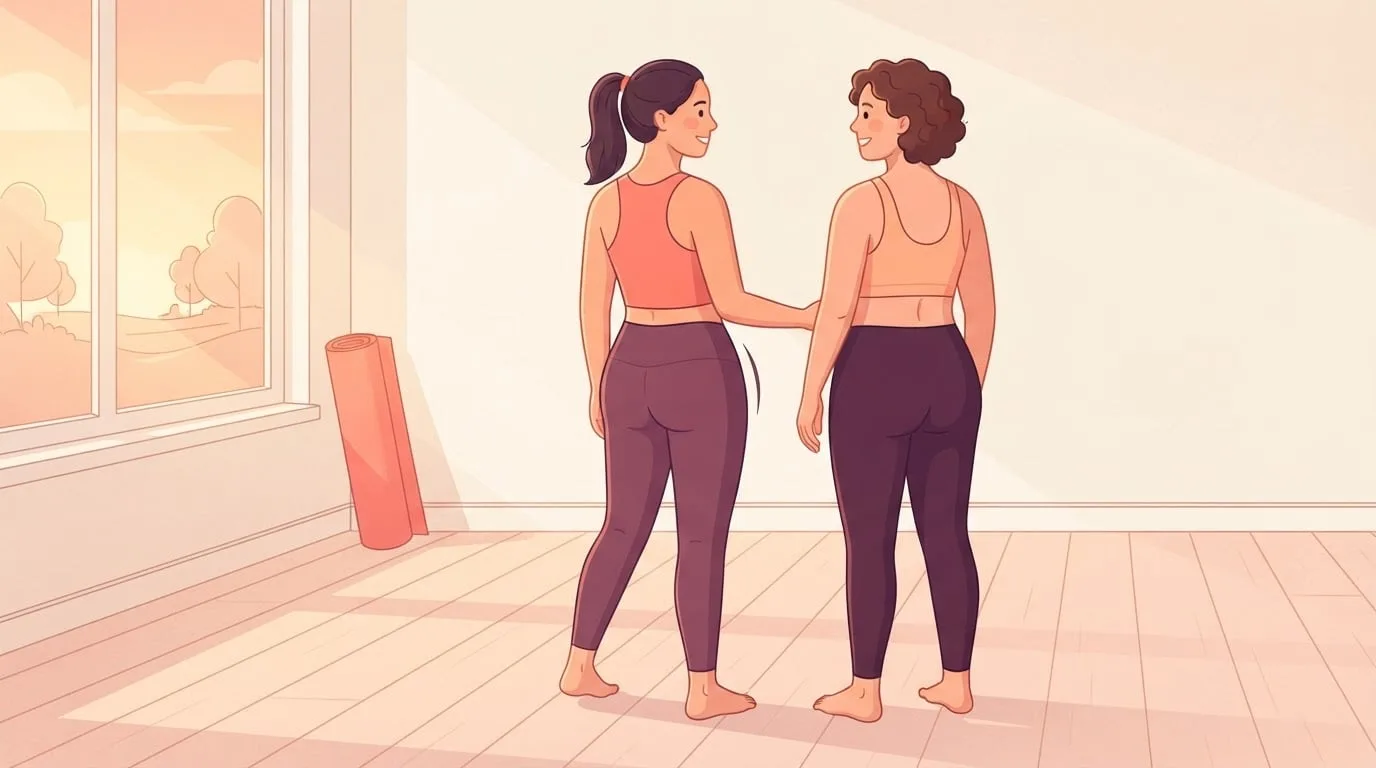
You noticed it in a mirror or a photo: a small inward curve on the side of each hip, just below your waistband. Then you searched for answers and found a wall of videos promising to erase hip dips in seven days.
If you've done those workouts for weeks and the curve is still there, nothing went wrong. Hip dips are mostly a feature of your skeleton, and no number of side leg raises changes bone. That's frustrating when a video promised otherwise. It's also good news, because the curve isn't a sign that you're unfit or carrying too much fat.
Below you'll find what hip dips are, what causes them, which muscles sit over them, the exercises that build those muscles best, a home hip dips workout with sets and reps, and how long changes take. If you searched for how to fix hip dips, the short answer is that there's nothing broken to fix. There's plenty you can build, though.
What Are Hip Dips?
Hip dips are inward curves on the outer side of the hips, between the top of the pelvis and the top of the thigh. You'll also see them called violin hips, because the outline looks like the waist of a violin, and cosmetic surgeons sometimes call them trochanteric depressions. They show up in women and men at every body weight. Hip dips in women get more attention, partly because a wider pelvis makes the whole outline curvier and partly because leggings put that exact spot on display.
A hip dip isn't a medical condition. No study has measured how common they are, because doctors don't treat them as something to diagnose. What you see is the space between two bony landmarks and the muscle and fat laid over them.
What Causes Hip Dips?
Three layers decide how deep a hip dip looks: bone, muscle and fat. Bone does most of the work.
Your pelvis and the greater trochanter
Press your fingers into your side just below your waist. The first bony ridge is the top of your pelvis, called the iliac crest. Move down a few inches and you'll find a second bony bump on the outside of your thigh: the greater trochanter, where the gluteus medius and minimus attach. Between those two points the outline usually curves inward. How far apart they sit, both up and down and side to side, sets the basic depth of that curve.
Pelvis shape varies a lot between people, and on average between the sexes. In a 3D shape analysis of 99 adult pelvises, Fischer and Mitteroecker (2017) found almost no overlap between female and male pelvis shapes. The differences included the angle of the iliac blades, the wing-shaped upper part of the pelvis, and how far apart the hip sockets sit. Hip sockets set farther apart move the thigh bones, and the trochanters on them, outward. That's one likely reason a curve below the iliac crest is so common in women.
The femoral neck
Your thigh bone doesn't run straight up into the hip socket. A short neck angles inward from the greater trochanter to the ball of the joint, and its length and angle decide how far out the trochanter sits. A longer neck or a lower angle puts it farther out. Gilligan and colleagues (2013) measured that neck-shaft angle in more than 8,000 thigh bones from 100 human populations. It averaged about 127 degrees and varied between individuals and regions. That's bone shape you were born with and finished growing years ago.
Muscle and fat on top
Over that frame sit the gluteus medius and minimus, the upper part of the gluteus maximus and a small muscle at the front of the hip, the tensor fasciae latae. Fat comes next. On average, women store more fat around the hips and thighs than men, a pattern shaped by sex hormones, genes and development (Karastergiou and colleagues, 2012). Where that fat collects, above or below the curve, can make a hip dip look deeper or shallower.
That's also why some very lean, very fit people have the most visible hip dips of all. With little fat smoothing the outline, the shape of the bones shows more clearly.
Hip Dips vs No Hip Dips: What's the Difference?
The difference is proportion, not fitness. A person with no visible hip dip usually has an iliac crest and greater trochanter that line up in a straighter vertical line, or more muscle and fat filling the space between them. A person with deep hip dips has a bigger step between the two. Neither shape is healthier or stronger, and you'll find both on sprinters, dancers and lifters.
Before and after hip dips photos online deserve a second look. Standing with your weight shifted onto one leg drops the pelvis on the other side and deepens that dip, and light from the side exaggerates any curve. Many dramatic transformations are mostly a change of stance and lighting.
Can You Get Rid of Hip Dips?
Not completely, and not with exercise alone. You can't train adult bone into a new shape, and you can't burn the fat over one spot by working the muscle underneath it. Ramírez-Campillo and colleagues (2013) had 11 adults train only one leg, three times a week for 12 weeks, with very long sets of leg presses. Their total body fat fell by about 5%, but the trained leg lost no more fat than the untrained one. The fat came off the arms and trunk instead.
What you can change is the soft tissue over the frame. More muscle on the side of the hips fills part of the space, and a change in overall body fat changes the outline too, though not always in the direction people expect. That's the honest goal: a softer, fuller hip line rather than a straight one.
What Muscles Fill Out Hip Dips?
The muscles closest to the curve sit on the outer pelvis. Gottschalk and colleagues (1989) described how they work together to steady the hip every time you stand on one leg.
- Gluteus medius. A fan-shaped muscle that runs from the outer surface of the pelvis to the greater trochanter. It's the main muscle that lifts your leg out to the side, and it sits directly above the dip, so it's the main target.
- Gluteus minimus. Smaller and deeper, under the medius, with a similar job.
- Upper gluteus maximus. The top fibers of the big buttock muscle shape the upper-outer corner of the glutes, where the hip blends into the seat.
- Tensor fasciae latae. A small muscle at the front of the hip that blends into the band along the outer thigh. It works hard during side leg raises, especially if the leg drifts forward.
Do Hip Thrusts Help With Hip Dips?
A little, but they aren't the best tool for this job. Hip thrusts and squats build the gluteus maximus well. In a nine-week trial, Plotkin and colleagues (2023) had 34 untrained college-aged adults train with either hip thrusts or back squats. Both grew the glutes by similar amounts on MRI, but the gluteus medius and minimus showed little to no growth with either exercise.
Hip abduction, lifting the leg out to the side, trains those side muscles more directly. Attarieh and colleagues (2026) trained 17 young adults for 10 weeks, with one leg doing hip extension and the other doing hip abduction on a cable machine. The abduction leg grew its upper gluteus maximus by about 10% and its gluteus medius and minimus by about 4%. The extension leg grew the lower glutes most and barely changed the medius and minimus. So keep bridges or hip thrusts for overall glute size, and add abduction work for the side of the hips. The full plan for bigger glutes lives in our guide on how to grow glutes.
The Best Exercises for Hip Dips
EMG studies measure how hard a muscle works during a movement, compared with a maximal effort. They don't prove a muscle will grow, but they show which exercises load the side of the hip. DiStefano and colleagues (2009) tested 12 exercises in 21 active adults and found side-lying hip abduction was the best for the gluteus medius, while single-leg squats and single-leg deadlifts worked the gluteus maximus hardest. Boren and colleagues (2011) compared 18 exercises in 24 adults. A side plank with the top leg lifted reached 89% to 103% of a maximal contraction in the gluteus medius, the highest of anything they tested.
These five glute exercises for hip dips use that evidence. You need a mat, a bench or sturdy couch, and a pair of dumbbells.
1. Side-lying hip abduction
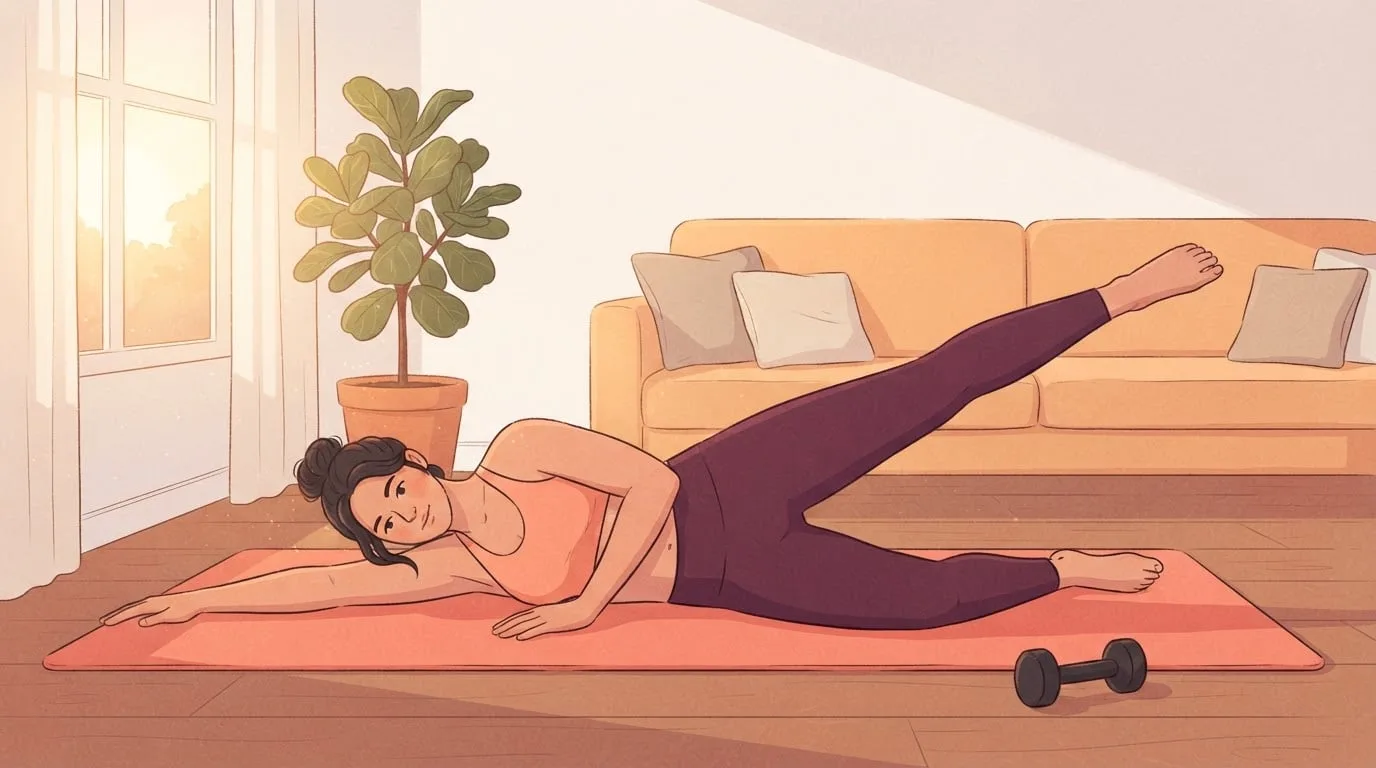
Lie on your side with your bottom knee bent and your hips stacked. Keep the top leg straight, point the toes forward rather than up, and let the leg sit slightly behind your body. Lift it to about 30 degrees, pause for a second, and lower slowly. If you feel it mostly at the front of the hip, move the leg a little farther back. When 20 reps feel easy, rest a light dumbbell on your outer thigh and steady it with your top hand.
2. Side plank with top-leg lift
Start on your forearm with your knees bent and stacked, then lift your hips until your body forms a straight line from head to knees. Raise the top leg a few inches, hold for a second, and lower it. Once you can do 10 controlled lifts a side, move to the full version on your feet. Our side plank guide covers the base position.
3. Bulgarian split squat
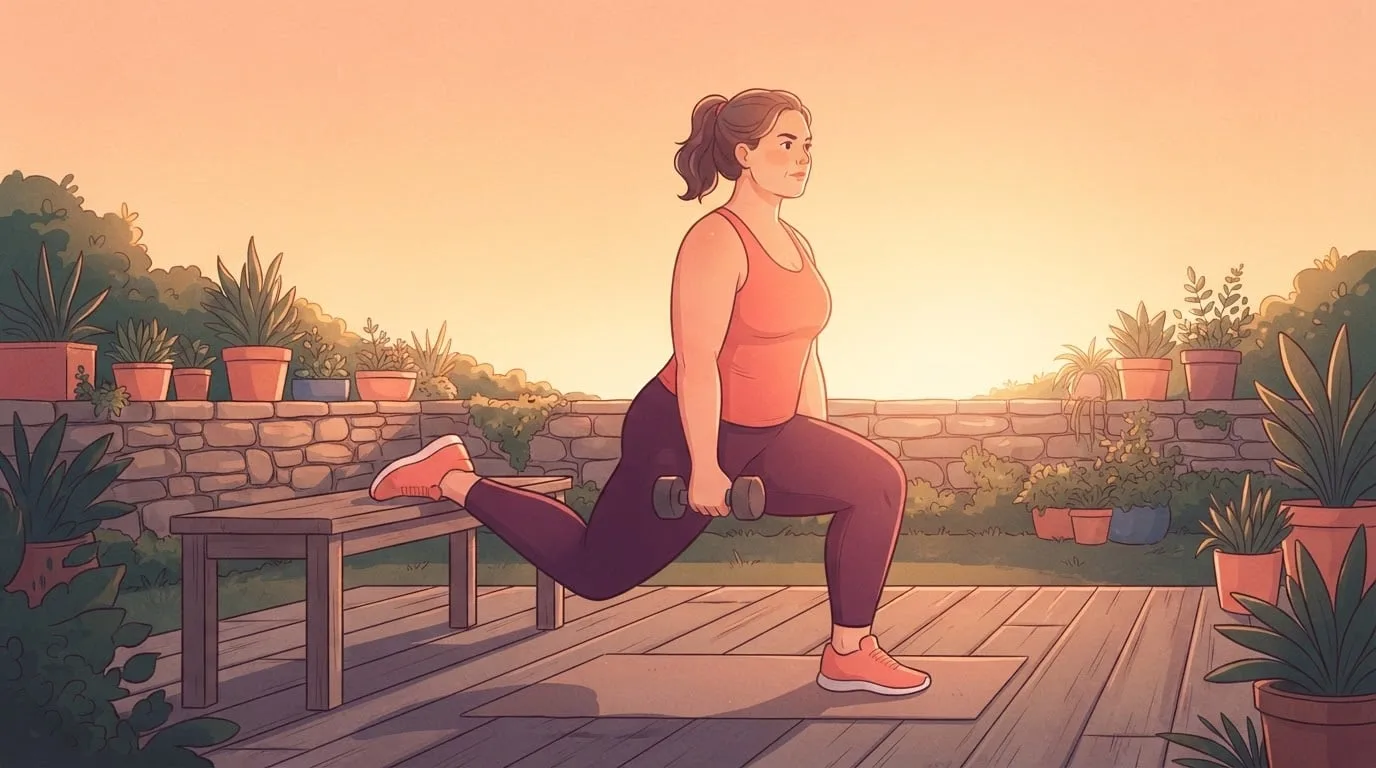
Stand about two steps in front of a bench or couch and rest the top of your back foot on it. Hold a dumbbell in each hand and lower until your front thigh is close to parallel with the floor, keeping your weight over the front foot. A slight forward lean of the torso shifts more of the work to the glutes. It's a supported single-leg squat, the pattern DiStefano's team found among the best for the gluteus maximus. Form details are in our Bulgarian split squat guide.
4. Single-leg Romanian deadlift
Hold one dumbbell in the hand opposite your standing leg. Soften the standing knee, hinge at the hip and let the free leg float back until your torso is nearly parallel with the floor, then drive the hip forward to stand tall. Balancing on one leg makes the gluteus medius work to keep your pelvis level. See the single-leg deadlift page for common mistakes.
5. Glute bridge or couch hip thrust
Lie on your back with your knees bent and a dumbbell resting across your hips. Press through your heels and lift until your body forms a line from shoulders to knees, then squeeze for a second at the top. For more range, put your upper back on the edge of a couch and do a hip thrust instead. This builds the main glute mass that rounds out the area just behind the dip. Our glute bridge guide has the setup.
Find out what's really holding you back
FitCraft, our mobile fitness app, pairs you with an AI coach who builds you a personalized plan around your goals, schedule, and fitness level. Every FitCraft program is designed by Domenic Angelino, MPH (Brown University) and NSCA-CSCS, with research published in the Journal of Strength and Conditioning Research and Medicine & Science in Sports & Exercise.
Take the Free Assessment Free • 2 minutes • No credit cardA Hip Dips Workout You Can Do at Home
Do this session twice a week, with at least two days between sessions. It takes about 35 minutes. Warm up first with the clamshells and bridges from our glute activation warm-up, which takes about five minutes.
| Exercise | Sets and reps | Rest |
|---|---|---|
| 1. Glute bridge or couch hip thrust (one dumbbell) | 3 sets of 10 to 15 | 90 seconds |
| 2. Bulgarian split squat (two dumbbells) | 2 sets of 8 to 12 per leg | 90 seconds |
| 3. Single-leg Romanian deadlift (one dumbbell) | 2 sets of 8 to 12 per leg | 60 seconds |
| 4. Side-lying hip abduction | 3 sets of 12 to 20 per side | 45 to 60 seconds |
| 5. Side plank with top-leg lift | 2 sets of 6 to 10 per side | 45 to 60 seconds |
Over a week that's 10 sets of side-hip work, the same weekly dose as the abduction leg in the 2026 trial, plus 14 sets of bridges, split squats and deadlifts for the rest of the glutes.
How hard each set should be
End each set with about one to three reps left in the tank, which coaches call reps in reserve. Light dumbbells are fine if you work that close to failure. In a meta-analysis of 21 studies, Schoenfeld and colleagues (2017) found that light loads, at 60% of a one-rep max or less, built as much muscle as heavy loads when sets went to failure. Heavy loads still built more maximal strength.
How to progress
Use double progression. Stay at one weight until you reach the top of the rep range on every set, then pick up a heavier dumbbell and drop back to the bottom of the range. For the side-lying and side plank moves, add a one-second pause at the top, slow the lowering to three seconds, or rest a dumbbell on your thigh. A light resistance band above the knees is another option for the side-lying lift if you own one.
How Long Does It Take to See Results?
Longer than a seven-day challenge, and the change you'll see is a softening rather than a disappearance:
- Weeks 1 to 3: Your strength climbs quickly as your nervous system learns the movements. The side of your hip may feel sore after the first few sessions.
- Weeks 4 to 10: Muscle growth is under way. In the trials above, 9 to 10 weeks were enough to measure glute growth on MRI, but the change in the gluteus medius and minimus was small, about 4%.
- Months 3 to 6: Many people notice a rounder upper-outer glute and a slightly fuller hip line in photos taken in the same pose and light.
- After 6 months: Changes keep adding up slowly as long as your loads keep climbing. The bony outline stays the same.
Track your progress with photos from the same spot, in the same light and the same relaxed stance, every four weeks. Day-to-day mirror checks mostly measure the lighting. If your hip dips look the same after six months of steady training, that's your skeleton, not a lack of effort.
How to Make Hip Dips Look Less Noticeable
You don't have to change your hip dips at all. If you'd still like the curve to look softer, these are the levers that actually work:
- Build the side of the hips. The abduction and single-leg work above adds muscle directly over the dip.
- Build the whole glute. A fuller upper and outer glute blends the line from waist to thigh, which is where bridges and split squats earn their place.
- Think carefully before cutting fat for this reason. Losing fat changes the whole body, not one spot, and it can make the bony outline more visible rather than less. If fat loss is a goal for other reasons, go slowly and keep lifting.
- Notice your stance in photos. Standing evenly on both feet shows your hips as they are. Shifting your weight onto one leg deepens the dip on the other side.
If you're wondering how to get rid of hip dips without exercise, cosmetic procedures are the only way to change the outline itself. Fat grafting moves fat from another part of the body into the dip, and fillers are sometimes injected there. Both carry real risks and recovery time, so they're a conversation for a board-certified plastic surgeon. Nothing about having hip dips means you need one.
Hip Dips Are a Normal Body Shape
You can train hard, get strong and still have hip dips. Stronger glutes pay off whether or not the curve changes, because they carry you up stairs, through every run and through every moment you stand on one leg.
The hard part is showing up twice a week for three to six months when the mirror changes slowly. Our roundup of the best fitness apps for women compares the options built to keep you training through the weeks when motivation fades. FitCraft is one of them: a 3D AI coach demonstrates each exercise in interactive 3D you can pinch to zoom, says your name during the workout and keeps your streak going, and its dumbbell and bodyweight strength workouts are built for training at home. As one user, Sarah, 27, put it: "First app that made exercise feel like something I chose, not forced."
The Bottom Line
You can't get rid of hip dips, because they're mostly bone. You can build the gluteus medius and upper glutes that sit over them with side-lying hip abduction, side planks with a leg lift, single-leg work and bridges, twice a week for three to six months. Expect a stronger, softer hip line, and feel free to keep the dips. They're part of a lot of strong bodies.
Frequently Asked Questions
Are hip dips genetic?
Yes, mostly. Hip dips come from the shape of your pelvis and thigh bones, which you inherit, and from where your body stores fat, which genes and sex hormones shape. That's why exercise can soften them but can't remove them.
Are hip dips normal?
Yes. Hip dips are a normal variation in hip shape that shows up in people of every size and fitness level, including athletes and dancers. They aren't a medical condition, and having them doesn't mean you're out of shape or carrying extra fat.
Do hip dips ever go away?
Not on their own, and usually not completely. Bone shape doesn't change in adulthood, so the curve stays. Building the gluteus medius and upper glutes can make hip dips look shallower, and a change in body fat can make them look shallower or deeper depending on where the fat comes off.
Can you get rid of hip dips in a week?
No. A seven-day challenge can't change bone, and muscle growth takes about two months to measure and longer to see. A difference you notice after a week is almost always posture, lighting or less bloating.
What are the best exercises for hip dips?
Side-lying hip abduction and side planks with a top-leg lift load the gluteus medius hardest in EMG studies, so they're the core of a hip dips workout. Add single-leg work such as Bulgarian split squats and single-leg Romanian deadlifts, plus glute bridges or hip thrusts for overall glute size, twice a week.
Are hip dips attractive?
Attraction is personal, and plenty of people like the curve hip dips create. The shape says nothing about your health, strength or fitness. Train for how strong you feel and let the outline be whatever your skeleton makes it.