
Two miles into your run, an ache shows up on the outside of your knee. It fades when you stop and comes back at the same point on the next run. So you roll your outer thigh until it stings, stretch it every night, and the ache keeps coming back.
It's easy to decide your body isn't built for running anymore. The plan you were handed is the real problem. Most IT band advice treats the band like a tight strap you can pull longer. The iliotibial band is a tough sheet of tissue that runs from your hip to just below your knee, and it's tied to your thigh bone along the way, so a stretch mostly reaches the muscles at its top end.
Below are six IT band stretches, each labelled with what it really stretches, four hip exercises from the IT band syndrome studies, and a 10-minute routine for runners and active beginners in their 30s and 40s. You'll also see when outer knee or hip pain needs a clinician instead of more stretching.
6 IT Band Stretches and What Each One Stretches
Each stretch below targets the muscles that pull on the band or sit beside it. Hold each one for about 30 seconds per side at a mild pull you'd rate 4 to 6 out of 10. One hold is enough, and a second round is fine if it feels good. Do them after a run or on a rest day, when your muscles are warm.
| # | Stretch | What it really stretches | Position |
|---|---|---|---|
| 1 | Standing cross-leg reach | TFL, glute medius and the side of your trunk | Standing |
| 2 | Seated cross-body stretch | Glute max and outer hip | Seated |
| 3 | Lying strap crossover | Hamstrings, glutes and outer hip | On your back, works in bed |
| 4 | Side-lying stretch at the edge of a bed | TFL, glute medius and outer thigh | On your side |
| 5 | Figure-four glute stretch | Glute max and deep hip rotators | On your back |
| 6 | Half-kneeling hip flexor stretch with a side lean | TFL, hip flexors and the front of your thigh | Kneeling |
The TFL, or tensor fasciae latae, is a small muscle at the front corner of your hip. It and part of the glute max attach to the top of the IT band, which is why every stretch here aims at the hip end.
1. Standing cross-leg reach
To stretch your right side, cross your right leg behind your left, raise both arms overhead with your hands clasped, and lean your upper body to the left while your right hip slides out to the right. Stand next to a wall if you need it for balance. You'll feel the pull along the outside of your right hip. In a motion-capture study of five elite distance runners, Fredericson and colleagues (2002) found that adding the overhead reach made this the most effective of three standing versions.
2. Seated cross-body stretch
Sit on the floor with both legs straight. Cross your right foot over your left knee and set it flat on the floor, then hug your right knee toward your left shoulder and sit tall. You'll feel it at the back and outside of your right hip. On a chair, rest your right ankle on your left knee, sit tall and hug that knee in, which is the hip abductor stretch.
3. Lying strap crossover
Lie on your back with a belt, strap or towel around your right foot. Lift the leg up straight, then guide it across your body toward your left side, keeping both shoulders and your right hip on the floor. Stop when you feel the pull along the back and outside of your hip. This one works in bed, and it covers your hamstring and outer hip in one hold.
4. Side-lying stretch at the edge of a bed
Lie on your left side near the edge of a bed with your left knee bent for balance. Take your right leg slightly behind your body, keep it straight and let it drop over the edge toward the floor, with your hips stacked rather than rolling back. This side-lying IT band stretch is based on the Ober test physical therapists use, one of the three positions tested in the cadaver study below.
5. Figure-four glute stretch
Lie on your back with both knees bent. Cross your right ankle over your left knee, then pull your left thigh toward your chest until you feel it deep in your right buttock. Because part of the glute max feeds into the top of the IT band, this is a direct way to loosen that end without crossing your leg in front of your body.
6. Half-kneeling hip flexor stretch with a side lean
Kneel on your right knee on a cushion with your left foot flat in front of you. Tuck your pelvis under, squeeze your right glute and shift your hips forward until the front of your right hip pulls. Then raise your right arm and lean a little to the left. The TFL sits at the front corner of your hip, so this stretch reaches it from the front while the other five reach it from the side.
Can You Actually Stretch Your IT Band?
Barely, and the anatomy explains why. Falvey and colleagues (2010) dissected 20 embalmed cadavers and found the band fixed firmly to the thigh bone along a ridge that runs from the bony point at the side of your hip down to the outer knee. In 5 unembalmed cadavers, they fixed strain gauges to the band during three stretches: the side-lying Ober position, a hip stretch that bends, crosses and turns the leg, and a straight leg raise. The gauges barely registered any strain. In 20 living volunteers, the point where the TFL joins the band moved about 2 millimeters when they pressed a leg out to the side, and the band's average lengthening was under half a percent.
The lower end is just as fixed. Fairclough and colleagues (2006) found fibrous strands tying the band to the femur above the knee, a layer of fat rich in nerves and blood vessels underneath it, and no bursa, the fluid-filled sac often blamed for the pain, in any cadaver, volunteer or patient they examined. On MRI, the band pressed into the outer knee bone at about 30 degrees of knee bend. They suggested that IT band pain comes from that fat layer being squeezed, rather than from the band rubbing back and forth.
So what do IT band stretches change? Mostly the muscles at the top of the band and your nervous system. A 2025 meta-analysis by Ingram and colleagues pooled 65 studies of 1,542 adults. Regular static stretching lowered overall stiffness and raised stretch tolerance, which means you can move further before the pull feels too strong, while the length of the muscle fiber bundles didn't change. In the band itself, Pepper and colleagues (2021) used shear-wave ultrasound on 30 adults and found that one session of stretching or foam rolling didn't change its stiffness at the mid-thigh, near the knee or at the TFL.
The stretches still help. Loosening the TFL and glutes can ease the tight feeling on the outside of your thigh, but stretching alone won't settle IT band syndrome. Keep long holds for after your run, since moving stretches suit the warm-up better, as our review of static vs dynamic stretching explains.
How to Loosen a Tight IT Band
To loosen a tight IT band, work on the muscles around it. Stretch the TFL and glutes, roll the outer hip and thigh, and strengthen your hips over the next few weeks. The tight feeling usually comes from those muscles and from a band that's sensitive to pressure, so that's where your effort pays off.
Foam rolling the IT band: what it changes
Foam rolling buys you a short-term gain in range of motion. In a 2020 meta-analysis of 26 trials by Wilke and colleagues, rolling improved range of motion a lot compared with doing nothing, and it did about as well as stretching. It didn't change IT band stiffness in the Pepper trial, so rolling doesn't loosen the band itself.
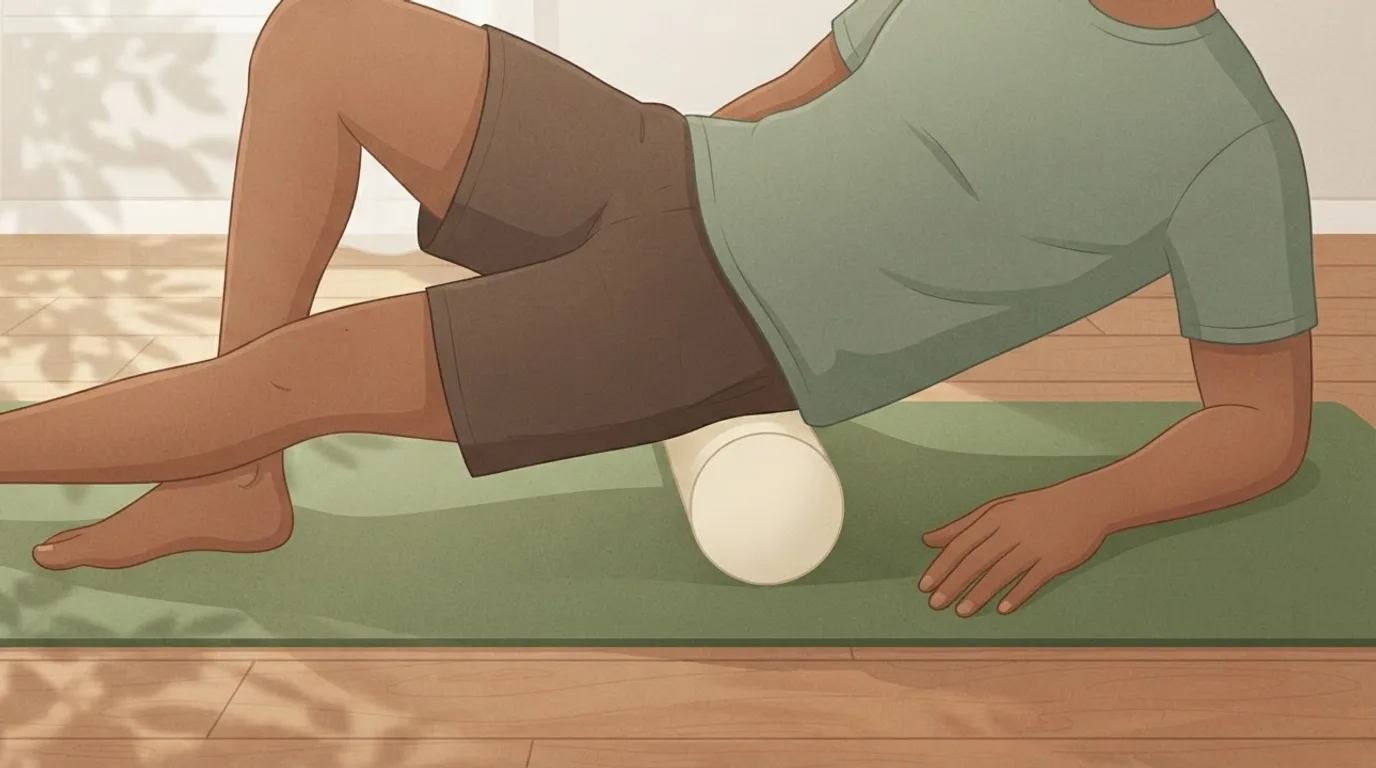
Roll the TFL at the front corner of your hip and the glutes behind it for about 90 seconds each, at a pressure you can breathe through, then the outer quad just in front of the band. Keep heavy pressure off the area just above the outside of your knee, where the band is tied to the bone over that sensitive fat layer. Our guide on how to use a foam roller covers the dose for each muscle.
Find out what's really holding you back
FitCraft, our mobile fitness app, pairs you with an AI coach who builds you a personalized plan around your goals, schedule, and fitness level. Every FitCraft program is designed by Domenic Angelino, MPH (Brown University) and NSCA-CSCS, with research published in the Journal of Strength and Conditioning Research and Medicine & Science in Sports & Exercise.
Take the Free Assessment Free • 2 minutes • No credit cardIT Band Syndrome Exercises: Why Hip Strength Matters
IT band syndrome is pain on the outside of the knee, where the band crosses the end of the thigh bone. It's common in runners. In a review of 2,002 running injuries at a sports medicine clinic, Taunton and colleagues (2002) found it was the second most common injury after runner's knee.
How you move matters more than how tight you feel. Noehren and colleagues (2007) recorded the running mechanics of healthy female runners and followed them for two years. The 18 who developed IT band syndrome had run with more hip adduction, the thigh drifting in toward the midline, and more inward knee rotation than 18 matched runners who stayed healthy.
The hip abductors, mainly the glute medius, are the muscles that stop that drift. Fredericson and colleagues (2000) tested 24 distance runners with IT band syndrome and found weaker hip abduction on the injured side than on the healthy side or in 30 uninjured runners. After a six-week program built around the glute medius, hip abduction strength rose by about 35 percent in the women and 51 percent in the men. Twenty-two of the 24 runners were pain-free and back running, with no return of symptoms at six months.
The evidence has limits. That study was a case series with no control group, and Grau and colleagues (2008) found no difference in hip strength between 10 runners with IT band syndrome and 10 without. A 2024 systematic review by Sanchez-Alvarado and colleagues covered 13 studies of 201 runners. Hip abductor strengthening was the most common treatment, pain fell by 27 to 100 percent over 2 to 8 weeks, and the studies were too different to pool. Strengthening your hips is the best-studied option and it worked in these trials, even though weak hips aren't proven to cause the problem.
These four IT band strengthening exercises train the glutes while keeping the TFL quieter. Selkowitz and colleagues (2013) placed fine-wire EMG electrodes, which measure how hard a muscle works, in the hip muscles of 20 healthy adults and ranked 11 exercises by how much they worked the glutes compared with the TFL. Start with 2 sets of 10 to 15 slow reps per side, three days a week, and add a set when the last reps feel easy.
1. Clamshell
Lie on your side with your hips and knees bent and your feet together. Keep your feet touching and lift your top knee without letting your pelvis roll back, then lower it slowly. The clamshell came first in the Selkowitz ranking, and our clamshell guide shows the form step by step.
2. Side-lying leg raise
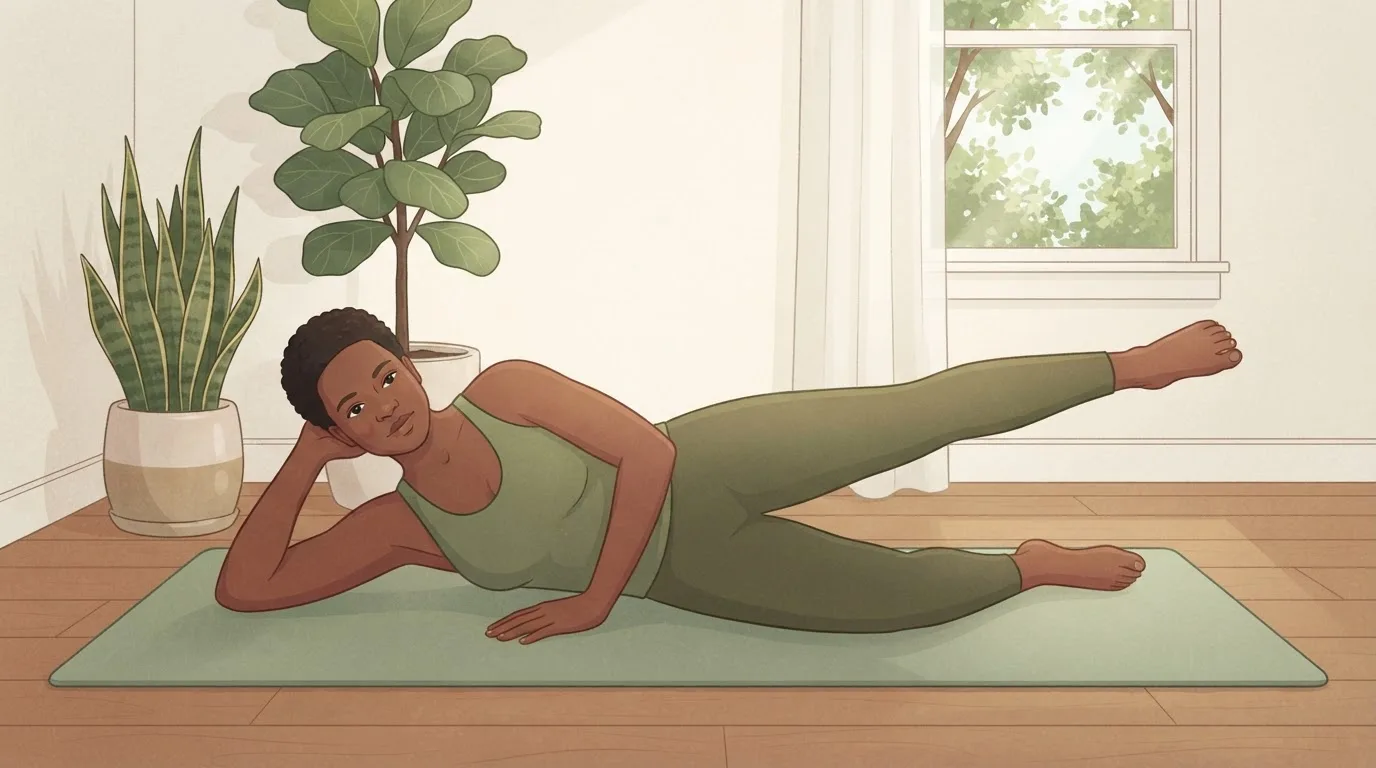
Lie on your side with your bottom leg bent or straight for balance and your top leg straight, in line with your body. Keep your toes pointing forward, lift the top leg about a foot by leading with your heel, and lower it over two seconds. In 21 active adults, Distefano and colleagues (2009) found it worked the glute medius harder than any other common rehab exercise they tested. If your hip bends forward as you lift, the TFL is taking over.
3. Side steps with a band
Loop a light resistance band around your legs just above your knees, or around your ankles to make it harder. Bend your knees slightly, sit your hips back and take 10 to 15 steps sideways with your feet pointing forward, then come back. Side steps came second in the Selkowitz ranking. If you don't own a band yet, do them slowly without one.
4. Single-leg bridge
Lie on your back with your knees bent, lift one foot and push through the other heel to raise your hips until your body forms a straight line from knee to shoulder. Keep your pelvis level and lower slowly. The single-leg bridge came third in the Selkowitz ranking, and if it's too hard, start with the two-leg glute bridge.
Hip work protects more than your IT band. Our guide to strength training for runners has a two-day plan for the rest of your legs.
IT Band Stretches for Knee Pain
IT band pain at the knee sits on the outside, just above the joint line. It tends to start at a predictable point in a run, often hurts more going downhill or down stairs, and fades with rest. You can't stretch the band at the knee, because that end is tied to the bone, so a plan for knee pain works on the hip end and on how much you run.
Downhill running is a common trigger. Orchard and colleagues (1996) measured the knee angles of nine runners with IT band syndrome and found that the painful contact happens near foot strike, at about 30 degrees of knee bend or a little less. Running downhill keeps your knee straighter when your foot lands, so it spends more time in that range. Faster running on flat ground was less likely to aggravate it, because the knee is already bent past that range at foot strike.
- Shorten your runs. Run a distance that stays pain-free, even if that's 15 minutes, and take walk breaks before the ache usually starts.
- Pick flat routes. For two or three weeks, avoid hills and walk the downhill sections you can't avoid.
- Stretch the hip end. Do stretches 3, 5 and 6 after each run, since they don't need you to stand on the sore leg.
- Strengthen three days a week. Do the four hip exercises above, and build your running back up in small steps.
For the rest of a post-run routine, our guide to the best stretches for runners covers the calves, quads and hamstrings.
IT Band Stretches for Hip Pain
Pain on the bony point at the side of your hip is often gluteal tendinopathy, an irritated tendon of the glute medius or glute minimus where it attaches under the band. That's the reason crossed-leg stretches can backfire. In their review, Grimaldi and colleagues (2015) describe it as mostly a mid-life condition, more common in women, driven by compression and high tension on the tendon, with excessive hip adduction a key factor. Hip adduction means your leg crossing toward or past your midline, which is exactly what stretches 1 to 4 ask for.
Common signs are pain when you lie on that side at night, sit with your legs crossed or stand on that leg, and a tender spot on the outer hip bone. In the LEAP trial, Mellor and colleagues (2018) randomly assigned 204 adults aged 35 to 70 with gluteal tendinopathy to education plus exercise, a corticosteroid injection, or wait and see. The education included avoiding positions that squeeze the tendons against the hip bone. At 8 weeks, 77 percent of the exercise group reported improvement, against 58 percent after the injection and 29 percent with waiting.
If your pain sits on the outer hip rather than the knee, skip stretches 1 to 4, keep the figure-four and half-kneeling stretches only if they feel comfortable, and see a physical therapist for a tendon-loading program.
A 10-Minute IT Band Routine for Runners
This routine fits around a running week. Do the stretches after each run and the hip exercises three days a week, after a run or on a rest day. If you're in your 30s or 40s and coming back to running, start with the strength half, because it's the part most people skip.
| When | Exercise | Dose | Time |
|---|---|---|---|
| After runs | Lying strap crossover | 30 sec per side | 1 min |
| After runs | Figure-four glute stretch | 30 sec per side | 1 min |
| After runs | Half-kneeling hip flexor stretch with a side lean | 30 sec per side | 1 min |
| 3 days a week | Clamshell | 2 x 12 per side | 2 min |
| 3 days a week | Side-lying leg raise | 2 x 10 per side | 2 min |
| 3 days a week | Side steps | 2 x 10 each way | 1.5 min |
| 3 days a week | Single-leg bridge | 2 x 8 per side | 1.5 min |
One 30-second hold per stretch is enough to keep your range. Bandy and colleagues (1997) had 93 adults aged 21 to 39 stretch their hamstrings five days a week for six weeks. A 30-second hold improved flexibility as much as a 60-second hold, and stretching three times a day added nothing over once a day.
If you'd rather have the strength and mobility sessions planned for you, a personalized training program can take that job off your plate. FitCraft's strength, mobility and yoga workouts come with an AI coach who demonstrates each exercise on an interactive 3D model and says your name as you train. Your workouts adjust as you progress, and streaks keep the rest-day sessions from slipping.
When to See a Clinician About IT Band Pain
See a physical therapist or sports medicine doctor if any of these apply:
- The pain lasts more than two or three weeks, even after you cut back.
- It's sharp, or it makes you limp.
- Your knee swells, locks or gives way.
- You feel numbness or tingling down your leg.
- The pain wakes you at night, or it started with a fall or a twist.
Those signs can point to problems that stretching can't fix, such as a torn meniscus, a stress injury or an irritated nerve. They're worth ruling out before you keep training through the pain.
The Bottom Line
IT band stretches work on the muscles at the top of the band, the TFL and glutes, because the band itself is fixed to your thigh bone. Use the stretches for comfort and range of motion, use the four hip exercises for IT band syndrome, and keep downhill running light until the pain settles.
Working out consistently is hard, but it doesn't have to be. Tim went from zero flexibility to completing a yoga program in 60 days. Do your first 10-minute session after your next run.
Frequently Asked Questions
What is the best stretch for the IT band?
The standing cross-leg stretch with both arms reaching overhead is the best-tested IT band stretch. In a motion-capture study of five elite distance runners, the overhead reach made it the most effective of three standing versions (Fredericson 2002). It mostly stretches the TFL and glutes at the top of the band, because the band itself barely lengthens.
How do you stretch your IT band in bed?
Lie on your back and use a belt or towel to guide one straight leg across your body, or lie on your side near the edge of the bed and let your straight top leg drop toward the floor. A figure-four stretch on your back works in bed too. Hold each one for about 30 seconds per side.
Should you stretch your IT band if it hurts?
Gentle stretching is fine if the outside of your knee aches but the stretch itself doesn't hurt. Stop any stretch that causes sharp pain, and skip crossed-leg stretches if the pain sits on the bony point of your outer hip, where they can squeeze an irritated gluteal tendon. Pain that lasts more than two or three weeks needs a clinician.
How long does IT band syndrome take to heal?
Runners in the treatment studies usually improved within 2 to 8 weeks (Sanchez-Alvarado 2024), and 22 of 24 runners were pain-free and back running after a six-week hip strengthening program (Fredericson 2000). If the pain hasn't eased after two or three weeks of cutting back, see a physical therapist or sports medicine doctor.
How do you strengthen your IT band?
You strengthen the hip muscles that control the band, because the band itself is connective tissue. Clamshells, side steps and single-leg bridges work the glutes hard while keeping the TFL quieter (Selkowitz 2013), and the side-lying leg raise works the glute medius hard (Distefano 2009). Start with 2 sets of 10 to 15 per side, three days a week.