Shoulder stand looks calm from the outside, but the pose asks a lot from the neck, shoulders, and nervous system. Most problems start before the legs ever lift. If the shoulders aren't supported and the upper arms aren't pressing down, the cervical spine ends up carrying pressure it doesn't need.
The goal is a quiet inverted line with a stable base. Your shoulders and upper arms make that base. Your hands support the back. Your neck stays still, spacious, and free from strain.
Quick Facts: Shoulder Stand Pose
- Equipment needed: Folded blanket and yoga mat
- Difficulty: Advanced
- Modality: Yoga inversion
- Body region: Upper body, core, and spine
- FitCraft quest category: Yoga
Muscles Engaged & Stretched
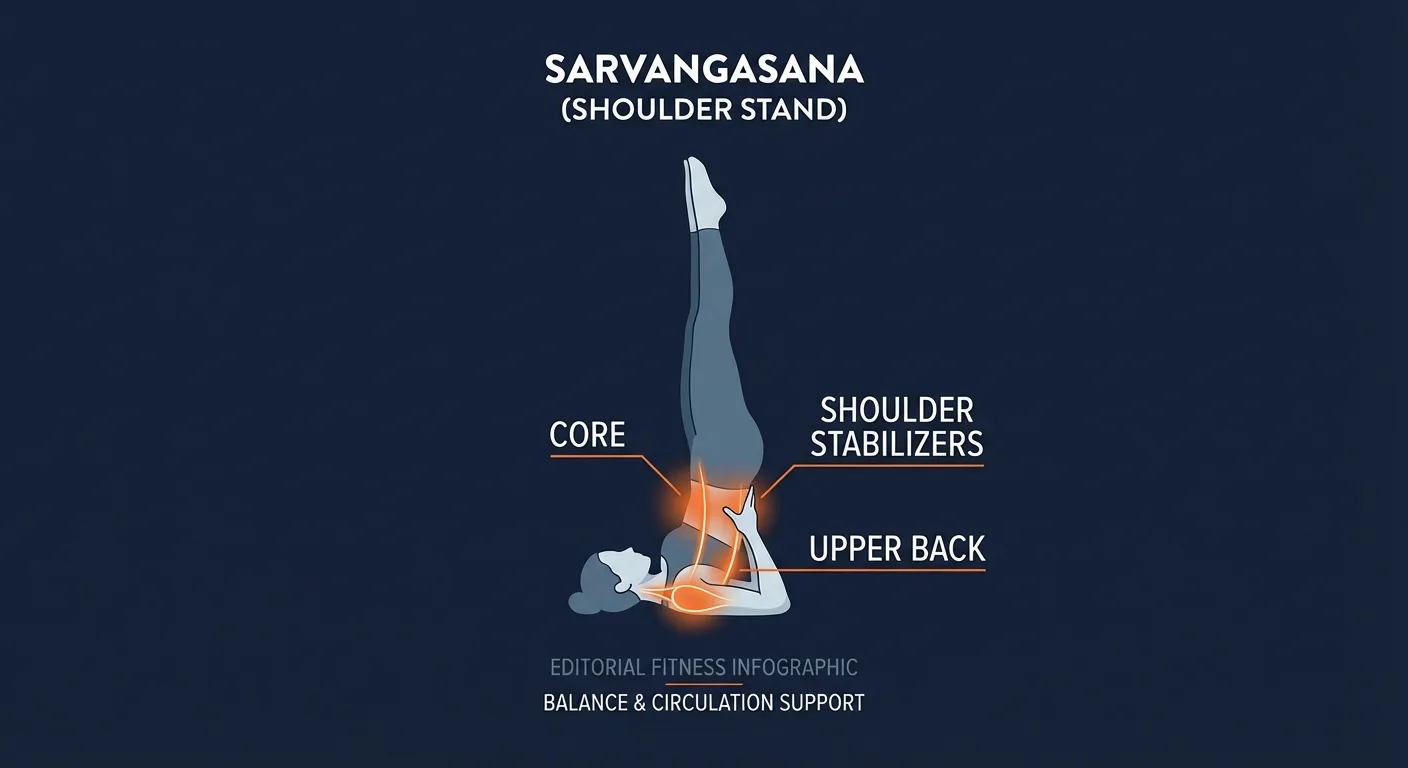
Primary movers: shoulder stand is a static inversion, so the prime work is isometric rather than a concentric-eccentric lifting pattern. The deep neck flexors and extensors, deltoids, rotator cuff, scapular stabilizers, and abdominals hold the body in position while the hands support the back.
Secondary movers: the glutes, quadriceps, hamstrings, and calf muscles help keep the legs long and stacked. The spinal erectors assist the vertical line through the torso, especially as the hips move from a tucked entry into the full hold.
Stabilizers: the transverse abdominis, obliques, rectus abdominis, serratus anterior, rhomboids, lower trapezius, and deep cervical muscles work together to protect the cervical spine. Inversions demand whole-body engagement because a small wobble at the hips can shift load toward the neck.
Mechanism: there is no exercise-specific PubMed, PMC, or DOI citation for shoulder stand in FitCraft's verified citation library. The safest evidence framing is mechanical: the blanket lifts the shoulders so the cervical spine has room, the upper arms create the base of support, and slow breathing limits panic-driven movement while inverted.
Step-by-Step: How to Do Shoulder Stand Pose
Step 1: Set Up the Base
Fold a thick blanket into a firm rectangle about 6 to 8 inches wide. Lie on your back with your shoulders and upper back on the blanket, and the back of your head resting on the floor just beyond the blanket edge. Your neck should feel spacious.
Coach Ty's cue: "Shoulders on the blanket, head off the blanket. Give your neck room before you lift."
Step 2: Lift the Legs
Keep your arms alongside your body with palms down. Bend your knees toward your chest, then roll your hips up by pressing the upper arms and elbows into the floor. Move slowly enough that you can stop at any point.
Coach Ty's cue: "Press down through your arms first. The lift should feel controlled, not thrown."
Step 3: Support the Back
Place your hands on your mid- to lower back with fingers pointing upward. Keep the elbows shoulder-width if possible and press them into the mat. Over time, walk your hands closer to the shoulder blades for a taller line.
Coach Ty's cue: "Use your hands like a shelf for your back, then keep the elbows heavy."
Step 4: Stack the Body
Straighten the legs toward the ceiling. Work toward ankles over hips and hips over shoulders. Keep your gaze straight up toward your chest or toes, and never turn your head while you are inverted.
Coach Ty's cue: "Reach the legs up while the shoulders press down. If your neck feels loaded, come out."
Step 5: Hold and Release
Hold for a few calm breaths at first. To exit, bend the knees, lower the hips with control, and roll down one vertebra at a time. Rest flat on your back for several breaths before sitting up.
Coach Ty's cue: "The exit counts as part of the pose. Slow down and keep your head still."
Get this exercise in a personalized workout
FitCraft, our mobile fitness app, uses its AI coach Ty to program yoga poses like this into your plan at the right volume and intensity, based on your level, goals, and equipment. Ty was designed and trained by Domenic Angelino, MPH (Brown University) and NSCA-CSCS, with research published in the Journal of Strength and Conditioning Research and Medicine & Science in Sports & Exercise.
Take the Free Assessment Free • 2 minutes • No credit card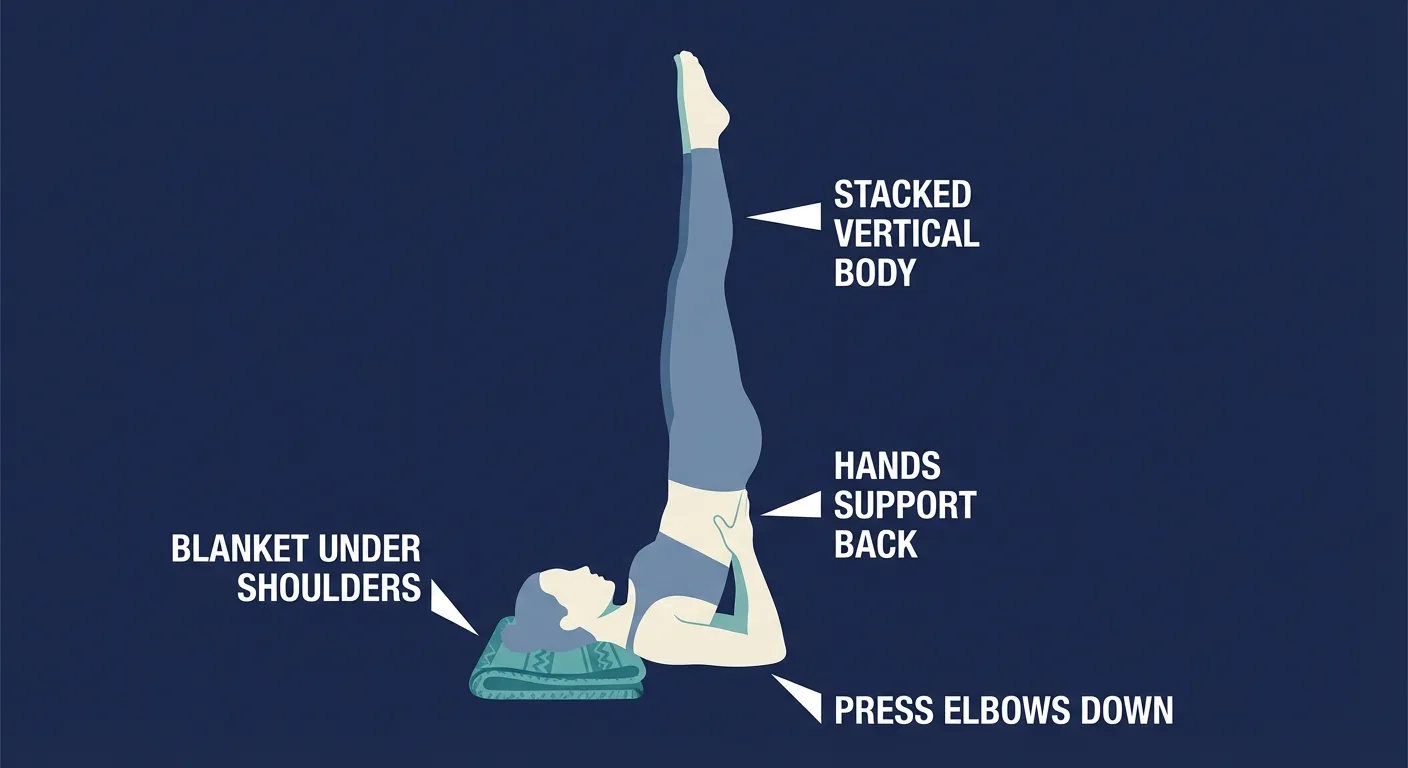
Common Mistakes (and How to Fix Them)
- Loading the neck. If the shoulders are flat on the floor or the blanket is under the head, the cervical spine takes more pressure. Fix it by placing only the shoulders and upper back on the folded blanket.
- Turning the head. Looking sideways while inverted can irritate the neck under load. Keep your gaze straight up. Come out of the pose before checking anything around you.
- Letting the elbows slide wide. Wide elbows make the back support collapse. Press the elbows down and keep them close enough that your hands can support the ribs and lower back.
- Sagging at the hips. A banana-shaped line shifts weight toward the neck and makes breathing harder. Walk the hands higher on the back and reach the legs up instead of letting them drift toward the face.
- Holding past your breath. A shaky, held breath is a sign the pose is too intense today. Come out, rest, and use an easier variation.
- Skipping preparation. Shoulder stand needs shoulder mobility, upper-back endurance, and core control. Prepare with cat-cow, downward dog, and forearm planks before loading the inversion.
Shoulder Stand Pose Variations: Regressions and Progressions
Legs-Up-the-Wall Pose
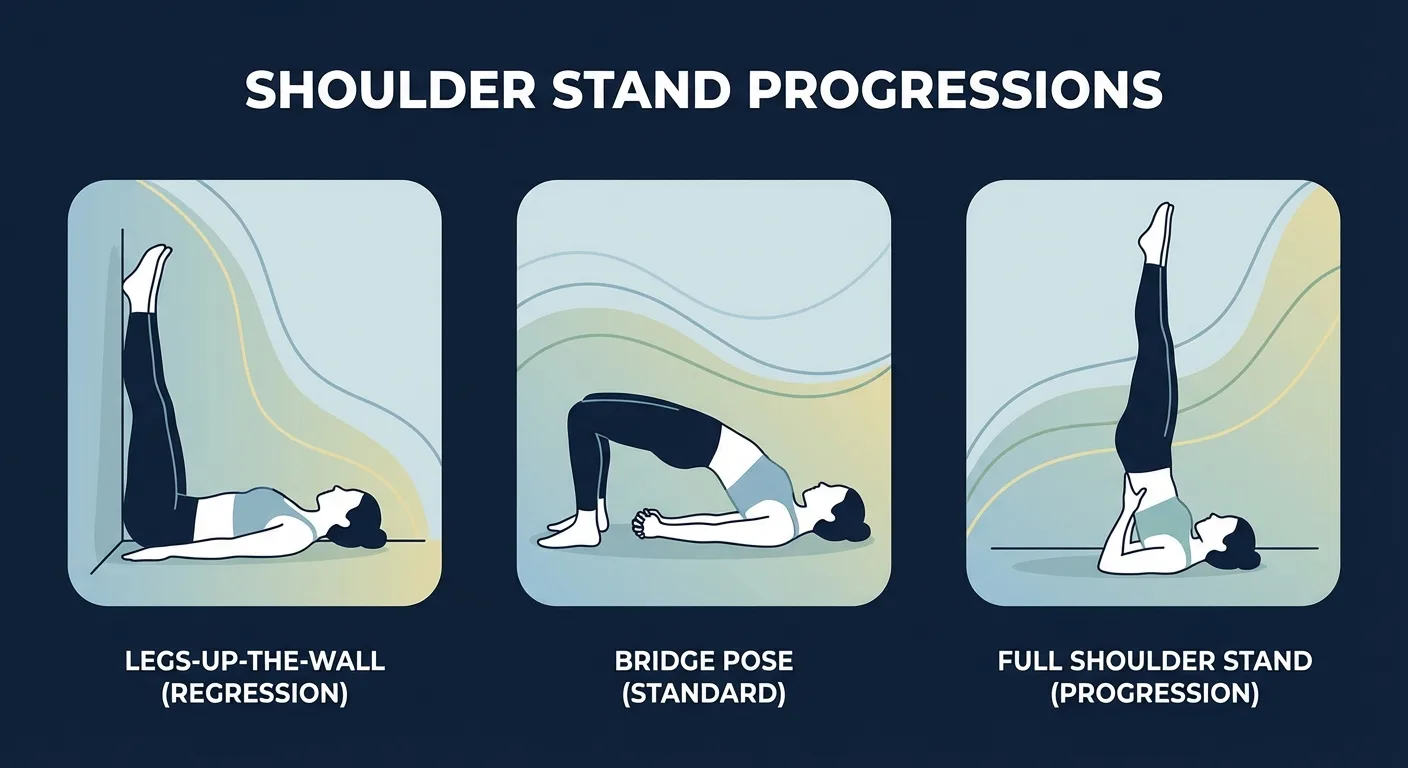
This is the best regression for most beginners. You get an inverted leg position with almost no cervical load, which makes it the right choice when the full pose feels risky or too intense.
Supported Half Shoulder Stand
Use a wall behind you and keep the hips lifted only as high as you can control. This teaches the shoulder-and-arm base without forcing a full vertical line.
Blanket-Supported Shoulder Stand
This is the standard version covered in the steps above. Keep the blanket under the shoulders, hands on the back, and holds short until the pose feels steady.
Plow Pose Transition
From shoulder stand, the feet lower behind the head into plow pose. This adds much more spinal flexion and should wait until the standard shoulder stand is calm and teacher-supervised.
Unsupported Arm Variation
Advanced practitioners sometimes release the hands from the back and extend the arms along the floor. Try this only after months of stable supported practice and with qualified instruction.
When to Avoid or Modify Shoulder Stand Pose
Shoulder stand is appropriate only when the neck, eyes, blood pressure, and breathing all tolerate inversion well. Always consult your physician, physical therapist, or qualified yoga teacher for personalized guidance before practicing loaded inversions.
- Uncontrolled hypertension or cardiovascular disease. Inversions can raise pressure in the head and stress the cardiovascular system. Avoid full shoulder stand until your physician clears it.
- Glaucoma, elevated intraocular pressure, recent eye surgery, or detached retina history. Inversions can increase eye pressure. Get explicit ophthalmologist clearance before practicing.
- Cervical spine injury, recent neck surgery, or chronic neck pain. Shoulder stand can load the neck even with good setup. Use neck-neutral options and rebuild control with cat-cow and rotator cuff stretch.
- Pregnancy, especially second and third trimester. Inversions affect blood flow, balance, and abdominal pressure. Use prenatal-specific guidance instead of full shoulder stand.
- Acute migraine, sinus infection, or upper respiratory infection. Pressure changes can intensify symptoms. Wait until symptoms resolve.
- Thyroid or throat-compression sensitivity. The chin-lock position can feel compressive through the front of the neck. Choose a gentler inversion or practice only with an experienced teacher.
Related Exercises
Use these movements to build the mobility, bracing, and shoulder control shoulder stand depends on:
- Shoulder and spine preparation: Downward Dog and Cat-Cow warm the shoulders and spine before inversion work.
- Shoulder mobility: Shoulder Rolls, Rotator Cuff Stretch, and Seated Rear Delt Stretch help the upper body tolerate the base position.
- Core foundation: Forearm Planks, Hand Planks, and Hollow Holds build the bracing needed to keep the hips stacked.
- Back-body control: Superman Holds train posterior-chain endurance that supports a long, organized line.
- Gentler yoga alternatives: Cobra Pose and Chair Pose offer yoga strength work without cervical loading.
How to Program Shoulder Stand Pose
Inversion programming should progress by setup quality, breath control, and hold time. The broader ACSM progression model supports gradual increases in training demand matched to the practitioner's level (Ratamess et al., 2009), but shoulder stand still needs a yoga-specific safety filter: form and calm breathing come first.
| Level | Sets × Reps | Rest between sets | Frequency |
|---|---|---|---|
| Beginner | 1-2 holds of 5-15 seconds with wall support | 60-90 seconds or full breath recovery | 2-3 sessions/week |
| Intermediate | 2-3 holds of 15-45 seconds | 60-120 seconds | 3-4 sessions/week |
| Advanced | 2-4 holds of 1-3 minutes | 90-180 seconds | 4-5 sessions/week if recovery stays good |
Where in your workout: practice shoulder stand near the end of a yoga session, after the shoulders, spine, and core are warm. Prepare with shoulder openers, core activation, and neck-neutral mobility. Practice near a wall until your exit is reliable.
Form floor over time targets: end the hold when the neck feels loaded, the elbows slide wide, the breath tightens, or the legs wobble enough that you cannot exit smoothly. A short clean hold beats a longer hold with cervical pressure.
How FitCraft Programs This Exercise
FitCraft keeps advanced yoga work tied to your current level instead of treating every pose as a target you should force. Ty can place yoga poses into a broader plan, scale volume and intensity, and keep prerequisite work in front of harder positions.
For a pose like shoulder stand, that means building the foundation first: shoulder mobility, core bracing, easy inversions, and a clear reminder that full loaded inversions should be learned with qualified in-person instruction.
Frequently Asked Questions
What does shoulder stand pose work?
Shoulder stand pose engages the deep neck stabilizers, shoulder girdle, upper back, abdominals, glutes, quads, and hamstrings while stretching the posterior shoulders and upper spine. The work is mostly isometric because the body holds one inverted line.
Can I do shoulder stand pose with neck pain?
No. Active neck pain, a cervical disc issue, recent neck surgery, or any history of neck injury is a strong reason to skip full shoulder stand. Use legs-up-the-wall, bridge pose, or another neck-neutral alternative until a qualified clinician and yoga teacher clear you.
How long should I hold shoulder stand?
Start with 5 to 15 seconds or 3 to 5 slow breaths near a wall. Intermediate practitioners can build toward 15 to 45 seconds. Longer holds belong to advanced practitioners who can enter, breathe, and exit without neck pressure.
Why does my neck hurt in shoulder stand?
Neck pain usually means too much weight is on the cervical spine. Use a folded blanket under the shoulders, press the upper arms down, keep the head still, and come out immediately if pressure remains.
What is the safest shoulder stand progression?
Build from legs-up-the-wall to bridge pose, then supported half shoulder stand near a wall, then short blanket-supported shoulder stand holds. Progress only when the prior level feels calm, controlled, and pain-free.